Apple is frantically sniping at Vibe Coding App
1 Apple App Store Blocks Updates for Multiple Vibe Coding Apps
On the occasion of Apple's 50th anniversary, the company, which once had the mission of "making computers accessible to everyone," is once again at the crossroads of technological routes and platform governance.
Recently, Apple has taken restrictive measures against multiple "Vibe Coding" apps in its App Store, sparking extensive discussions in the developer community and among industry observers.
According to multiple sources, Apple has blocked updates for at least two apps based on the Vibe Coding concept, including the well - known online development platform Replit, and has removed the related product Anything from the store twice on the grounds of security and compliance. Apple requires these apps to make significant adjustments to their core "Vibe Coding" functions. In some review stages, Apple's reviewers even hinted at completely removing these functions.
This restriction has directly prevented apps like Replit from pushing new versions to iOS devices, forcing users to stay on the old versions. Given the rapid pace of technological iteration, each time Apple blocks an update, it widens the gap between the old and new versions, ultimately resulting in a significant difference in the experience of iOS users compared to users on other platforms.
Dhruv Amin, the co - founder of Anything, said in an interview with the media that Apple removed their app on March 26. Although it was briefly restored later, the company has not been able to get it re - approved.
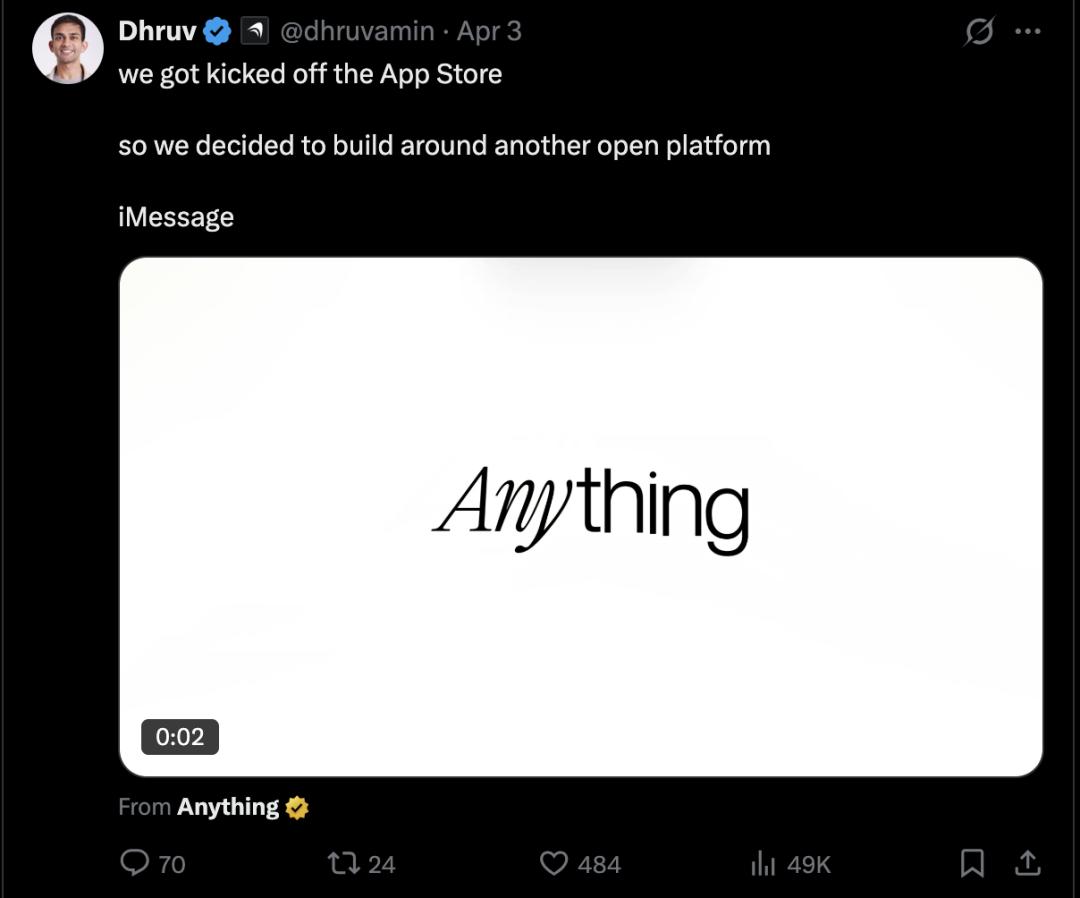
Amjad Masad, the CEO of Replit, publicly and bluntly stated that they have always complied with all of Apple's rules, but Apple's actions have left the developer tools on iOS in an inoperable state.
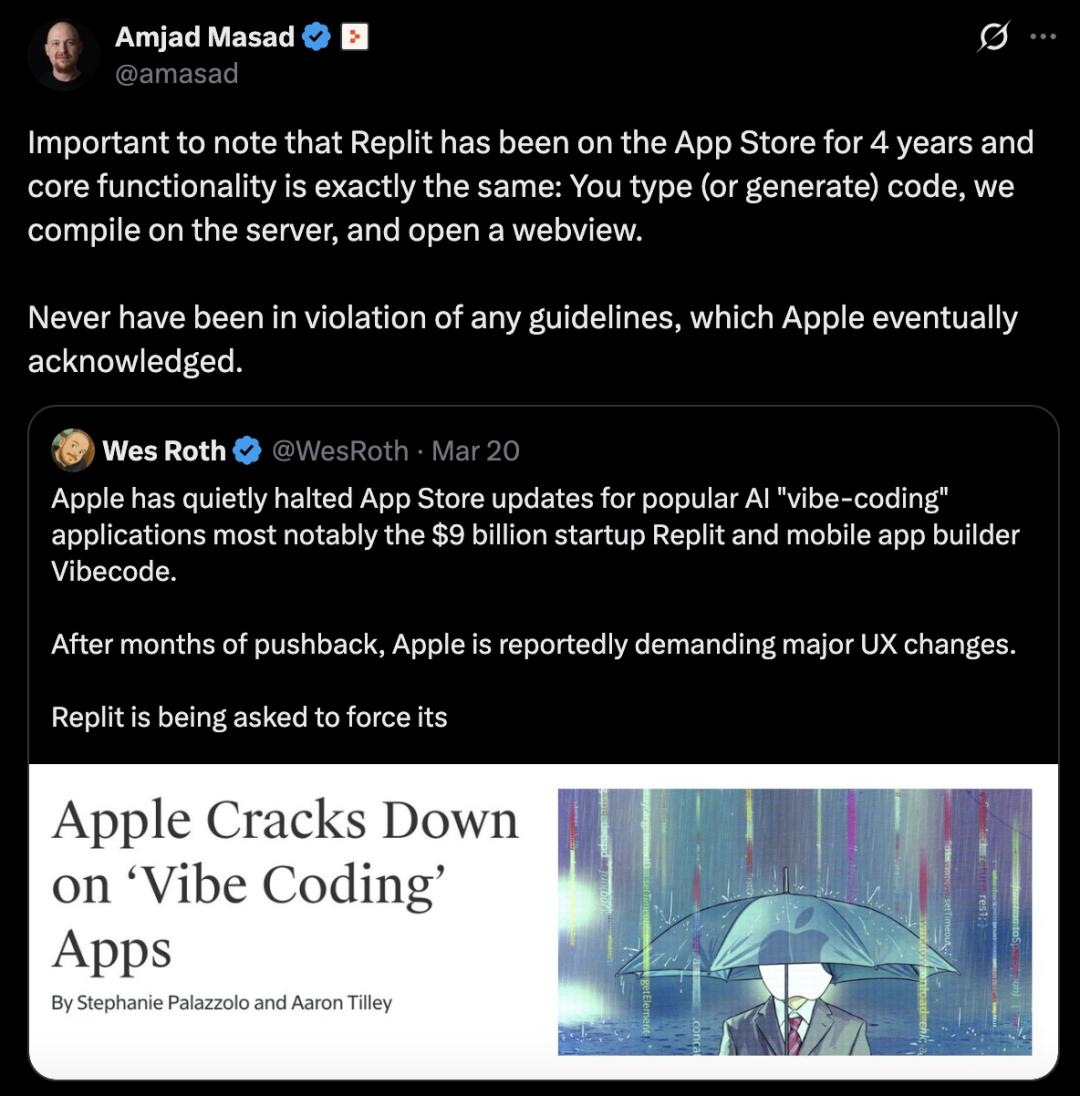
The day before yesterday, still fuming, Amjad Masad posted on X again, denouncing Apple for being on the wrong side of history.

So, why is Apple doing this?
The core reason why Apple has taken restrictive measures against "Vibe Coding" apps is that it believes these apps bypass the long - standing review mechanism of the App Store and pose potential security risks.
Apple points out that the key problem with such apps is that they allow users to run un - reviewed software logic within the app. Although the generated code usually runs in the cloud or browser environment (rather than being directly installed on the local iOS device), in essence, it bypasses Apple's pre - review process for app functions by dynamically generating and immediately executing code, which Apple cannot accept.
Moreover, Apple has stated that this restriction is not a temporary measure but is based on a clause (Rule 2.5.2) that has existed in the App Store review guidelines for many years.
"Apps should run independently within their software packages, not read or write data outside the specified container area, and not download, install, or execute any code that introduces or changes the features or functions of the app (including other apps). Educational apps designed for teaching, development, or allowing students to test executable code can download code under specific circumstances, provided that this code is not used for other purposes. Such apps must ensure that users can fully view and edit the source code they provide."
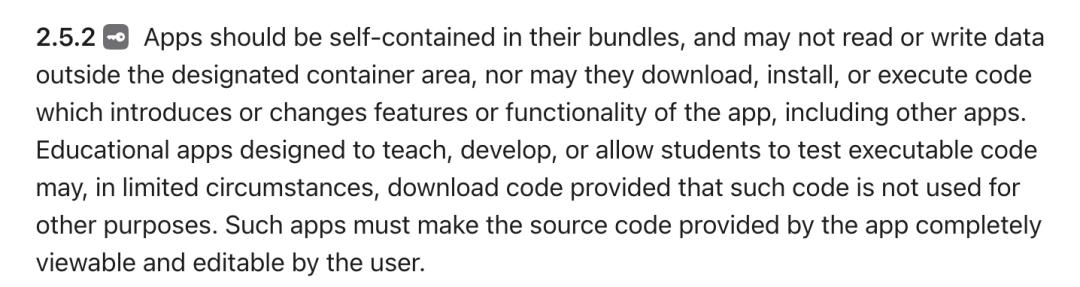
This clause clearly states that apps "should not download, install, or execute code that introduces or changes the functions or features of the app."
It is worth noting that this rule was formulated before AI coding became an independent technology category, but Apple believes its scope of application covers all scenarios of dynamic code execution.
Specifically, why does Vibe Coding trigger this rule?
The reason is simple. Apple's review process evaluates the code of an app before approving its release. If an app can execute code generated after the review, most of the value of the review process is lost. The app that users run may be very different from the version approved by Apple.
This rule has always prevented script environments, plugin systems, and update mechanisms that bypass the App Store.
For Apple, the App Store's review mechanism is not only a commercial distribution channel but also the cornerstone of its security model, which is used to prevent malware, privacy abuse, and illegal access to sensitive permissions such as the camera, contacts, and location. This "closed and controllable" ecosystem is also an important source of long - term trust for iPhone users.
In response to the outside world's doubts about Apple's actions against Vibe Coding apps, Apple has stated that its actions are not targeted at Vibe Coding itself but are based on the implementation of existing rules, and it emphasizes that different products have different implementation paths. For example, although Claude also supports generating and running apps, its functions are mostly completed within the app, rather than relying on an external browser environment like Replit. In addition, Apple has not rejected the trend of AI programming - its development tool Xcode has introduced model capabilities from OpenAI and Anthropic this year.
2 The Interest Game Behind the Blockade: The Defense of the 30% Commission
Among developers, some are skeptical of Apple's reason of "security and compliance" for restricting the updates of Vibe Coding apps, believing that the reason is inconsistent.
The core logic of their refutation is that users' actions of creating web apps through tools like Replit do not change the underlying logic of the Replit app itself - such operations are essentially the generation of personalized content by users within the app, which neither involves fundamental adjustments to Replit's functions nor interferes with the normal operation of other apps in the App Store. Therefore, Apple's determination to equate "dynamically generated content" directly with "security risks" lacks a practical basis.
External analysis further suggests that Apple's strict review of dynamic code execution is essentially maintaining its absolute control over the app ecosystem through rule - based restrictions - even though technological means (such as cloud - based operation) have reduced local risks, Apple still prefers to control the boundaries of app functions through the review power to ensure that all actions within the ecosystem are within the scope of supervision.
In addition to the excuse of technical security, in a video program on The Information, AI journalist Stephanie Palazzolo and journalist Aaron Tilley, who follows Apple, discussed the deeper - level commercial interest conflicts behind Apple's blocking of updates for apps like Replit and Vibecode.
Stephanie Palazzolo pointed out that there are three main motives behind Apple's actions:
Firstly, the sharp increase in review pressure. As the threshold for AI programming decreases, the number of new apps submitted to the App Store every day has increased exponentially, overwhelming Apple's review team. By restricting such programming tools, Apple can slow down the influx of new apps from the source.
Secondly, and most importantly, it is to prevent "escaping from the App Store". The apps generated using tools like Replit are often web apps (Web Apps), which can run without being listed on the App Store. For Apple, this not only means losing control over app data but also means not being able to collect the up - to - 30% "Apple tax".
Finally, the competitive threat cannot be ignored. These lightweight and intelligent third - party programming tools are gradually competing with Apple's own developer tool, Xcode, in terms of functionality. Apple obviously does not want to see developers bypass its official ecosystem and embrace more flexible third - party AI tools.
They also mentioned that although most heavy - duty developers still prefer to operate on the MacBook desktop, the obstruction on the mobile side has actually caused substantial damage to these AI startups. Take Replit as an example. Due to being unable to update its mobile app for several months, its ranking in the App Store's list of popular developer tools has dropped significantly, and its traffic and revenue have been affected to varying degrees.
Apple journalist Aaron Tilley commented that historical experience shows that Apple will never back down when it feels its platform status is threatened. From the dispute with Epic Games over the payment system, to dealing with European regulatory requirements for sideloading, and to the game with Tencent in the mini - program ecosystem, Apple has always been defending its "walled - garden" model.
The logic is not complicated: by strictly controlling the distribution channel and transaction path, it not only ensures user experience and security but also maintains its value - capturing ability in the ecosystem.
This commercial motive is particularly evident in the financial data.
The service business to which the App Store belongs has become one of Apple's important growth engines, with an annual revenue of over $100 billion and a significantly higher profit margin than hardware sales. Once an app bypasses the App Store and is distributed directly through the web, Apple will not be able to collect a 15% to 30% commission. This also makes the boundary between "security" and "business model protection" more subtle.
Meanwhile, the rise of Vibe Coding has far exceeded expectations. In just over a year, a market that hardly existed before has given birth to several companies valued at billions of dollars. More importantly, it is changing the main structure of software production - from professional developers to designers, creators, and even ordinary users. Data shows that the number of app releases on the App Store has increased by about 60% year - on - year in the past year, reaching a new high in the past decade, and this is only part of the entire Vibe Coding ecosystem. A large number of apps are actually born in the open web environment and do not enter Apple's review system.
Many projects created by a single person further illustrate this change.
Some users without a programming background have used AI programming tools to turn their ideas into real products for the first time and even achieve commercialization. These users do not have the conditions for the traditional development path of using a Mac and Xcode, and Vibe Coding fills this gap. From this perspective, the path provided by Apple of "developing on a Mac and then submitting for review", although technically feasible, does not really meet the needs of this emerging user group.
Although Apple may eventually reach a compromise with these companies and allow them to continue to exist, these apps are destined to operate within the "red line" drawn by Apple.
In terms of implementation, this incident also exposes uncertainties. There are reports that since the beginning of this year, Apple has repeatedly adjusted the review reasons for relevant apps. Even if developers have made modifications to previous issues, they still face new compliance challenges. Meanwhile, the rankings and revenues of relevant apps in the App Store have been affected. Developers said that their products have complied with Apple's rules for many years and have passed hundreds of reviews, and they are "surprised and disappointed" by this restriction.
From a more macro perspective, the core issue of this controversy is not whether Vibe Coding will become popular - this trend is almost a foregone conclusion - but in which ecosystem it will mainly occur.
Rebecca Haw Allensworth, a professor of antitrust law at Vanderbilt University, said that economists have long observed that monopolists only encourage competition on their platforms to a certain extent.
"They want to control the direction of innovation and keep it away from things that will undermine their monopoly position," she said.
If Apple continues to ban these tools, developers may leave. They will turn to developing web - oriented apps because publishing apps on the web does not require Apple's permission. Ultimately, iPhone users may face a worse app ecosystem because Apple has driven away the developers who once enriched the ecosystem.
Apple has faced such a dilemma before. In the 1990s, Microsoft rapidly expanded the personal computer market by opening up its ecosystem, while Apple was in trouble due to its closed - door strategy. It was not until Steve Jobs returned that he re - emphasized user experience and the release of creativity, which turned the situation around.
3 Netizens: Apple Is Pushing Users Away
Against the background of Apple's restrictions on multiple Vibe Coding apps, discussions in the developer community have heated up rapidly.
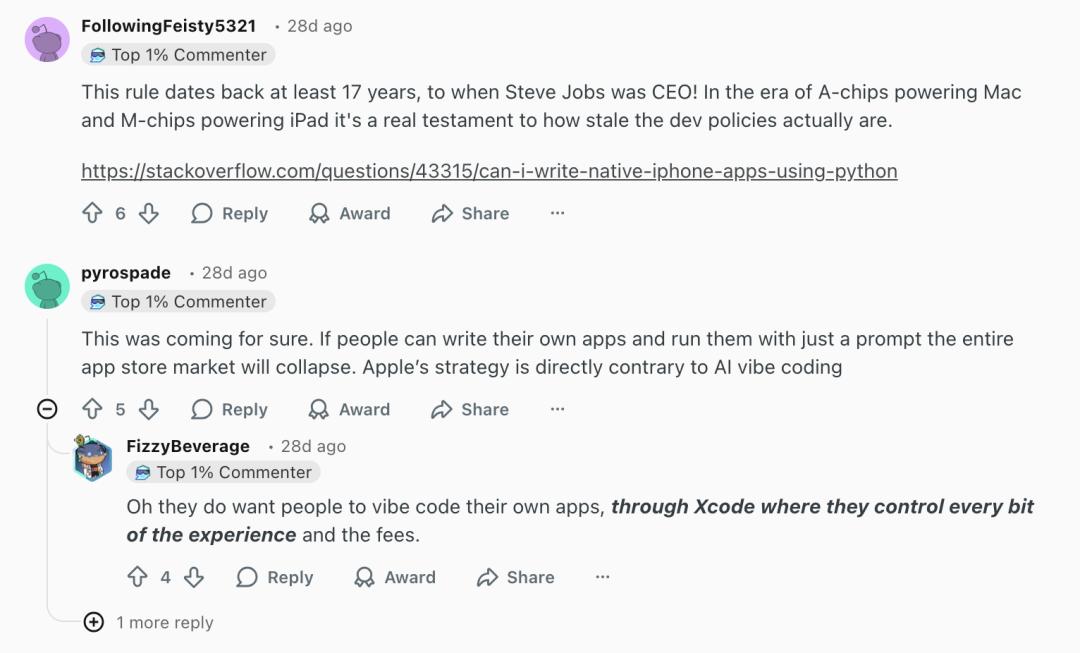
On the Reddit platform, some users complained that this policy is really outdated.
Apple's rule can be traced back at least 17 years, when Jobs was the CEO! In the era when Mac computers use A chips and iPads use M chips, this truly proves how outdated the developer policy is.
Some other users said that Apple is doing this to protect the interests of the App Store, and its closed - product strategy is contrary to the concept of AI Coding. He wrote:
This was bound to happen. If people can write their own apps and run them with just a prompt, the entire app store market will collapse. Apple's strategy is completely contrary to the concept of AI programming.
On Hacker News, a large number of comments dissected this event from multiple perspectives, including rule interpretation, technical implementation, and platform governance logic.
Regarding the rule itself, the controversy first focuses on Apple's restriction clause on "running external code".
A user directly quoted the relevant regulations, pointing out that Apple clearly requires apps "not to download, install, or execute code that changes the app's functions", with only limited exceptions for educational apps. This has also become the starting point for many people to understand this event - that is, Vibe Coding apps essentially allow users to generate and run code, so they are naturally in the gray area of the rule. Some comments believe that from this perspective, it is "not surprising" that such apps are restricted, because "allowing custom code to run within the app has always been prohibited".
However, the problem is that Apple seems to be "double - standard". Many users mentioned that some long - existing apps are actually doing similar things. For example, someone pointed out that Apple's own Swift Playgrounds allows users to write and run code and is classified as an "educational app", thus falling under the exception clause; while third - party apps like Pythonista have also allowed the execution of arbitrary Python code for many years without being subject to the same restrictions.
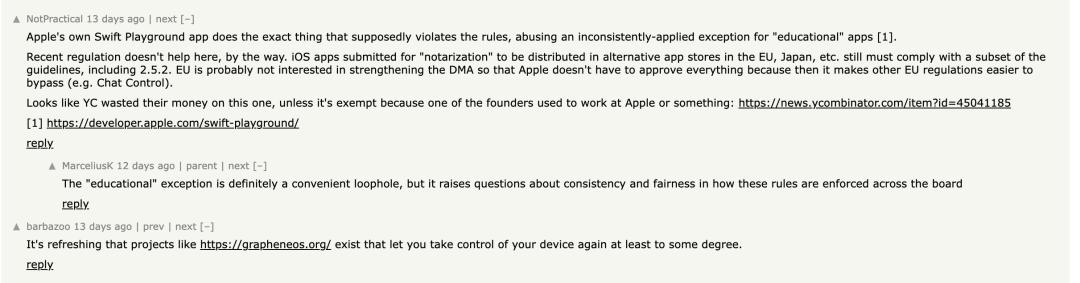
Some comments bluntly said that "the 'educational' exception clause is more like a convenient loophole", and the real problem is whether Apple is selectively following the rules.
Among all the comments, another important thread is the reflection on platform openness.
Some comments view this event in the context of a more macro - level ecological competition. Some users pointed out that for a long time, Linux and Windows have been significantly superior to Apple in terms of customizability, while Apple adheres to the concept of "defining the user experience by the platform". In the current era when generative AI makes "software customization" possible, this model may face challenges.
Some people believe that as users increasingly want to generate and modify apps on demand,