HEVC Patent Pool Power Map: Who Holds the Charging and Discourse Power in the Video Industry?
A battle for the right to speak in the video coding standard is surging beneath the surface.
In January 2026, HEVC Advance released the latest patent list. This list may seem like just a boring technical document, but when you carefully interpret the data in it, you'll find a power map related to the interest distribution of the entire video industry.
31,435 patents, 46,288 claims, 46 licensors, 2,630 expired patents - these are not just a set of simple numbers, but a complete portrait of the most important patent pool in the global video coding field.
The Three Layers of Meaning Behind a List
HEVC Advance clearly stated three core functions of this list in the Cover Letter:
First, the scope of the Patent Pool License (PPL) agreement. This list includes all Standard Essential Patents (SEPs) that HEVC Advance licensors have the right to license, whether or not these SEPs are explicitly listed in the list. This means that as long as a licensee signs the PPL agreement, even if the licensor itself doesn't know that a certain patent involves a standard essential patent, the licensee is still protected.
Second, to meet the patent marking requirements. Especially the requirements of Section 287(a) of the U.S. Patent Law. Simply put, this is to tell the world that products using HEVC/H.265 functions are legal and compliant as long as they mark the patents listed in this list.
Third, the list covers three types of claims: Encoder, Bitstream, and Decoder. The Cover Letter specifically emphasizes a key point: The encoder usually directly infringes on the decoder's claims because the encoding process itself includes the decoding function.
Overall Pattern: 31,435 Patents, 46,288 Claims
Let's first look at the overall data:
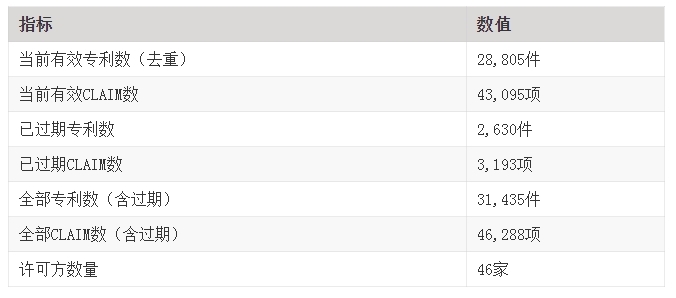
Core finding: On average, each patent has about 1.47 claims. Considering the technical complexity of the HEVC standard, this density is actually not high - which means that a large number of patents are "single-point claims" rather than "patent clusters".
Licensor Pattern: Samsung and Dolby System Compete for Hegemony
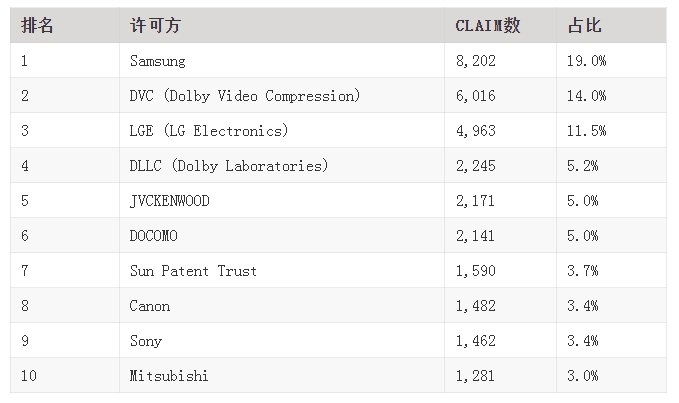
Ranked by the number of claims (Top 20):
Core findings:
- Samsung is the absolute hegemon: It has 8,202 claims, accounting for 19.0%, far ahead. This is highly consistent with its position in the global TV and smartphone markets.
- The Dolby system has amazing influence: DVC (Dolby Video Compression) + DLLC (Dolby Laboratories Licensing Corporation) + DIAB (Dolby International AB) hold a total of about 9,499 claims (if DIAB is included), accounting for about 22% - on par with Samsung! Dolby's ecological control in the video coding field far exceeds outside expectations.
- LG Electronics cannot be ignored: LGE ranks third with 4,963 claims, accounting for 11.5%. This is another important force of South Korea in the video coding field.
- Japanese and South Korean enterprises dominate: Among the Top 10, 7 are Japanese enterprises (Canon, JVCKENWOOD, Sony, Mitsubishi, Panasonic, Toshiba, NEC, Fujitsu), and 2 are South Korean enterprises (Samsung, LG), a total of 9. This reflects the technological accumulation of the Japanese and South Korean video industries.
- Chinese forces are initially rising: Huawei holds 1,058 claims (about 2.5%), and it is the most prominent Chinese licensor. ZTE only has 9 patents, and Oppo only has 1.
Expired Patents: Panasonic's "Twilight"
Key insights:
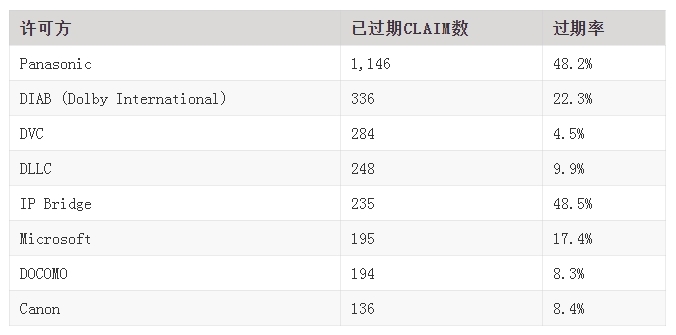
- Nearly half of Panasonic's patents have expired (48.2%). This means that Panasonic's influence in HEVC patents is rapidly declining. As a former giant in the video coding field, this may be an inevitable result of the long - term aging of its patent layout.
- Nearly half of IP Bridge's (a Japanese patent investment company) patents have also expired (48.5%). This is a company focusing on patent operation, and a high expiration rate may mean that its patent portfolio strategy is more radical.
- The Dolby system (DIAB + DVC + DLLC) has a total of about 868 expired claims, but the proportion is not high relative to its total.
Profile Distribution: Main/Main10 is the Absolute Core
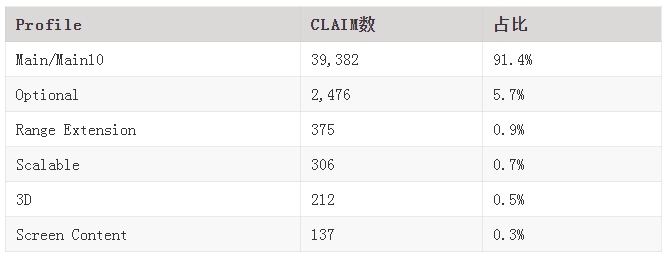
Key insights: Main/Main10 (the core profile of HEVC) accounts for 91.4% of the claims, which is the real "main battlefield". The extended profiles such as Optional, Range Extension, Scalable, 3D, and Screen Content together account for less than 9%, more in the nature of "reserving a position".
Category Distribution: Decoder is the "Nuclear Weapon"
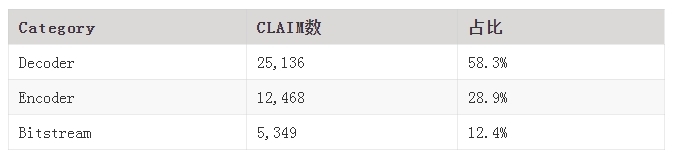
Key insights:
- The decoder claims account for as high as 58.3%, twice that of the encoder.
- This means that any enterprise producing HEVC decoding chips or software faces a higher risk of infringement.
- The Cover Letter specifically emphasizes: The encoder usually directly infringes on the decoder's claims because the encoding process itself includes the decoding function - this is not a legal loophole, but a technological reality.
Expiration Years: 2031 - 2032 is the "Dammed Lake"
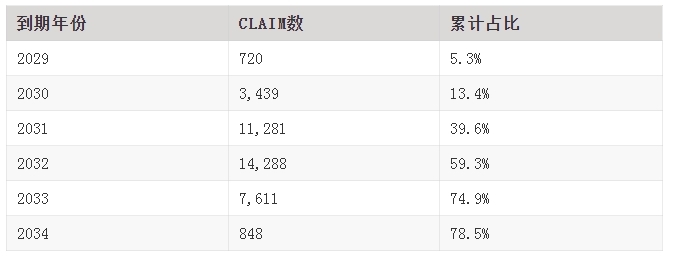
Key insights:
- 2031 - 2032 is the peak period for patent expiration, with 25,569 claims expiring, accounting for 59.3% of the total.
- This means that in the next 5 - 6 years, a large number of HEVC core patents will enter the public domain.
- 91.2% of the claims will expire between 2025 and 2035 - the "shelf life" of the patent pool is much shorter than you think.
Chinese Forces: Huawei Stands Out
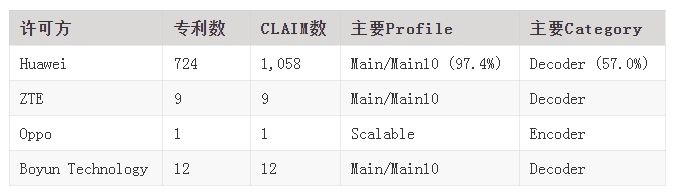
Key insights:
- Huawei is the only Chinese enterprise in the Top 15, but its 1,058 claims are only 12.9% of Samsung's.
- ZTE can almost be ignored (9 patents).
- China still has a lot of room for improvement in patent accumulation in the field of video coding standards.
- It is worth noting that Huawei's patent layout in the United States (117 patents) is basically on par with that in China (125 patents), reflecting its awareness of global layout.
Underestimated Facts: Five Key Insights
1. The Dolby system is not an "audio company"
Dolby is best known for its audio technology, but in this patent pool, the Dolby system holds about 22% of the claims, second only to Samsung. This is because the video compression technology in the HEVC standard is highly related to Dolby's encoding technology. Dolby's layout in the video field is much deeper than outside expectations.
2. Decoder claims are the "nuclear weapon"
The decoder accounts for 58.3%, which means that it is almost impossible for any enterprise trying to bypass HEVC patents to succeed. Enterprises producing HEVC - compatible devices not only "may" need to obtain decoder patent licenses, but "must" obtain them.
3. Patent expiration is not "disappearance", but "release"
The expiration of 25,569 claims in 2031 - 2032 means:
New patent pool negotiations will be more intense.
Patent fees may decrease.
But during the transition period, the existing patent pool will still be the mainstream.
4. Panasonic is "exiting the stage"
More than 48% of the patents have expired, which means that Panasonic's influence in HEVC patents is rapidly declining. For the patent pool, the exit of an established player is a long - term risk - the number of licensors may decrease, but the voice of a single enterprise may increase.
5. Apple is not on the list
As one of the world's largest smartphone manufacturers, Apple does not appear on the list of licensors. This means that Apple has not joined the HEVC Advance patent pool and may need to obtain a license through separate negotiations - or, choose not to join the patent pool and directly face the risk of infringement lawsuits.
Industry Impact: Who is Paying for What?
The essence of the HEVC Advance patent pool is a "patent alliance" - by integrating the SEPs of multiple enterprises, it forms a one - stop license. This reduces the negotiation cost of licensees, but it also means that the patent fees are shared by the entire industry.
Terminal manufacturers (TVs, mobile phones, players): For each HEVC - supported device sold, they need to pay fees to the patent pool. Patent fees are usually calculated based on the number of devices.
Chip manufacturers: Manufacturers of decoding chips and encoding chips also need to obtain licenses.
Content providers: Companies producing HEVC - encoded content (such as Netflix, Disney+) may also need to obtain a patent pool license.
Conclusion
28,805 valid patents, 43,095 claims, 46 licensors - these are not just a set of boring numbers, but a panoramic presentation of the interest distribution in the global video industry.
When you open an HEVC - encoded movie, play a HEVC video, or record a HEVC video with your mobile phone, you may not know that tens of thousands of patents from dozens of enterprises are "escorting" this behavior.
Behind this is the technological accumulation of giants such as Samsung, the Dolby system, and LG Electronics, and also the battlefield for Chinese enterprises such as Huawei and ZTE to catch up.
Data source: HEVC Advance 2026.01.01 Patent List
Analysis description: The total number of patents is calculated after deduplication, and the claims are counted line by line. The expiration rate calculation formula: expired claims / (current claims + expired claims)
This article is from the WeChat official account "Intellectual Property Power" (ID: zhichanli), author: Cheng Yao, published by 36Kr with authorization.