Only by studying Zhang Yiming can we clearly understand ByteDance.
When studying Zhang Yiming, one can't avoid a strong impression. ByteDance, this company, bears the distinct imprint of its founder.
In 2012, ByteDance was founded. In 2016, Douyin was launched. In 2017, TikTok was introduced, and the short - video capabilities began to expand globally. Later on, products such as Feishu, CapCut, Hongguo Short Dramas, and Tomato Novel were continuously rolled out, and the company's reach extended further and further. In recent years, ByteDance has continued to invest a large amount of resources in artificial intelligence.
Looking back on its development, there has always been the same force at work within ByteDance. It drives the company to continuously develop new products and also pushes the company to apply its proven capabilities to larger new scenarios.
What this article wants to explore is precisely where this force comes from. What kind of person is Zhang Yiming exactly? How did his way of seeing the world, making choices, and handling boundaries gradually shape the corporate character of ByteDance? These questions are worth pondering over and over again. Because ByteDance rarely gives people the feeling of being content with the status quo. It is always on the move, always exploring new boundaries.
There is an almost isomorphic relationship between Zhang Yiming and ByteDance. Zhang Yiming's habit of continuous calibration, self - reconfiguration, and placing things on a larger scale later became the way ByteDance deals with reality. The company reacts quickly when facing new opportunities and rarely lingers when encountering old boundaries. Products change, organizations change, and directions change, but the driving force forward remains stable.
It's difficult to truly understand ByteDance if we view it as an ordinary Internet company. It is more like an external manifestation of Zhang Yiming's internal order. The strong sense of expansion, the loosening of boundaries, the obsession with organization and efficiency, and the impulse to re - evaluate itself in a larger world can all find their origins in Zhang Yiming.
Writing this article is not to turn a large company into a personal legend. What is truly worth studying is to find valuable information from public data, observe and summarize how a person's character pattern enters an organization, turns into systems, rhythms, and methods, and finally becomes the destiny of a company.
1
Self - Reconfiguration
The character and behavior patterns formed by Zhang Yiming during his college years can be more clearly defined.
It is an active calibration method for life. It means quickly identifying the gap between oneself and the environment, then re - arranging time, abilities, and relationships, and concentrating on the direction that suits oneself better. Such a person makes choices not by persevering aimlessly, procrastinating, or self - indulging. He first makes judgments, then re - configures, and then accumulates over the long term.
Many of the qualities Zhang Yiming showed when running the company can be traced back to his college years.
In 2001, Zhang Yiming entered Nankai University, initially majoring in microelectronics. When he first entered the university, he had his own expectations for college life, with a bit of imagined excitement and possibilities. However, when he actually got there, reality quickly set in. The campus was quiet, and life was ordinary. Life didn't automatically turn into a fresh and exciting picture.
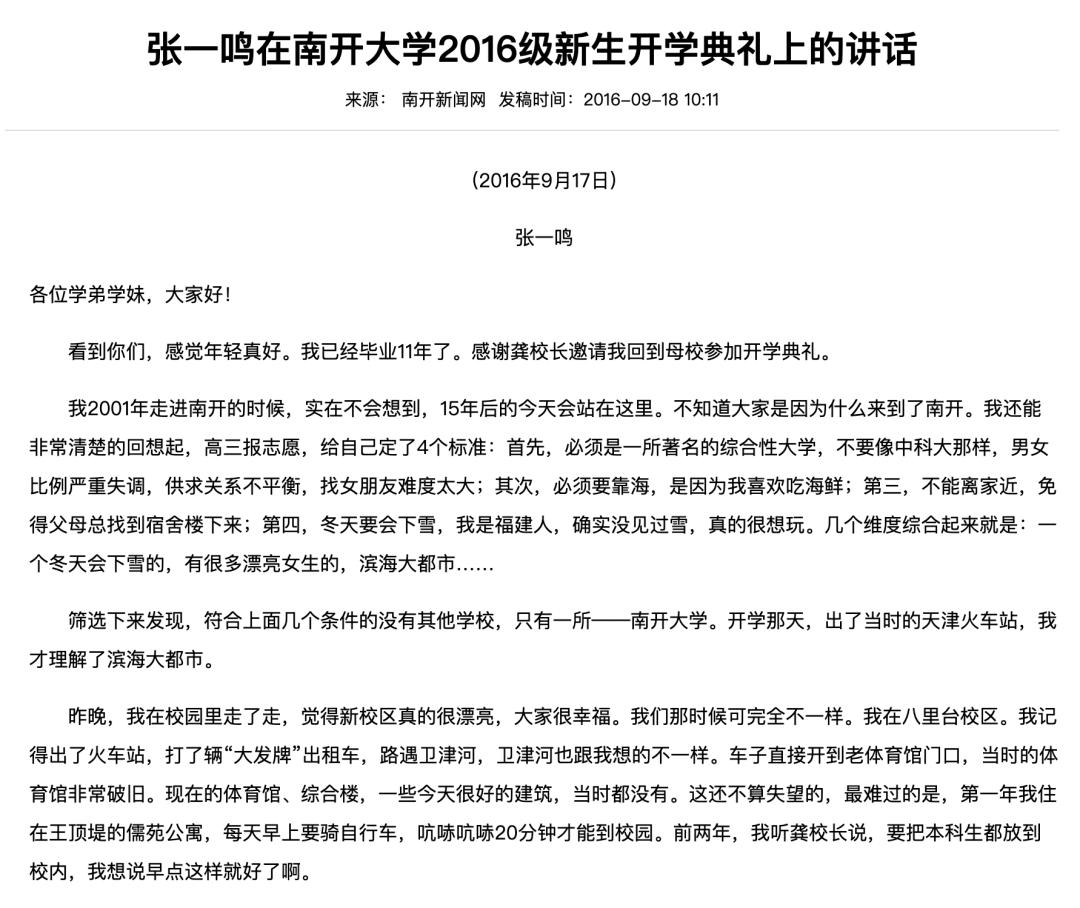
△ News about Zhang Yiming's speech on the official website of Nankai University. Image source: Official website of Nankai University
In 2016, he recalled that he was a bit disappointed at the beginning of his college days, but later gradually found his rhythm in this quiet and simple environment. Many people, when facing the gap, would cling to their original imaginations and struggle with reality. Zhang Yiming didn't waste his energy on emotions. Instead, he quickly turned to focus on what was truly useful, such as which courses were suitable for him, what things he could immerse himself in, and which path was worth pursuing.
He quickly switched from microelectronics to software engineering. Making a sine - wave signal generator took a long time and often didn't work out. After more than a year of study, there were few visible results, which made him anxious. Software engineering gave him a completely different experience. After writing a program, he could run it immediately, see the feedback right away, and even take part - time jobs off - campus.
There is a very crucial judgment ability hidden here. He wasn't just comparing which major was more popular or more prestigious. He was comparing two ways of ability training to see which one was more suitable for his rhythm and which one could allow him to enter effective accumulation as soon as possible. After seeing this clearly, he switched majors.
The value of this decision lies not only in his switch to the direction where he could truly exert his strengths but also in the fact that he learned an important lesson early on. When it becomes clear that the original path is not suitable, timely adjustment is more important than continuing to waste time. Many young people are easily tied down by the time they have already invested when making choices. They are reluctant to turn back and admit that their judgments were off.
Zhang Yiming's actions at that time were very decisive. He first recognized the gap and then dealt with it. This is a very mature form of active calibration.
What's more interesting is that after switching to software engineering, he didn't immediately enter an easy and smooth new life. After the switch, life didn't change much. It was still the library, the laboratory, and the daily routine. This detail especially illustrates the point. He approached choices with a strong sense of reality. Changing directions was just about putting himself in a more suitable position, and the rest of the journey still had to be completed through long - term accumulation.
During his college years, he clearly arranged his activities: writing code, reading books, and repairing computers. He often visited the web development technology section of the "I Love Nankai" BBS and made many friends through computer repair, programming, and website building. Liang Rubo was an important companion at that time. In his sophomore year, one of them bought the mainframe and the other bought the monitor, and they put them together to form a computer and studied programming together. Later, when Zhang Yiming switched to software engineering, he left that computer to Liang Rubo. Many years later, the two continued to start a business together.
Looking at these details together, the pattern Zhang Yiming formed during his college years becomes clear. First, he could quickly detect deviations. He could quickly tell whether there was a real fit between himself and a certain path. Second, he adjusted quickly. After seeing clearly, he changed the direction without being held back by sunk costs. Third, the adjustment was not aimless but focused. After switching to software engineering, he didn't try a little here and there but delved deeper into coding, reading, and technical socializing. Fourth, his long - term accumulation was stable. The quiet environment of Nankai, the library, the laboratory, the BBS, and the technical associations, all these seemingly ordinary things eventually became the foundation of his abilities and his network of partners.
Overall, the way of doing things Zhang Yiming formed during his college years was to calibrate first, then concentrate, and then advance steadily in the long term. This method later fully entered ByteDance. ByteDance always reacts quickly when it sees new opportunities. It is also brave enough to change when it finds the boundaries of the old path. After determining a new direction, resources will quickly gather towards the goal and continue to be invested deeply. Many of the company's later choices, whether in products, organization, or expansion, bear the shadow of this early - formed pattern.
Zhang Yiming first learned how to re - arrange himself in college, and many years later, he used the same method to re - arrange the company.
2
Boundary Impulse
Another very prominent feature of Zhang Yiming is his attitude towards boundaries.
Many business founders first draw a mental map for themselves, having a general idea of where their business, market, and capabilities should reach. Zhang Yiming's thinking is different. In an interview with Caijing in 2016, when talking about what kind of company he wanted to make Toutiao, he mentioned that he wouldn't set boundaries first. Instead, he would focus on improving the efficiency of information distribution and make it the world's largest platform for information creation and distribution.
In this statement, what's most notable is not just the grand ambition but his way of dealing with boundaries. For him, boundaries are not the starting point; capabilities are. First, develop the underlying capabilities of a thing, and then see how far it can go. In this way, boundaries become a result.
Many of Zhang Yiming's judgments in 2016 did seem a bit bold. At that time, although Toutiao was growing rapidly, it was still just an information - distribution product. Most people were more likely to understand the company from the product form, seeing it as a media, a news client, or a content aggregator. Zhang Yiming's perspective was completely different.
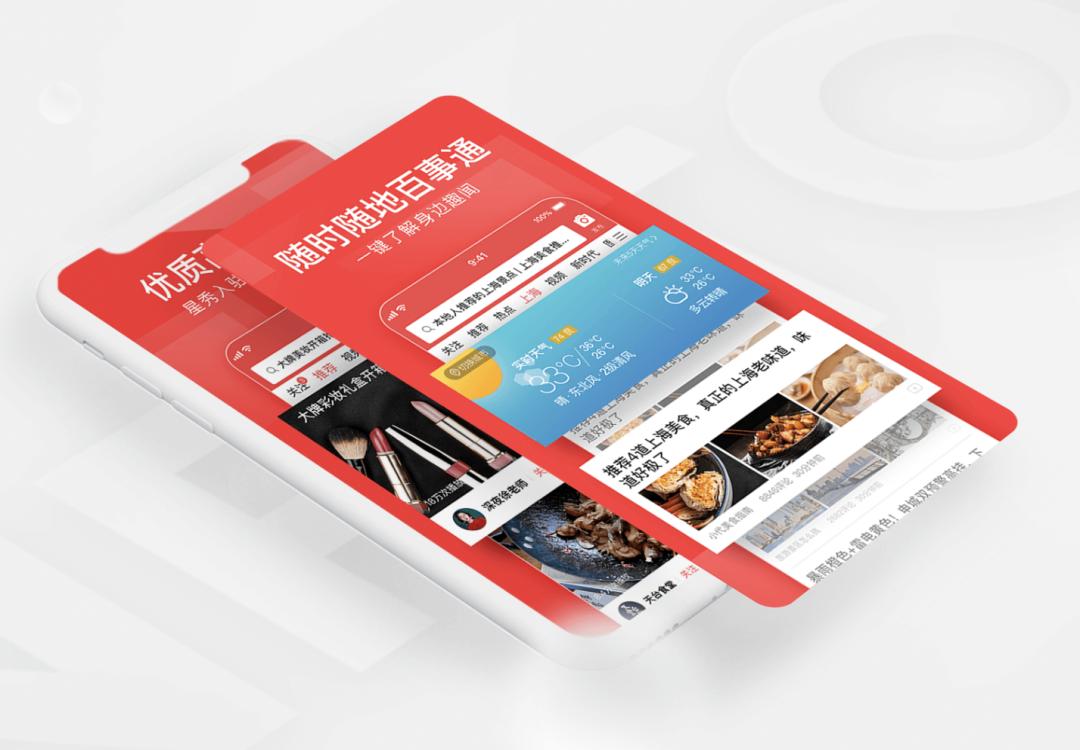
△ Toutiao promotional image. Image source: Official website of ByteDance
What he valued most was not news or a specific content form but the distribution mechanism. Whoever can distribute information more efficiently can enter more scenarios, cover more content, and connect with more users. Defining the company as an information - distribution platform, the current product is no longer the end but more like a starting point.
This also explains why Zhang Yiming always gives the outside world the impression of having a weak sense of boundaries. Because from the beginning, he was not thinking about sticking to a certain category but mastering a set of methods that could continuously expand. This set of methods can be applied to information, short - videos, graphics, and even some aspects of live - streaming, e - commerce, and social media. Although the specific business changes, the underlying rules remain stable. First, grasp the underlying capabilities, and then use these capabilities to open up new entrances.
When Zhang Yiming said not to set boundaries first, there is actually a strong sense of expansion behind it. Boundaries are not meant to be followed; they are re - defined by capabilities after they are developed.
From this, we can especially see the difference between Zhang Yiming and many other entrepreneurs. Some people run a company with a clear - cut business in mind. The product is like a ship, and the founder steers it to keep it stable. Zhang Yiming is more like building a system. The product is just a form that the system takes. It could be information today, short - videos tomorrow, or something else the day after. The key is not what it looks like on the surface but what makes it work internally.
Once this idea is established, the company can easily keep growing outward. Because whenever a new content form, a new traffic entrance, or a new user time slot is incorporated, Zhang Yiming doesn't see it as crossing boundaries but as the continuation of the same set of capabilities in a new environment.
More importantly, this sense of boundaries is also related to his self - understanding. In that interview, Zhang Yiming also mentioned that the trait he admired most was the ability to delay gratification, and the greatest delay gratification was in thinking. He rarely gets angry because it's not useful. Putting these words together, we can see that he is not a person who is driven by emotions.
His pushing of boundaries is not a rash impulse. It is more like a calculated internal drive. First, figure out the problem cognitively, and then push the boundaries in action. First, determine what capabilities are worth long - term investment, and then allocate time and resources. Such a person is unlikely to be trapped in the existing pattern. He always focuses on deeper things.
In this sense, Zhang Yiming's boundary impulse is not just an orientation in business operation but more like an internal habit. When applied to the company, this habit has become the most distinct characteristic of ByteDance. It rarely stays quietly within a clear, closed, and reassuring definition. It always wants to take a step forward and push the boundaries further until it loosens the original industry framework, changes the original way of understanding, and finally shapes new rules.
3
Calm Realism
Another deep - seated part of Zhang Yiming's character is a sense of reality.
This sense of reality is not simply about being practical or only focusing on immediate gains and losses. It is more like a way of dealing with the world. The more noisy the outside world is, the more stable one should be inside. The more complex the situation is, the more one should focus on facts, users, and current judgments.
At the 9th - anniversary annual meeting of ByteDance in 2021, Zhang Yiming explained this idea clearly. Despite the external fluctuations, one should keep a calm mind. When facing oneself, the business, competition, and success or failure, one should have an ordinary - mind attitude. He also said that people can often make better judgments when they are free from paranoia and distractions.
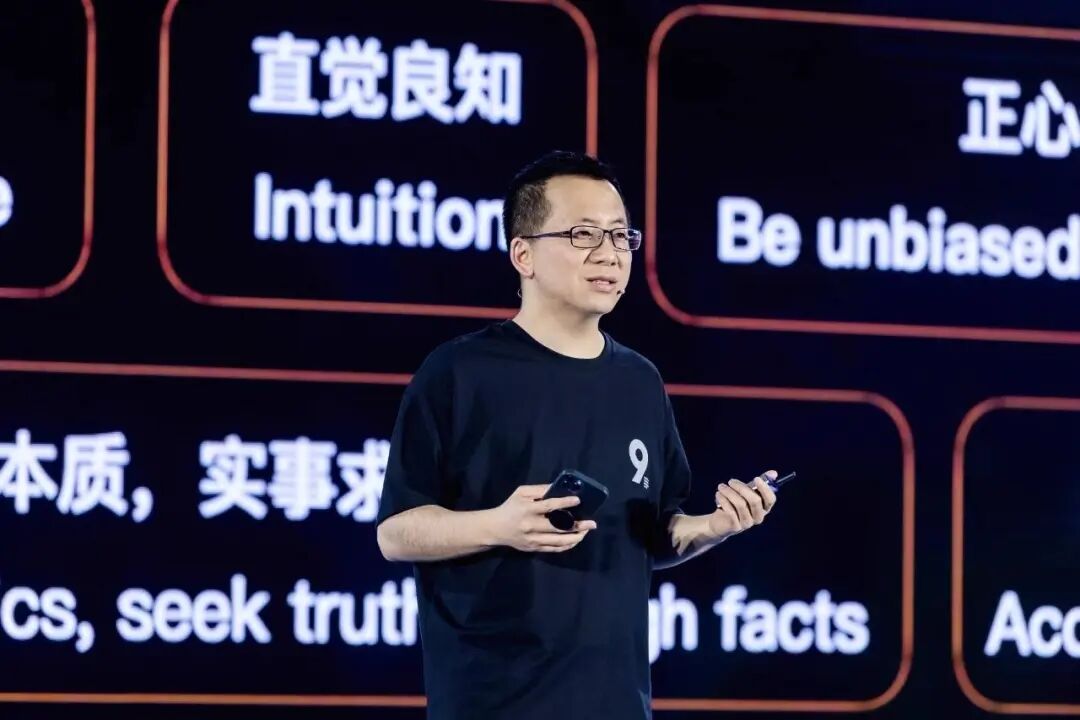
△ On March 30, 2021, ByteDance held its 9th - anniversary annual meeting. Founder Zhang Yiming gave a speech titled "Ordinary Mind". Image source: Official website of ByteDance
This passage is very important. It explains why Zhang Yiming always gives people a cold - hearted impression.
Many entrepreneurs like to put the company in a high - spirited mood when speaking, inspiring and exciting people, raising expectations, and pushing people forward in an accelerating atmosphere. Zhang Yiming's approach is different. He is more concerned about whether the judgments are distorted, whether the actions are off - track, and whether the team is led astray by emotions. When the growth is fast, he reminds everyone not to be indulged in past achievements. When the growth is slow, he doesn't want anxiety to take over decision - making.
In that speech, he also mentioned that the business will always have ups and downs. One should not let growth anxiety affect oneself. One should open one's eyes to see the environment clearly, understand the users, and make decisions without distractions. The result is what it is.
In this sentence, there is a main line of Zhang Yiming's way of doing things. He rarely pursues emotional certainty first. He is more concerned about clear cognition. Just because the numbers go up doesn't mean the judgment is correct. Just because the external evaluation is high doesn't mean the direction is stable. Once people care too much about the results, their actions are likely to be distorted. This is why he repeatedly emphasizes "treating oneself with an ordinary mind".
He said that everyone is an ordinary person. Labels and expectations will bring psychological burdens. The label of a senior executive may make people embarrassed to ask simple questions, and the label of a young person may make people afraid to put forward opinions. Positions and identities will become constraints. Only by removing these constraints can people return to more natural judgments.
Zhang Yiming's sense of reality is also reflected in his handling of time. In his speech, he quoted "The Power of Now" and specifically talked about how people are easily dragged away by the past and the future. Regretting the past will make one miss new opportunities. Worrying about the future will consume the energy that should be used in the present. He gave an example of himself. He planned to do work but was attracted by the content on his phone. Before going to bed, he started to regret and stayed up even later, and his state was worse the next day. Later, he learned a more direct way to deal with it. When he found it was too late, he went to sleep instead of letting the regret continue to waste time. This small detail can illustrate the point well. Zhang Yiming doesn't understand self - control as a show of discipline. He is more concerned about how to get out of ineffective emotions as soon as possible and focus on the present.
His attitude towards competition also shows this sense of reality. In that speech, Zhang Yiming said that competition is the norm, and competitors are good blue - teams. There are valuable parts in the innovation, methods, and criticism of opponents. Even if only 20% of a critical article is inspiring, one should seriously read that 20%. He reminded the team not to compete just for the sake of competition. Staring at the opponent for a long time will easily make "defeating the opponent" the only goal, and as a result, one will turn a blind eye to