Is Hermès Replacing Lobster? The Hermes Agent with 40,000 Stars Is More Than Just a Substitute for OpenClaw
In the previous article discussing how to translate "Harness", a reader left a message suggesting it could be called "Hermes", like the brand Hermès.

I thought it was just a pun, but unexpectedly, there is indeed an Agent product called Hermes. Moreover, it has ranked first on the GitHub trending list for a whole month and currently has a cumulative total of 48,000 Stars.
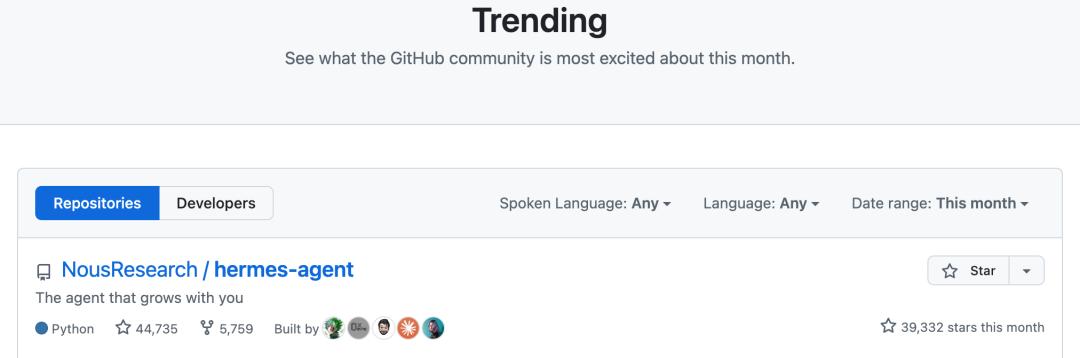
Different from the recently popular Agent Lobster, Hermes is a dedicated personal AI assistant that supports all operating systems and platforms. The introduction of Hermes says "the agent that grows with you", an Agent that grows with you.
It sounds very advanced, and this is indeed the unique feature of Hermes Agent.
It has a built - in learning loop framework. OpenClaw relies on modifying configuration files and combining multiple Agents to handle various complex tasks. Hermes Agent is a single Agent framework, and its capabilities will continuously enhance as the actual running time increases.
The problem it solves is that while everyone is discussing what an agent can do, no one notices that an agent leaves nothing behind after use, but Hermes Agent can now remember "what methods work".
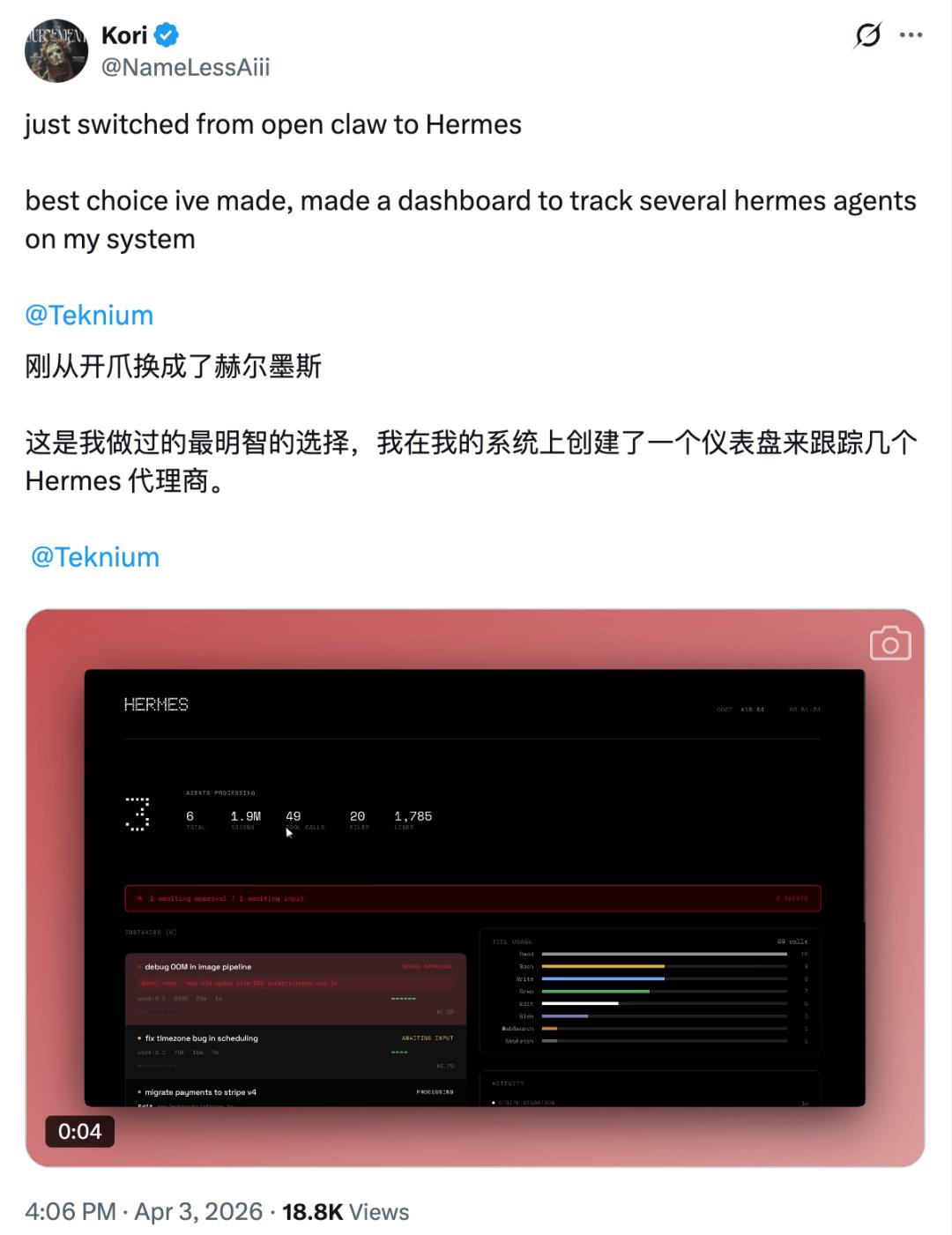
There are also many posts on social media recommending Hermes Agent. Some people say that they have just switched from OpenClaw to Hermes, and it was the wisest choice they've ever made.
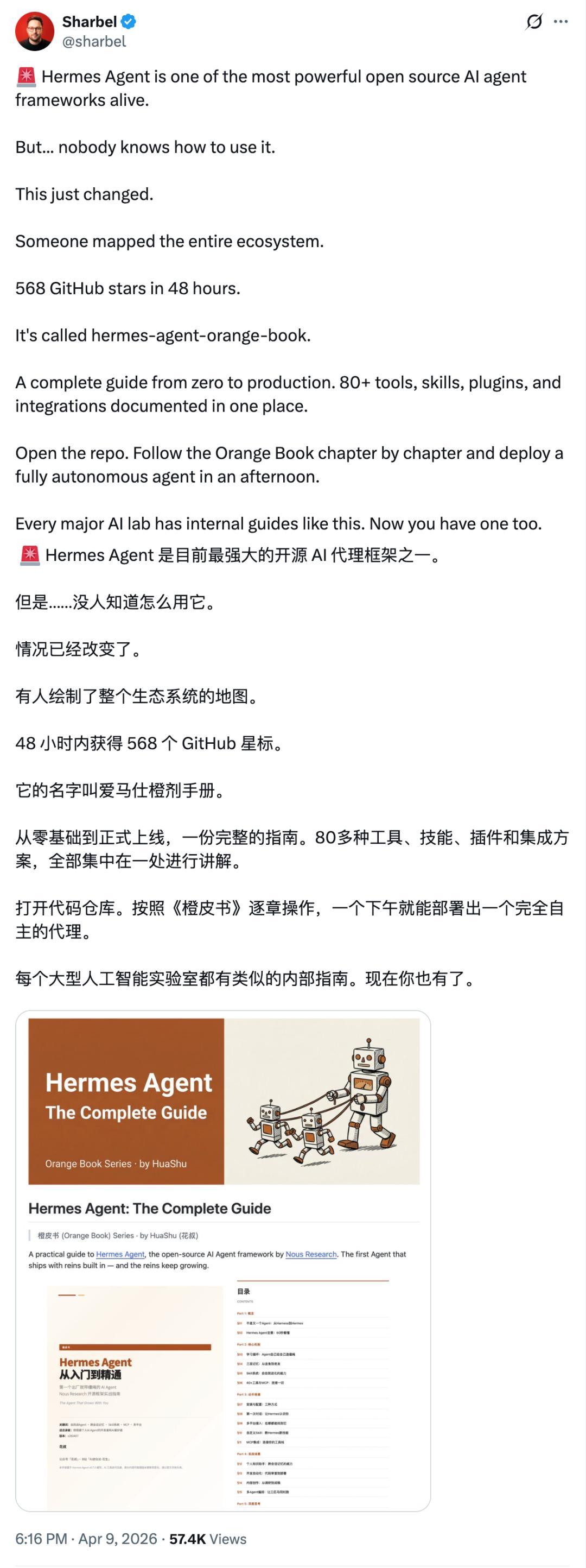
Some people also shared the "Hermes Orange Book", stating that Hermes Agent is a seriously underestimated product and is one of the most powerful open - source AI Agent frameworks at present.
Hermes Agent is developed by the Nous Research team. Looking at the release records on GitHub, from the update of version V0.2.0 in mid - March to the release of V0.8.0 yesterday, there have been a large number of code submissions and merges, as well as practical feature updates in each update. It is a very active open - source project.
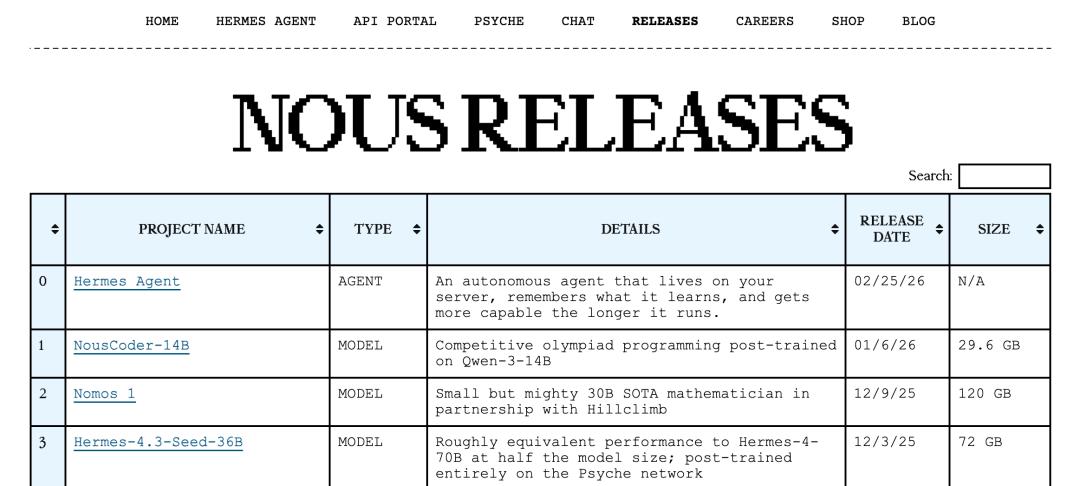
It was first launched on February 25th, https://nousresearch.com/releases
The note - taking method of LLM Wiki shared by Karpathy before, which uses large language models and the Obsidian note - taking tool to build one's own knowledge and research library, has also been immediately added to the built - in skills of Hermes.
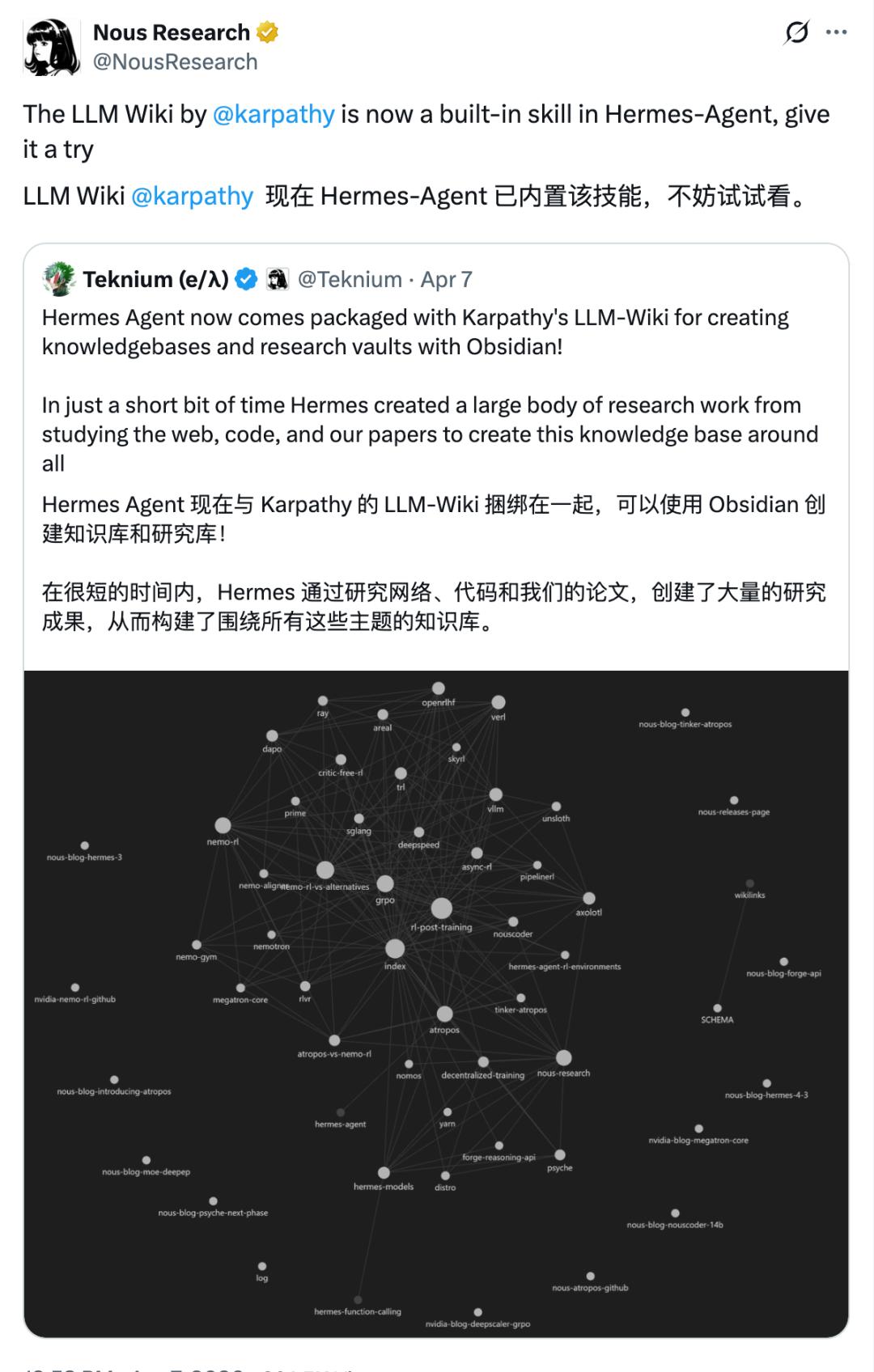
Hermes Agent not only supports installation on computers but also can be installed on Android phones through the Termux terminal emulator. The configuration of the model and gateway is similar to that of OpenClaw.
It is worth mentioning that it has not been "blocked" by Claude yet. We can still directly complete the configuration of the large model by logging in to Claude's Pro or higher membership. At the same time, Hermes Agent also provides its own Nous Portal login based on the subscription model.
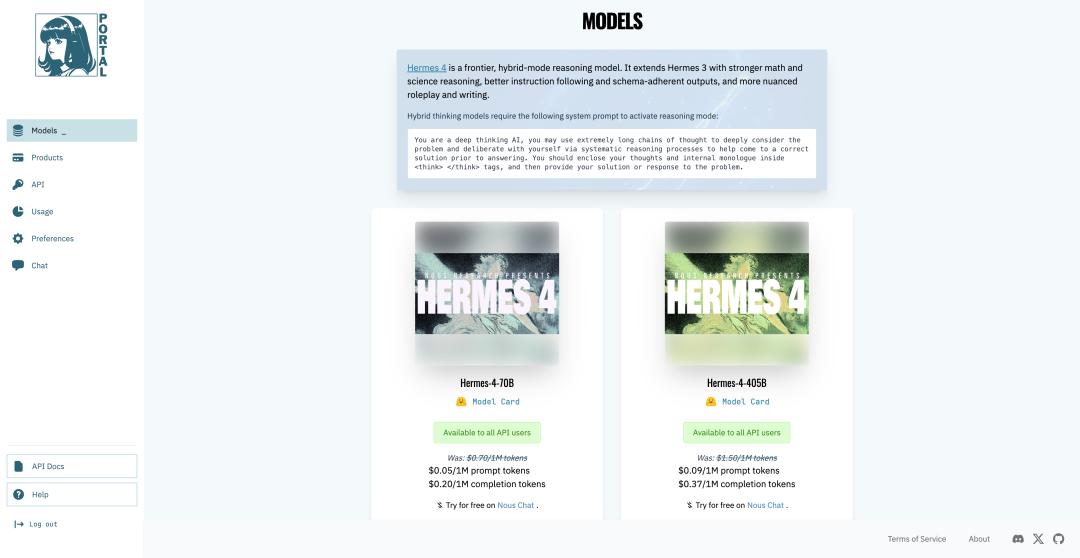
The Hermes 4 model of the Nous Research team
Today, Xiaomi's large model also officially announced that "Xiaomi MiMo has been connected to the world - class Agent framework Hermes Agent, and it is free for two weeks."
🔗 Hermes Agent official website: https://hermes-agent.nousresearch.com
Why is it a real competitor to OpenClaw?
The core of OpenClaw is to pull our AI out of the chat box completely and connect it to actual work, study, and life to truly execute tasks. It can connect to WeChat, WeCom, Feishu, run terminal commands, control browsers, help us send emails, manage schedules, etc.
However, OpenClaw has a flaw in that it cannot automatically learn and evolve from our daily use.
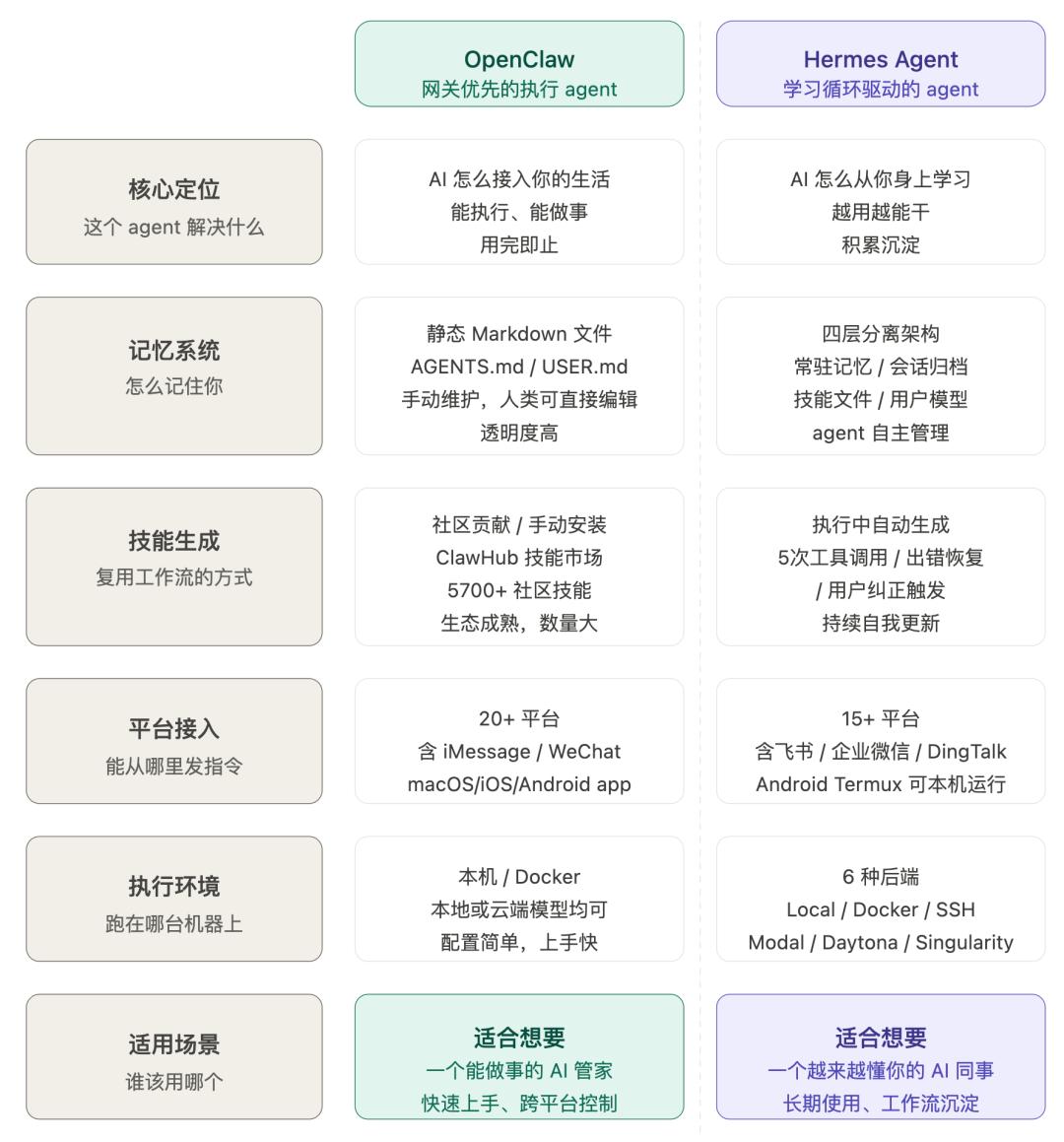
OpenClaw's memory is static - we write information into the configuration file, it reads it, the session ends, and it reads it again next time. It won't actively extract anything from the execution process, nor will it automatically do things right the next time just because we've corrected it once.
After using all the workflows once, we still need to remind it, package them into Skills or specific prompts, etc.
Although there are currently some specific Skills designed to give OpenClaw the ability to learn by itself, Hermes Agent focuses on "understanding you better the more you use it" from the learning loop of the underlying architecture, to the memory system, and inside the Agent execution.
The special feature of Hermes Agent is a closed learning loop, the Learning Loop.

After each task is completed, Hermes will check: Is it worth writing down this execution? The triggering conditions are very specific, such as the tool being called more than 5 times, making a mistake and then fixing it by itself, being corrected by the user, or taking an unobvious but effective path. If any of these conditions are met, it will generate a Skill file in the ~/.hermes/skills directory.
Just like the widely used Skills in the skill market, this automatically generated file is an operation process that can be directly followed next time.
The name, description, steps, and involved tool calls are all clearly written. The format follows the open standard of agentskills.io, and in theory, it can be cross - compatible with agents and used in tools such as OpenClaw, Claude Code, and Cursor.
At the same time, the skill file is not fixed once written. If Hermes Agent finds a better path during subsequent execution, it will directly modify it. It prefers to use the patch method, only passing in the old string and the replacement content instead of rewriting the whole file.
There are two considerations behind this choice: Overwriting the whole file may easily damage the originally useful parts, while patching only touches the problematic parts, which is safer and consumes fewer tokens.
Memory is the most difficult problem for an Agent to handle
Another difference from OpenClaw is the memory system.
A few days ago, Milla Jovovich, the heroine of "Resident Evil", and engineer Ben Sigman jointly released the open - source AI memory tool MemPalace, which received more than 23,000 GitHub stars within two days.
Its design inspiration comes from the memory techniques of ancient Greek orators, putting the things to be remembered into different rooms of an imaginary building and retrieving them when needed.
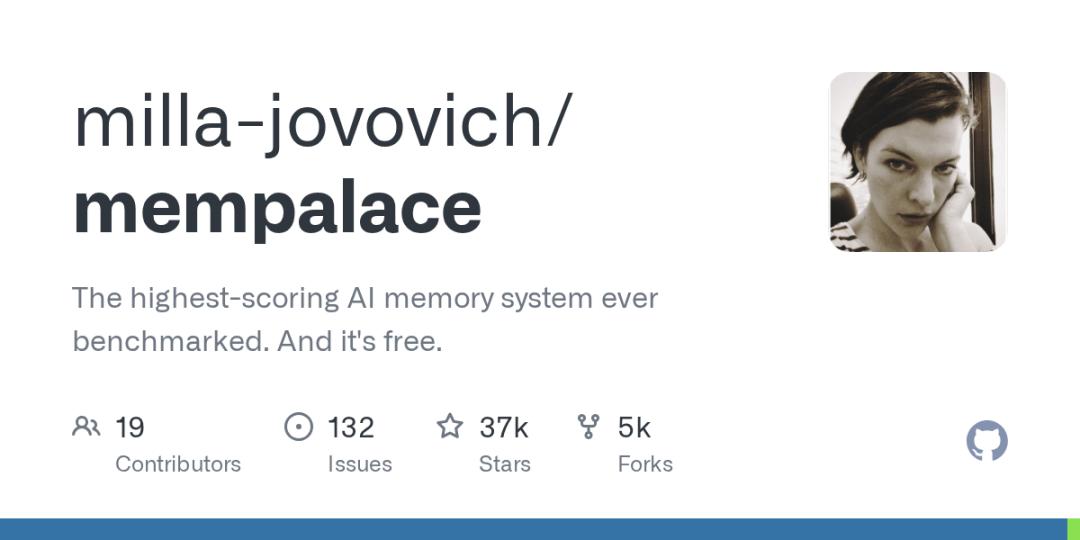
The whole system is divided into five layers: Wing (project or person), Hall (memory type), Room (topic), Closet (compressed summary), Tunnel (cross - topic reference). Relying only on this hierarchical structure, MemPalace claims that the retrieval accuracy has increased from 60.9% to 94.8%.
The core judgment of MemPalace is that AI should not be allowed to decide what is worth remembering because AI's judgment is unreliable. Instead, everything should be stored, and retrieval should determine what is useful.
In the event of the leakage of 500,000 lines of code of Claude Code at the beginning of the month, another solution for memory relies on AI. Some netizens found that Claude uses a "dreaming" method, Auto Dream, to automatically organize our memory files.
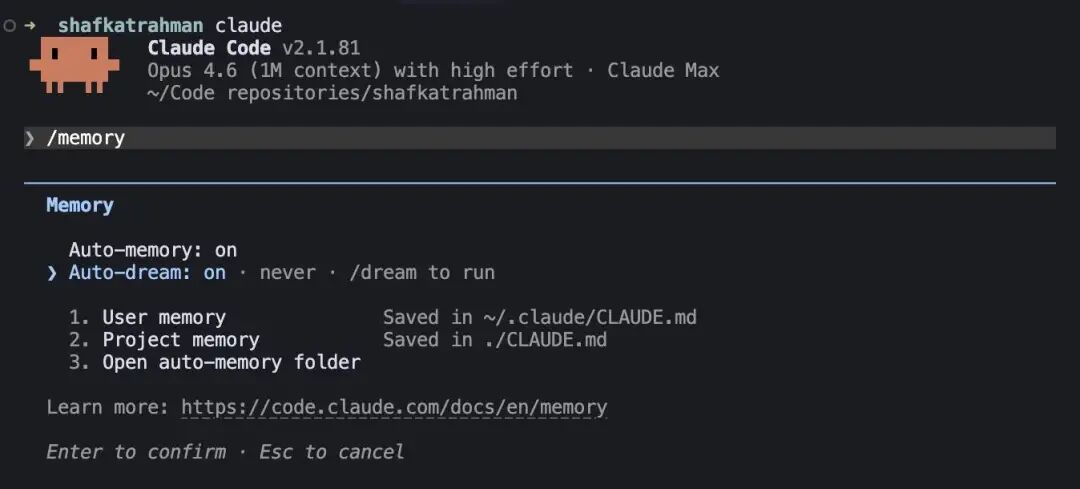
Hermes' memory system is also specially designed. It is divided into four layers in total, with each layer responsible for different tasks and being retrieved at different times.
The first layer is called the resident prompt memory. There are two files, MEMORY.md and USER.md, which store the context that needs to be automatically loaded at the beginning of each session. The total character limit is only 3,575. This number is deliberately narrowed by Hermes Agent to force us to screen instead of stuffing everything in.
The second layer is the session archive. Each conversation is written into an SQLite database and retrieved using full - text indexing. When Hermes Agent needs historical context, it actively initiates a query, summarizes the retrieval results through an LLM, and only injects the part relevant to the current task.
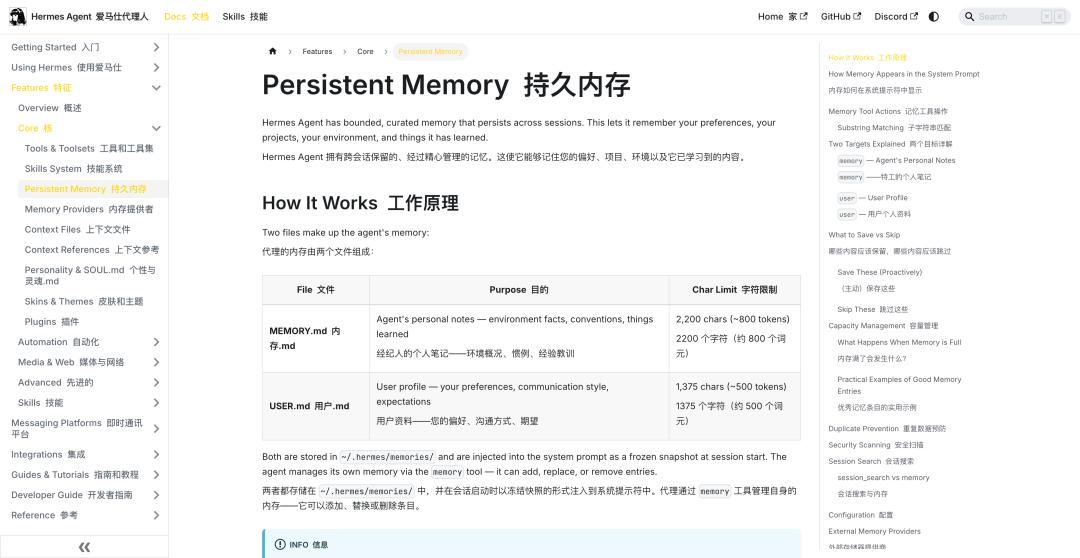
Document link: https://hermes-agent.nousresearch.com/docs/user-guide/features/memory
The third layer is the skill file, which is the output of the learning loop mentioned above. By default, only the names and brief descriptions of the skills are loaded in the system prompt, and the full text is loaded on demand. The effect of this design is that the skill library can grow from 40 to 200, while the context cost hardly changes.
The fourth layer is called Honcho, which is an optional user - modeling layer that passively accumulates your preferences, communication style, and domain knowledge across sessions. It is suitable for the scenario where you use Hermes Agent as a daily personal assistant for a long time.
The division of labor principle of these four layers is also very clear. If something needs to appear in every conversation, put it in the first layer; if it is only useful when a specific topic appears, leave it in the second layer for retrieval; if it is a reusable operation process, let the third layer handle it; if it is the long - term portrait of the user, hand it over to the fourth layer.
When a message reaches Hermes Agent, whether it comes from a third - party gateway such as Telegram or the command line, it enters the same set of synchronous execution engines: generating a task ID, constructing a system prompt from the memory layer, preferentially reusing the cached version to avoid repeated construction, checking whether the context length is close to the upper limit before sending, and then calling the model.
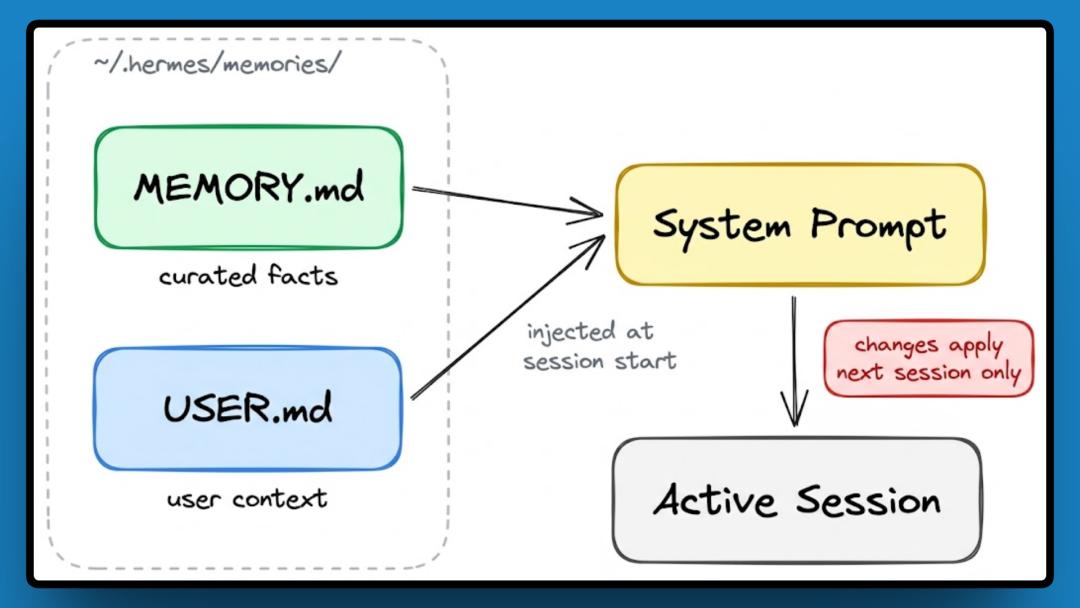
Image source: https://mranand.substack.com/p/inside-hermes-agent-how-a-self-improving
In addition to automatically updating using the learning loop during task execution, Hermes also triggers a mechanism called Periodic Nudge during each session.
Without user input, the system will automatically send an internal prompt to the agent periodically, asking it to review recent operations and determine what is worth writing into memory. Hermes Agent decides what is worth keeping completely on its own without user triggering.
How much cost is needed to get started with Hermes Agent?
Similar to installing OpenClaw, on Linux, macOS, and WSL2, you can use a single command. It also supports installation on Android phones using Termux.
Hermes mentions that it does not support native Windows. We need to install WSL2, the Windows Subsystem for Linux, which is a compatibility layer that can run native Linux binary executables on Windows.
The installation command will automatically handle a large number of dependencies, including Python 3