4 billion, the brain-computer interface has exploded: money can be obtained in all directions.
At the beginning of the year, BrainX Technologies secured a 2 billion yuan financing, which directly ignited the industry.
Recently, Mingshi Brain-Machine Interface, which has been established for only one and a half years, completed an angel financing of 150 million yuan in total.
……
In the first three months of 2026, the total financing of Chinese brain-computer interface companies has exceeded that of the whole year of 2025. As of April 7, the total financing amount exceeded 4 billion yuan.
It is very rare that in an industry still in its very early stage (the global market was only 2.9 billion US dollars in 2025), capital is no longer testing the waters but accelerating its investment.
"Almost all (brain-computer interface) directions can raise funds," Zhou Xin, an investor from Honghui Fund, told Pencil News.
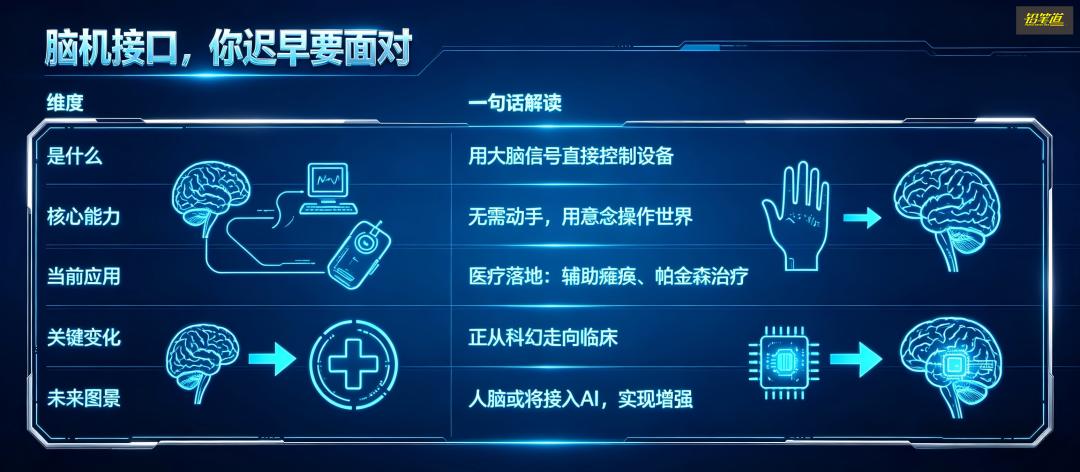
Common knowledge of brain-computer interface
Behind this, several landmark events have boosted the sentiment of the investment circle.
First, Elon Musk announced that Neuralink, the world's leading brain-computer interface company (valued at 9 billion US dollars), plans to achieve large-scale mass production of brain-computer interface devices in 2026.
Second, the brain-computer interface has been included in the list of future industries to be key cultivated in the 15th Five-Year Plan, rising to the national strategic level.
Third, the invasive brain-computer interface product of Borui Kang obtained the registration certificate for Class III medical devices, becoming the world's first approved and marketed invasive brain-computer interface product.
Although the technical path is far from converging, the business model has not been verified, and the regulatory path is still being explored, the combination of four factors - money, policies, clinical trials, and benchmark companies - has led to this round of upsurge.
2025 is regarded as the "Year of the Development of China's Brain-Computer Interface", while 2026 is generally considered the "Year of Commercialization".
Pencil News had conversations with several investors to discuss industry opportunities with them.
01 "Almost all directions can raise funds!"
Zhou Xin
Executive Director of Honghui Fund
Honghui Fund was founded as a pharmaceutical fund. Since 2021, it has established a technology investment team and has deployed in hard technology fields such as semiconductor equipment and embodied intelligence. It invested in Mingshi Brain-Machine Interface in this round.
We noticed Mingshi Brain-Machine Interface in August or September last year. It focuses on "visual reconstruction" - which immediately caught our attention.
Why? Because most brain-computer interface companies in the market are concentrated in two directions: motion control and language reconstruction. But in China, hardly anyone is working on the visual path.
Later, we simply checked the background of the team and found that the people and the direction were a good match. So we made an appointment to meet them through friends. After the meeting, it was quite clear: on the one hand, the team is reliable; on the other hand, their experimental progress was faster than we expected.
At that time, they could already enable patients to stably see colored phosphenes, which has not been reported globally. For us, this is no longer a "storytelling" project, but a project with partial verification.
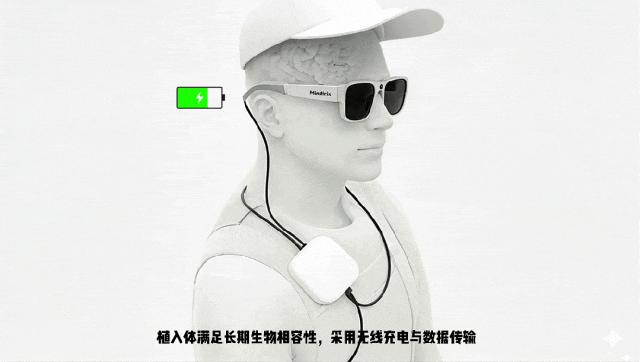
Mingshi Brain-Machine Interface's technology can be used to treat eyes (Source: Mingshi Brain-Machine Interface WeChat official account)
We judged it to be a "semi-underwater" opportunity - the technology is ahead, but the market has not fully reacted. We made the decision in about a month.
For early-stage projects, we only look at two things.
First, the people. The Mingshi team has a complete set of capabilities. There are people working on the brain-computer interface itself, on visual reconstruction, and on electrodes, and they are all very experienced. The brain-computer interface is an interdisciplinary field. If you are only strong in one area, it's actually hard to go far.
Second, verification. If someone just says "I want to do this" without any data, we will be more cautious. But since they already have preliminary human experiment data to prove that this path is feasible, the persuasiveness is completely different.
From a broader perspective, this wave of the brain-computer interface's explosion didn't actually start this year. We think it started in 2025, and this year is just a continuation.
There are two core reasons.
One is the policy. The brain-computer interface has been clearly listed as a national future industry, and this signal is very crucial.
The other is technical verification. For example, Musk's Neuralink has proven in human experiments that the brain-computer interface can operate relatively long-term and safely in motion control. This is very important as it has turned the whole industry from "possibility" to "certainty".
From a technical perspective, the real turning point is the electrode. In the past, rigid electrodes were used, which caused relatively large damage to the brain. Later, flexible electrodes emerged, and only then did this become feasible.
The flexible electrode is a very crucial point, which makes people think that this thing can really be achieved.
Currently, the industry is roughly divided into three paths: non-invasive, semi-invasive, and fully invasive.
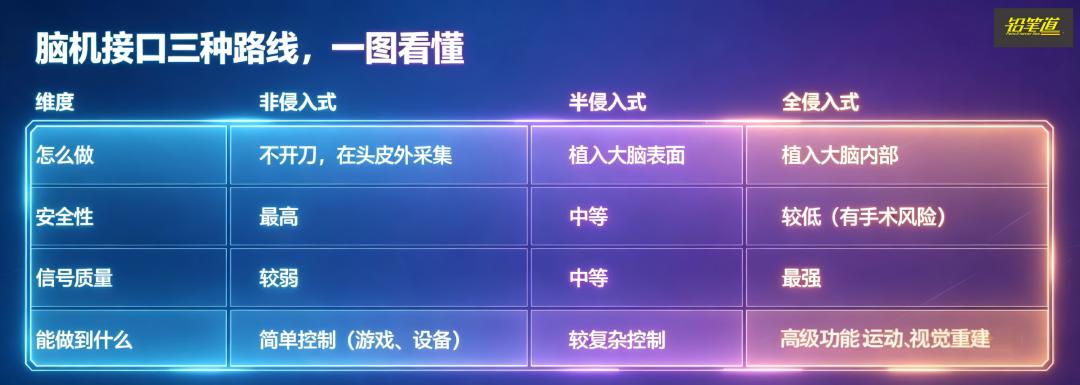
The non-invasive path is the easiest to commercialize, and products can already be sold. The semi-invasive path seeks a balance in medical scenarios. The fully invasive path is the most difficult but has the highest ceiling - for example, complex capabilities like visual reconstruction must follow the fully invasive path.
These three paths do not replace each other but correspond to different scenarios. It's just that people are more cautious about the fully invasive path now because it is still in the early stage.
Although it's very hot now, we've been reminding ourselves internally that there are still quite a lot of uncertainties in this industry.
The first is the science itself. Currently, there has been some progress in "reading", such as reading motion intentions and language intentions. But if you want to "write", such as visual reconstruction, the difficulty of accurately stimulating external images is different. Further on, for mental diseases, which area to stimulate most effectively and safely is still being explored. Human understanding of the brain is still insufficient.
The second is regulation. Especially for the fully invasive path, the clinical and registration paths are still being explored. The semi-invasive path has seen some companies succeed, but the fully invasive path is not yet completely clear.
So for enterprises, the most important thing now is not to tell big stories but to push forward clinical trials. You need more human experiment data to prove its effectiveness and stability. These are the real keys to determining whether you can go on.
In recent months, when communicating with our peers, there has been a quite obvious change.
In addition to the traditional invasive and non-invasive paths, people are also discussing some new technical paths - with a lower degree of invasiveness but stronger capabilities than traditional non-invasive methods. Of course, these are even earlier stages with greater uncertainties.
Among entrepreneurs, the differentiation is also very obvious. Those who have raised funds are desperately turning the money into technology, advancing clinical trials, and expanding the team; those who haven't raised funds are thinking about how to be different. Everyone is looking for their own entry points. Mingshi impressed us at that time because it chose a different path - visual reconstruction, and it is a direction with strong clinical demand.
From an investment perspective, there are both consensuses and differences in the industry.
The consensus is that this is definitely a long-term major track with a very large application space, with opportunities ranging from treating diseases to enhancing capabilities.
The differences mainly lie in the paths - whether it's the invasive path, the non-invasive path, or future new paths that will succeed? People have different views. But in essence, it's not a difference in cognition but a difference in risk preference. If you're willing to take high risks, you can invest in the invasive path for a major breakthrough; if you want to see commercialization earlier, you can invest in the non-invasive path.
Our own choice is also very clear. Since we're doing hard technology investment, we're willing to take a certain amount of risk, but this risk must be "controllable" - this thing must be feasible, have policy support, and we must have a sufficient understanding of this track.
Globally, the paths are also quite typical. The United States is working on the 0-to-1 stage, while China is working on the 1-to-100 stage. For example, Neuralink has been verifying the 0-to-1 stage, and in the subsequent engineering stage, China has an advantage.
Of course, there are also some changes now. For example, in fields such as innovative drugs and AI drug development, China has started to do the 0-to-1 stage on its own. But when it comes to the brain-computer interface itself, there is still a gap between China and the United States, mainly in engineering. Integrating electrodes, chips, power control, temperature control, and biocompatibility into an implant is a very complex systems engineering. Currently, China's overall progress is a bit slower.
But I'm not too worried about this. China will catch up with the engineering problem sooner or later, and it's very likely to do so faster.
Overall, the brain-computer interface is now in a very typical "contending hundred schools" stage. Different paths, different judgments, and different risk preferences coexist, so you can see that almost all directions can raise funds. I'm also very looking forward to what surprises the market will bring us in one or two years.
02 "This round of explosion was unimaginable three years ago"
Chen Shuoqi
Senior Investment Manager of Delian Capital
Delian Capital invested in Mingshi Brain-Machine Interface in this round
There are several reasons why the brain-computer interface has been intensively bet on by the capital circle.
First, policy-driven.
From listing brain science as a major topic in the 13th Five-Year Plan to emphasizing industrial implementation and moving towards commercialization in the 15th Five-Year Plan, the path is relatively clear.
Second, the technical progress is faster than expected.
For example, the invasive electrode technology is maturing (the most core), chips and algorithms are iterating synchronously, and the acquisition system is improving; for example, Borui Kang obtained the first medical device registration certificate for an implantable brain-computer interface; and some companies have reached the stage of human clinical research.
Three years ago, this was unimaginable.
A major change brought about by the technical advancement is that people are starting to see some clear regulatory paths and approval support. This is very important for entrepreneurs and investors because it directly affects whether they can truly move towards commercialization.
In the case where commercialization is not completely clear, the certainty of approval will give the market more confidence.
From a personal perception, the most obvious change in the brain-computer interface industry in recent years is the significant increase in the richness and diversity of enterprises.
Previously, most brain-computer interface companies started from electrodes, which was relatively single. But now it's different. Many different types of companies are emerging: those driven by algorithms, those driven by data, and those driven by chips.
Some companies that originally focused on electrodes are also expanding into platform-type companies after obtaining funds, rather than just focusing on a single link. This is something that didn't exist before.
Let's first look at companies driven by data and algorithms.
The initial problem was that stable data couldn't be collected because the electrodes were not mature, the data was unstable and the quantity was insufficient, so the space for such companies was very limited. But now it's different. Electrodes are gradually becoming more general-purpose devices. Whether it's flexible electrodes or hard electrodes for scientific research, the amount of data is increasing.
At the same time, some new indications are being continuously explored. These changes are equivalent to providing a stable data source for data and algorithm companies, allowing them to truly make attempts in models and algorithms.
Now let's look at chip companies.
Previously, it was actually unclear what kind of chips the brain-computer interface needed. Since the products hadn't entered the human body, it was also unknown how to use and process the data. But now, as some products enter the human body stage, whether invasive or non-invasive, the demand is starting to become specific, and people are starting to be clear about how to collect, process, and transmit signals. Once the demand is clear, someone will come up with solutions. So these chip companies are starting to increase now.
But the brain-computer interface industry is still in a relatively early stage. For now, there is only some preliminary evidence in clinical practice.
For example, Borui Kang obtaining the certificate indicates that semi-invasive or invasive brain-computer interfaces are starting to enter the clinical promotion stage. But the real product value of the brain-computer interface definitely goes beyond clinical applications.
Whether it's invasive or non-invasive, if it is to be used by normal people in the future, full medical verification is required in terms of effectiveness, safety, signal transmission, decoding ability, computing power, and privacy.
Only when all these are established is it possible to move from the medical scenario to a wider range of applications.
In terms of the commercialization rhythm, our judgment is that in the short term, within about five years, it will mainly be concentrated in clinical scenarios; in the next five to ten years, invasive brain-computer interfaces may start to make some new attempts.
Among them, non-invasive brain-computer interfaces will be faster. In the next one or two years, some good applications may be seen, serving both patients and covering the needs of some healthy people.
If we look from the perspective of generating revenue for enterprises, we actually pay more attention to a type of scenario - a direction where the demand is rigid enough, the alternative solutions are weak, and users are willing to pay for the results.
A typical example is the reconstruction of sensory functions, such as visual reconstruction and auditory reconstruction. The cochlear implant is a very successful and proven commercialization case, which is essentially also a type of brain-computer interface.
As for more distant directions, such as entertainment, industry, and the military, although the space is certainly large, at present, it's difficult to bypass the clinical path for direct promotion.
The uncertainties in the industry are first at the technical level. Even for core components like electrodes, there is no clear convergence of technical paths yet.
The second is the policy. Whether the existing policies can support the real implementation of products. Because many companies are now developing products that are quite innovative globally. How to register, conduct clinical trials, and finally obtain certificates for such innovative products in China is actually a matter of great concern to everyone.
03 "Neuralink is the benchmark for everyone"
Wang Zhuoyi
Director & Dean of the Research Institute of Kairong Capital
Kairong Capital has long been focusing on financial advisory work in the field of biopharmaceutical and healthcare, and served as the exclusive financial advisor for the Series A financing of Zhiran Medical.
Before the beginning of 2025, the industry was generally cold. Mainly because the primary market was also in a bad situation, and the risk preference of funds was relatively low. Therefore, for high-risk and long-cycle projects like the brain-computer interface, most institutions were interested to some extent but were also waiting and watching.
But during the Spring Festival in 2025, DeepSeek suddenly emerged, and Yushu Robotics appeared on the Spring Festival Gala, which drove the return of the main logic of Chinese technology investment. Investment institutions began to believe again that China can do better than the United States in various aspects of technology, especially in industries represented