Losing 30% in weight and with lower costs, Chinese electric vehicles are driving a wave of magnesium replacing aluminum: The Wenjie uses up to 20 kilograms of magnesium per vehicle, and Leapmotor and Changan are urgently seeking suppliers...
When the range anxiety of new energy vehicles is combined with the strict constraints of the "dual carbon" goal, lightweighting has evolved from a technical "extra question" to an industry "must - answer question."
"For every 10% reduction in the total weight of a vehicle, the driving range can increase by 5% to 8%, and the power consumption per 100 kilometers can decrease by 5% to 6%," said Yang Weibin, an expert in new energy vehicles and power batteries, in an interview with a reporter from NBD (National Business Daily). Against this backdrop, magnesium alloy, with its extreme lightweight potential, is becoming a new focus for automakers.
According to the reporter's understanding, the single - vehicle usage of magnesium alloy in Seres' AITO series models has reached the 20 - kilogram level. Its integrally die - cast magnesium alloy rear body integrates 87 parts into one whole. Automakers such as Leapmotor and Changan have also launched the procurement or tendering of magnesium alloy components, and a "race to use magnesium alloy in vehicles" has quietly begun.
Automakers Compete to "Adopt Magnesium": AITO's Single - Vehicle Usage Reaches 20 - Kilogram Level
"Currently, the main reasons for the industry's focus on using magnesium to replace aluminum in vehicles are driven by the lightweight advantage and cost advantage of magnesium materials," said a relevant staff member of BYD's Automotive Engineering Research Institute in an interview with a reporter from NBD.
It is reported that magnesium is one of the metals with the lowest density among engineering structural materials at present. Its density is only 1.74 g/cm³, which is equivalent to 2/3 of aluminum and 1/4 of steel. Yang Weibin said, "Under the same volume, the weight of magnesium alloy parts is only 64% of that of aluminum alloy, and the theoretical weight - reduction ratio is stably in the range of 30% - 35%."
This means that using magnesium alloy can bring significant weight - reduction effects without sacrificing structural strength.
"New energy vehicles are a breakthrough point for the application of magnesium alloy," analyzed a professor from the School of Materials Science and Engineering of a Beijing university to the reporter. On the one hand, the increasing weight of power batteries makes automakers have a strong demand for weight reduction. On the other hand, the development of new platforms and the construction of new production lines by new - force and traditional automakers also provide excellent opportunities for the application of new materials and new processes.
The application of magnesium alloy has gradually expanded from small interior parts such as steering wheel skeletons and instrument panel skeletons in the early stage to important components of the three - electric system such as battery trays and electric drive housings, and even to main load - bearing structural parts such as the rear body, achieving a leap from small parts to large parts and from "auxiliary parts" to "main load - bearing parts."
Against this backdrop, leading new energy automakers have taken the lead. Among them, Seres has been particularly active in this "magnesium alloy race."
According to the reporter's understanding, as of now, the number of magnesium alloy parts used in each AITO series vehicle has exceeded 10, and the single - vehicle usage has reached the 20 - kilogram level. In addition, Seres launched an integrally die - cast magnesium alloy rear body in 2025, integrating 87 original parts into a single casting. Compared with the aluminum alloy version, the weight - reduction rate is as high as 21.8%. This breakthrough not only demonstrates the application potential of magnesium alloy in large - scale structural parts but also opens up a new path for the integration and lightweighting of vehicle body manufacturing.
BYD also had an early layout in the field of magnesium alloy. A relevant staff member of BYD's Automotive Engineering Research Institute revealed to the reporter that the company has invested in both the application of magnesium alloy - related products and technical research and is actively promoting technology reserves and mass production in vehicles. Currently, BYD has applied magnesium alloy tube beams, structural brackets and other components in its vehicles and clearly stated that "more magnesium alloy products will be applied in the future to improve the overall vehicle lightweight level."
Multinational automakers have also taken action in terms of magnesium alloy. BMW Group told a reporter from NBD that as early as in the BMW G30 5 - Series models launched in 2016, it had applied magnesium materials to the instrument panel structural parts. Currently, BMW Group has also applied magnesium alloy materials to some parts of some models.
"According to the different requirements of specific models, derivative versions and components, BMW Group mainly uses a variety of innovative steel and aluminum alloy materials, including alloys containing a certain proportion of magnesium elements, to improve the processing performance and other characteristics of the materials," said BMW Group. It is closely following the development of new technologies related to magnesium and maintaining continuous communication and exchanges with the International Magnesium Association (IMA) and its supply - chain partners.
In addition, the reporter learned from Jianghuai Automobile that magnesium alloy parts have been applied to the Zunjie S800, the first mass - produced vehicle of its luxury brand jointly built with Huawei, including some small electronic product casings and electric drive axles. A relevant person in charge of Jianghuai Automobile told the reporter that the company has a layout in the field of magnesium alloy, but it is still in the research stage. In addition to the Zunjie S800, magnesium alloy components will also be applied to other products in the future.
New - force and traditional automakers have not missed this transformation. In early March 2026, Leapmotor publicly released a demand for suppliers of magnesium alloy electric drive die - castings on its procurement official account. Almost at the same time, Changan Automobile also released a tender announcement for the project of integrally formed magnesium alloy rear floor samples.
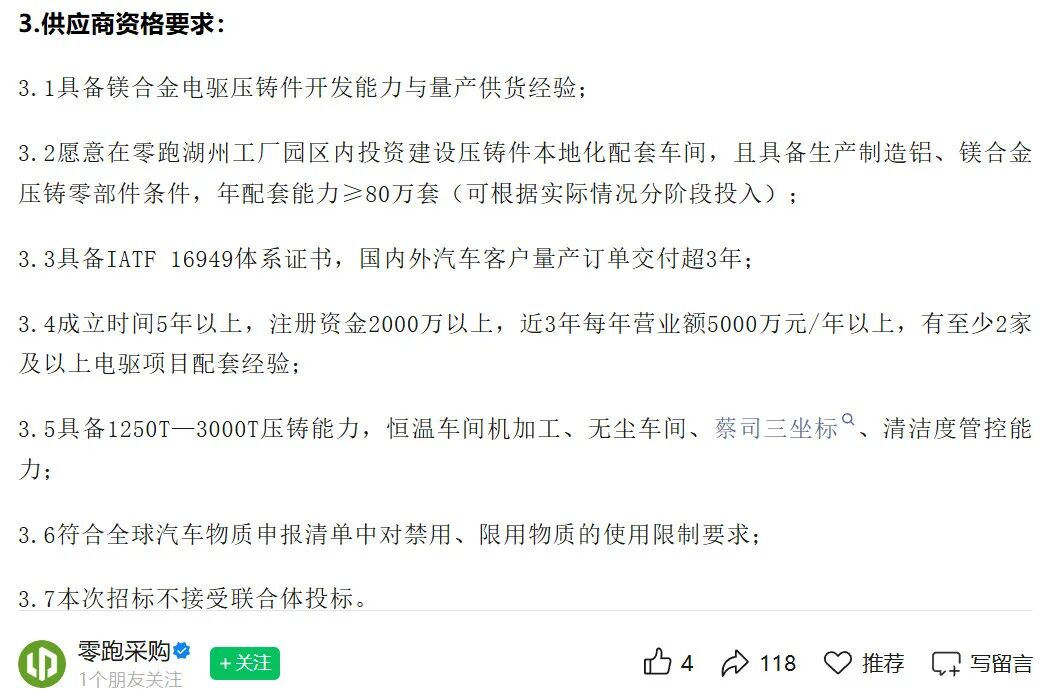
These public procurement and tendering information clearly indicate that magnesium alloy is accelerating its penetration into the supply - chain systems of mainstream automakers from small - scale trials.
Although the models under Guangxi Automobile Group do not have magnesium alloy parts installed, the magnesium alloy parts it has developed are supplied externally. "In the automotive field, the magnesium alloy structural parts and aluminum alloy components independently developed by the company are compatible with mainstream vehicle platforms," said Guangxi Automobile Group. In the new energy field, the magnesium alloy battery casings developed for supporting enterprises demonstrate the advantages of the material in heat dissipation and lightweighting.
The business growth at the supply - chain end also proves from the side that the speed of magnesium alloy being used in vehicles is accelerating. Public information shows that since August 2025, Xingyuan Zhuomei has received three notices of fixed - point supply of magnesium alloy powertrain components from new energy vehicle customers, with a total sales amount of up to 3.309 billion yuan. Due to the confidentiality agreement, the company has not disclosed the names of many automakers.
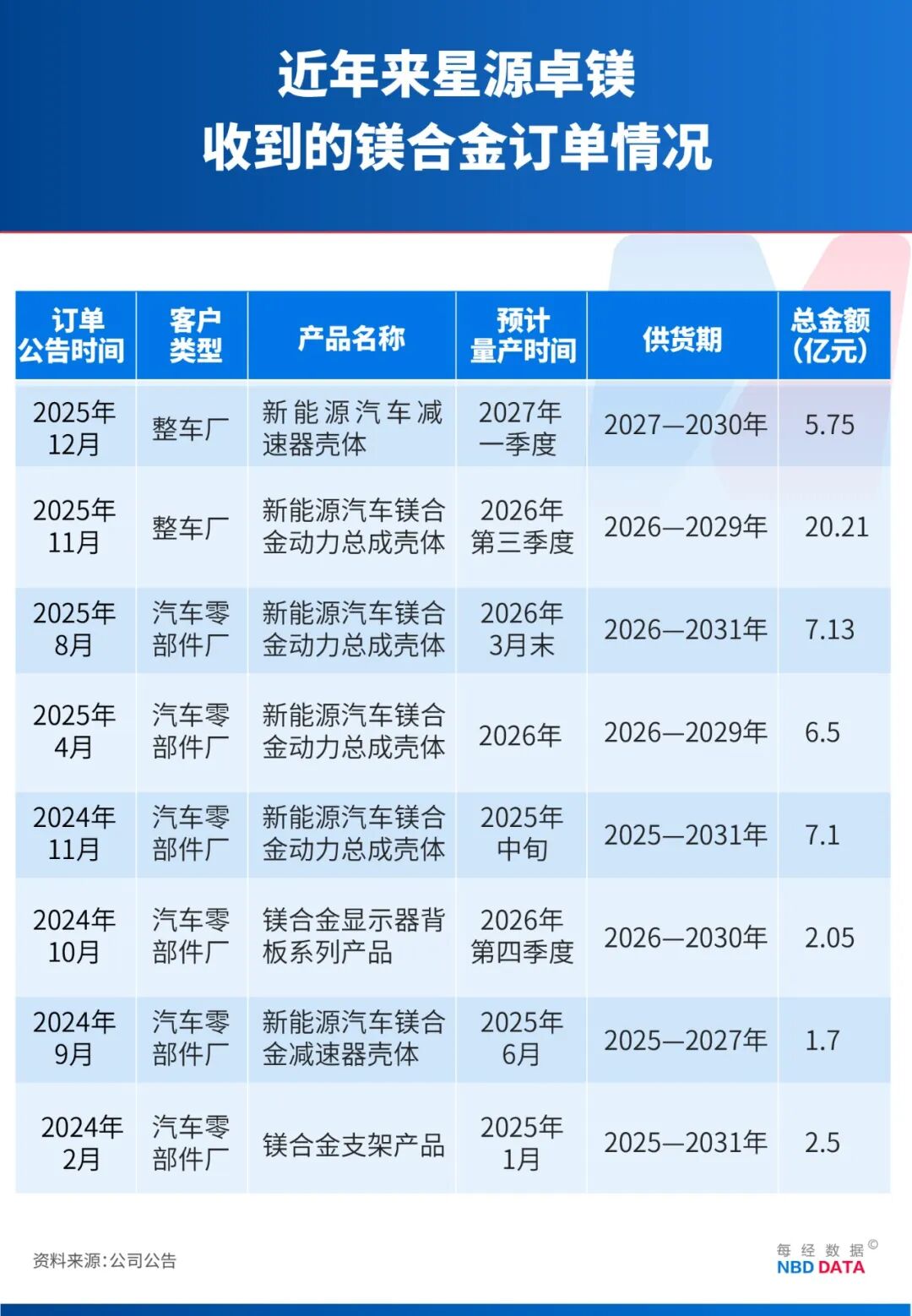
The strong demand of automakers for magnesium alloy business has also driven the performance growth of Xingyuan Zhuomei. According to its announcement, the total amount of new project orders publicly announced by the company in the past year is about 4 billion yuan, and the products are mainly high - value - added powertrain housings. The company's annual revenue in 2024 was only 409 million yuan, and the order growth shows an explosive trend.
Not only Xingyuan Zhuomei, but also Baowu Magnesium Industry, a leading enterprise in primary magnesium and magnesium alloy in the upstream, is deeply involved in this transformation through the whole - industrial - chain model of "materials + deep processing." Different from Xingyuan Zhuomei's "single - product large - value long - term order" model, Baowu Magnesium Industry's orders are mainly in the form of multi - category and framework - type batch supply. The company has carried out in - depth cooperation with many automakers such as Seres, Geely, BYD, NIO, Changan and Jianghuai, covering a variety of components such as electric drive housings, instrument panel brackets, seat skeletons and even integrally formed rear floors.
Breaking Through Technical Bottlenecks: Magnesium Alloy Sheds the "Corrosion - Prone" Label
For a long time, high cost and easy corrosion have been two "curses" hindering the large - scale application of magnesium alloy in the automotive industry. However, with the progress of materials science and the innovation of manufacturing processes, these bottlenecks are being overcome one by one, removing obstacles for the accelerated use of magnesium to replace aluminum in vehicles.
The most critical turning point occurred at the cost end. Since 2025, the price trends of magnesium and aluminum have undergone a fundamental reversal. Data shows that in December 2025, the average price of domestic magnesium ingots was 17,225.65 yuan per ton, while the aluminum price was as high as 21,941.30 yuan per ton. The magnesium - to - aluminum price ratio hit a historic low of 0.79.
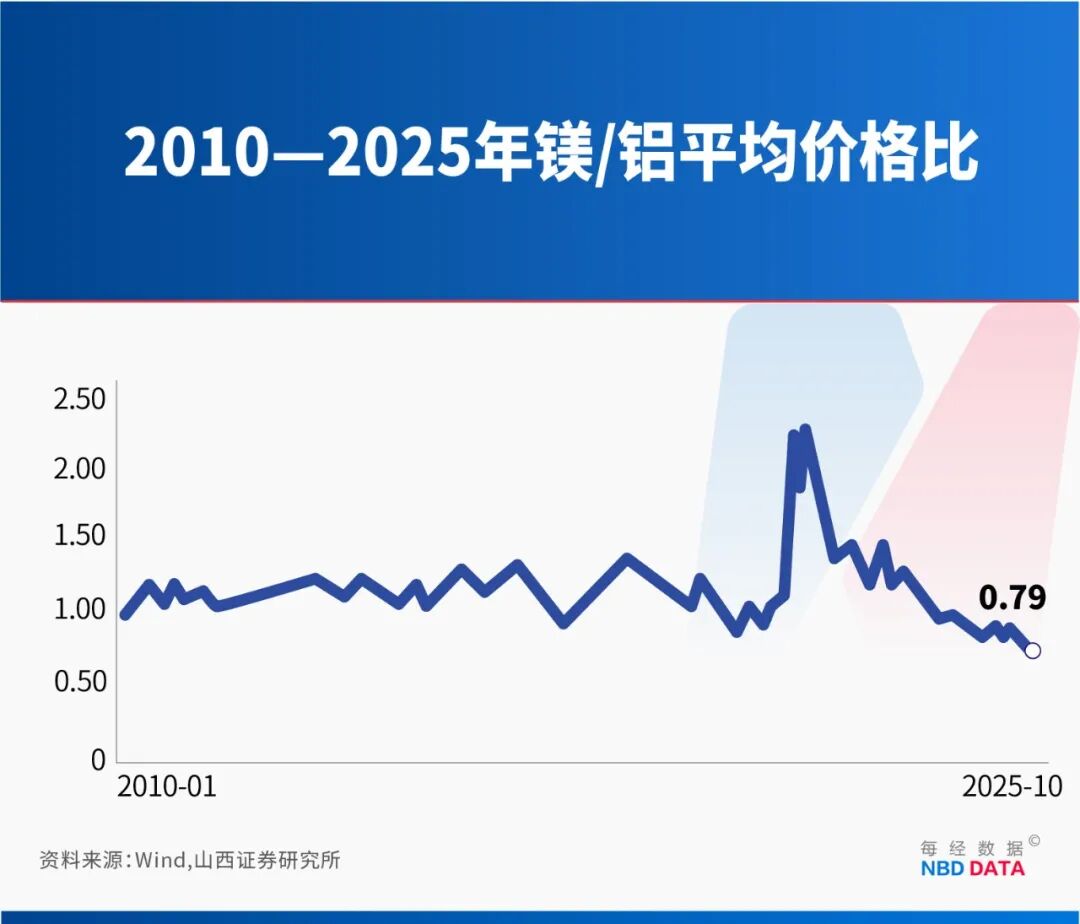
Fu Chunyu, an analyst of magnesium metal at Shanghai Ganglian E - Commerce Co., Ltd., pointed out that currently, the magnesium - to - aluminum price ratio remains at a historical low of 0.72, far lower than the replacement threshold of 1.3. The material cost of parts of the same volume can be directly saved by 1/4, and the comprehensive cost advantage will be greater after large - scale production.
"The cost - performance ratio of magnesium alloy completely surpasses that of aluminum alloy, mainly due to the combined effects of material price difference, process innovation and economies of scale," Yang Weibin believes. This price inversion makes it possible to reduce the single - part cost of magnesium alloy in core structural parts such as battery trays, electric drive housings and rear bodies by 15% - 25%. This is undoubtedly a huge attraction for the automotive industry struggling on the cost line.
In addition to the cost advantage, technological breakthroughs have also enabled magnesium alloy to shed the old labels of "not durable" and "corrosion - prone." Fu Chunyu told the reporter that in recent years, magnesium alloy has made breakthroughs in die - casting technology, surface treatment and connection technology, and has fully met the technical conditions for large - scale application in vehicle body structural parts and the three - electric system.
In die - casting technology, the breakthrough of semi - solid die - casting technology is the key. This technology can significantly reduce the porosity of castings, improve the yield and tensile strength, and at the same time reduce subsequent processing procedures. It has high material utilization rate and can safely and environmentally form large - scale complex structural parts in one step.
Guangxi Automobile Group also said that the group has focused its R & D on the industry - leading semi - solid die - casting process. This technology can greatly improve the density, mechanical properties and consistency of magnesium alloy castings, and is the key to solving the defects of traditional die - castings and realizing high - quality mass production of large - scale complex thin - walled structural parts.
In terms of corrosion resistance, which has been most criticized, the technical problem has been solved through a two - track parallel solution of material modification and surface engineering. Yang Weibin explained to the reporter that on the one hand, by optimizing the material formula, the corrosion resistance of the magnesium alloy itself is improved from the source, implanting the "anti - corrosion gene." On the other hand, through advanced surface treatment processes such as micro - arc oxidation and composite coating systems, the magnesium alloy parts are given a strong "protective suit," making their corrosion resistance comparable to that of high - end aluminum materials and able to pass the strict vehicle - grade salt - spray test standard.
In addition, the development of stainless magnesium alloy and the addition of rare - earth elements have also improved the high - temperature creep resistance and strength - toughness of the material, enabling it to meet the requirements of working conditions with higher performance requirements such as electric drive and gearbox housings.
Mastering the Production - Capacity Advantage: China's Primary Magnesium Production Capacity Accounts for More Than 80% of the Global Total
If cost and technology are the two wheels driving the "replacement of aluminum with magnesium," then China's dominant position in the global magnesium industry provides the most solid resource and production - capacity guarantee for this transformation.
China has unique resource endowments. A research report from Dongxing Securities shows that China has 90% of the world's primary magnesium production capacity, 75% of the magnesium oxide production capacity and 65% of the downstream refractory material output. In 2025, China's primary magnesium production capacity and output accounted for 82% and 89% of the global total respectively.
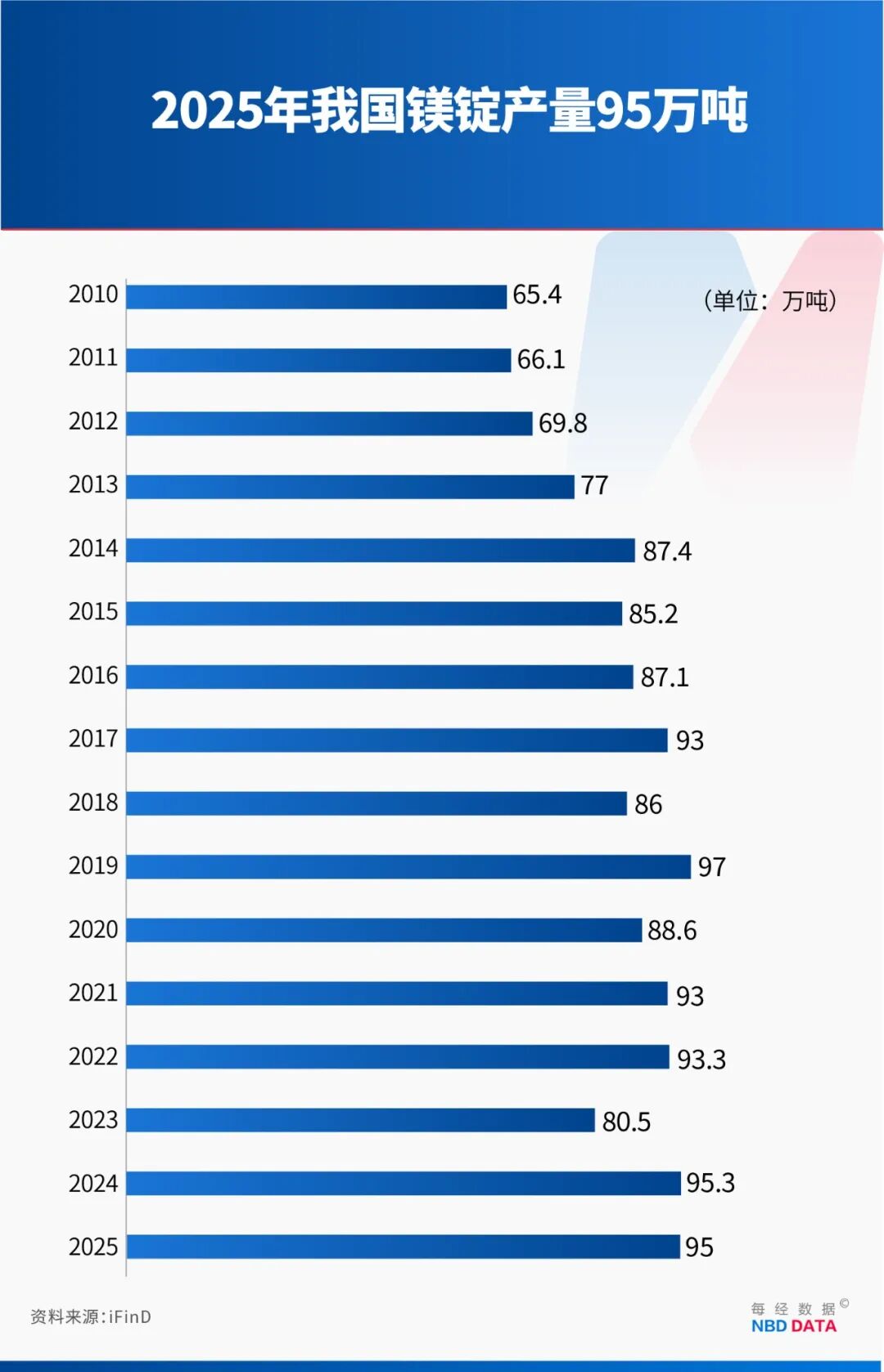
From the exploitation of dolomite (a natural mineral mainly composed of calcium magnesium carbonate), smelting and purification, alloy formula optimization to core processes such as semi - solid forming, China has achieved independent control of all key links in the whole chain, without the risk of being "held back" by overseas countries, and the supply stability and security are extremely high.
This control of the whole industrial chain means that when the demand in the automotive industry explodes, China can quickly respond and form economies of scale, further consolidating the cost advantage. "The automotive industry is the absolute main consumer of magnesium alloy, accounting for up to 70%, mainly used in components such as instrument panel brackets, seat skeletons and steering wheels, and is opening up a new growth curve," said Guangxi Automobile Group.
Facing this historical opportunity, enterprises in all links of the domestic industrial chain have begun to accelerate their layout. In the upstream, Baowu Magnesium Industry has formed a complete industrial - chain closed - loop.
A research report from Wukang Securities mentioned that as of the end of April 2025, Baowu Magnesium Industry had a primary magnesium production capacity of 100,000 tons and a magnesium alloy production capacity of 200,000 tons. In addition, the company is building a new primary magnesium production capacity of 50,000 tons in Zhouhu, a new primary magnesium production capacity of 100,000 tons and a magnesium alloy production capacity of 100,000 tons in Wutai, and a new primary magnesium production capacity of 250,000 tons and a magnesium alloy production capacity of 300,000 tons in Qingyang. After the new production capacity is put into operation, the total primary magnesium and magnesium alloy production capacities will reach 500,000 tons and 600,000 tons respectively.
In the mid - stream manufacturing end, a group of enterprises with high technical barriers and strong growth potential are becoming value high - points. Xingyuan Zhuomei has been deeply involved in the high - end magnesium and aluminum die - casting field, and its products have been applied to many brands such as BMW, Audi, Porsche and NIO. Chunqiu Electronics has entered from the field of consumer - electronic structural parts. Relying on its advantages in processing accuracy, speed and yield of magnesium and aluminum structural parts, it has entered the supply chains of automakers such as Xiaomi, NIO, XPeng and BYD.
Dongxing Securities predicted in its research report that the global demand for magnesium alloy in the automotive industry will increase from 421,000 tons in 2025 to 1.061 million tons in 2028, with an average annual compound growth rate of up to 36%.
