Shareholders, Huawei, and the "Self": The Three-Party Chess Game of SERES
Seres released its annual financial report for 2025 at the end of March. The data shows that the company achieved an annual operating revenue of 165.054 billion yuan, a year-on-year increase of 13.69%. The net profit attributable to shareholders of the listed company was 5.957 billion yuan, a slight year-on-year increase of 0.18%.
In the current highly competitive automotive industry environment, it is truly remarkable that Seres has maintained overall profitability for two consecutive years.
In terms of profitability, the gross profit margin of Seres' new energy vehicle business reached 28.78%, an increase of 2.55 percentage points compared to 2024. This is mainly due to the average selling price of the AITO brand rising from 377,000 yuan to 391,000 yuan.
Looking at the horizontal comparison, the average gross profit margin in the automotive industry is approximately around 13%. Even for leading group - type enterprises, those with excellent performance can only reach around 18%. The entire industry exhibits the typical characteristic of "small profits but large sales".
And Seres' gross profit margin of 28% is far ahead.
However, a phenomenon worthy of deep thought is that despite the significant increase in the gross profit margin, the increase in net profit is only 0.18%. The reason behind this is thought - provoking.
01 Seres' Strategic Layout Behind the Profits
It is not difficult to find from the financial report that there are mainly two aspects affecting Seres' profits:
One is asset impairment. Seres made a one - time provision of 1.26 billion yuan for asset impairment in the fourth quarter, accounting for about 80% of the total annual asset impairment. This includes the impairment treatment of intangible assets worth up to 759 million yuan after discontinuing the self - developed S - OS system.
The other is the sharp increase in the three major expenses.
Seres' R & D investment reached 12.51 billion yuan, a year - on - year increase of 77.4%. The sales expenses were 24.19 billion yuan, a year - on - year increase of 26.12%. The management expenses were 4.787 billion yuan, a year - on - year increase of 34.96%.
The expansion of management expenses is not difficult to understand.
As sales volume increases and business expands, the enterprise naturally needs to recruit more people.
But it is worth noting that why have these two expenses also increased significantly for Seres, which has always relied on Huawei's R & D and sales channels?
Behind the expansion of expenses is Seres' multiple strategic layouts.
In response to investors' questions about the whereabouts of R & D expenses, Seres gave the following answer.
On the basis of insisting on mainly investing in the AITO business, the company has simultaneously increased R & D investment in overseas models and innovative businesses.
It is clear that the R & D funds mainly flow to three battlefields.
In the AITO segment, Seres launched a new model, the AITO M6, last month, entering the market above 200,000 yuan and covering a wider range of consumer groups.
In addition, Seres has intensively launched core technologies such as the Magic Cube Technology Platform 2.0 and the fifth - generation super extended - range system, and achieved certain results in fields such as extended - range technology and intelligent chassis. These technological accumulations enable Seres to participate more equally in the technological definition and R & D of AITO models in cooperation with Huawei.
The innovative business is mainly concentrated in the field of embodied intelligence.
In October 2025, its subsidiary, Chongqing Phoenix Technology Co., Ltd., signed a "Framework Agreement for Embodied Intelligence Business Cooperation" with Beijing Volcengine Technology Co., Ltd. It is committed to making the robot business a future growth curve.
At a recent analysts' meeting, Seres' management revealed that bipedal, quadrupedal, wheeled, and wheel - legged composite intelligent robots are expected to be launched this year.
In terms of overseas expansion, Seres has launched three global models, the AITO 9, AITO 7, and AITO 5, and clearly identified the Middle East and Europe as the core breakthrough points.
According to Seres' plan, the long - term goal is for overseas sales to account for 30% of the total sales.
In terms of sales expenses, Seres is accelerating the expansion of its sales layout.
Among the 24.19 billion yuan in sales expenses, advertising, image store construction, and service fees totaled 22.95 billion yuan, accounting for 94%, a year - on - year increase of 26.7%.
During the reporting period, the company recruited more than a hundred high - quality stores with high - end user service capabilities to join the AITO system. As of the end of the reporting period, Seres had 380 operating user centers, covering 218 cities across the country, achieving 100% coverage of third - tier and above cities.
Obviously, a large part of Seres' current sales expenses are used to expand the exclusive AITO user centers.
Relatively speaking, this will further reduce its dependence on Huawei's Hongmeng Smart Mobility channels.
For Seres, this is a good thing. On the one hand, it reduces the burden on Hongmeng Smart Mobility, and on the other hand, it enhances its brand independence.
It is worth mentioning that R & D and sales expenses may further increase in the future.
In November last year, Seres was officially listed on the Hong Kong Stock Exchange, raising a total of HK$14.283 billion. After deducting issuance fees, the net proceeds were approximately HK$14.016 billion.
According to the prospectus, approximately 70% of the net proceeds will be used for R & D investment in core technologies and products of intelligent electric vehicles; approximately 20% will be used for the construction of diversified new marketing channels, the layout of overseas sales networks, and the establishment of a global charging service network.
As of the end of 2025, the funds had only been received for about two months, and no large - scale project investment had been made. Most of the funds were still deposited in a special account.
From the perspective of expense investment and future capital allocation, Seres' future development will mainly focus on three directions: continuously strengthening the product matrix of the AITO brand, exploring overseas markets, and deploying the robot business.
However, although these strategies seem to be independently planned by Seres, in fact, they cannot avoid the influence of Huawei.
Currently, Seres has occupied an absolute dominant position in the high - end new energy SUV market. The products under the AITO brand have achieved all - round success: the sales volume of the AITO M9 exceeded 110,000 units last year, ranking first in the annual sales of the 500,000 - yuan - level market; the AITO M8 sold more than 150,000 units throughout the year and quickly became the sales champion in the 400,000 - yuan - level market after its launch; the AITO M7 also achieved a sales volume of more than 110,000 units, dominating the 300,000 - yuan - level market.
With the launch of the AITO M6, there is limited room for the price of the AITO M series to decline - after all, it is unlikely to further decline to below 200,000 yuan.
According to the conventional approach of traditional automakers, after a brand becomes popular, it usually expands derivative models such as sedans and MPVs based on a mature platform. Just as Tesla uses the popular combination of the Model 3 and Model Y to cover the sedan and SUV markets.
However, Seres does not seem to have such an intention, and there are no signs of plans for sedans and MPVs so far.
The consideration behind this deliberate strategic avoidance may be that if Seres enters the sedan market, it will inevitably conflict with the overall strategy of Hongmeng Smart Mobility - the Xiangjie brand has already occupied the luxury sedan market.
Since there are inevitable differences between making sedans and the strategy of Hongmeng Smart Mobility, Seres can only choose a more long - term strategy.
It can either increase overseas expansion to create incremental growth or participate in the popular field of embodied intelligence to tell a more high - end story.
But frankly speaking, neither of these two paths is easy.
In China, Huawei is a well - known brand and a traffic magnet, but in overseas markets, especially in Europe, Huawei is deeply associated with "sanctions".
This means that the "Huawei empowerment" card is not easy to play overseas.
The biggest marketing selling point in China may become the biggest brand burden when going overseas.
What's more worrying is that Huawei's dense network of stores in core business districts in China has been an important support for AITO's sales, but this retail system and marketing approach are almost completely ineffective overseas.
As for embodied intelligence, the entire industry is still far from real commercialization. XPeng has been working on it for three years and only briefly gained popularity with a video of a robot walking like a cat. Even the industry star Unitree Technology has not yet established a sustainable business model.
02 The Grace of Rebirth and the Responsibility to Shareholders: Two Accounts of Seres
When analyzing Seres, it is inevitable to mention Huawei.
Currently, Seres and Huawei are at a crossroads.
In the past, Huawei needed a soul carrier, and Seres needed a savior. The cooperation between the two was a perfect match.
The success of AITO in surpassing BBA has achieved Seres and also given Chinese automakers a boost.
However, "If life could always be as beautiful as the first encounter", cooperation will not always be as wonderful as at the beginning.
According to Huawei's strategy, it wants to define cars with software, which means that Huawei is not just a software supplier but wants automakers to become its suppliers.
Now, the Wujie and Sanjing brands are well - known, and some high - end self - owned brands such as Avatr and Voyah are also cooperating with Huawei.
Seres has gone from being Huawei's "crown prince" to being the most important basic market, and the dilution of its brand halo is becoming increasingly serious.
So how should Seres face this situation?
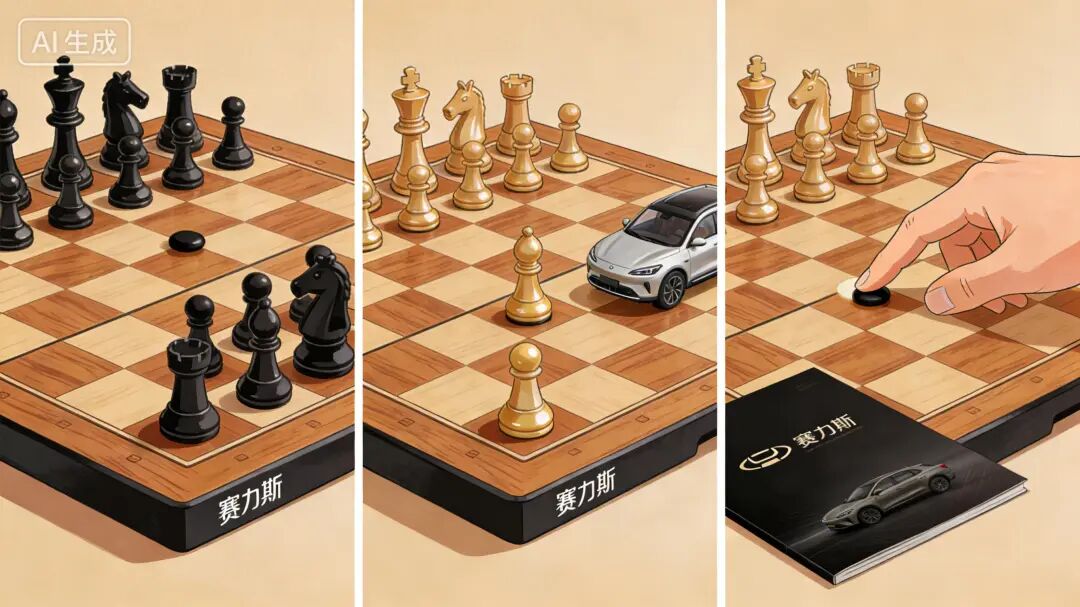
Rather than saying that the two are at a crossroads, it is better to say that Seres is facing a choice alone - should it continue to revolve around Huawei strategically or take a path of "self - reliance"?
Of course, some people will say that without Huawei, there would be no Seres today. Otherwise, Seres would still be selling minivans.
In fact, this is true. According to Chinese values, one should repay a kindness many times over.
It can be said that Huawei has a "grace of rebirth" for Seres, and this cannot be denied.
But some people always talk about the "grace of rebirth".
There is actually a deviation in the narrative.
People in this land love stories of underdog success. Just like Zhang Xue's story, which once again moved people to tears.
But few people know that before cooperating with Seres, Huawei's intelligent driving business was also facing difficulties.
Chen Hong, the former chairman of SAIC Group, put forward the classic "soul theory" at the 2021 SAIC Group shareholders' meeting.
In fact, not only SAIC is reluctant to hand over its "soul". Any relatively large - scale automaker would not want to do so from their perspective.
At the end of October 2020, Huawei launched the intelligent vehicle solution brand HI (Huawei Inside) and announced that it would cooperate with three automakers, GAC, BAIC, and Changan, to create sub - brands.
However, one year later, the mass - production volume of the models resulting from Huawei's cooperation with these three automakers was extremely low, and no other automakers joined the HI solution cooperation.
At that time, Huawei had invested tens of billions of yuan in this field, but due to the lack of automakers willing to cooperate deeply, this investment was at risk of being wasted.
To make matters worse, Huawei's mobile phone business was facing multiple rounds of sanctions at that time, and its situation was not easy. As Yu Chengdong previously said, Huawei originally hoped that the automotive business could fill the gap left by the mobile phone business.
From this perspective, isn't Seres also the savior of Huawei's automotive business?
The two are more like Zhou Yu and Huang Gai. Without Zhou Yu's plan, the Battle of Chibi could not have been won. Without Huang Gai's "willingness to be beaten", Zhou Yu's "fire - attack plan" could not have been achieved.
It's just that in the dissemination, people prefer stories of underdog success like Zhang Xue's and prefer to focus on Zhou Yu's "strategizing". Subjectively, they are more inclined to Huawei's promotion of Seres and less likely to see Seres' "self - sacrifice".
In terms of return, Seres has not let Huawei down.
From 2022 to the first half of 2025, Seres paid 75 billion yuan in procurement fees to its largest supplier.
Although Seres acquired the trademarks and design patents related to AITO held by Huawei for 2.5 billion yuan, the "soul" of AITO is still in the hands of Hongmeng Smart Mobility. People are still attracted to AITO because of Huawei.
Seres is essentially buying a "shell". One of the major benefits is for "going overseas", as it can promote AITO as its own brand rather than Huawei's brand to avoid the impact of sanctions.
But in fact, the so - called "impact" is also brought about by Huawei.
Of course, the author does not mean that Seres should break away from Huawei.
It is just that in the current situation, there are indeed certain strategic differences between Seres and Huawei in their cooperation.
Should Seres be more proactive in striving for some strategic options?
After all, Seres is not a subsidiary of Huawei. If Seres were an unlisted company, there would be no problem with strategically serving Huawei whole - heartedly.
But there are 300,000 shareholders behind Seres, and the company also needs to be responsible to these shareholders.
After Seres was listed on the Hong Kong Stock Exchange last year, its stock price reached a peak of 131.5 yuan, but as of the close on April 9, the stock price was 79.75 yuan, almost halved.
For shareholders, the company's strategy should be more in line with the company's interests.
For example, Seres' AITO could try to make some sedans instead of focusing on long - term projects like the robot business.
Or, it could ask Huawei to charge less "tuition fees".
In short, it should strive for more strategic options from Huawei.
After all, Huawei is now cooperating with many automakers, and the impact on AITO is the greatest.
The future strategic focus of Hongmeng Smart Mobility may be shifting from AITO to the Xiangjie brand or other brands.
The underlying logic is that Huawei needs to prove not only its ability to create a single hit product but also its systematic ability to continuously replicate success - this is another key to defending its industry discourse power and attracting more automakers to join the ecosystem.
Currently, AITO is still the main sales contributor in Hongmeng Smart Mobility, but when the next hit product appears, will Seres' negotiation power be weakened?
Of course, Huawei has not ignored Seres' situation.
In August 2024, Seres issued an announcement that its wholly - owned subsidiary, Seres Automobile, planned to purchase a 10% stake in Yinwang held by Huawei in cash for a transaction amount of 11.5 billion yuan