What kind of high - end product is a 3D - printed dragon that costs 9.9 yuan each? How did it take over the ancient town?
During the Tomb-Sweeping Festival holiday, you must have seen the nationally standardized 3D printed dragons at night markets, street stalls, and ancient towns across the country.
These dragons are very colorful. Some have a Chinese style, while others have a Western fantasy style. In most cases, they are just lined up, just like selling hairtail fish. The expensive ones cost 99 yuan, and the cheap ones are only 9.9 yuan. They come in various sizes.
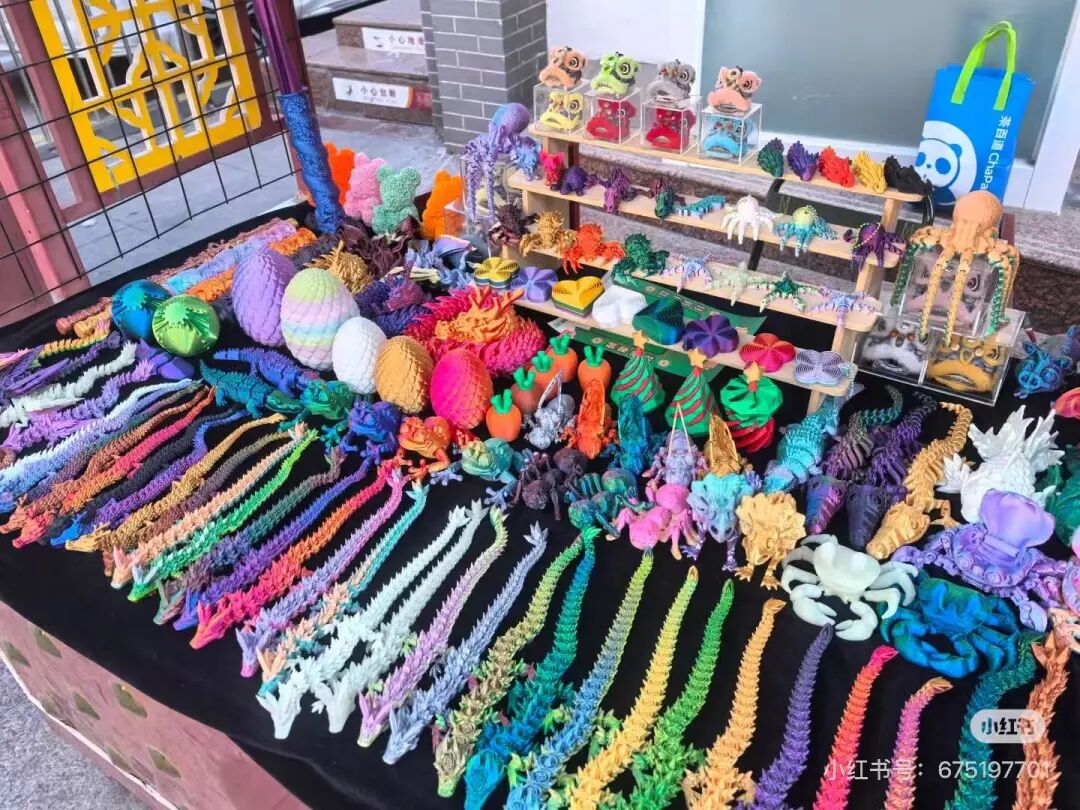
3D printed dragons at a street stall in Dalian | Xiaohongshu
When I say night markets and street stalls across the country, it also includes those in the United States.
In the past year, I've seen these colorful dragons and their variant relatives (slightly modify the head and it becomes an alligator, sea monster, or salamander) everywhere, such as at farmer's markets, comic and game conventions, scenic spots, and amusement parks. However, the price is ten times that in China.
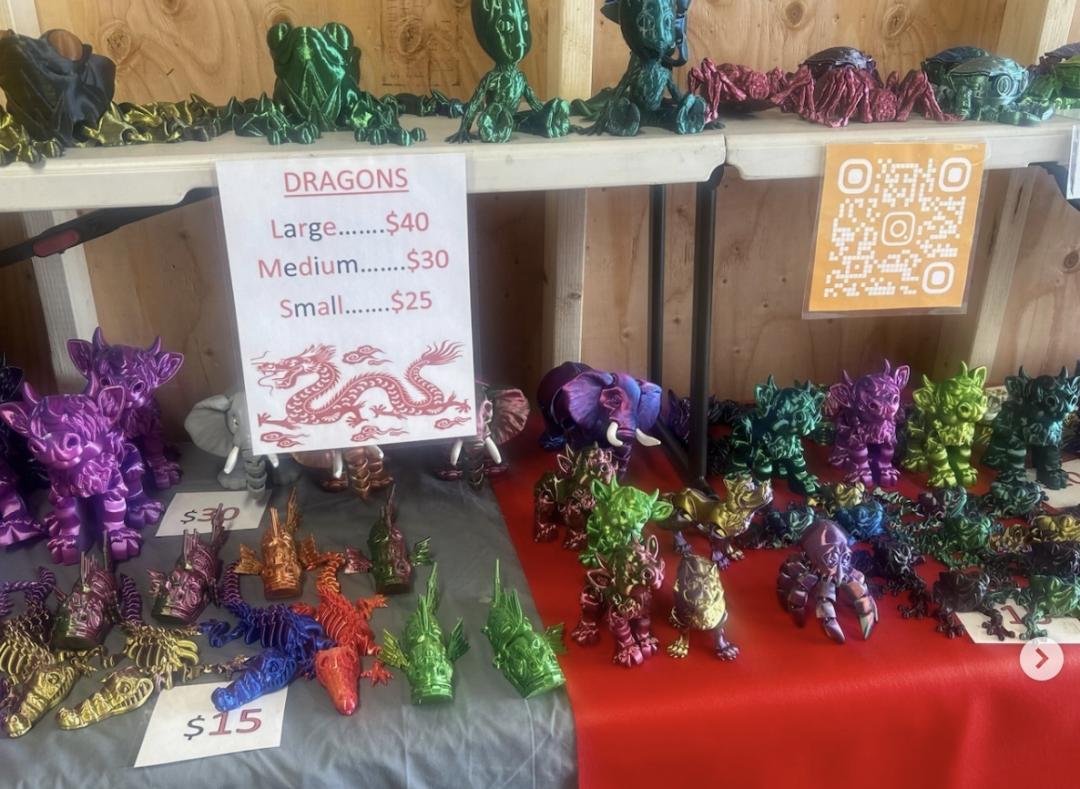
The large ones cost $40, and the small ones cost $25. Smart you, now you know how to make money! | Alaska State Fair
On the Reddit forum, an American also asked, "These 3D printed dragons are everywhere. They all look similar, and their surfaces are rough. Who on earth is buying them!"

Meanwhile, 3D printing materials are not cheap, and it's also time-consuming. Friends who have printed things at home know that it takes several hours to print a small item. If you're not careful, it might turn into a "ramen" (a mess like instant noodles that comes out after a 3D printing malfunction), and all your waiting and efforts will go down the drain.
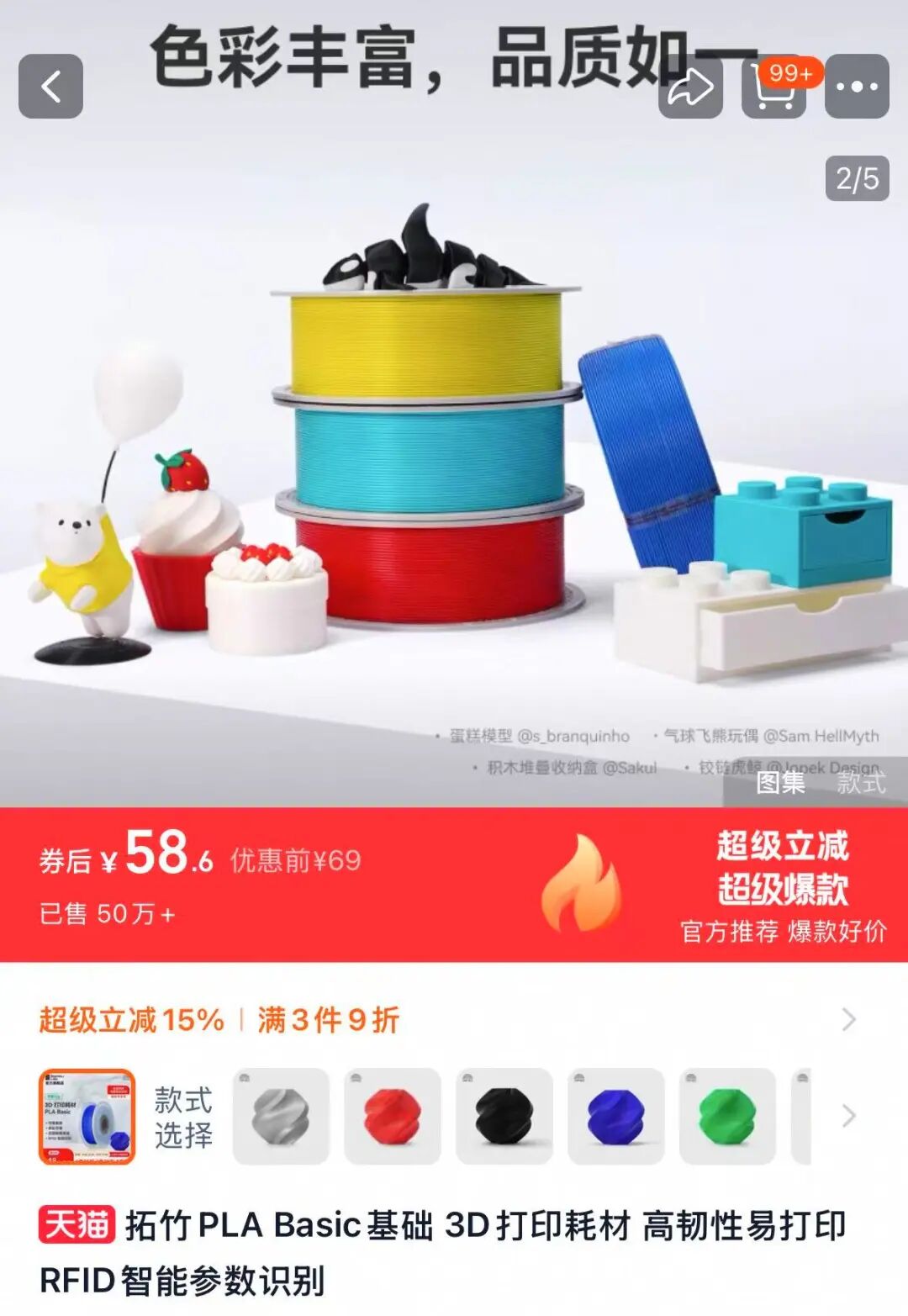
TuoZhu 3D printing materials. A 1-kilogram monochromatic consumable costs about 60 yuan. It can print 4 dragons without considering losses | Taobao
Where on earth do these dragons come from? Why are there so many and so cheap? Who is buying them?
Harvesting at the 3D Printing Farm
Most likely, these mass-produced dragons come from "3D printing farms."
This term sounds cyberpunk, but in fact, its organizational form is similar to that of a picking garden. You can set up a farm with a good production capacity with just a few hundred square meters.
In the factory building of the farm, hundreds or even thousands of desktop 3D printers are arranged in an orderly manner. Almost every one of them is running non-stop throughout the year, with the print heads shuttling back and forth. Colorful dragons are printed layer by layer like this.
Workers walk around with plastic baskets, just like harvesting vegetables, picking the finished dragons one by one from the hot beds and throwing them into the baskets.
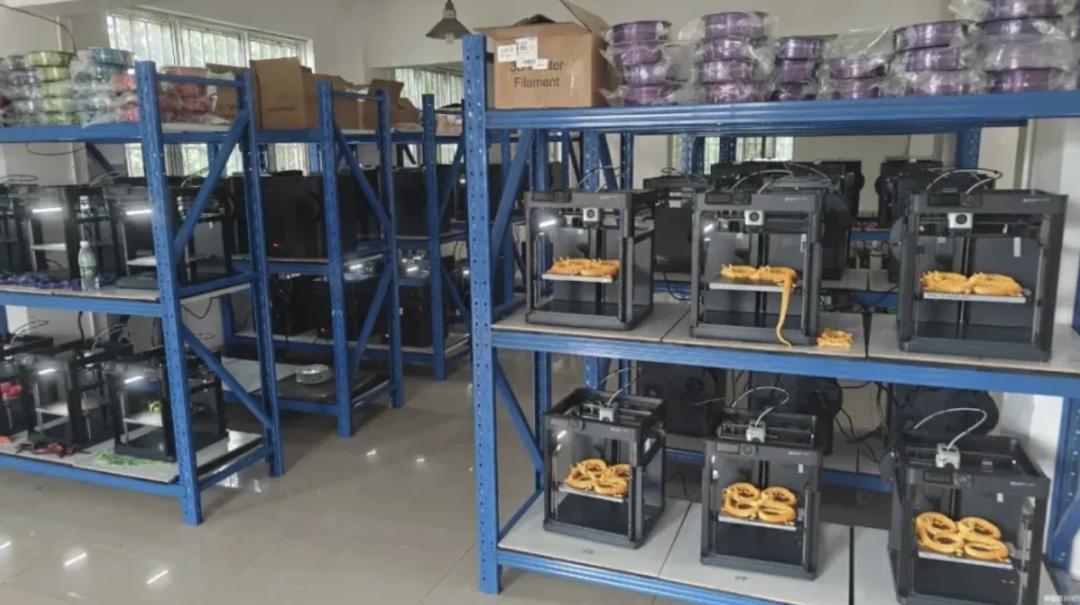
This model is extremely efficient. An operator only needs a computer or a mobile phone to monitor 500 devices simultaneously - it's clear at a glance which machine is out of materials, which one has an error, and which one has finished printing. With day and night shifts, 3D dragons are produced non-stop.
Take Jinqi Toys, a leading company in the industry, as an example. In 2025, they were operating 5,500 3D printers, covering an area of 10,000 square meters, with a daily production capacity of 30,000 pieces.
Other small manufacturers also have amazing production volumes. In a village in Deqing, Zhejiang, a young man named Ma Yanchao, who returned to his hometown to start a business, achieved an annual sales volume of over 20 million yuan with just 800 printers and only about 20 employees.
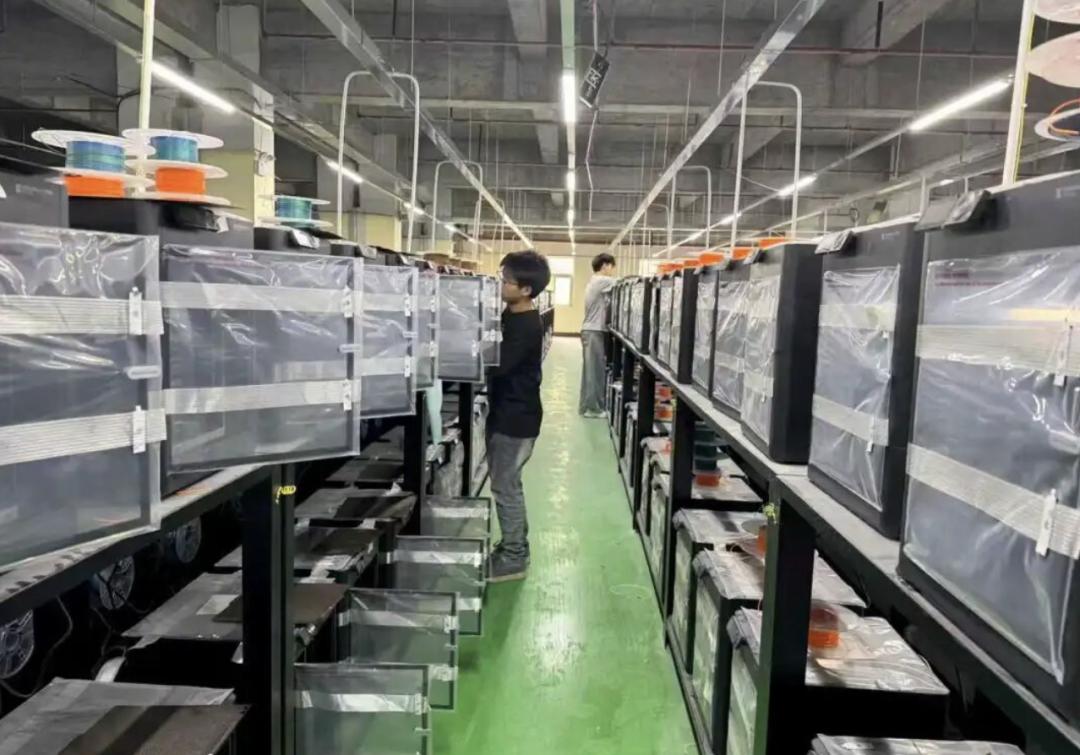
Huasu 3D Printing Farm | Shanghai Securities News
As mentioned before, a 1-kilogram PLA consumable of the TuoZhu brand costs about 60 yuan and can print 4 dragons. Just the material cost is 15 yuan. Coupled with electricity, equipment depreciation, labor, and venue costs, how can they not lose money selling them for 9.9 yuan?
Brand consumables do cost 60 yuan per kilogram, but the industrial-grade consumables purchased in large quantities by farmers can be priced as low as 30 yuan per kilogram or even lower. At this price, the material cost of one dragon drops to 7 - 8 yuan. Of course, some in the industry are worried that some ultra-low-cost consumables may use recycled materials or even non-compliant additives. The equipment is also in a competitive situation. An entry-level consumer 3D printer now only costs 1,000 - 2,000 yuan. Calculated based on a two-year lifespan and 20 hours of operation per day, the depreciation per product is only a few cents.
The profit of the 9.9-yuan dragons is indeed meager, but it's still possible to make money. Moreover, the business of these farms is not limited to domestic night markets.
About 80% of Jinqi Toys' orders come from overseas. The dragon you bought for $40 in Alaska probably came all the way from a factory in Zhejiang or Yiwu. Smart you, now you know how to make money.
Why Dragons in Particular?
From the previous radish knives and retractable swords to dragon eggs and 3D dragons, 3D printed popular toys have a common feature: they are all one-piece products with movable joints.
Traditional toy production mainly relies on injection molding. First, it costs hundreds of thousands of yuan to make a set of metal molds. Then, melted plastic is injected into the molds and cooled to take shape, and finally, it is assembled manually. This process is fast and cheap for toys with simple shapes, but it becomes extremely difficult when dealing with complex movable joint structures - each joint requires a separate mold, the assembly process increases exponentially, and the yield rate drops sharply.
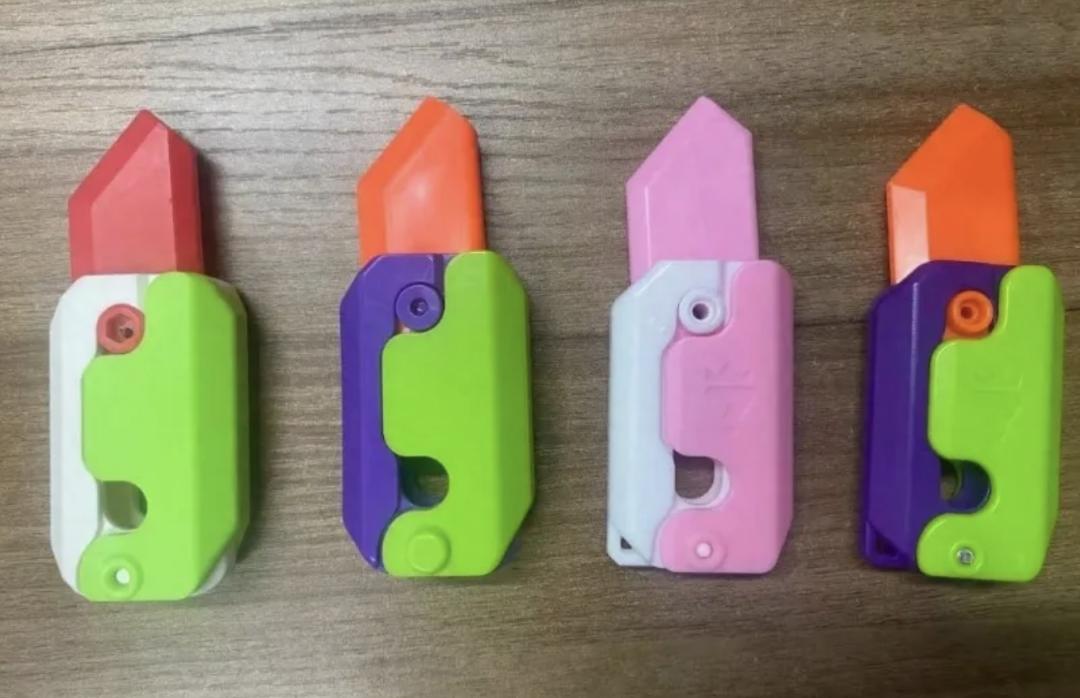
It's okay to talk about it online, but in real life, who doesn't want to swing a radish knife in a fit of anger
3D printing completely bypasses this problem. It uses FDM (Fused Deposition Modeling) technology, which heats and melts a roll of PLA plastic filament (polylactic acid, a degradable material extracted from corn starch) and then builds the entire model layer by layer. The gaps between the joints are reserved during the design stage. After printing, you just need to bend them a little to make them movable. It's a one-time molding process without the need for assembly. For a dragon with dozens of joints, only one operation is required from start to finish.
There is also an upgraded version of the dragon egg, which contains a movable little dragon inside, and the shell has a scaly texture - this nested structure is almost impossible to achieve with traditional molds, but for 3D printing, it's just a matter of designing a few more layers. Coupled with the blind box gameplay, dragon eggs were once sold out at the end of 2023, directly giving rise to a large number of 3D printing farms.
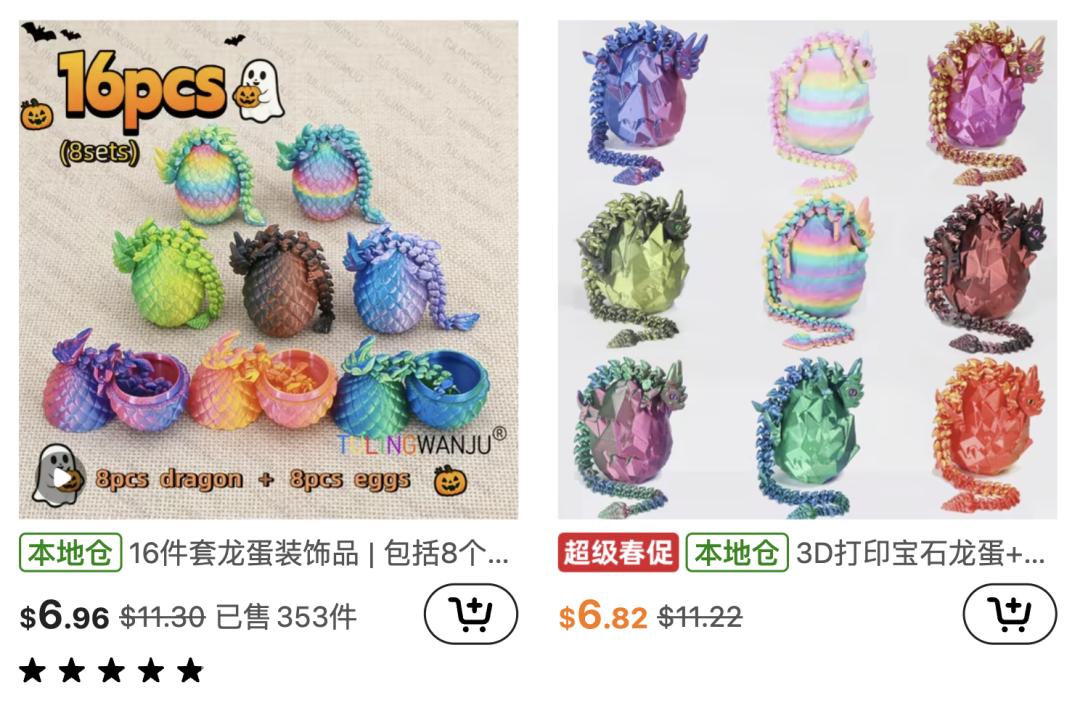
With both the dragon and the egg, it's more exquisite | Temu
In short, 3D printed toys target dragons because this is an area that injection molding can't handle.
Who on Earth is Buying Them?
Back to the question on Reddit - "Who is buying all these articulated dragons??" There are more than 600 comments below, and the discussion is in full swing.
The answer of a netizen was highly upvoted: "Kids. Kids are buying these. Seriously, there are about a dozen of them in different sizes and colors at my home." Another father's story is even more touching: "My son has Down syndrome and has been obsessed with anything that sways or hangs since he was a child. He's 14 years old now and can sit there playing with these articulated dragons for hours. For him, it's like a sensory toy for stress relief."
This is actually a hidden reason why 3D printed dragons have become popular. Essentially, they are excellent fidget toys (stress-relieving/sensory toys). The flexible joints of 3D dragons can be bent, twisted, and hung repeatedly, with a unique touch. For people with ADHD, anxiety disorders, or sensory processing disorders, they are a natural self-regulation tool. And for ordinary children, a wriggling rainbow dragon is cool enough on its own, not to mention there are alligator, sea monster, and salamander versions to collect.
3D dragons are also the reason why many people got into 3D printing. Many people admitted on Reddit that they bought a printer because their children saw a $50 dragon at a fair and thought it was too expensive - "Fifty dollars is enough to buy half a second-hand printer. I can just print it myself." As a result, once they got into it, they couldn't stop.
Before 2023, the total number of 3D printers in Chinese 3D printing farms was only a little over 9,000. Just two years later, Jinqi Toys alone plans to deploy 12,000. According to industry forecasts, the scale of global 3D printing farms may increase to 1.5 million units in the next five years. A machine only costs one or two thousand yuan, and the threshold is so low that almost anyone can enter - this is both an opportunity and a hidden danger.
The products are highly homogeneous. You sell dragons, and I sell dragons too. If you sell them for 9.9 yuan, I'll sell them for 8.8 yuan. The price war has pushed some farms to the verge of losses. The issue of material safety has surfaced. Intellectual property is also in a gray area. More than one post on Reddit pointed out that most of the dragon models sold at street stalls are sold without design copyright.
However, some farms have started to shift from selling dragons to selling capabilities - taking on customized small-batch orders, producing limited-edition peripherals for brand owners, and even building 3D printing laboratories for schools. The real potential of 3D printing may not lie in replicating ten thousand identical dragons, but in quickly bringing new designs into reality.
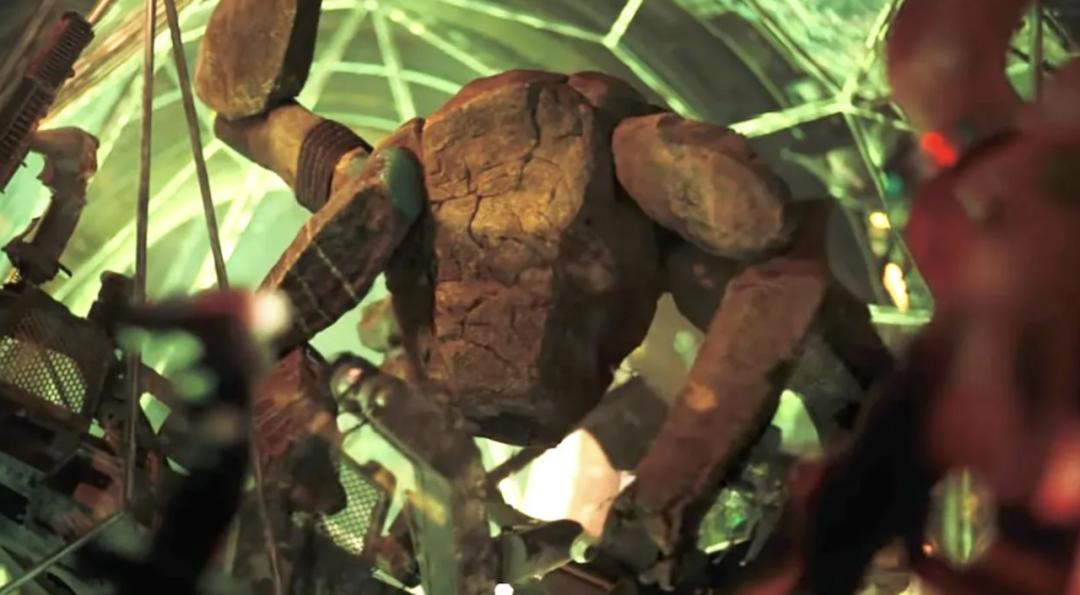
The most skilled 3D printing mechanic in the universe. Who dares to say that 3D printing can only make toys? | Project Hail Mary
References
[1] Nanji Xiong 3D Printing, "The large American farm with 2,700 3D printers is facing fierce competition from Chinese counterparts", https://mp.weixin.qq.com/s/SKWsM0hUU81dzfau3Jth7w
[2] messe frankfurt, "The popular 3D printing farms are 'rolling' out a new manufacturing format", https://formnext-sz.hk.messefrankfurt.com/shenzhen/zh-cn/press/casestudy/3DPrintFarm_CaseStudy.html
[3] Sangmin "Simon" Lee, "Formnext Asia Shenzhen 2025: When Boring Beats Brilliant", https://3dprint.com/320390/formnext-asia-shenzhen-2025-when-boring-beats-brilliant/
[4] Reddit r/3Dprinting, "Who is buying all these articulated dragons??", https://www.reddit.com/r/3Dprinting/comments/1fi73y1/
[5] Reddit r/3Dprinting, "What makes these dragons so popular", https://www.reddit.com/r/3Dprinting/comments/1jj7ujb/
[6] Reddit r/3Dprinting, "Holy 3D printing Dragons Batman. $50 each.", https://www.reddit.com/r/3Dprinting/comments/1nusjbc/
[7] Reddit r/3Dprinting, "What‘s your opinion on people selling these dragons?", https://www.reddit.com/r/3Dprinting/comments/1pdzzat/