Rushing to list in Hong Kong, why is XREAL in a hurry to go public?
In May 2025, Google unveiled an AR glasses at the Google I/O Developer Conference. This AR glasses, the world's first to be equipped with the Android XR platform, is regarded as a sign of Google's return to the smart glasses market after many years.
Alongside this glasses, a Chinese AR glasses company - XREAL - also made its debut. This AR glasses was jointly developed by XREAL and Google, and as a result, XREAL has received more attention.
In fact, by 2025, this company favored by Google had already achieved a certain scale in the niche market of AR glasses. Its high - end One series products launched at the end of 2024 gradually gained prominence, with sales exceeding 110,000 units in 2025. The company's revenue has been increasing year by year, and its losses have been continuously narrowing.
With the rise of the smart glasses market, the attention of capital, and the entry of cross - border giants, XREAL's popularity has further increased.
In 2026, XREAL first completed a Series D financing of $100 million, with a valuation reaching $1 billion. Subsequently, it initiated the IPO process. Everything seemed to be going smoothly.
Image source: XREAL's prospectus
However, behind the glamour, challenges cannot be ignored.
XREAL has had negative operating cash flows for three consecutive years, and the company's cash on hand has shrunk significantly. Although the high - end products have gradually gained popularity, the growth of the company's overall sales has almost stagnated.
In addition, can the "impossible triangle" of smart glasses be broken? Against the backdrop of the booming AI glasses market, how much potential does XREAL, which adheres to the AR market, have? When cross - border players flock to the smart glasses market, how much room for survival is there for independent hardware manufacturers?
These questions lie ahead of XREAL's listing journey, awaiting answers.
Cash - strapped XREAL
In XREAL's prospectus, we can see many positive signals.
From 2023 to 2025, XREAL's revenues were 390 million yuan, 394 million yuan, and 516 million yuan respectively, representing a 30.8% increase in 2025 compared to 2024. During the same period, the company's pre - tax losses were 882 million yuan, 708 million yuan, and 456 million yuan respectively, gradually narrowing.
The change in gross profit margin is one of the biggest highlights in XREAL's financial report. In 2023, this figure was only 18.8%. It rose to 22.1% in 2024 and soared to 35.2% in 2025, an increase of 13 percentage points from 2024 to 2025 alone, with a growth rate far exceeding that of 2024.
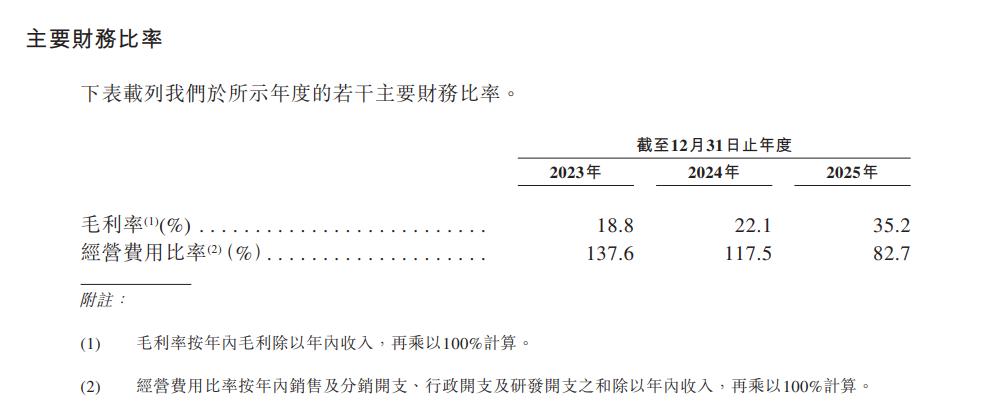
XREAL's main financial ratios. Image source: XREAL's prospectus
For a hardware company, a 35% gross profit margin is not low. For example, the gross profit margins of international hardware giants such as Apple and Sony mostly fluctuate between 30% and 45%.
According to a research report by Bank of America, the material cost of a pair of binocular AR glasses is approximately between $400 and $1,000, three to six times that of ordinary AI glasses. XREAL's ability to increase the gross profit margin from 18.8% to 35.2% is already a good achievement.
The significant increase in the shipment volume of the popular high - end products played a crucial role in XREAL's substantial growth in gross profit margin in 2025. Since the launch of the One series products in 2024, they have gradually become the main driver of the company's sales. In 2025, 111,400 units of this series were sold.
The financial report shows that the average selling price of the One series products in 2025 was 3,196 yuan, nearly twice as high as the 1,656 - yuan average selling price of the Air series.
On the one hand, the high - end products are selling well. On the other hand, XREAL's two non - hardware businesses also have good gross profit margin performances.
Among them, accessory products such as the Beam series computing terminals and Eye external camera modules contributed 72.74 million yuan in revenue in 2025, with a gross profit margin of 47.3%. The gross profit margin of the enterprise service revenue even reached 60.8%. Although the revenue amount was not large, only 40.3 million yuan, it was backed by in - depth technical services such as the joint development of Project Aura with Google and the customization of in - vehicle AR glasses for NIO.
All these mean that while the company's product strength is increasing, there are more than just hardware sales as a means of commercialization.
However, on the other side of the coin, XREAL is facing a cash shortage dilemma.
As of the end of 2025, the company's cash on hand was only 63.63 million yuan, nearly a 70% reduction compared to 205 million yuan at the end of 2024.
XREAL also admitted in its prospectus that the company has mainly funded its operating capital through cash from financing activities in the past. This means that even though XREAL has achieved an increase in gross profit margin through new products, it still cannot maintain the company's operations with the money earned from product sales.
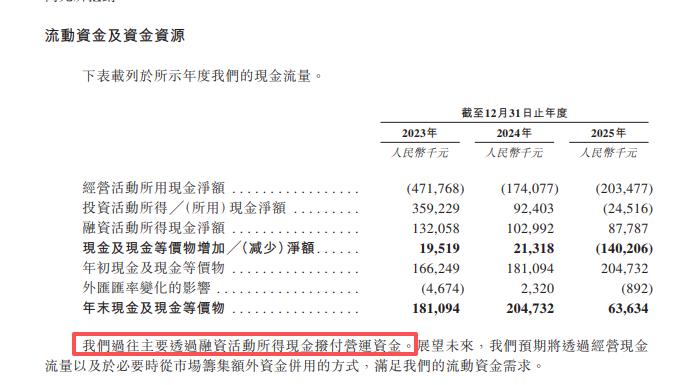
Image source: XREAL's prospectus
The net cash flow from operating activities more intuitively illustrates the problem of the company's insufficient hematopoietic ability. XREAL has had negative figures in this regard for three consecutive years: a net outflow of 472 million yuan in 2023, 174 million yuan in 2024, and 203 million yuan in 2025. The outflow amount in 2025 even further expanded.
In order to "save money", XREAL has been cutting expenses in the past three years. From 2023 to 2025, the company's sales and distribution expenses decreased from 214 million yuan to 131.7 million yuan. The administrative expenses in 2025 also decreased compared to 2024.
More importantly, this "technology - driven" AR hardware company has been reducing its R & D investment. The company's R & D expenses have continuously decreased from 216 million yuan in 2023 to 183 million yuan, and the proportion of R & D expenses in total revenue has also decreased from 55.3% in 2023 to 35.5% in 2025.
If XREAL's narrowing losses are not due to business expansion, the quality of this performance improvement may be questionable.
Perhaps it is precisely because of the tight capital situation that XREAL chose to submit its prospectus at this time. However, this real - world dilemma also lays a foreshadow for its listing journey.
Can XREAL Win the Favor of the Capital Market in Its Sprint for the Hong Kong Stock Exchange?
Judging from the company's short - term growth potential, XREAL has some grounds for confidence.
Market share is one of XREAL's strongest cards. According to data released by iResearch, in terms of sales revenue, XREAL ranked first in the global AR glasses market from 2022 to 2025.
XREAL also listed the market share rankings of the world's top five AR glasses companies in 2025 in terms of sales in its prospectus. Among them, XREAL's market share reached 27%, 10.9 percentage points higher than that of the second - ranked company.
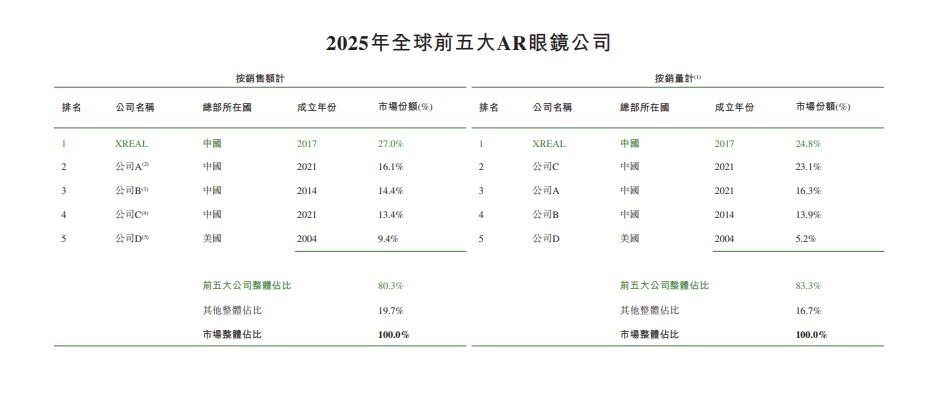
Ranking of the world's top five AR glasses companies in 2025. Image source: XREAL's prospectus
In the AR glasses industry, global rankings carry a certain amount of weight because consumers in markets such as Europe, America, Japan, and South Korea generally have a higher acceptance of AR glasses.
The performance of XREAL's overseas business is also one of its sources of confidence. In 2025, the proportion of the company's overseas revenue in total revenue reached 71%. Its overseas revenues from 2023 to 2025 were 255 million yuan, 260 million yuan, and 366 million yuan respectively.
More importantly, XREAL's global layout and popularity have attracted a reliable "big tree" - Google. Since last year, this international giant, which started to layout AR glasses as early as 2012 but has faced numerous setbacks, has been actively expressing its long - term cooperation intention with XREAL.
The official cooperation between the two parties was first announced in May 2025, when Google announced a deep - seated strategic cooperation with XREAL and jointly launched a new - generation AR glasses - Project Aura.
Recently, related news has become more frequent. In December 2025 (US time), Google demonstrated the AI glasses - Project Aura - jointly developed with XREAL in a live - streaming event. In January this year, Google announced again that it had renewed its multi - year strategic partnership with XREAL, and XREAL will continue to be the primary hardware partner of the Android XR ecosystem.
In addition to establishing cooperation, according to a report by 36Kr, people familiar with the matter revealed that Google plans to complete its investment in XREAL within this year to improve the Android XR end - to - end ecosystem and cope with the competitive challenges from Meta and Apple.
Beyond Google as a partner, XREAL's prestigious shareholder lineup also serves as a trust endorsement. Since the angel - round financing in 2017, XREAL has completed 12 rounds of financing, attracting participation from many institutions such as Sequoia Capital China, Hillhouse Capital, Alibaba, Kuaishou, and Shunwei Capital, with a cumulative investment of more than 2.3 billion yuan.
Just in January 2026, XREAL completed a Series D financing of $100 million. After the financing, the company's valuation reached $1 billion.
However, all these do not necessarily mean that XREAL will be favored by the capital market.
A core issue is that although XREAL's high - end products seem to have achieved an increase in sales, the company's overall user base has not actually grown.
From 2023 to 2025, the total annual sales of XREAL's AR glasses products were 137,200 units, 124,900 units, and 133,700 units respectively, fluctuating around 130,000 units in these three years.
Breaking down the sales of the Air series and the One series also reveals a situation of "internal competition" among XREAL's product lines. In 2024, the sales of the One series were 13,500 units, and the sales of the Air series were 104,000 units. By 2025, 111,000 units of the One series products were sold, while the sales of the Air series in the same period were compressed to 17,400 units, a decrease of more than 80%.
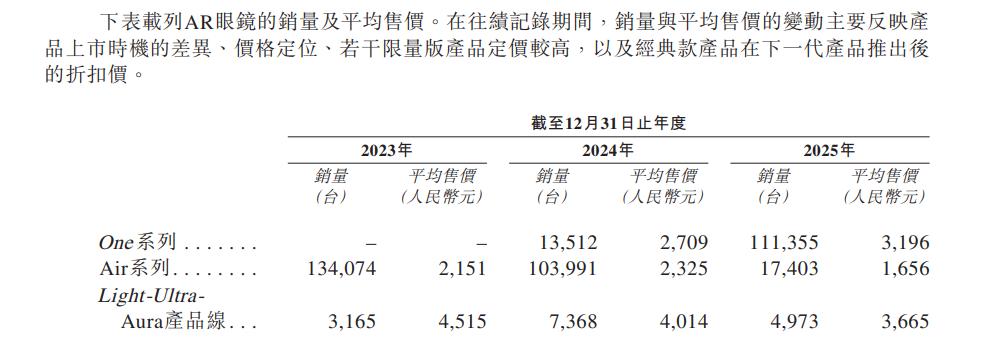
Sales volume of XREAL's various product series. Image source: XREAL's prospectus
The stagnant sales are one of XREAL's weaknesses in seizing market share. According to an iResearch report, in terms of sales volume, XREAL's market share in the global AR glasses market in 2025 was 24.8%, and the gap with the second - ranked enterprise with a 23.1% market share was not large. Its leading position in the industry is not stable.
Another challenge comes from the AI glasses market. After the explosion of large models, AI glasses have become the fastest - growing segment in the smart glasses market.
The latest data from Omdia shows that the global shipments of AI glasses reached 8.7 million units in 2025, a significant year - on - year increase of 322%. Among them, Meta accounted for 85.2% of the global market share with shipments of more than 6 million units. In the domestic market, the annual shipments of AI glasses were 950,000 units, a surge of 3,545% year - on - year.
However, XREAL is not interested in this emerging market. It has publicly stated more than once that it will adhere to the technical route centered on "AR spatial display". For example, Yang Shiqi, the CMO of the company, once said in an interview that at this stage, the company does not overly pursue cutting - edge concepts but focuses on the core market of AR glasses and concentrates its resources on optimizing optical technology and strengthening spatial computing capabilities.
This strategic determination shows that XREAL has a clear understanding of its own technical route, but it also means that XREAL may be marginalized in the more popular AI glasses market.
In addition, with the entry of cross - border enterprises represented by Alibaba, Xiaomi, and Huawei, the competition in the smart glasses market will become more intense. With the development of AI technology, hardware may only be an entrance for AI applications, and the competition in the industry will shift from display to operating systems, AI capabilities, and application ecosystems.
As an independent hardware manufacturer, although XREAL has established cooperation with Google, it is not clear whether it can break through in the ecological competition dominated by giants in the future.
Is This the Best Time for Smart Glasses Companies to Go Public?
From the perspective of the industry cycle, 2026 is very likely to be a turning point for the capitalization of the smart glasses industry.
In 2025, the smart glasses industry experienced a year of significant growth in both popularity and shipments. According to data released by IDC, in 2025, the global shipments of smart glasses were 14.773 million units, a year - on - year increase of 44.2%. Among them, the shipments in the Chinese smart glasses market were 2.46 million units, a year - on - year increase of