Earned 40,000 stars in a frenzy. Replacing OpenClaw is so satisfying. You can have an AI worker for just $5.
The strongest opponent of OpenClaw has arrived!
It is the open - source Agent artifact launched by Nous Research in February this year: Hermes Agent.
Nous Research claims it is an "Agent that grows with you."
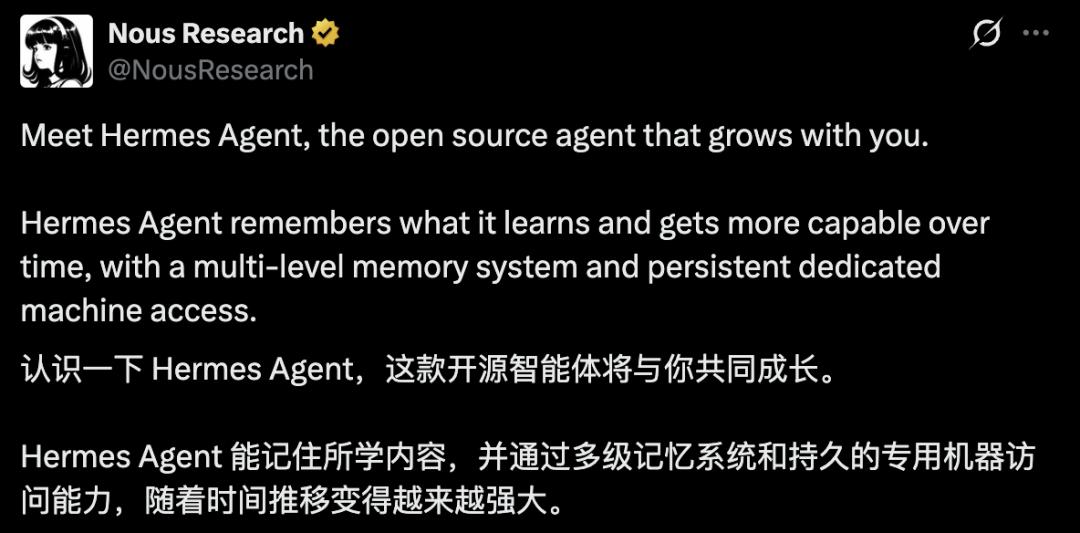
Hermes Agent has shown strong momentum since its launch.
Since its launch at the end of February, it has quickly exceeded 40,000 stars on GitHub. Currently, it has been iterated to v0.8.0, with an average of one major version release in less than a week. There are over 240 contributors, and the number of merged PRs has reached 1,400.
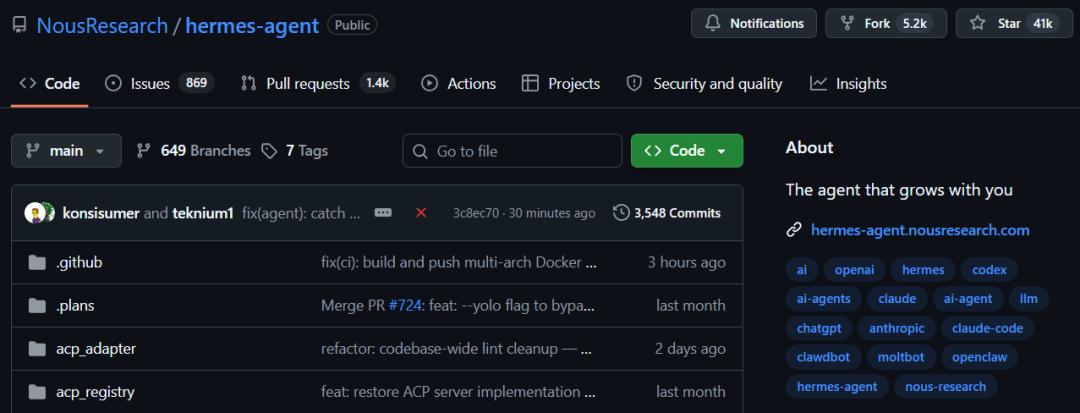
https://github.com/nousresearch/hermes-agent
Its update speed surpasses that of most commercial Agent products.
The community feedback has been enthusiastic, giving a strong impression of "replacing OpenClaw."

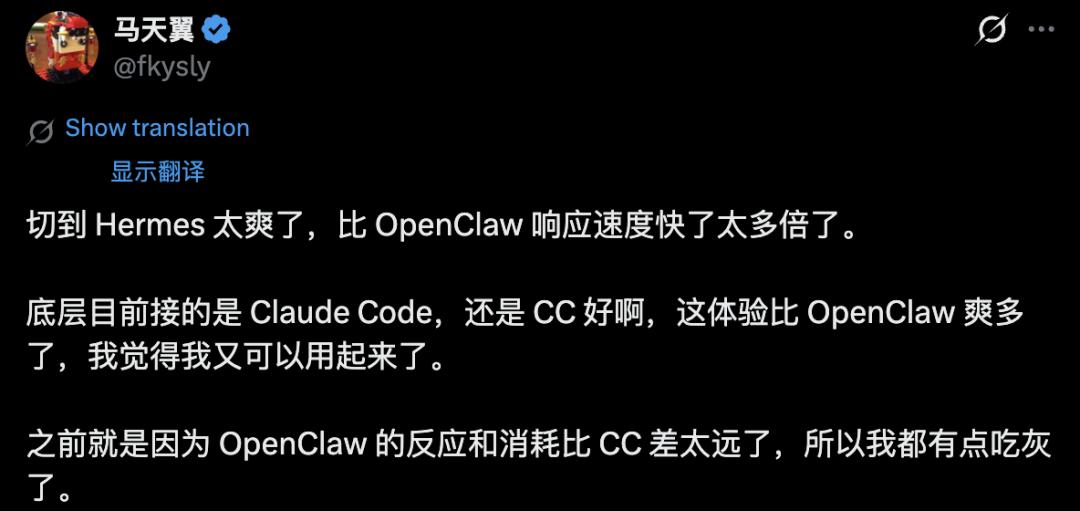
Some netizens said, "Switching to Hermes is so great. It responds much faster than OpenClaw."
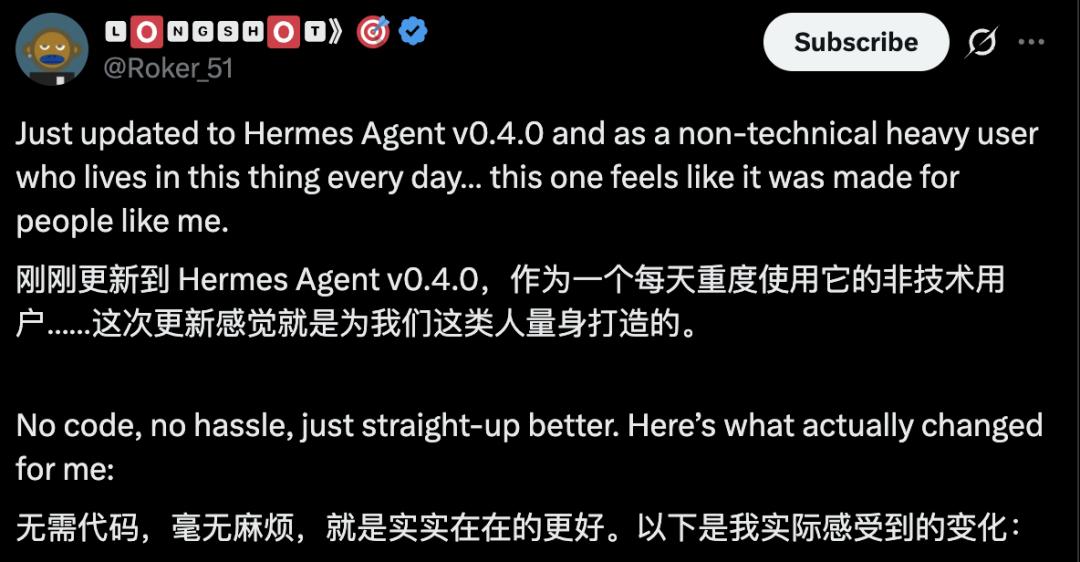
Some non - technical netizens felt that the update of v0.4.0 was tailored for them: "No code required, no hassle."
This autonomous Agent resides on your server
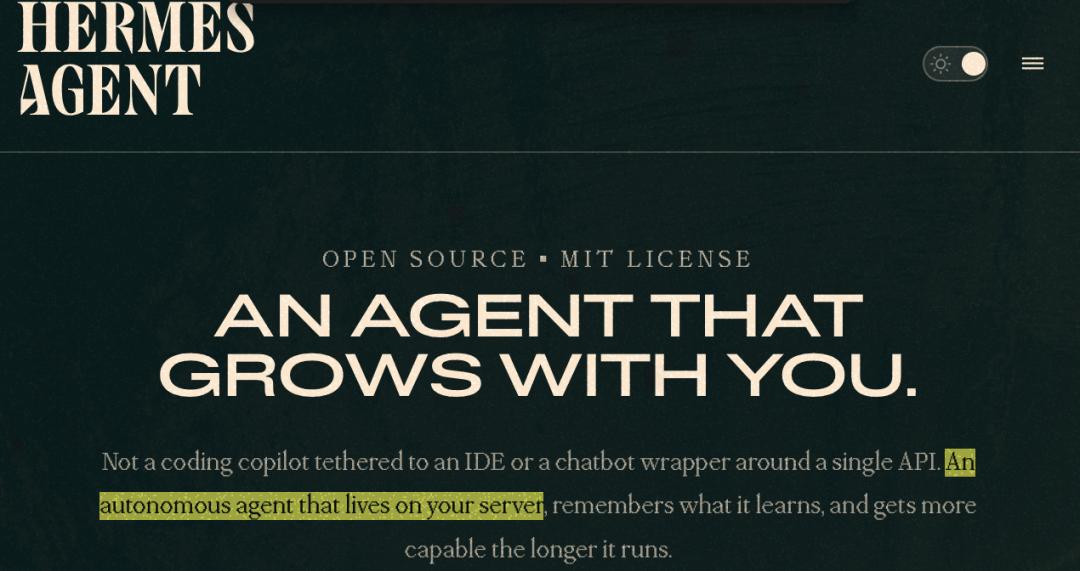
When Nous Research officially describes Hermes Agent, it calls it "an autonomous Agent running on your server."
https://hermes-agent.nousresearch.com/
"Running on your server" means it is a private AI deployed on your own terminal.
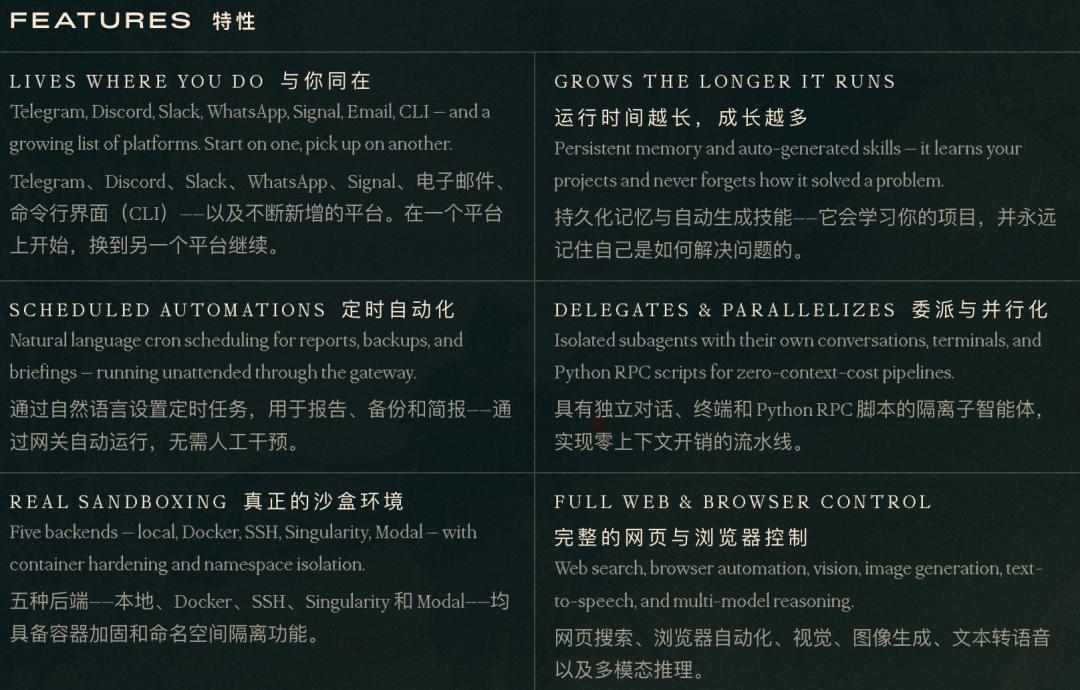
According to the official website, Hermes Agent has six core features: being with you, getting stronger with use, scheduled automation, delegation and parallelism, sandbox isolation, and full - web and browser control.
It can run on a VPS server that costs $5 per month, or on a GPU cluster, and costs almost nothing when idle.
You can talk to it through platforms such as Telegram, Discord, Slack, WhatsApp, Signal, SMS, Feishu, and WeCom. One gateway process connects all entry points.
Moreover, Nous Research is not just creating an Agent; they are building an entire ecosystem.
agentskills.io is an open skill standard, and the skills created by Agents can be shared across projects and communities.
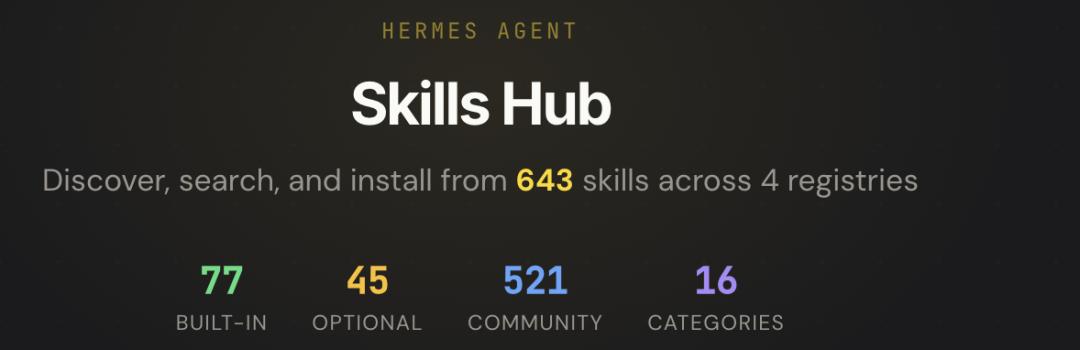
agentskills.io is an open skill standard launched by Nous Research, and the official also operates a Skills Hub for the community to discover and install skills.
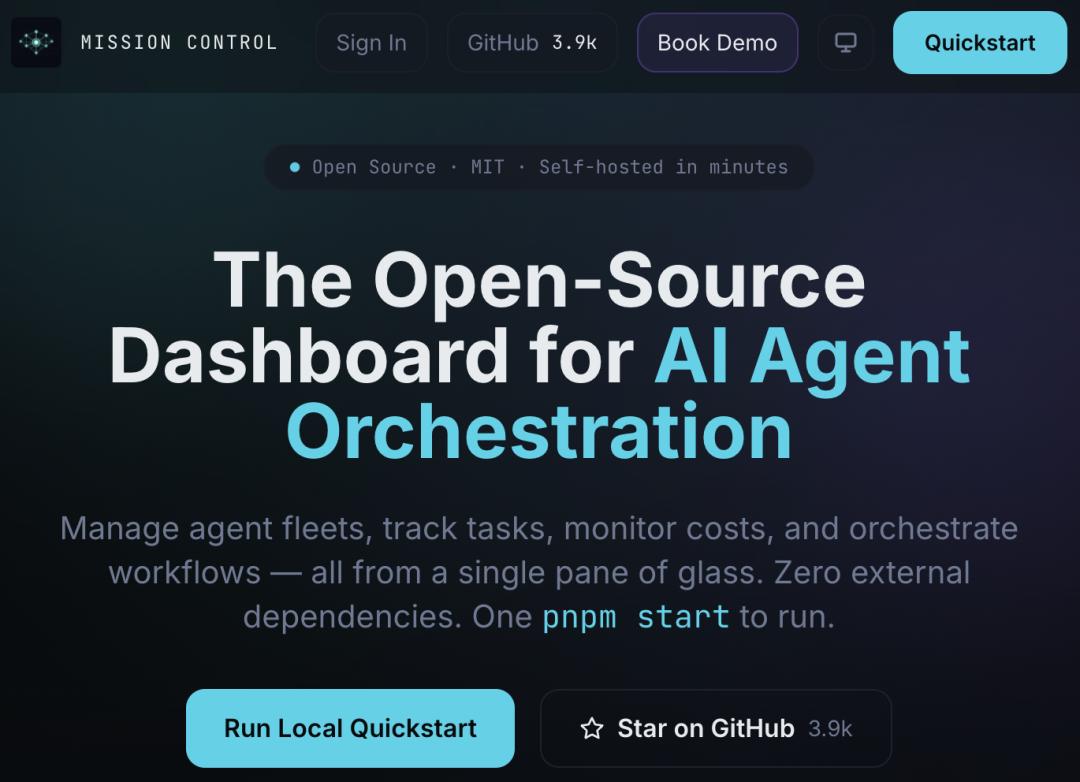
Around this standard, third - party communities have developed projects such as HermesHub (a skill marketplace with security scanning), hermes - workspace (a web - based GUI, a work from the Nous Hackathon), and mission - control (a multi - Agent management panel).
Jeffrey Quesnelle, one of the co - founders of Nous Research, even demonstrated using Hermes Agent to autonomously write a 79,000 - word novel across multiple iterative sessions without any human intervention.
Memory → Skills → Training data, a three - layer closed - loop
The skills of OpenClaw are maintained by humans, while the skills of Hermes Agent are maintained by itself, which is what makes it noteworthy.
A core concept of Hermes Agent is called "built - in learning loop."
It means that it can create skills from experience, improve skills during use, actively remind itself to save knowledge, search its past conversations, and build an increasingly in - depth user model across sessions.
Breaking it down, this closed - loop has three layers.
Layer 1: Memory.
The official memory mechanism of Hermes Agent includes the built - in MEMORY.md and USER.md, and supports cross - session retrieval and LLM summarization based on FTS5.
It can search for conversation content from a few weeks ago and load two core files at the beginning of each session: MEMORY.md records environmental information and historical lessons, and USER.md records your preferences and work habits.
Layer 2: Skills.
When the Agent completes a complex task (usually more than 5 tool calls), it will automatically write this experience into a structured skill file, including operation steps, common pitfalls, and verification methods.
The next time it encounters a similar task, it can directly call the skill without reasoning from scratch. Even better, if it finds a better way during the use of the skill, it will automatically update the skill.
Some Reddit users reported that after the Agent created 3 skill documents within two hours, the execution efficiency of repetitive research tasks was significantly improved.
Layer 3: Training data.
Hermes Agent has a built - in batch trajectory generation and Atropos reinforcement learning environment.
That is to say, the tool call records generated by the Agent in daily use can be directly used to train the next - generation model.
Memory precipitates skills, skills feed back into training, training improves model capabilities, and model capabilities return to the Agent.
This chain is what Nous Research really wants to make work.
What can Hermes Agent do?
Currently, the most common scenario is automated intelligence monitoring.
You only need to write a cron - like instruction in natural language, such as "Scan the new releases of these GitHub repositories every morning at 8 o'clock and send the summaries to my Telegram." The Agent will then continuously execute it unattended in the background through the gateway.
Some users have built an open - source AI trend daily report across Reddit and X based on it: automatically grab information every day, generate a structured morning report, and then push it to the mobile phone.
The second high - frequency scenario is "programming with memory."
For many developers, it is more like a programming partner that never forgets: it remembers the structure of your codebase, naming habits, deployment process, and historical context.
Combined with 6 terminal back - ends, you can let it work continuously on a cloud VM while you do other things.
What really excites the community is the Gateway itself.
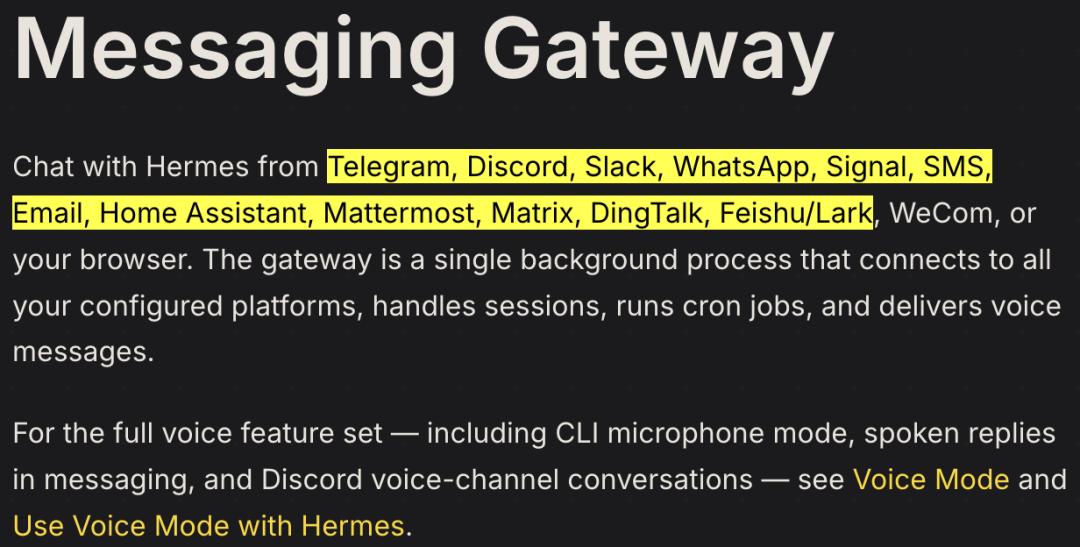
You can start a conversation on your mobile Telegram and seamlessly continue the conversation in the terminal when you get back to your computer. Send a voice memo, and it will be automatically transcribed and continue into the subsequent processing flow.
The same Agent, residing in the same process, can appear on all your platforms simultaneously.
At the architectural level, it has begun to support cross - framework Agent federated communication.
A Hermes Agent and an OpenClaw Agent can send messages to each other and delegate tasks.
The community is also promoting deeper multi - Agent collaboration: allowing multiple specialized Agents to form teams, divide labor, and share states.
It hasn't learned "self - evolution" yet
The current "growth" of Hermes Agent occurs at the skill and memory levels, not at the model parameter level.
It will not automatically fine - tune the model weights on your server, nor will it become "smarter" beyond the capabilities of the underlying model with use.
Its evolution is more like that of an experienced employee. It remembers what it has done, writes down the pitfalls it has encountered as SOPs, and executes tasks faster and more accurately next time.
However, the ceiling of the model itself still depends on the large model you connect to.
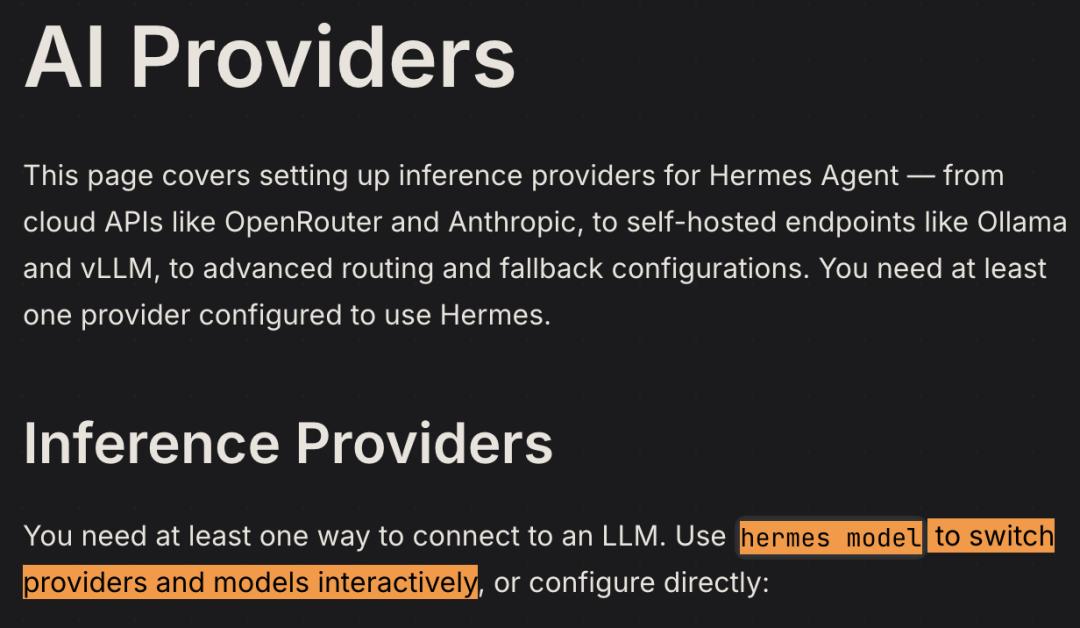
Hermes Agent supports multiple model sources such as Nous Portal, OpenRouter, OpenAI, Anthropic, Google Gemini, xAI, z.ai, Kimi, MiniMax, etc. It also supports local Ollama and any OpenAI - compatible endpoints, and you can switch models at any time through hermes model without being locked to any vendor.
The evolution route of Hermes Agent
The update directions of recent versions have clearly outlined the evolution route of Hermes Agent.
Version v0.5.0, released on March 28, 2026, was defined as a "hardening release," with the core keyword being security hardening: more than 50 security and reliability fixes, supply - chain audits, to lay a solid foundation for the entire system.
Version v0.7.0, released on April 3, 2026, was called a "resilience release," with the focus shifting to long - term operation ability, including a pluggable memory architecture, credential pool rotation, gateway race condition and approval routing fixes, and a systematic enhancement brought by a total of 168 PRs and 46 resolved issues.
With the release of v0.8.0 this time, this round of updates is named an "intelligence release," focusing on intelligence: automatic notifications for background tasks, real - time model switching, MCP OAuth 2.1, starting to further promote the "usability" of the Agent to "intelligence."
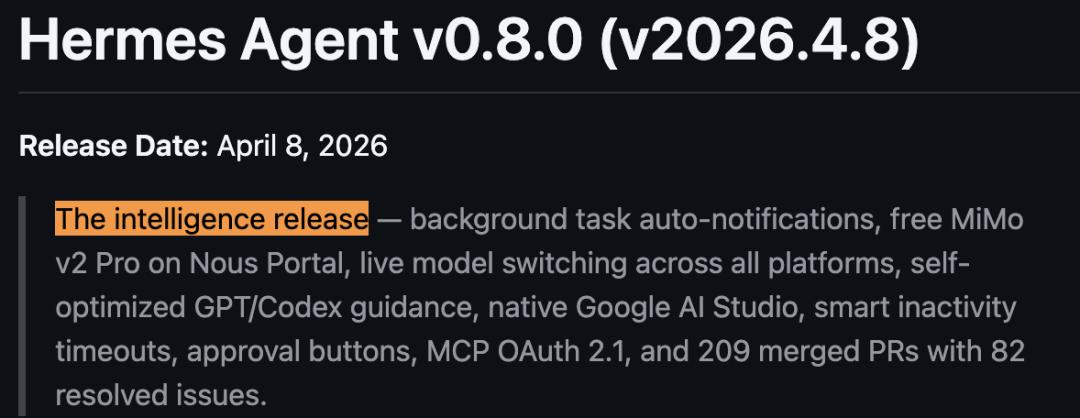
From security, to stability, and then to intelligence, this version evolution path itself reflects Nous' real judgment on the product form of the Agent.
They are well aware that for an Agent that needs to reside on your server 24/7, the biggest enemy has never been "not smart enough," but rather "crashing during operation," "credential leakage," or "gateway failure."
Long - term operation is the real engineering challenge for an Agent.
Get started with one command and $5
After talking about the architecture and route, how do you get started?
The official has made the installation entry into a standard command:
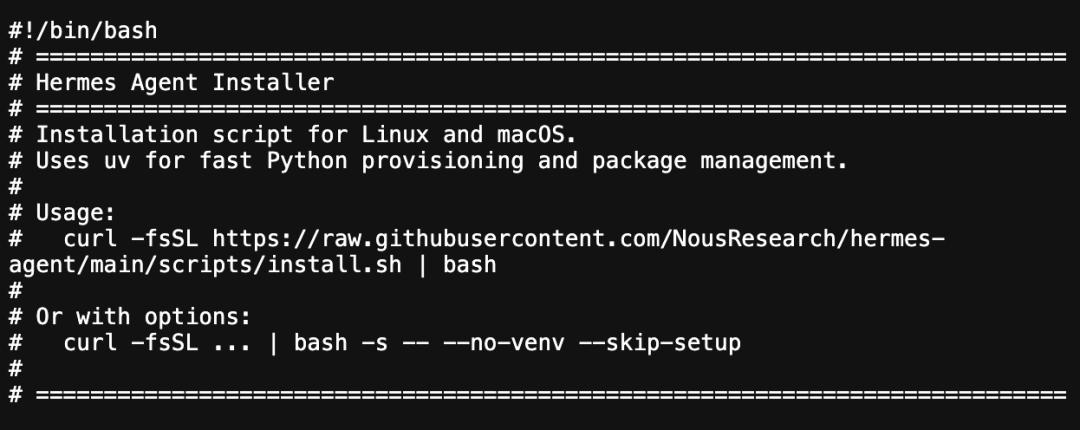
curl -fsSL https://raw.githubusercontent.com/NousResearch/hermes-agent/main/scripts/install.sh | bash
The most direct way is to rent a cheap VPS, SSH into it, and complete the installation with one command.
According to the instructions of the official installation script, this is the default entry for Linux and macOS users and the fastest way to get started.
After installation, run hermes setup to complete the initialization: select your LLM provider, enter the API Key, choose a model, and you can start the conversation.
Nous Portal, OpenRouter, OpenAI, and local Ollama are common choices