Price guarantee disputes damage reputation. Deepal still struggles to break out of the predicament despite monthly sales of 30,000 units.
A rights - protection WeChat group with more than 300 Shenlan car owners has been operating for over half a year. They all had disputes with Shenlan Automobile over the "price - protection agreement", and "silience" is one of them.
In March this year, netizen "silience" posted on Xiaohongshu, saying that when he purchased the rear - wheel drive Ultra+ version of the Shenlan S09 in May 2025, the salesperson presented a "price - protection agreement". The agreement promised that within a one - year price - protection period, "if the official guide price of the same model is lowered or there is a cash promotion, the price difference will be compensated."
However, just three months later, Shenlan Automobile launched a new version of the S09 with an upgraded battery capacity and charging power. It added a four - wheel drive Ultra+ long - range customized version and a rear - wheel drive ultra+ long - range version. The official guide prices were the same as those of the first - batch Shenlan S09 four - wheel drive Ultra+ customized version and the rear - wheel drive ultra+ version launched three months ago, starting from 309,900 yuan and 279,900 yuan respectively. On the basis of the same official guide price, the new Shenlan S09 increased the cruising range and added the 5C super - charging function.
When the car owner asked the salesperson for compensation according to the agreement, the request was rejected. The netizen said that the salesperson claimed that "due to the different battery capacities, it is a new model" and thus considered that the original price - protection commitment did not apply. This move was accused by the car owner of deliberately narrowing the definition of the "same model" and using standard terms to unilaterally avoid responsibilities. In the same month when the new model was launched, the old model was marked as "out of stock" and removed from the market, causing the value of second - hand cars to plummet.
Dianchang inquired with Shenlan Automobile's official customer service about this situation and received a similar response. The customer service said, "The long - range version launched in this upgrade is not the same model with the same configuration as the previously price - protected models, so it will not trigger the price - protection rights of other models."
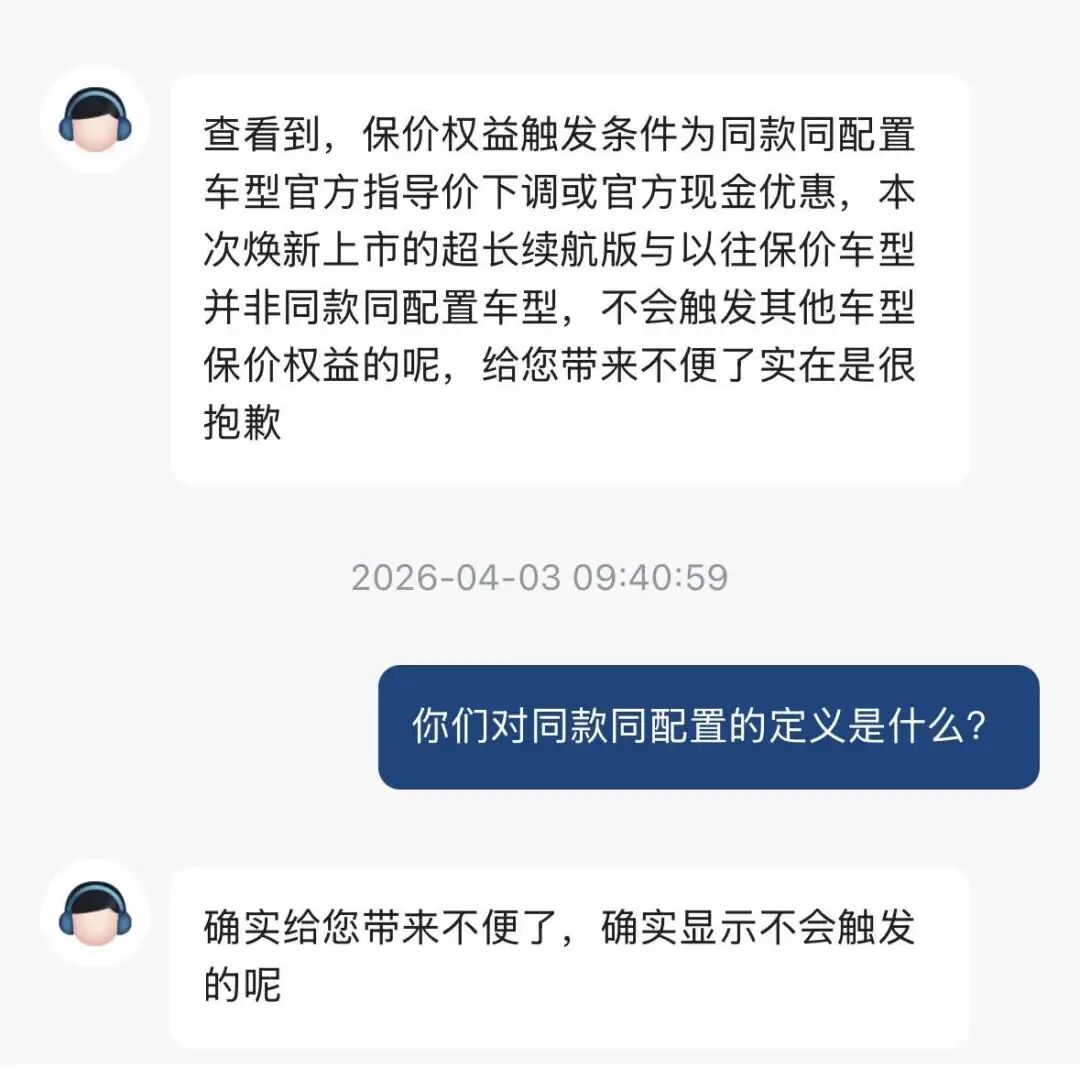
Image source: Screenshot of the Shenlan Automobile mini - program
Dianchang learned from the car owner that the name of the WeChat group he is in is "A group of Shenlan S09 car owners who have been betrayed". There are already more than 300 people in the group, all of whom own the same model and have similar experiences. Recently, some car owners in the group have expressed their intention to file a lawsuit.
Further investigation revealed that after the launch of the new Shenlan S09 last year, there had already been large - scale protests from old car owners, but Shenlan's official side had no definite solution. The netizen who posted the message said that since September 2025, he had repeatedly reported the problem through channels such as the 400 customer service hotline and the official APP, but had not received a substantial response.
Also in March this year, Shenlan announced impressive monthly sales results: global sales exceeded 30,000 units, a month - on - month increase of 87.8% and a year - on - year increase of 30%, just crossing the "break - even point" previously mentioned by Deng Chenghao, the chairman of Shenlan. Meanwhile, from the end of last year to March this year, Shenlan completed a financing of 6.122 billion yuan and introduced new strategic shareholders.
A series of Shenlan's actions reveal the anxiety of "caring about the present but neglecting the future", which is a common situation faced by many car companies in the industry. In the fierce elimination competition, even though Shenlan has reached the new milestone of monthly sales of 30,000 units, it still faces survival difficulties.
The price - protection agreement: a poisoned chalice
When Shenlan launched the price - protection commitment in May last year, it received a lot of praise from consumers. After experiencing multiple rounds of price cuts, consumers had already got used to the frequent fluctuations in car prices. At this time, a car company's promise of "one - year price - protection" was quite rare.
Different from the period when car companies collectively launched "price - protection policies" a few years ago, this time, few brands followed Shenlan's lead, and the price - protection period was usually only about three months, far shorter than Shenlan's one - year period.
The lukewarm response from the industry already indicates the problem to some extent: in the current automotive market environment, price - protection is not a good move.
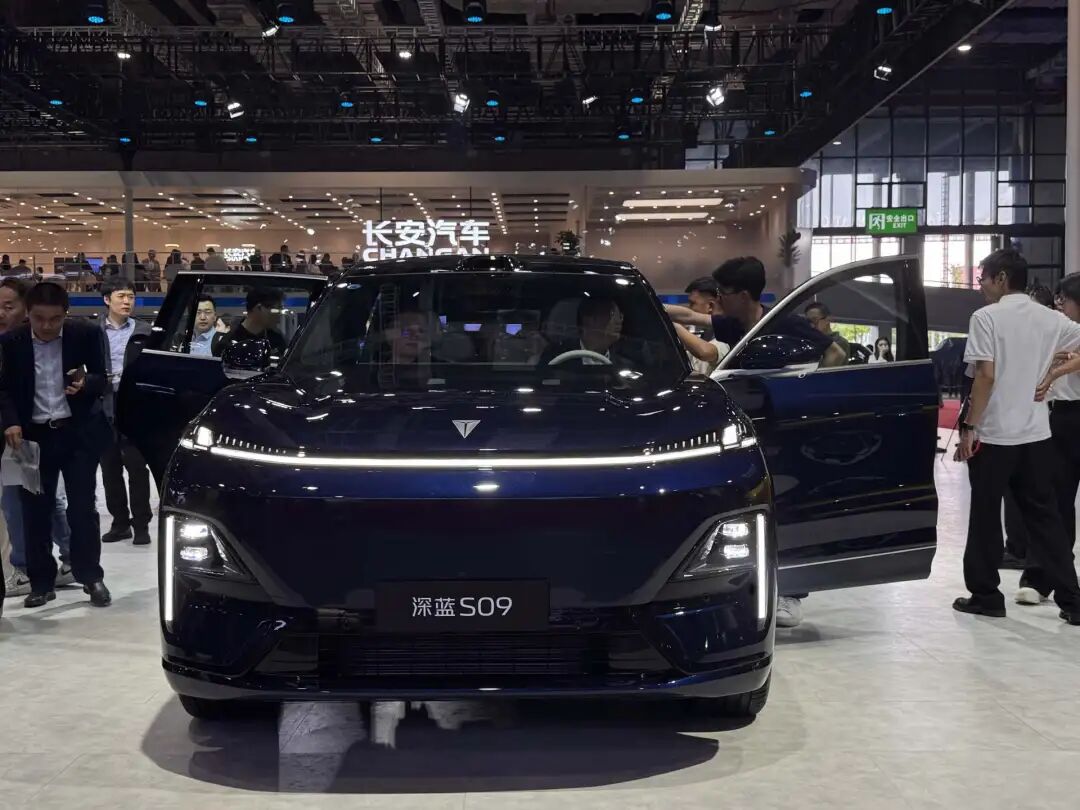
Image source: Photo taken by reporter Zhai Fangxue
On the one hand, the iteration speed of automotive technology has truly entered a stage of "rapid change every day". The assisted - driving system is continuously upgraded, the chip computing power is rapidly improving, and the super - charging power is constantly increasing. The update frequency of new models is much higher than before. Against this background, the product strength of old models inevitably declines rapidly, while the price - protection commitment almost locks the price adjustment space, which in turn accelerates the decline of the model's competitiveness.
Data from the Yiche model library shows that in 2025, a total of 1,278 new passenger car models (car series) were launched in the Chinese market, a year - on - year increase of 6%. On average, 3.5 new models were released every day. The overly fast iteration speed even forced the regulatory authorities to take action. In January this year, the Ministry of Industry and Information Technology issued new regulations, requiring traditional fuel - powered vehicles to complete a reliability driving test of no less than 30,000 kilometers during product access, and new energy vehicles to complete no less than 15,000 kilometers.
On the other hand, the price - protection agreement often does not become the decisive factor for consumers when purchasing a car, but once a dispute occurs, it will quickly turn into a brand risk.
The complaint analysis report released by the Chezhiwang shows that in 2025, the number of complaints against self - owned brands reached a new high, a year - on - year increase of 53.4%. The proportion of complaints exceeded 50% of the total for the first time, an increase of 8.3 percentage points compared with 2024. In terms of complaint types, more than 90% of the complaint points were concentrated on "disputes over the iteration of old and new models", which has become the core pain point of complaints against self - owned brands at this stage. Among them, some car companies that failed to fulfill their price - protection agreements were subject to concentrated complaints from consumers.
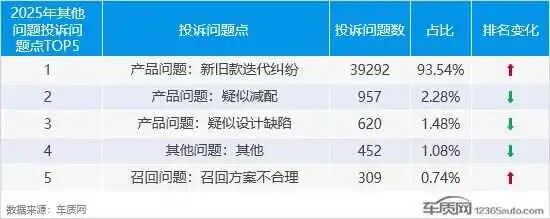
Image source: Chezhiwang official account
After entering the first quarter of 2026, according to Dianchang's search results, almost no brands of new cars launched in China have made price - protection commitments. This also shows from the side that car companies are not optimistic about future price competition.
Price cuts remain the main theme in the car market.
Data from the China Passenger Car Association shows that in March 2026, the promotion rate of new energy vehicles rebounded to 10.6%, at a medium - high level; the promotion rate of traditional fuel - powered vehicles reached 22.7%, and has remained at around 23% for nine consecutive months.
The profit margin is also continuously declining. From January to February 2026, the sales profit margin of the automotive industry further dropped to 2.9%, at a historical low, while this indicator was only about 4% for the whole year of 2025.
In such an environment, Shenlan is also hard to get rid of the cycle of trading price for volume, and is even more deeply trapped in it.
Many popular models of Shenlan, such as the S07, S09, SL03, and G318, have had public or disguised price cuts. Complaints around this issue are also common. As a result, the vehicle's residual value has declined. A Shenlan S7 owner said that Shenlan's rapid model replacement and price cuts made the second - hand car dealer who bought his car lose 6,000 yuan.
According to the China Automobile Residual Value Report for March released by the China Automobile Dealers Association, Shenlan models did not appear in the residual value lists of cars in various price ranges, sizes, and power forms.
After sacrificing profits, residual value, and the relationship with old car owners, Shenlan did achieve sales results. In March this year, Shenlan's global sales volume was 31,742 units, a month - on - month increase of 87.8% and a year - on - year increase of 30%. Deng Chenghao once clearly emphasized that "Shenlan Automobile can achieve profitability only when the monthly sales exceed 30,000 units."
In a sense, Shenlan has finally obtained the ticket to enter the next round of the elimination competition.
However, the evaluations from its car owners have inevitably declined. Comments like "I won't buy a second Shenlan car. It's not that the car is bad, but Shenlan's behavior is so ugly" and "The price - protection is like a joke. Shenlan is the king of betraying its customers" have emerged.
Crisis still exists despite monthly sales of 30,000 units; capital increase to cope with the elimination competition
Reaching the milestone of 30,000 units in monthly sales does not mean that Shenlan is out of the woods.
Looking at the sales structure, among the 31,742 units sold by Shenlan in March, 17,586 units were the entry - level model S05 in the 100,000 - 150,000 - yuan price range, accounting for as high as 55.4%. In contrast, the S09 and G318, which target the 200,000 - yuan - level market, have maintained monthly sales in the three - digit range for several consecutive months.
This means that Shenlan's current sales growth still mainly relies on the sales volume of low - priced models, and its overall profitability has not been significantly improved.
What's more complicated is that Shenlan's current price range not only overlaps with the brands within the Changan Group but also has a high degree of overlap within its own product line.
Within the Changan system, the prices of some models of Avita and Qiyuan are similar to those of Shenlan; within Shenlan, the L06, L07, and SL03 are also very similar in terms of size, power, and price range, which is likely to cause customer diversion at the sales end and even trigger internal competition.
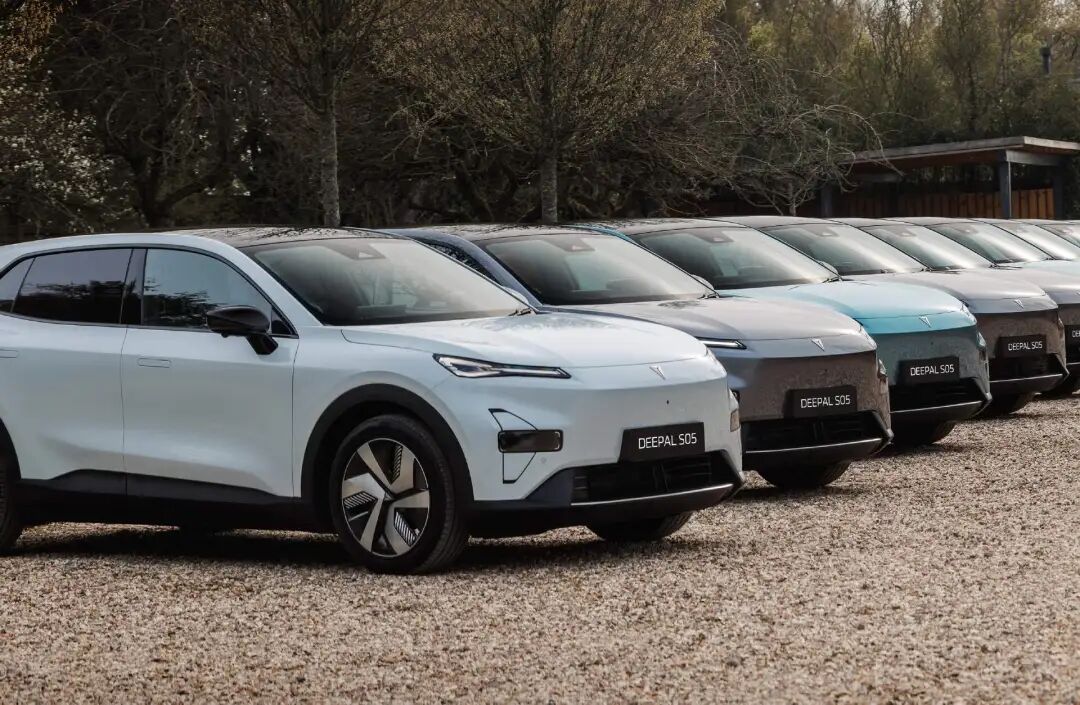
Image source: Shenlan official
The brand positioning also seems a bit wavering. Shenlan initially tried to target the mid - to - high - end market but then continuously lowered its prices; it once emphasized "high - value" design and then launched box - shaped off - road - style models. Now the brand promotes "Shenlan's super - extended - range technology on the one hand and Huawei's Kunlun intelligence on the other", but as the overall "Huawei factor" in the market continues to increase and Wenjie has absorbed most of Huawei's brand influence, the sales boost that Shenlan gets from its technical cooperation with Huawei is not obvious. For example, the Shenlan L07, which promotes "bringing the standard of high - level intelligent driving to the 130,000 - yuan level", has had monthly sales of less than 1,000 units for several consecutive months.
However, Shenlan is ahead in the field of L3 autonomous driving. In December 2025, the Ministry of Industry and Information Technology issued L3 - level highway autonomous driving access permits to two models, the Changan Shenlan SL03 and the BAIC ARCFOX Alpha S. These are also the first batch of domestic models to obtain relevant special license plates.
Many car companies are betting on L3, but they are still in the approval or testing stage, while Shenlan has taken the lead.
However, the commercialization of L3 still belongs to the future. Due to the unclear market demand and complex regulatory rules in different regions, brands including BMW and Mercedes - Benz have postponed the mass - production and implementation of L3. Deng Chenghao also said previously that currently L3 is still mainly in the exploration stage, and in the short term, it is mainly for B - end applications, and there is still a long way to go before large - scale sales to consumers.
But the capital market values the "future story" more. At the end of last year, Shenlan completed a Series C financing of 6.122 billion yuan, jointly invested by Changan Automobile, Chongqing Yufu Holdings Group Co., Ltd., and CMBC Financial Asset Investment Co., Ltd. This year, the registered capital of Shenlan Automobile Technology Co., Ltd. also increased from about 330 million yuan to 470 million yuan, an increase of more than 40%. Chongqing Yufu and CMBC Financial Asset Investment became the two new major shareholders.
Deng Chenghao said that this round of financing will be mainly used for the R & D of next - generation intelligent and electrified technologies and to further promote the brand's global layout.
Against the background of rising oil prices and policy promotion, the global penetration rate of new energy vehicles is still increasing. For Shenlan, the opportunity is right in front of it. However, before entering the next round of competition, it still needs to solve more problems beyond sales.
This article is from the WeChat official account "Dianchang", author: Zhai Fangxue. Republished by 36Kr with permission.