Yaosu Technology secures RMB 200 million in financing, integrating "AI + organ-on-a-chip" into the new drug development process
Text | Hu Xiangyun
Editor | Hai Ruojing
The pharmaceutical industry is one step closer to "saying goodbye" to animal testing.
Since the approval of the FDA Modernization Act 2.0 in 2022, the regulatory strategy of "replacing animal testing" has been ongoing. In mid-March this year, the FDA finally issued a statement, stating that it would start accepting non-animal data to support new drug reviews and encourage the use of new methodologies (NAMs) such as organoids/organ-on-a-chip and AI toxicology models to gradually reduce pharmaceutical companies' reliance on animal testing.
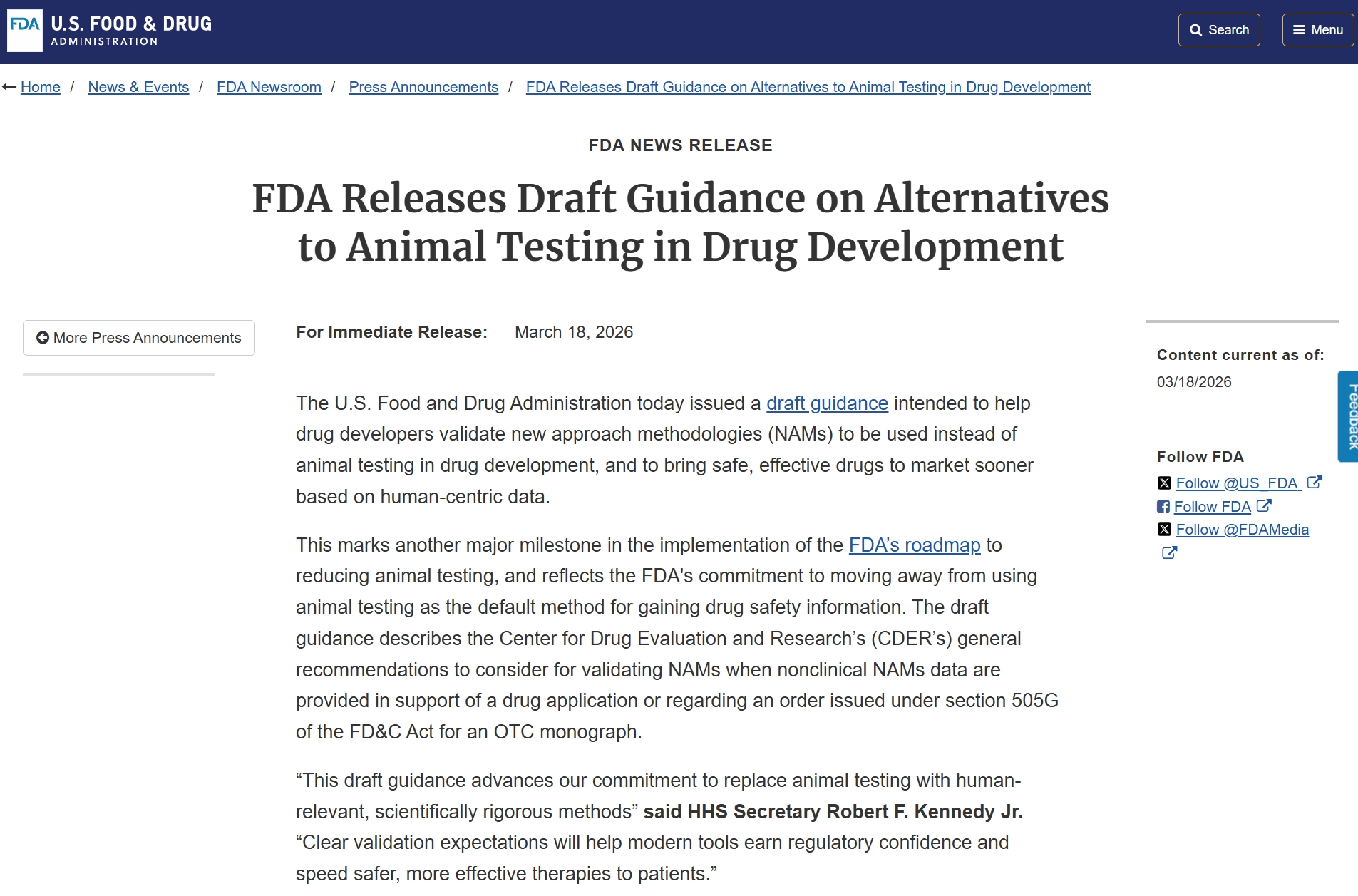
Image source: FDA official website
With the deepening of policies, the voice of organoid/organ-on-a-chip companies in the primary market has gradually increased. Just this year, at least five related companies have disclosed financing. For example, in early April, the AI for 3D Bioliogy platform company Yaosu Technology just announced the completion of a 200 million RMB Series A financing. This round of fundraising was exclusively led by China Life Equity, and old shareholders XtalPi, Yayi Capital, and Legend Capital increased their investments.
Xie Xin, the founder and CEO of Yaosu Technology, explained that the new FDA draft shows that regulatory authorities are actively lowering the early use threshold of new methodologies such as organoids/organ-on-a-chip. "This helps to accelerate the entry of new technologies into the real R & D process and complete data accumulation. In the future, our technology platform is also expected to directly enter the IND declaration system and become a standard tool in the new drug R & D process."
Previously, one of the major doubts about organoid/organ-on-a-chip companies in the pharmaceutical industry was whether their data could be recognized by regulators and truly used in new drug approvals. Now, the new FDA draft has, to a certain extent, dispelled the industry's concerns about regulatory uncertainty and also opened a key link for related companies to achieve real-world applications.
“This gives us a window period,” Xie Xin believes. “It allows organoid/organ-on-a-chip companies to first enter the real drug R & D process through cooperation with traditional pharmaceutical companies and quickly accumulate high-quality data and application scenarios.”
Previously, Yaosu Technology had already cooperated with multinational pharmaceutical companies such as Sanofi and Pfizer, as well as beauty companies such as L'Oréal and Winona, trying to apply organ-on-a-chip products to toxicity assessment and other links in the R & D of new drugs/skincare products, and the relevant cooperation has gradually "moved from the early verification stage to joint R & D or long - term cooperation." Thanks to this, in 2025, Yaosu Technology's "overall revenue will achieve an order - of - magnitude increase."
Meanwhile, in order to more flexibly explore the application potential of organ-on-a-chip products in scenarios such as personalized diagnosis and treatment and companion diagnosis, Yaosu Technology also jointly carried out relevant IIT clinical research with the Henan Cancer Hospital.
It is reported that the first study focuses on gynecological malignancies. As malignancies in the gynecological field, diseases such as ovarian cancer and cervical cancer are characterized by high heterogeneity, strong drug resistance, and high recurrence rates. Clinically, the main treatment methods are surgery combined with radiotherapy and chemotherapy, which have problems such as large individual differences in efficacy, obvious side effects, and common drug tolerance, resulting in less than satisfactory clinical treatment effects.
Therefore, if drug response data can be generated in a short time through organ-on-a-chip and AI image analysis technology, it may provide clinical doctors with efficient and intelligent personalized treatment references to assist them in making more accurate treatment decisions. "We also hope to build a higher-quality multi-dimensional database in this process to support the update of future diagnosis and treatment guidelines," Xie Xin said.
As of March this year, the study has enrolled 31 patients (the planned enrollment is 200) with recurrent and refractory gynecological tumors, covering various types such as cervical cancer and ovarian cancer. Data provided by Yaosu Technology shows that the success rate of drug sensitivity testing based on ascites organoids/chips is as high as 88.9%; in the cases with clinical feedback, the prediction accuracy reaches 100%.
In addition, from the perspective of platform technology iteration, the combination of AI and organ-on-a-chip models is the current development focus of Yaosu Technology. In essence, the organ-on-a-chip is an underlying engineering platform, and the more valuable thing is the biological data produced on this basis. If the value of these biological data can be deeply mined to empower the discovery of new targets or the R & D of new drug pipelines, it will naturally create greater commercial value for the enterprise.
In the past year, in addition to building a high-throughput and quantifiable disease model system and developing organ-on-a-chip models around key areas such as vascular toxicity and tumor microenvironment, Yaosu Technology has also focused on strengthening the construction of its AI team and computing capabilities, promoting the fusion modeling of multi-modal data (such as imaging, phenotypic, and molecular data), and initially forming a biological data understanding framework centered on graph learning and phenotype-driven analysis.
“At this stage, our focus is no longer on the single-point model ability, but on building an integrated closed-loop of ‘organ-on-a-chip + AI + automation’, and then creating a biological intelligence platform that can continuously generate data, understand mechanisms, and drive new drug discovery in reverse,” Xie Xin said.
It is also learned that Yaosu Technology will also expand the modeling capabilities of virtual organoids and virtual cells on the basis of the gradual maturity of data and models for more efficient screening, mechanism prediction, and target discovery. Currently, Yaosu Technology is in talks with some overseas leading virtual cell companies that have received billions of dollars in financing. "We hope to obtain high-quality human-derived data based on our organoid/organ-on-a-chip platform for their model training and verification."