The Great Transformation of NIO, XPeng, and Li Auto: Bowing to the Price War, Hard to Become the "BBA" of Electric Vehicles
"For NIO at present, survival is the most important thing." This was the helpless words uttered by Li Bin after the pre - sale price of the third - generation ES8 was significantly reduced.
Zhu Jiangming, the founder of Leapmotor, has been voicing the same view since 2024.
This seems to be the most direct and effective strategy in the industry at the moment.
Previously, NIO, which insisted on benchmarking against BBA, and XPeng, which once aimed to break into the high - end market, finally achieved a turnaround after launching low - priced cars and reducing prices through model upgrades. In contrast, Li Auto, which insisted on not reducing prices, is facing its darkest hour.
The "Wei Xia Li" (NIO, XPeng, Li Auto) have returned to the same starting line.
Price Concession, Sales Recovery
The year 2025 became a turning point for each of the "Wei Xia Li".
At the beginning of 2025, perhaps no one would have believed that Li Auto's sales volume would be surpassed by NIO and XPeng.
At that time, Li Auto set an annual sales target of 750,000 units, almost equivalent to the sum of NIO and XPeng.
However, the final result was that Li Auto only briefly led the "Wei Xia Li" in the second quarter and ranked last among the three in the fourth quarter. Its annual sales volume was only 406,000 units. Not only did it fail to meet the target, but it was also surpassed by XPeng.
In contrast to Li Auto, which started strong but ended weak, NIO achieved a remarkable turnaround. Its sales volume increased quarter - on - quarter for four consecutive quarters and led in the last quarter.
XPeng also showed a continuous upward trend. Although it lacked momentum in the fourth quarter, it finally became the company with the highest sales volume among the three in 2025 due to its stable sales performance.
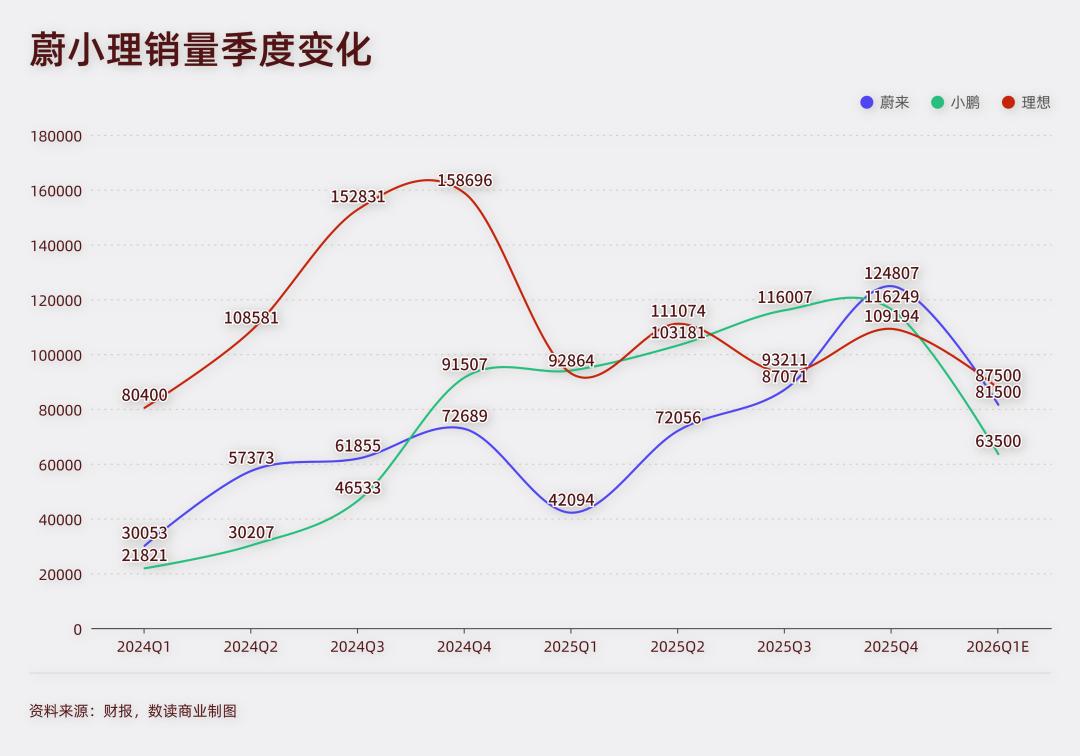
The key reason for the change in sales volume lies in the strategic divergence between Li Auto and NIO and XPeng.
In 2025, Li Auto launched two models, the i8 and the i6. After the setback of the MEGA, Li Auto's pure - electric vehicle development has not been smooth. Similar to the L6 before, the i6 is a key model for Li Auto to lower prices and boost sales. However, Li Auto priced the i6 at 249,800 - 269,800 yuan. In addition, it still did not venture into the price segment below 200,000 yuan.
In contrast, NIO and XPeng have made concessions.
In 2024, NIO launched the first model of its first sub - brand, the LeDao L60, with the price segment dropping to 219,900 yuan. By the end of the year, the third brand, Firefly, was launched, further pushing the price segment down to 100,000 - 200,000 yuan.
In the same year, XPeng, which had already been deployed in the 100,000 - 200,000 yuan price segment, also launched the MONA series, with the starting price further reduced to 119,800 yuan.
Price cuts mean an increase in sales volume, and increased sales volume further leads to revenue growth.
In 2025, XPeng's revenue increased by 87.7%, leading in revenue growth rate. NIO's revenue increased by 33.1%, while Li Auto's revenue declined by 22.3%.
Not only in terms of revenue, but also in terms of development indicators, Li Auto almost ranked last.
In Q4 of 2025, NIO achieved a single - quarter profit for the first time, with a net profit of 120 million yuan, ending consecutive losses. This was mainly due to the delivery volume reaching a record high of 125,000 units, and the scale effect diluted costs. In Q1 of 2026, the delivery volume increased by 98.3% year - on - year, and the scale effect was further magnified, and profitability is expected to continue.
XPeng made a profit of 380 million yuan in Q4 of 2025, also achieving a turnaround from losses to profits.
In contrast, Li Auto suffered a loss of 630 million yuan in Q3 of 2025 and barely returned to the break - even point in Q4, with a net profit of only 700,000 yuan. Its annual profit was only supported by the first half of the year.
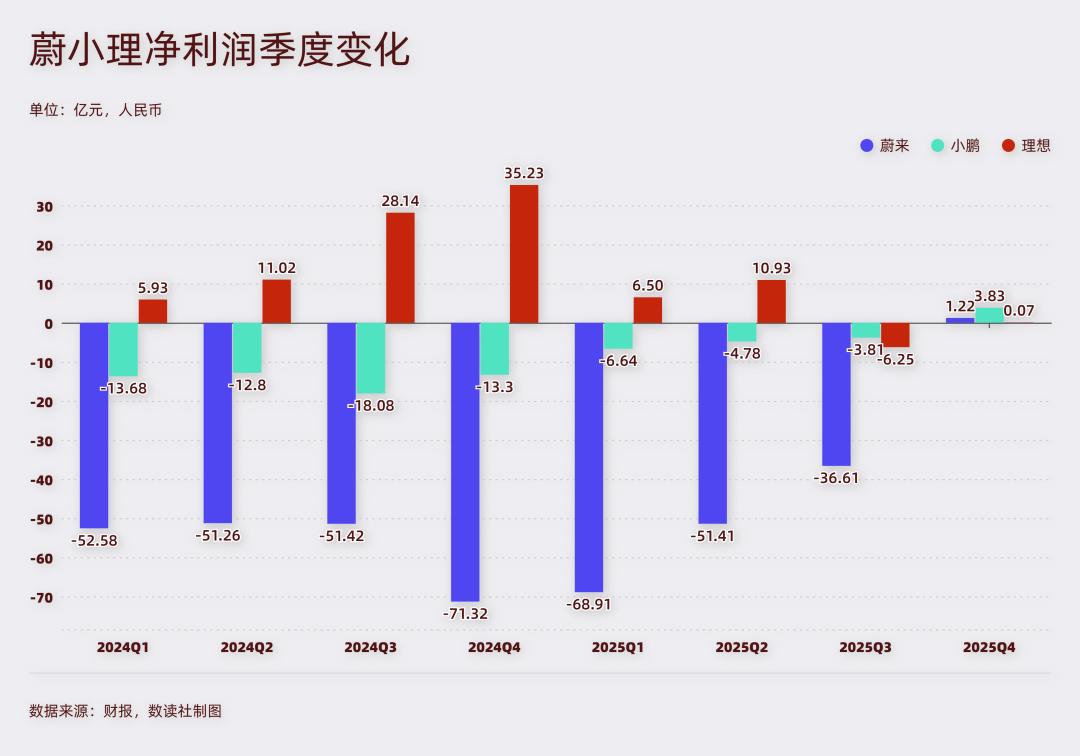
The year 2025 was a watershed: NIO and XPeng were in an upward - moving state, while Li Auto was in a quagmire.
As a result of the ebb and flow, in 2026, the three automakers returned to a stalemate. Li Auto is expected to sell 500,000 units annually, XPeng 550,000 - 600,000 units, and NIO between 456,400 and 489,000 units, with a small gap.
So much has changed in just one year. Why can exploring the lower - price segment bring about such a significant change?
Price Cuts Are Not a "Choice", but a "Necessity for Survival"
The key indicator of ASP (Average Selling Price) reveals the principle behind this phenomenon.
Automobile manufacturers have not announced the ASP, but by combining the automobile sales revenue and sales volume, a rough estimate shows that from 2021 to 2025, NIO's ASP dropped from 362,800 yuan to 235,800 yuan, a cumulative decrease of 35%.
XPeng's ASP dropped from 204,200 yuan to 159,200 yuan, a cumulative decrease of 22%.
The price cuts of these two automakers are not surprising. LeDao and Firefly lowered NIO's average price, and the price reduction of the MONA M03 also decreased XPeng's average unit price.
What is truly special is Li Auto. In the past two years, except for the i6, all the models it launched were high - priced models. However, its ASP still dropped from 288,800 yuan to 262,500 yuan, a cumulative decrease of about 9.1%. If we only look at the past two years, it has successively broken through the 270,000 - yuan and 260,000 - yuan thresholds.
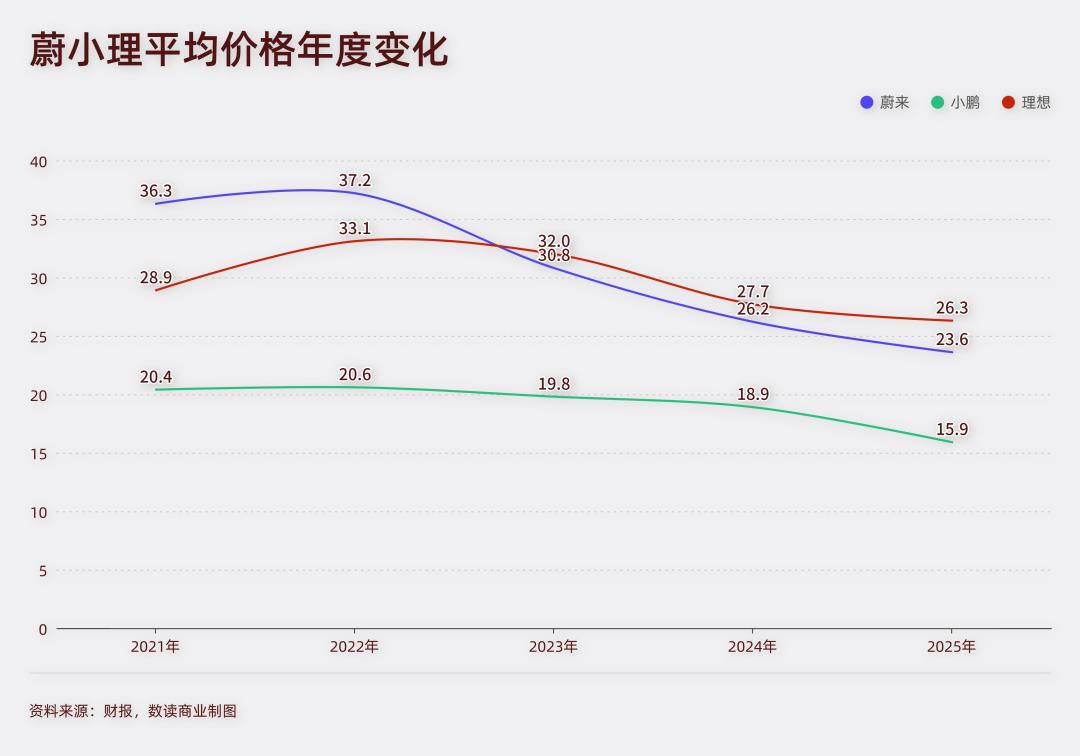
This shows that even though Li Auto tries to maintain its high - end positioning, users still prefer the lowest - priced models.
In the second half of 2025, Li Auto actually loosened its stance. In October, Li Auto carried out a disguised price cut on all models of the L series in the name of insurance subsidies.
Price cuts are one of the mainstream trends in the current competition among automakers. From 2024 to 2025, the price war continued to intensify. In 2025, the profit margin of the entire Chinese automobile industry dropped to 4.1%, the lowest in a decade, and new - energy vehicles were the hardest - hit area.
Considering the external competitive environment, traditional automobile manufacturers are also deploying across all price segments. Squeezed by well - known brands like Huawei and Xiaomi, it is difficult for the "Wei Xia Li" to maintain the price segments set at the beginning of their establishment.
When Li Bin said, "Survival is the most important thing", it indirectly confirmed the mainstream trend of price cuts to stay in the game.
Lei Jun once said that the key to true success is to go with the trend and find the right opportunity.
Obviously, in 2025, NIO and XPeng went with the trend, while Li Auto still adhered to the high - price segment, which was more like going against the trend. So the current situation is not surprising.
From the perspective of corporate management, price cuts do not necessarily mean "losing money".
Looking back at the performance in 2025, Li Auto's gross profit margin dropped sharply in Q3, from 21.5% to 16.3%, and slightly rebounded to 17.8% in Q4, but it was already lower than XPeng's.
XPeng, which lowered its prices, saw its gross profit margin continuously increase from 12.9% in Q1 of 2024 to 21.3% in Q4 of 2025. NIO's gross profit margin was also significantly restored, rising from 7.6% in Q1 of 2025 to 17.5% in Q4.
In 2025, Li Auto's gross profit margin fell below the 20% red line for two consecutive quarters, which was a red line that founder Li Xiang once valued highly. In contrast, XPeng exceeded the 20% mark for two consecutive quarters, and NIO also soared all the way, almost reaching the same level as Li Auto in the fourth quarter.
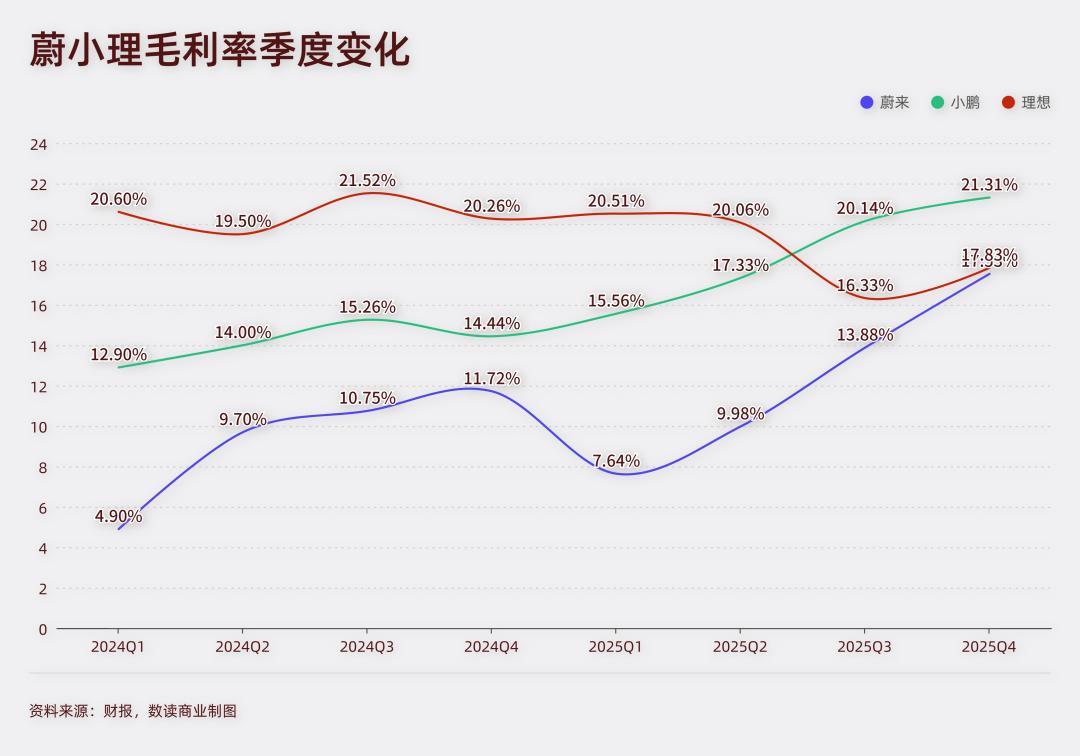
The key reason is that the increase in sales volume can dilute costs.
XPeng's annual R & D expense ratio dropped to 12.4%, a year - on - year decrease of 2.43 percentage points. The sales, general and administrative expense ratio dropped to 12.3%, a decrease of 4.56 percentage points.
After NIO's scale recovered, the R & D expense ratio dropped to 12.12%, a year - on - year decrease of 7.12 percentage points. The sales, general and administrative expense ratio dropped to 18.29%, a year - on - year narrowing of 5.56 percentage points.
Li Auto, once known for its cost control, had difficulty controlling its expense ratio. In 2025, its R & D expense ratio rose to 10.07%, an increase of 2.41 percentage points; the sales, general and administrative expense ratio was 9.5%, a year - on - year increase of 1.04 percentage points.
This shows that the layout in the lower - price segment is the easiest choice for the "Wei Xia Li" at present, and the price to pay is the brand image.
The "Wei Xia Li" Can't Be the "BBA" for Now
In their relatively short development process, the "Wei Xia Li" have all benchmarked against the "BBA".
He Xiaopeng said when upgrading the P7, "Let the sense of luxury no longer be exclusive to the BBA."
Li Bin once said when launching the administrative version of the ET7, "The market for administrative sedans is the core stronghold of the BBA. NIO is willing to take the lead."
Li Xiang proudly said as early as 2023, "With only three SUVs, we have exceeded the total sales volume of any BBA brand's SUV products in the Chinese market."
With the rise of Chinese new - energy automakers, the BBA is indeed in decline and can no longer maintain its prices.
In 2025, the sales volume of Mercedes - Benz, BMW, and Audi in China dropped back to a level close to that in 2017. The triple pressures of lagging electrification, insufficient intelligence, and the impact of domestic brands are forcing these century - old giants to accelerate strategic restructuring.
After the Spring Festival in 2026, the BBA collectively adjusted their prices. The BMW 7 Series had a maximum discount of 270,000 yuan, the entry - level Mercedes - Benz GLB dropped to 144,900 yuan, and some Audi A6L models had a discount of more than 150,000 yuan.
However, the decline of the "BBA" does not mean that the "Wei Xia Li" can take their place.
The core characteristics of the BBA are not only high prices but also brand premium, price stability, and not relying on price cuts to boost sales.
Facing the cruel competition in the high - price segment, the "Wei Xia Li" do not have enough brand - premium space.
NIO and XPeng exchanged scale for low - priced models, which is essentially a trade - off between "brand height" and "survival space". Although Li Auto did not actively lower its prices, it also could not maintain price stability in the price war. The decline in both sales volume and profits shows that it also does not have the same anti - pressure ability as the BBA in the past.
In addition, the research report on the depreciation rate of Chinese new - energy vehicles in February by the China Automobile Data and Research Institute shows that among the top ten pure - electric vehicles in terms of one - year depreciation rate, the "Wei Xia Li" only occupied two seats; they also occupied two seats in the plug - in hybrid vehicle category. In the three - year depreciation rate, the "Wei Xia Li" occupied 0 and 2 seats respectively. Their brand depreciation rate is not significantly higher than that of other automakers.
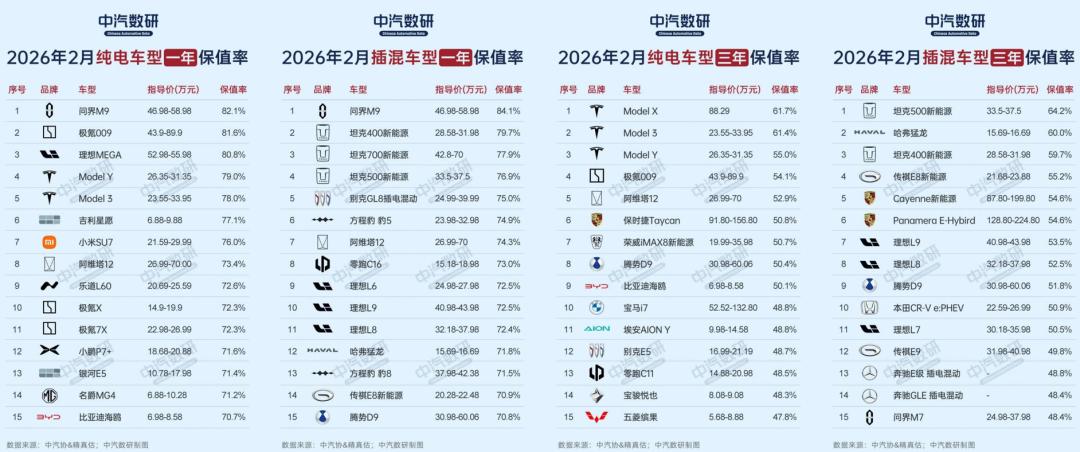
Facing foreign companies, traditional automakers, and newly - entered large - scale Internet brands, the "Wei Xia Li" are currently more focused on finding a way out rather than relying on their brands to maintain a stable position.
The way out for the "Wei Xia Li" is focused on a more grand narrative.
Li Auto and NIO still adhere to the main line of the automobile industry and improve the human - vehicle interaction experience through cutting - edge technologies such as AI.
Li Auto is betting on the narrative of AI and embodied intelligence.
On social platforms, Li Xiang frequently discusses his thoughts on the development of embodied intelligence. In the new - generation Li L9 launched in the second quarter, Li Auto may try to create an "experience gap" through AI and embodied intelligence. In Li Xiang's own words, it is to "build a truly intelligent and lively car."
NIO is more focused on the upgrade of the interaction experience brought by self - research capabilities.
At the beginning of this year, NIO established the Artificial Intelligence Technology Committee (AGI Committee). Li Bin elaborated on two directions of AI investment in an internal speech: one is to strengthen the full - stack R & D of intelligent driving; the other is to implement AI across the