Before the critical point: The chain reaction between nuclear energy and artificial intelligence has begun.
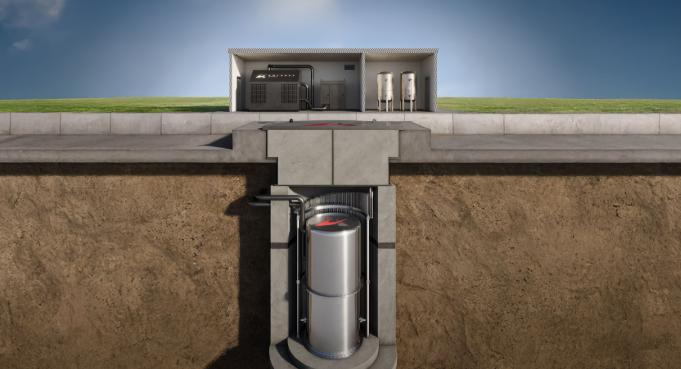
Conceptual diagram of the micro - reactor presented by Antares Nuclear Energy Corporation
On April 6, 2026, local time, Bob Boston, the head of the Idaho Operations Office of the U.S. Department of Energy, signed a document. There was no press conference and no cameras. It was simply a safety analysis approval document numbered DOE Standard 1271. The recipient was Antares Nuclear Energy Corporation, a California startup founded in 2023.
This is the first approved safety analysis document in the U.S. Department of Energy's Reactor Demonstration Program. Nine competitors are still in the queue, and Antares has passed this hurdle first.
Next is the readiness review, which will be held at the Idaho National Laboratory. The goal is to achieve a self - sustaining chain reaction by July 4. If successful, it will take less than three years for this company to reach criticality since its establishment.
01 Energy Hunger
Antares' Mark - 0 is a zero - power demonstration reactor. Its commercial design, the R1, has a power generation capacity between 100 kilowatts and 1 megawatt (a micro - reactor). What can this level of power do? It can supply power to remote military bases or meet the energy needs of certain NASA missions. However, it is far from enough to power a large - scale data center. Data centers require hundreds of megawatts, and Antares' micro - reactor is just a drop in the bucket.
The U.S. Department of Energy's Reactor Demonstration Program stems from four executive orders signed in May 2025. John Wagner, the director of the Idaho National Laboratory, calls it "the most aggressive nuclear energy deployment schedule in U.S. history": to quadruple the nuclear energy capacity from about 100 gigawatts to 400 gigawatts by 2050. Wagner said at a Senate hearing in March this year that Microsoft, Google, Amazon, and Oracle have all promised to invest in nuclear - powered data center infrastructure. Microsoft's 20 - year agreement with the Kairos Clean Energy Center is currently the largest one.
Data centers need hundreds of megawatts, not one megawatt. But what the tech giants really need are small modular reactors in the 50 - 300 megawatt range, as well as the restart of closed traditional nuclear power plants. Theodore Garish, the assistant secretary of the Department of Energy, gave the figure that just by increasing the reactor power, an additional 2.5 gigawatts can be added by 2027 and another 5 gigawatts by 2029.
Antares' micro - reactor does not directly serve data centers. Its value lies in paving the way for the entire industry.
02 Regulatory Process
On April 2, the U.S. Nuclear Regulatory Commission proposed a new rule: Reactor designs that have been authorized by the Department of Energy do not need to start from scratch when applying for a commercial license. The chairman of the commission, Christopher T. Hanson, put it simply: "If another federal agency has done the heavy lifting, the Nuclear Regulatory Commission won't make developers start over."
Traditionally, for a new reactor to obtain a commercial license, it must go through a long - term review by the Nuclear Regulatory Commission, which takes several years and costs hundreds of millions of dollars. For startups, this is a difficult hurdle to overcome. The new rule essentially acknowledges the principle of "one review, multiple applications."
Currently, 12 Nuclear Regulatory Commission staff members have been embedded in the Department of Energy's demonstration projects. According to the new rule, these interactions can be counted towards future commercial license applications. For companies like Kairos Power and Oklo that want to sell electricity to data centers, the path from demonstration to grid connection has become shorter.
There are a total of 11 reactor designs in the demonstration program, and four have passed the preliminary safety analysis: Antares, Radiant Industries, Ultra Safe Nuclear, and X - Energy. They use different coolants, fuels, and have different power levels. But they all face a common bottleneck.
03 Fuel Bottleneck
High - Assay Low - Enriched Uranium (HALEU) is required for most advanced reactor designs. Wagner made it clear at the Senate hearing that outside of Russia and China, there is no commercial - scale production capacity for high - assay low - enriched uranium. The projected demand by 2030 will far exceed the existing production capacity.
In January this year, the U.S. Department of Energy issued task orders worth a total of $2.7 billion to three enrichment companies - American Centrifuge Operating, General Atomics, and Orano Federal Services - $900 million each. However, the timeline for domestic production remains uncertain. Antares' fuel manufacturing started at BWX Technologies in October 2025, using high - assay low - enriched uranium allocated by the Department of Energy.
This means that even if Antares' Mark - 0 reaches criticality before July 4, even if the Nuclear Regulatory Commission's rules are finally implemented, and even if all regulatory obstacles are removed, the U.S. advanced nuclear reactor industry is still constrained by a fuel supply chain that is almost entirely dependent on foreign competitors.
04 Institutional Innovation
Antares has raised approximately $134 million in financing to date. The factory in Torrance, California, can produce a maximum of 10 micro - reactors per year. These figures are insignificant compared to the billions of dollars invested by tech giants. Antares' reactor will not directly power any GPU clusters.
However, the infrastructure it is helping to build - the simplified Department of Energy approval process, the shortcut for commercial licenses from the Nuclear Regulatory Commission, and the domestic high - assay low - enriched uranium supply chain - are all things that all reactor developers aiming for the 400 - gigawatt goal need.
The criticality goal on July 4 itself carries a certain symbolic meaning. Achieving a self - sustaining chain reaction on Independence Day is a very American image. But true independence, breaking away from overseas dependence in fuel supply, breaking the decades - long deadlock in the regulatory process, and catching up with global competitors in terms of commercialization speed, is still a long way off.
How far this path can be paved depends on whether policymakers in Washington, engineers in Idaho, capital on Wall Street, and power demand planners in Silicon Valley can work together in this newly launched system in the next few years.
The story of nuclear energy revival has been told in the United States for decades. This time, the infrastructure and capital finally seem to be in place. The gap in the fuel supply chain is the biggest remaining variable.
This article is written based on publicly available information and is for information exchange purposes only. It does not constitute any investment advice.
This article is from the WeChat official account "Jinduan" (ID: jinduan006). Author: Xuanyue. Republished by 36Kr with permission.