Break the monopoly? Intel joins Elon Musk's Terafab project to jointly manufacture chips.
On April 7th local time, Intel officially announced its participation in the Terafab project led by Elon Musk. It will join hands with Tesla, SpaceX, and xAI (the Musk ecosystem) to plan to build a brand - new chip manufacturing industrial system.
The Terafab project originated from Tesla's annual shareholders' meeting in November 2025. At that meeting, Musk first publicly proposed the idea of building his own chip factory, stating bluntly that the production capacity of traditional wafer foundries could no longer meet the explosive growth of computing power requirements of his companies.
With the popularization of Tesla's FSD autonomous driving technology, the advancement of Optimus humanoid robots, the rapid iteration of xAI's large - scale models, and SpaceX's exploration of space AI applications, the total number of AI chips required by the Musk ecosystem is increasing geometrically every year. Building a new advanced - process wafer factory requires an investment of $25 billion to $40 billion, and the construction period is as long as 3 to 5 years. Such a pace simply cannot meet the demand for in - house AI chips. Therefore, getting rid of the dependence on the external chip supply chain has become an urgent task for Musk.
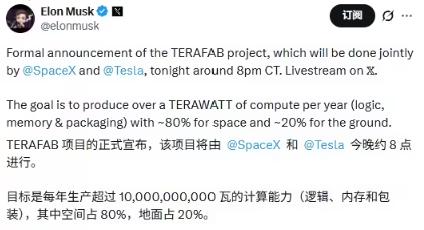
According to the original plan, the Terafab project is located in Austin, Texas, USA. It is positioned as the world's largest 2nm advanced chip factory, aiming to achieve an integrated layout of the entire chain of chip design, manufacturing, and advanced packaging, with an annual production capacity target of 100 billion to 200 billion chips.
In addition, the goal of the Terafab project is to achieve a computing power production capacity of more than 1 terawatt per year. This scale far exceeds the carrying capacity of ground - based power. Therefore, Musk proposed that 80% of the computing power production capacity will be used for the space computing power network, and the remaining 20% will be used for ground - based application requirements such as Tesla's autonomous driving and humanoid robots.
It is worth noting that Musk clearly defined the positioning of Terafab in the field of edge inference, not to replace NVIDIA's core position in large - scale data center training tasks. His companies will continue to purchase NVIDIA chips in large quantities, thus avoiding direct confrontation with industry giants.
01
Before Intel officially joined, the Terafab project was just a new pie drawn by Musk.
According to the investment estimates of TSMC and Samsung, the investment scale of a single 2nm wafer factory has exceeded $40 billion, and it also requires the purchase of core equipment such as EUV lithography machines worth more than $5 billion. The annual production capacity of global EUV lithography machines is only about 30 units, and the equipment delivery cycle is as long as 18 to 24 months. This means that even if the factory starts construction immediately, it will be difficult to achieve full - load operation before 2030.
In addition, there is a shortage of more than 100,000 engineers in the advanced - process field in the United States. Although Musk's companies have gathered a large number of top - notch scientific and technological talents, they lack the core technical teams and industrial experience in large - scale chip manufacturing and advanced packaging. Tesla's self - developed FSD chips still need to rely on TSMC for manufacturing to meet its own needs.
NVIDIA CEO Jensen Huang once publicly stated that advanced semiconductor manufacturing requires in - depth collaboration of technology, talent, and the supply chain, and it is "almost impossible" to catch up with TSMC. At this time, Intel's participation can just make up for these key shortcomings and provide the greatest support for the implementation of the plan.
As a former semiconductor industry leader, Intel has encountered obvious bottlenecks in recent years, and its market share has continued to shrink. TSMC's 2nm process was mass - produced at the end of 2025, and its monthly production capacity is expected to reach 140,000 wafers by the end of 2026, firmly occupying the leading position in the industry. Although Intel's 18A process entered risk production in early 2026, it only received small - batch orders from Microsoft's cloud computing department, with a monthly production capacity of less than 5,000 wafers, and large - scale implementation was hindered.
In terms of market share, in the global advanced - process foundry market in 2025, TSMC accounted for 62%, Samsung accounted for 21%, while Intel only accounted for 3%, deeply trapped in the embarrassing situation of "having technology but no orders".
In contrast, the total number of AI chips required by the Musk ecosystem will exceed 1 billion per year, and it will maintain a growth rate of more than 30% in the next five years. This can not only provide Intel with stable long - term orders but also become a key application scenario for the large - scale implementation of its 18A process and a core bargaining chip for it to seize the future AI computing power foundry market.
Intel CEO Pat Gelsinger has high hopes for this cooperation. This senior executive with rich semiconductor industry experience said that the Terafab plan will completely transform the global chip manufacturing model. Intel will give full play to its core advantages in the large - scale design, manufacturing, and packaging of ultra - high - performance chips to help Terafab achieve its annual computing power target of 1 terawatt as soon as possible.
In fact, in addition to providing ready - made technology and production capacity support, Intel's mature custom chip development services will also create exclusive chips for Tesla, SpaceX, and xAI, further deepening the cooperation between the two sides and achieving mutual benefit and win - win results.
02
Currently, the cooperation between the two sides is still in the initial stage of promotion. Only an official announcement has been released on the X platform. No official press release has been issued, and no relevant filing documents have been submitted to the US SEC. Core details such as the cooperation framework, responsibility division, and legal constraints have not been disclosed to the public.
Some industry insiders said that for the ambitious Terafab plan, the most feasible cooperation path is to integrate the self - owned factories of the Musk ecosystem and Intel's production capacity resources to build a collaborative and efficient supply chain system. After the initial cooperation is successful, the two sides can jointly invest in building factories and unify the process technology to precisely match the explosive growth of computing power requirements of the Musk ecosystem.
Therefore, this computing power revolution still faces many uncertainties. Whether the radical goals of the Terafab plan can be achieved as scheduled, whether the cooperation between the two sides can be smoothly promoted, and how to break through the bottlenecks of funds and talents all need time to test.
However, it is undeniable that the alliance between Intel and Musk is likely to inject new vitality into the semiconductor industry monopolized by giants.
This article is from the WeChat official account "Meku.com". The author is Meku.com. It is published by 36Kr with authorization.