When He Xiaopeng said, "The automotive industry is not a good business."
Cars may not be a good business. However, judging from OpenAI's shutdown of Sora, generative AI and physical AI have not yet become profitable businesses as expected. NVIDIA's success seems to be a perfect mirror image of CATL's in the AI industry.
Is the car business a good one?
On April 2nd, during the media communication session after the first official upgrade of the Mona M03, when asked why the Chinese name of the company was changed from "XPeng Motors Co., Ltd." to "XPeng Group", He Xiaopeng said straightforwardly, "I think current car companies don't have a good business model. They are all in a highly competitive and involuted mode."
This statement stirred up a wave.
By the end of the first quarter of 2026, the 2025 financial reports of 12 Chinese car companies had been released. These include six traditional car brands - Geely, BYD, Great Wall, SAIC, GAC, and Chery, as well as new - energy car startups like NIO, XPeng, Li Auto, Xiaomi, Leapmotor, and Seres.
Among the new - energy car startups, only Leapmotor and Li Auto achieved full - year profitability, and Seres performed relatively well. Although NIO and XPeng released their best - ever financial reports, they still fluctuated around the break - even point.
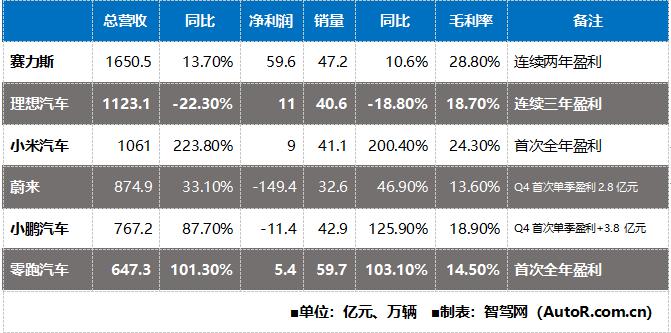
Comparison of revenues of new - energy car startups in 2025
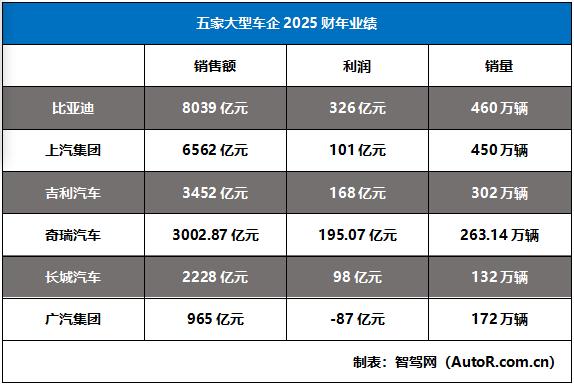
The performance of the six traditional car groups was also worrying. BYD, which had been booming in the past two years, saw its net profit in 2025 drop significantly by 19% to 32.6 billion yuan, showing a decline for the first time in three fiscal years. Its gross profit margin in the domestic market was only 17%, and the average unit price of passenger cars decreased for three consecutive fiscal years.
The per - vehicle sales revenue of Geely Automobile Holdings decreased by 8% year - on - year. GAC Group suffered losses for the first time since its listing in 2010, with a loss of 8.7 billion yuan and a 14% year - on - year decline in sales volume.
Data released by the China Association of Automobile Manufacturers showed that the average selling price of passenger cars in China in 2025 was 170,000 yuan, an 8% decrease compared to 2024. On one hand, the production cost increased; on the other hand, the selling price dropped. All car companies were caught in the awkward situation of increasing sales volume without increasing revenue or having to adopt the "low - profit, high - volume" strategy.
In contrast, the joke that "car companies are working for CATL" became more real. CATL's net profit attributable to shareholders in 2025 reached a staggering 72.201 billion yuan, a year - on - year increase of 42.28%, far exceeding the total net profit of Chinese car companies.
In 2025, the net profit margin of China's automotive industry remained between 2% and 3%, roughly the same as the bank deposit interest rate.
The statement "The car business is not a good one" resonated widely in the industry.
Meanwhile, German luxury brands like BMW, Benz, and Audi, as well as Japanese carmakers Nissan and Honda, also fell into a cycle of losses and layoffs.
In the bustling and chaotic Chinese car market, there were nearly 50 new car launches in March, almost two per day.
During the media communication session, He Xiaopeng's opening remark to the journalists was, "Tired? That's normal."
If the car business is not a good one, then what is?
He Xiaopeng said that just focusing on cars is not enough. A new car company should think about how to transform into a technology company in the future.
However, in fact, 2025 was the year when XPeng Motors had its best financial situation.
01. XPeng's "Automobile Business" Turned Profitable Last Year
On March 20th, XPeng Motors released its unaudited financial results for the fourth quarter and the whole year of 2025:
The net profit in the fourth quarter was 380 million yuan, achieving single - quarter book profitability for the first time since its establishment;
The total annual revenue was 76.72 billion yuan, a year - on - year increase of 87.7%;
The annual delivery volume was 429,445 vehicles, a year - on - year increase of 125.9%. The net loss narrowed from 5.79 billion yuan in 2024 to 1.14 billion yuan.
Facing the media, He Xiaopeng was obviously satisfied with this result:
"Although XPeng didn't achieve full - year profitability last year, the loss was very small. Last year, our R & D expenses were close to 10 billion yuan (including 4.5 billion yuan related to AI). If we include the investment in flying cars, it exceeded 10 billion yuan. This year, our R & D expenses will increase significantly. (During a conference call, He Xiaopeng revealed that the R & D investment related to physical AI is expected to increase to 7 billion yuan.)"
"If we don't count the R & D investment in chips, next - generation AI, robots, and some other projects that we can't disclose for now, we achieved profitability in March last year, and we can maintain it this year as well."
Of course, no car company can calculate profitability without considering investment.
Calculated based on the ratio of R & D investment to revenue, XPeng entered a stage where revenue was increasing, but the investment was growing even faster.
Regarding this approach, He Xiaopeng said, "This strategy was not right according to the previous operating logic of the automotive industry, but it is correct for a technology company."
The company that best fits this logic in China is Huawei. According to its 2025 financial report, the ratio of its R & D investment to revenue was 21.8%. Globally, Meta's R & D investment accounted for as high as 26.52% of its revenue. The R & D - to - revenue ratios of well - known technology companies such as Microsoft, Amazon, and Google also exceeded 10%.
"Sacrificing profits for R & D" is a common strategy for technology companies, and He Xiaopeng has repeatedly stated:
"We firmly believe that in the future, XPeng will be a technology company, not just a car company."
During the 2025 financial report conference call, He Xiaopeng said that XPeng was systematically shifting its business narrative to "physical AI".
The first step of this "shift" was the name change of XPeng Motors.
On March 27th, XPeng Motors announced in Hong Kong that effective April 1st, 2026, the Chinese name of the company was changed from "XPeng Motors Co., Ltd." to "XPeng Group", while the English name "XPeng Inc." remained unchanged. The short - name of its Hong Kong - listed shares was also changed from "XPeng Motors – W" to "XPeng Group – W".
After years of being urged by the outside world to change its name, He Xiaopeng finally changed the name of "XPeng Motors", but kept the "XPeng" part.
After the name change, the automobile business became the foundation of XPeng Group, on which the company extended its layout to multiple directions such as flying cars, humanoid robots, AI chips, and autonomous driving models.
Regarding this change, at the XPeng Technology Day in November last year, He Xiaopeng redefined the company's core positioning: i.e., an explorer of mobility in the physical AI world and an embodied intelligent company facing the global market.
This is a way of paying tribute to Elon Musk and Tesla.
At the end of March, Tesla stopped the production lines of the Model S and Model X and was fully transforming into an AI company.
He Xiaopeng, who also claims to "abandon the traditional car business", believes that although the core business of XPeng in the past decade has been new - energy vehicles, with the development of technology, the company's form in the next decade should be a combination of "new - energy vehicles and intelligent agents".
"I think current car companies don't have a good business model. They are all in a highly competitive and involuted mode."
Although the entire industry is calling for an end to involution and striving for high - quality development, the (traditional) automotive industry, which is hardware - centric, "is not a particularly good business model."
This is obviously the result of He Xiaopeng's careful consideration.
This is in line with his previous view that "it's not enough for a company to succeed in just one thing. For example, achieving a certain sales volume is good, but it's still not enough. Sales volume alone can't lead to long - term success."
So, how should a new car company think about transforming into a technology company in the future?
"Two or three years ago, I thought the revolution of robots would happen in the next decade. But the changes in the physical AI large models I've seen in the past year have really surprised me. I used to think that L5 - level autonomous driving would be impossible to achieve in ten years, but now I think it's really possible within ten years. It's even more likely for robots because the requirements for robots are not as high as those for L5 - level autonomous driving."
This is the reason why XPeng chose to invest a large amount of profit in cutting - edge fields such as flying cars, humanoid robots, and AI chips even when its car business could have been profitable.
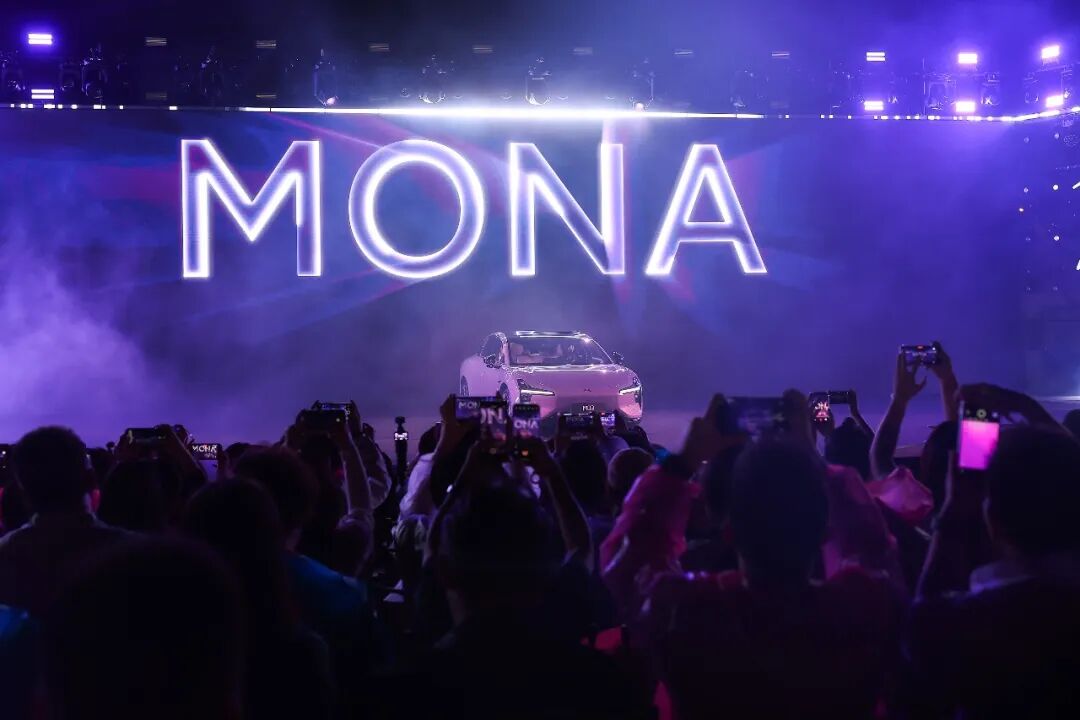
Some media believe that what He Xiaopeng is doing is essentially using the MONA M03, a high - volume model, to buy time for high - end business narratives and high - investment projects. However, the sales volume brought by the MONA M03 in the future may restrict XPeng's evolution into a high - end technology company with brand premium capabilities.
Coincidentally, when releasing the financial report, He Xiaopeng responded to this view in advance during the conference call:
"Expanding the scale can help us survive in the competition. The absolute leadership in physical AI technology and commercialization will build our core competitiveness."
As evidence, XPeng's service and other revenues in the fourth quarter of 2025 were 3.18 billion yuan, a year - on - year increase of 121.9% and a quarter - on - quarter increase of 36.7%. The full - year service and other revenues were 8.34 billion yuan, a year - on - year increase of 65.6%.
This part of the revenue mainly comes from three aspects: technology R & D service revenue provided to car manufacturers (such as the cooperation with Volkswagen), parts and accessories sales revenue, and carbon credit business revenue.
In XPeng's profit structure, technology output has played a huge role. While other new - energy car startups rely on car - selling profits to cover R & D expenses, XPeng has already created additional revenue through technology licensing.
When the second - generation VLA was released, XPeng officially announced that Volkswagen would purchase the second - generation VLA, becoming XPeng's customer in terms of technology again. For reference, XPeng earned about 1.7 billion yuan from the cooperation with Volkswagen in the first half of 2025, with a gross profit margin as high as 60.1%.
This is the most familiar way of making money for He Xiaopeng before entering the car - manufacturing industry.
However, although the revenue structure is becoming more diversified, XPeng Group still needs car products to complete capital accumulation to break through the current situation and reach a better future.
Which car can undertake such a mission?
02. Not Producing Cars Priced Under 100,000 Yuan
After 12 years of establishment, if you ask which cars are the most significant for XPeng, there are probably two answers: the P7 and the Mona M03.
The P7 was the first model among domestic new - energy car startups to reach a sales volume of 100,000 units. The Mona M03 was the savior that pulled XPeng Motors out of the sales slump when it was launched on the tenth anniversary of the company.
In 2025, the annual sales volume of the MONA M03 reached 197,500 units, accounting for 45.6% of XPeng's total annual sales volume, and it ranked first in the sales of the pure - electric sedan segment priced between 100,000 and 200,000 yuan for 18 consecutive months.
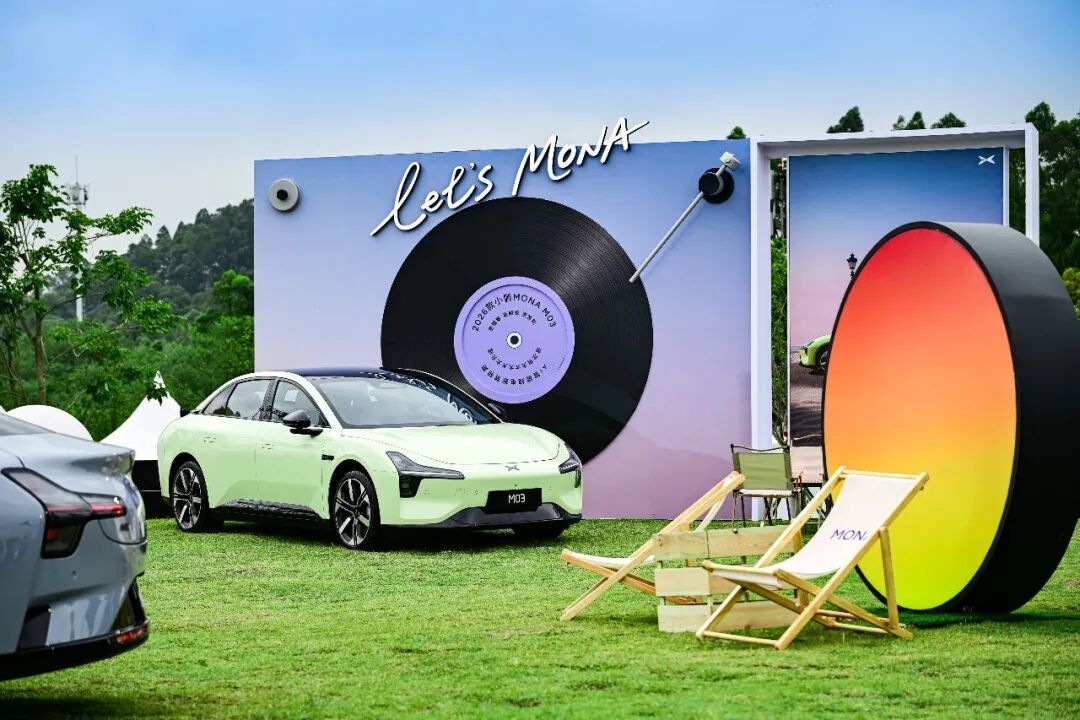
It is truly a meritorious model.
On April 2nd, the Mona M03 was officially upgraded. He Xiaopeng said that the "best L2 - level assisted driving capabilities in the industry" would be introduced to the company's cheapest model.
This is a way of paying tribute to DeepSeek, by distilling and equipping the second - generation VLA of XPeng on a model priced at around 100,000 yuan. In terms of the shock in the industry, it is comparable to Leapmotor's claim of running a world model on an 80,000 - yuan model equipped with a lidar.
The 2026 Mona M03 comes in a total of 6 versions:
The 540 Long - Range Plus is priced at 119,800 yuan;
The 640 Ultra - Long - Range Plus is priced at 129,800 yuan;
The 510 Long - Range Max is priced at 129,800 yuan;
The 610 Ultra - Long - Range Max is priced at 139,800 yuan;
The 510 Long - Range Ultra SE is priced at 141,800 yuan;
The 610 Ultra - Long - Range Ultra SE is priced at 151,800 yuan.
<