Als He Xiaopeng sagte: "Das Automobilgeschäft ist kein gutes Geschäft."
The automotive business may not be a good business idea. However, considering the shutdown of Sora by OpenAI, neither generative AI nor physical AI has yet become a business model that can be profitable as expected. The success of NVIDIA seems to be the perfect counterpart of CATL in the AI industry.
Is the automotive business a good business idea?
On April 2nd, during the media round - table after the first official redesign of the Mona M03, He Xiaopeng openly said: "I think that current automotive companies do not have a good business model. They are in an extremely competitive area."
This statement attracted a wave of attention.
The first quarter of 2026 has already passed. The annual reports of twelve automotive companies in China for 2025 were released. These include six traditional automotive brands such as Geely, BYD, Great Wall, SAIC, GAC, and Chery, as well as new vehicle manufacturers like NIO, XPeng, Li Auto, Xiaomi, Leapmotor, and Seres.
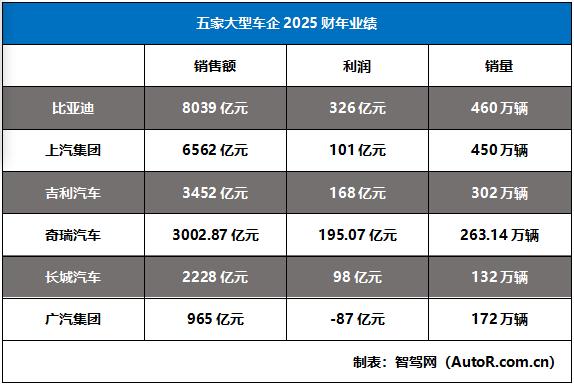
Among the new vehicle manufacturers, only Leapmotor and Li Auto made profits throughout 2025, and Seres showed relatively good performance. Although NIO and XPeng released their best - ever annual reports, they still hovered around the break - even point.
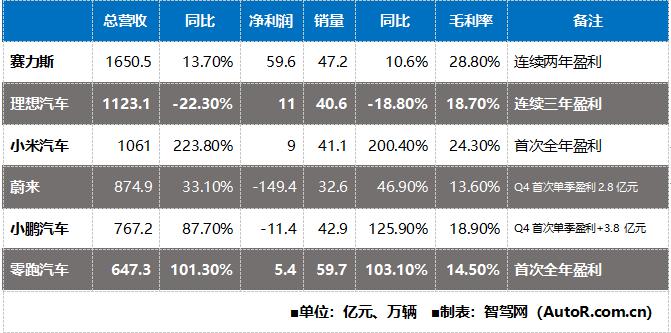
Comparison of revenues of new vehicle manufacturers in 2025
The performance of the six traditional automotive groups is also worrying. BYD, which has expanded significantly in the past two years, reduced its net profit by 19% to 32.6 billion yuan in 2025. This is the first decline in three business years. The gross margin in the Chinese market is only 17%, and the average selling price of passenger cars has decreased for three consecutive business years.
The average selling price per vehicle of Geely Auto Holdings decreased by 8% compared to the previous year. GAC Group reported losses for the first time since its listing in 2010, amounting to 8.7 billion yuan. Sales decreased by 14%.
Data released by the China Association of Automobile Manufacturers show that the average selling price of passenger cars in China in 2025 was 170,000 yuan, a decrease of 8% compared to 2024. On the one hand, production costs are rising; on the other hand, selling prices are falling. All automotive manufacturers are in the embarrassing situation of selling more but earning less, or achieving only small margins to increase sales volume.
In comparison, the remark "Automotive manufacturers are working for CATL" is becoming more and more realistic. CATL achieved a net profit of 72.201 billion yuan in 2025, an increase of 42.28% compared to the previous year, far exceeding the sum of the net profits of Chinese automotive manufacturers.
The net margin of the Chinese automotive industry in 2025 was between 2% and 3%, approximately equal to the bank deposit interest rate.
The statement "The automotive business is not a good business idea" has received wide agreement in the industry.
At the same time, German BBA, Japanese Nissan, and Honda are also in a phase of losses and staff cuts.
In March last year, nearly 50 new vehicle launches took place on the busy and disorderly Chinese automotive market, which is on average nearly two events per day.
During the media round - table, He Xiaopeng started his speech with the words: "Are you tired? That's normal."
If the automotive business is not a good business idea, then what is a good business idea?
He Xiaopeng said that it is not enough to just manufacture cars. A new automotive company should think about how it can become a technology company in the future.
In fact, 2025 was the best year for XPeng's financial situation.
01. XPeng's "automotive business" made profits last year
On March 20th, XPeng announced its unaudited financial reports for the fourth quarter and the whole year of 2025:
In the fourth quarter, the net profit was 380 million yuan. This was the first time the company made a monthly profit.
The total annual revenue was 76.72 billion yuan, an increase of 87.7% compared to the previous year.
A total of 429,445 vehicles were delivered, an increase of 125.9% compared to the previous year. The net loss decreased from 5.79 billion yuan in 2024 to 1.14 billion yuan.
He Xiaopeng was obviously very satisfied with these results:
"Although XPeng did not make an annual profit last year, the loss was very small. Our research and development expenditure last year was nearly 10 billion yuan (including 4.5 billion yuan for AI - related projects). If we add flying cars, the expenditure exceeds 10 billion yuan. This year, we will further increase our research and development expenditure. (In a telephone conference, He Xiaopeng announced that the research and development expenditure for physical AI should increase to 7 billion yuan.)"
"If we do not consider the expenses for chips, the next - generation AI, robots, and some research and development projects that are not yet named, we already made a profit in March last year, and we can achieve this again this year."
Naturally, no automotive company can calculate the profit without considering the investments.
If we look at the research and development expenditure in relation to the revenue, XPeng has an increase in revenue, but the expenditure is increasing even faster.
He Xiaopeng said about this approach: This approach is not correct in the traditional business model of the automotive industry, but it is correct for a technology company.
A company that follows this logic is Huawei in China. According to its 2025 annual report data, the research and development proportion of revenue is 21.8%. In the global market, the research and development proportion of Meta is 26.52%. The research and development proportions of well - known technology companies such as Microsoft, Amazon, and Google are also over 10%.
"Sacrificing profit for research" is a common strategy of technology companies, and He Xiaopeng has said several times:
"We are firmly convinced that XPeng will be a technology company in the future, and not just an automotive company."
At the 2025 annual report telephone conference, He Xiaopeng said that XPeng systematically shifted its business operations towards "physical AI".
The first step of this "shift" was the renaming of XPeng Motors.
On March 27th, XPeng announced in Hong Kong that as of April 1st, 2026, the Chinese name of the company will be changed from "XPeng Motors Co., Ltd." to "XPeng Group". The English name "XPeng Inc." remains unchanged, and the short - name of the stocks on the Hong Kong Stock Exchange will be changed from "XPeng Motors – W" to "XPeng Group – W".
After years of external calls for "renaming", He Xiaopeng finally changed the name "XPeng Motors", but he retained the name "XPeng".
After the renaming, the automotive business is the foundation of XPeng Group. On this basis, strategies are developed in various directions such as flying cars, humanoid robots, AI chips, and autonomous driving models.
At the XPeng Technology Day in November last year, He Xiaopeng re - defined the core position of the company: As an explorer of mobility in the world of physical AI and as a global company for Embodied Intelligence.
This is a tribute to Elon Musk and Tesla.
At the end of March, Tesla stopped the production lines of Model S and Model X and fully focused on transforming into an AI company.
He Xiaopeng, who is also "moving away from automobiles", believes that although XPeng's core business has been electric vehicles in the past ten years, the company's business model should develop towards "electric mobility plus intelligence" in the next ten years.
"I think that current automotive companies do not have a good business model. They are in an extremely competitive area."
Although the entire industry advocates against over - competition and strives for high - quality development, the (traditional) automotive industry based on hardware is not a particularly good business model.
This is obviously the result of He Xiaopeng's in - depth thinking.
This is consistent with his previous view "It is not enough for a company to do only one thing well. For example, achieving sales volume is good, but still not enough. Sales volume alone does not lead to success."
How should a new automotive company think about how it can become a technology company in the future?
"Two or three years ago, I still thought that the robot revolution would take place in the next ten years. But in the past few months, I have seen the changes in large physical AI models, and I must say that I am very surprised. Previously, I thought that L5 would not be possible in ten years. Now I think that it might actually be possible to achieve L5 in ten years. It is even more likely for robots because the requirements for robots are not as high as for L5."
This is the reason why XPeng, despite the potential to make a profit in the automotive business, still invests large amounts of profit in forward - looking areas such as flying cars, humanoid robots, and AI chips.
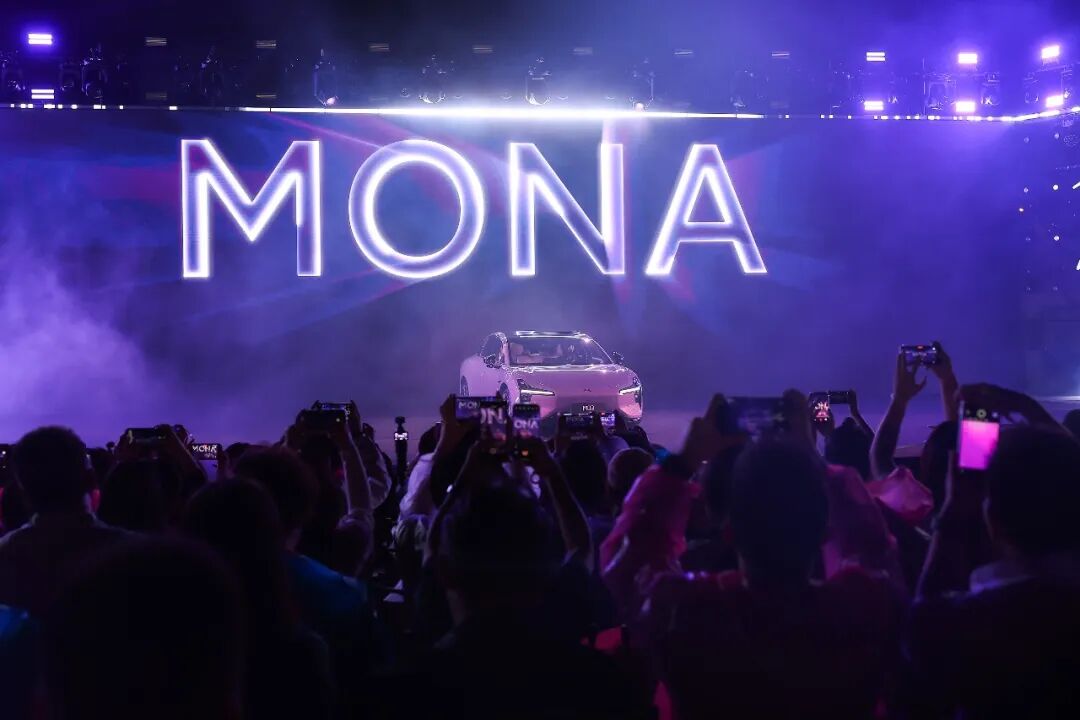
Some media believe that He Xiaopeng is essentially buying time for high - quality business ideas and high - investment projects with the MONA M03, a mass - market model. The sales volume of the MONA M03 may potentially limit XPeng's further development into a high - quality technology company with brand premium.
Coincidentally, He Xiaopeng refuted this view in advance at the annual report release telephone conference:
"The expansion of scale enables us to survive in the competition. Absolute leadership in physical AI technology and commercialization will form our core competitiveness."
As proof, the revenue from services and other sources in the fourth quarter of 2025 was 3.18 billion yuan, an increase of 121.9% compared to the previous year and 36.7% compared to the previous quarter. The total annual revenue from services and other sources was 8.34 billion yuan, an increase of 65.6% compared to the previous year.
These revenues mainly come from three sources: revenues from technological research and development services for automotive manufacturers (e.g., cooperation with Volkswagen), revenues from the sale of parts and spare parts, and revenues from the CO2 certificate business.
In XPeng's profit structure, technology output plays a large role. While other new vehicle manufacturers rely on vehicle sales profit to cover research and development expenses, XPeng has already achieved additional revenue through technology licensing.
When releasing the second - generation VLA, XPeng announced that Volkswagen will buy the second - generation VLA and become a customer of XPeng again at the technological level. For comparison: XPeng earned approximately 1.7 billion yuan from the cooperation with Volkswagen in the first half of 2025, and the gross margin was 60.1%.
This is exactly the business model that He Xiaopeng was most familiar with before founding XPeng.
Even though XPeng's revenue sources are becoming increasingly diverse, XPeng Group currently still needs automotive products to accumulate capital to overcome the current situation and move into the future.
Which vehicle can fulfill this mission?
02. No vehicles under 100,000 yuan
After twelve years of XPeng's establishment, the answer to the question of which vehicle is most important for XPeng is probably the P7 and the Mona M03.
One is the first model among new Chinese vehicle manufacturers to sell 100,000 units. The other is the life - saver that pulled XPeng out of the sales slump when it... (The original text seems incomplete here)