Only five people in the world have seen this color.
In 1900, L. Frank Baum wrote about a fictional city.
In his The Wonderful Wizard of Oz, the Emerald City appears entirely green. However, all those entering the city must wear a pair of green - tinted glasses locked onto their faces by the guards, with the reason being "to protect the eyes from the brilliance of the Emerald City."
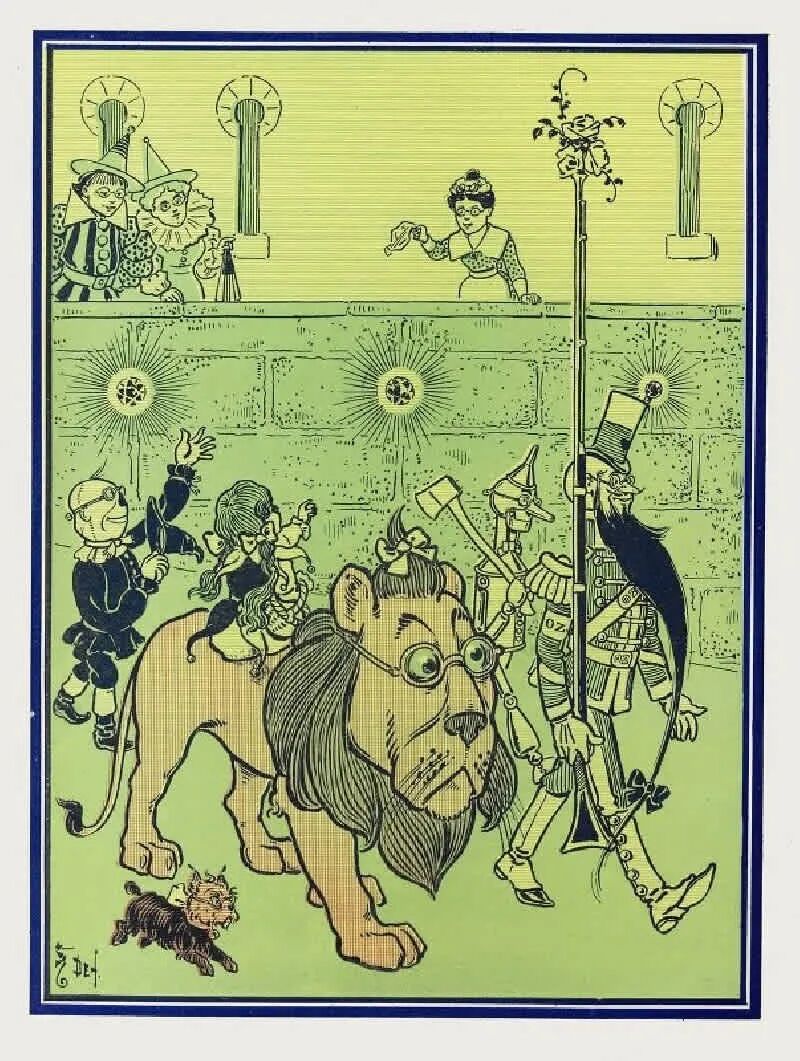
Image source: reprodukcijos
In Chapter 15, the Wizard of Oz personally exposed the deception: the city is no different from other cities. Of course, everything looks green when wearing green - tinted glasses.
One hundred and twenty - five years later, the University of California, Berkeley built a machine also named Oz. Here is what the machine looks like:

Image source: Berkeley ins
It does something in the exact opposite direction: instead of making people see false colors, it enables people to see a color that truly exists but is absolutely impossible to see under normal circumstances.
This color is called olo. Only five people in the world have ever seen it.
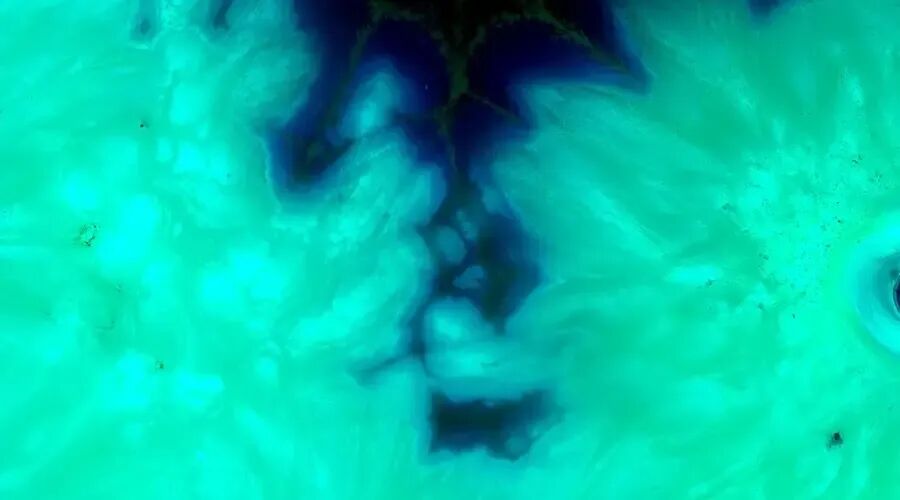
Image source: OSLD
To understand why it's said to be "impossible to see", we first need to know how people see colors. There are three types of cone cells (S - cones, M - cones, and L - cones) in your retina, which are most sensitive to light in the blue, green, and red regions respectively.
However, each cone cell itself is color - blind. It can only report "how many photons it has absorbed" and cannot distinguish wavelengths. Colors are "calculated" by the brain after comparing the activation ratios of the three types of cones: each color corresponds to a specific ratio.
The problem is that the spectral sensitivity curves of M - cones and L - cones overlap significantly, with a peak difference of only about 30 nanometers. As a result, there is no light in nature that can activate only M - cones without touching L - cones at all. All green and cyan light, when hitting M - cones, will inevitably also hit L - cones. The brain always receives mixed signals.
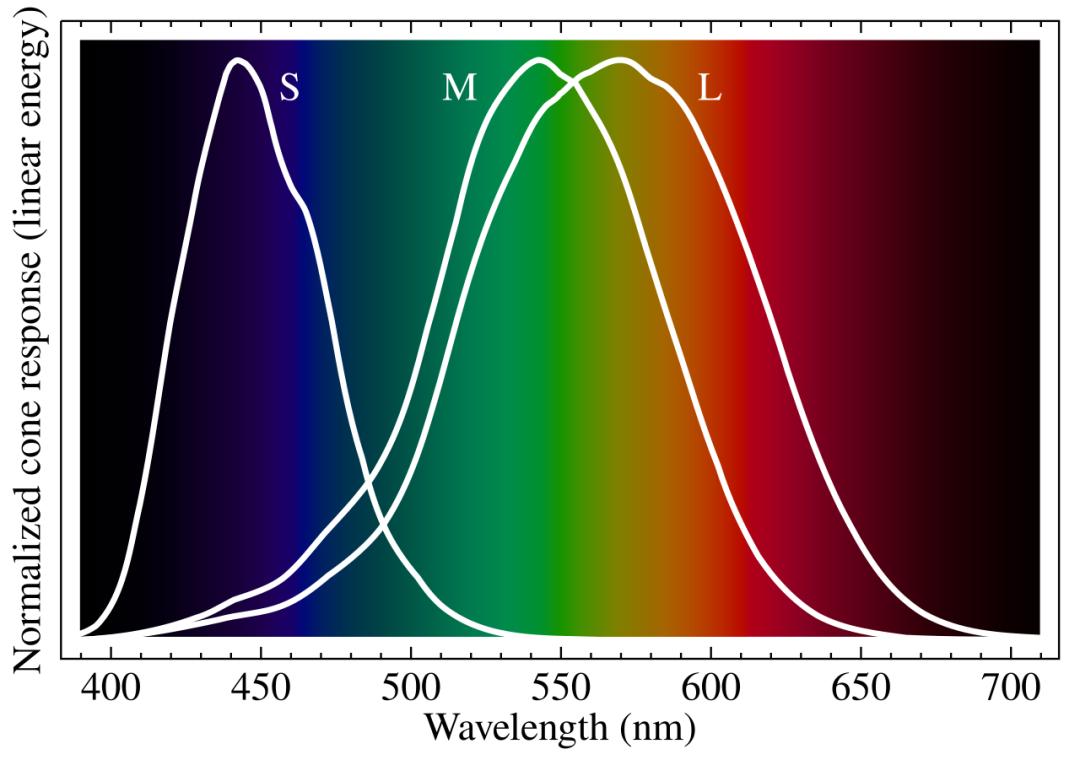
Image source: wikipedia
You might think, why not use a very thin beam of light to hit just one M - cone?
That won't work either. After light passes through the cornea and lens, it diffracts and blurs. A point source of light becomes a blob of light on the retina, much larger than a single cone cell. When aiming at an M - cone, the light will inevitably spill onto the neighboring L - cones.
Therefore, what limits the number of colors you can see is not physics (the spectrum is continuous), but the biological wiring of your eyeball: the spectral overlap prevents you from separating "types of light", and the optical blur prevents you from separating "positions of light".
The Berkeley team spent more than a decade "removing" these two shackles.
The first one: use adaptive optics to correct the optical distortion of the eyeball and focus the laser on a point the size of a single cone cell (this technology was first invented by astronomers to correct atmospheric turbulence).

Image source: berkeley
The second one: use high - resolution retinal imaging to identify the types and positions of up to about a thousand cone cells one by one and draw a retinal map. This step is extremely time - consuming, which is why the experiment was only conducted on five people.
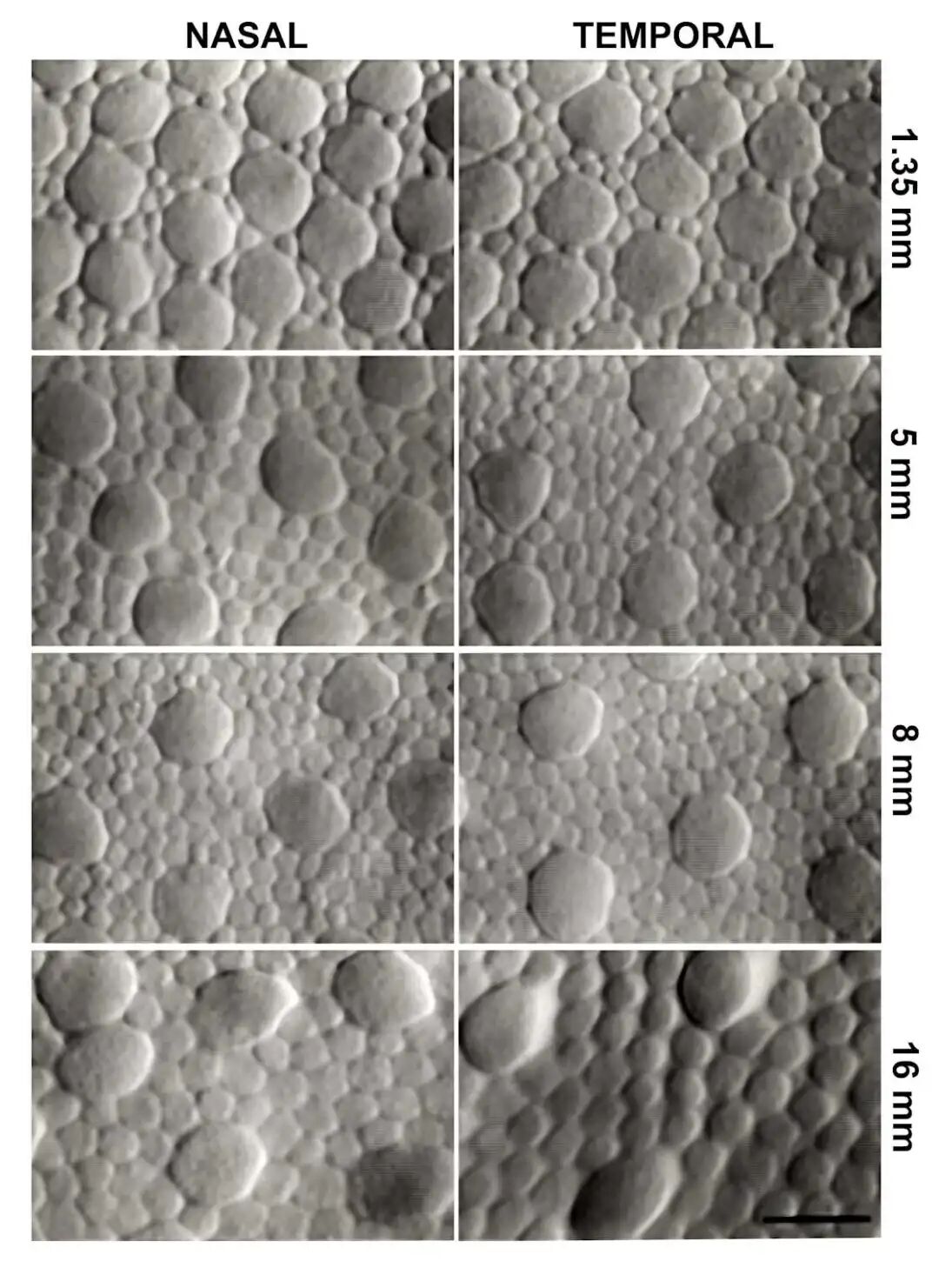
Image source: christineacurcio
After removing the two shackles, the remaining logic is straightforward. The system uses infrared light to track the retina in real - time (invisible to the subjects). At the same time, a 543 - nanometer green laser scans the target area at a rate of about one hundred thousand times per second. When it scans an M - cone, it releases a light dose, and when it scans an L - cone or an S - cone, it skips. Only the M - cones are lit, and all other cells are turned off.
The actual experience is much simpler than the description:
You need to apply dilating eye drops, bite on a metal rod to fix your head, and stare at a fixed point. Every time you blink, the system has to be recalibrated, so olo can only last for a few seconds each time, and the field of view is about the size of your fingernail when your arm is fully extended.
But in these few seconds, all five people saw the same thing: an extremely saturated blue - green color, much more vivid than the purest cyan laser in nature.
The following picture shows two perspectives that the subjects saw during the experiment:
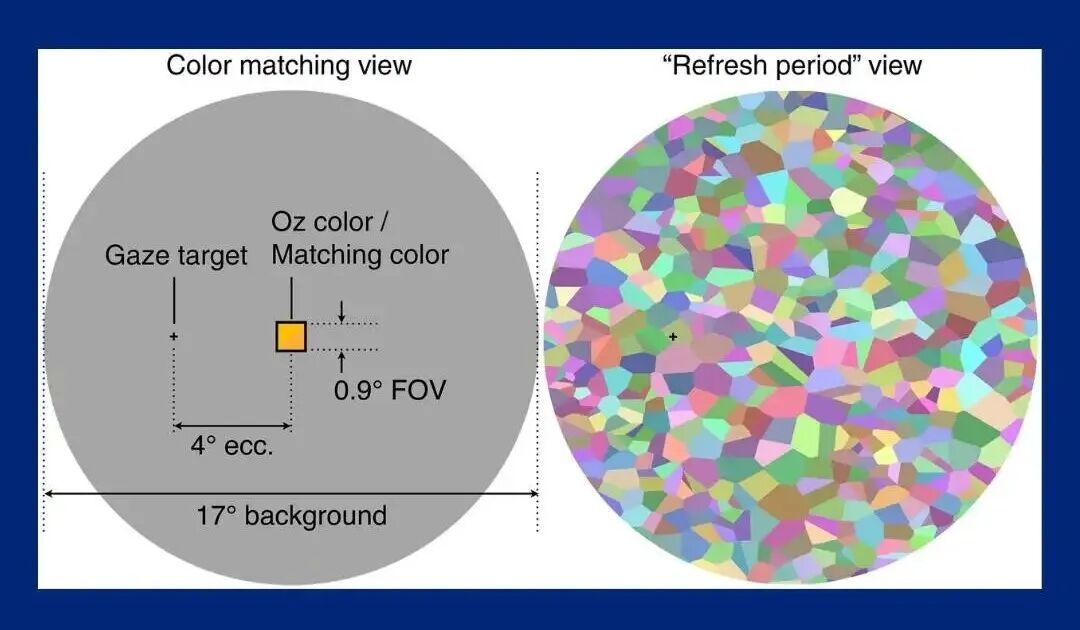
Left - hand color - matching perspective: The actual image the subjects stared at, a large gray circle with a small orange square slightly to the right in the middle, where olo appears. The subjects need to adjust a lamp to match the color of this square. The position is about 4° off the gaze target. Image source: Literature
Right - hand refresh - interval perspective: During the intervals between each olo stimulation, the subjects saw a colored mosaic pattern, which is used to clear visual after - images and prevent the previous colors from interfering with the next judgment.
Austin Roorda (a professor at the Berkeley School of Optometry and one of the subjects) said that when comparing olo with the purest monochromatic light in the laboratory, the latter appears pale.
To quantify how "extreme" olo is, the researchers asked the subjects to use a lamp with adjustable wavelengths to match olo. Every time, they had to add a large amount of white light before reporting "it's about the same". In other words, the saturation of olo exceeds the range that all natural light can reach.
The paper gives a screen color value #00FFCC (which is the current font color) as the closest match, but its relationship with olo is probably similar to the relationship between a mobile - phone photo and seeing the aurora with your own eyes.

Image source: Internet
An interesting detail: The person who named olo is James Fong, the first author of the paper. Olo comes from the coordinates (0, 1, 0) in the LMS color space, which means the L - cones are not activated, the M - cones are fully activated, and the S - cones are not activated. It's spelled out in hacker - style text as olo.
James spent a lot of time during his Ph.D. studying this color, but as of the publication of the paper, he had never seen it himself. The experiment spots were determined by lottery, and he was unlucky.
The significance of this research lies not only in the technology itself but also in the new principle it proposes. Your mobile - phone screen mixes three types of LEDs (red, green, and blue) to deceive the cone cells into thinking they are looking at a sunset.
All screens, printers, and projectors do this, but this method can never go beyond the natural color gamut.
The Oz system takes a different approach: instead of controlling the spectral composition of light, it controls the spatial position where light falls on the retina. Using a laser with a fixed wavelength, simply by choosing "which cells to illuminate and which not to", a series of different colors can be produced, including olo, a color that cannot be achieved by any combination of natural light. One laser pointer, multiple colors.
After the paper was published in Science Advances in April 2025, the academic community's debate quickly polarized. Jay Neitz, a professor of ophthalmology at the University of Washington, called it "a technological feat almost out of science fiction."

Jay Neitz Image source: creativemornings
John Barbur, a color - vision researcher in London, directly stated in The Guardian: This is not a new color; it's just a more saturated green.
The core of the debate is that the hue of olo can be identified as blue - green or cyan (the subjects themselves also said so), and its novelty lies in the fact that its saturation is pushed to a level that is impossible to achieve under natural conditions.
Is this considered "new"? It depends on how you define "a color".
The color space you see has boundaries, and these boundaries are not the boundaries of the world but your own boundaries. The spectrum is continuous and uniform, but your three types of cone cells and their overlapping relationships only allow you to see a limited section of it.
Bypassing the limitations, the brain can immediately process signal ratios it has never received before, and the reactions of the five people are almost identical. The brain doesn't break down; it simply calmly translates a new color.
The deception of the Emerald City says: the green color is not in the city but in the glasses you wear. Olo says the same thing: color is not in the light but in the translation process of your cone cells and brain.
A few days after the paper was published, British artist Stuart Semple launched a tube of acrylic paint called YOLO, claiming it can approximate olo. It costs £10,000 for non - artists and only £30 for those who claim to be artists.
Can it be more discriminatory?
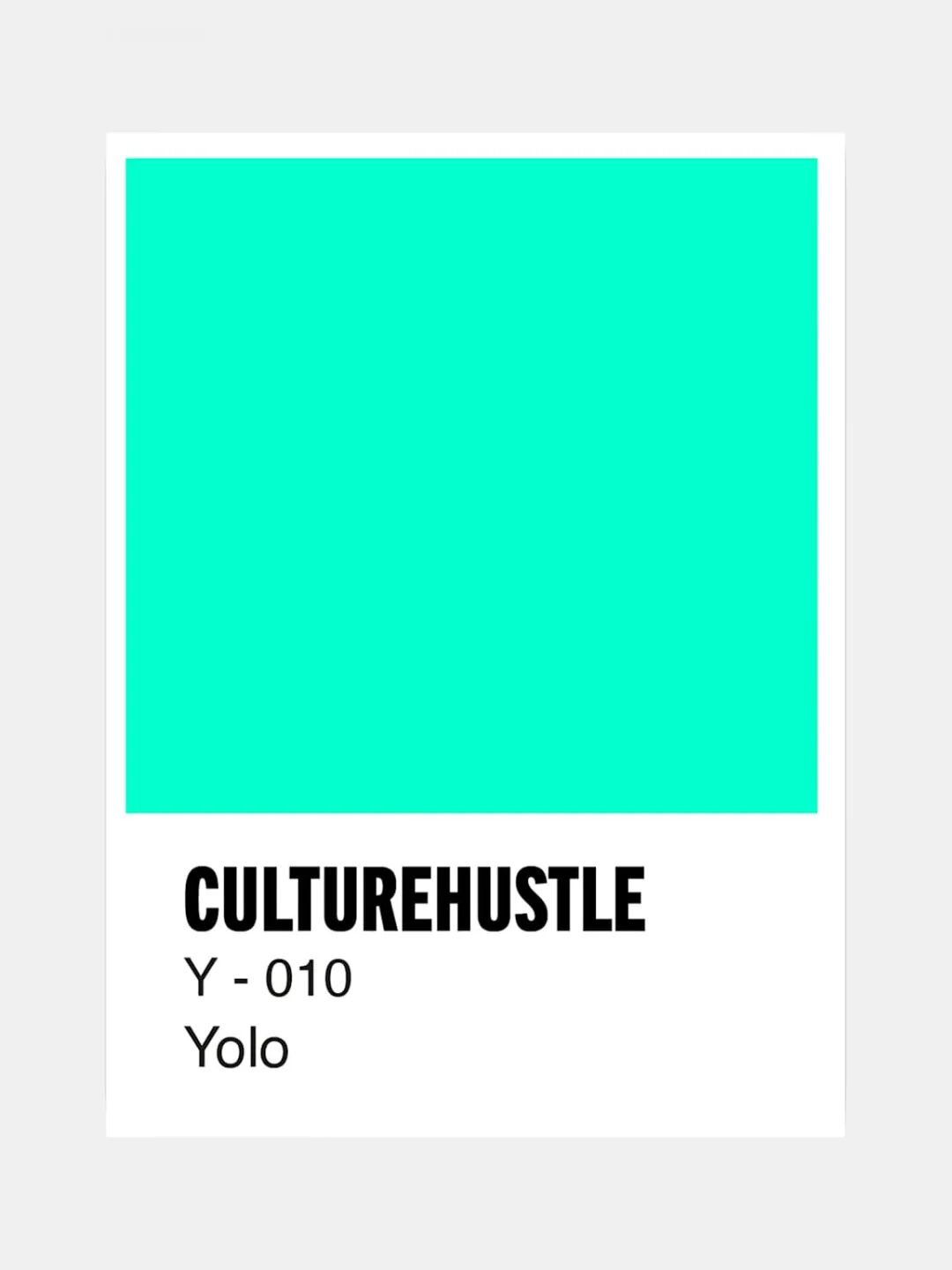
Image source: dezeen
The Berkeley team's response was straightforward: Any color you can buy will appear pale in front of olo. Stuart Semple himself is also aware: "Of course, it can't compare to actually shining a laser into your eyes."
We don't have to wait for the day when the Oz system covers a larger field of view, shows new colors to color - blind patients, or attempts to create tetrachromatic vision for humans.
At least olo has made one thing clear: Every color you see at this moment is not the true appearance of the world but a compromised version negotiated by your cone cells and brain.
The residents of the Emerald City thought they saw a green city. You think you see the real colors of the world. It's pretty much the same thing.
References:
Fong, J.†, Doyle, H.K.†, Wang, C.† et al. (2025). Novel color via stimulation of individual photoreceptors at population scale. Science Advances, 11(16), eadu1052.
Schmidt, B.P., Boehm, A.E., Tuten, W.S. & Roorda, A. (2019). Spatial summation of individual cones in human color vision. PLOS ONE, 14(7), e0211397.
Hofer, H., Carroll, J., Neitz, J., Neitz, M. & Williams, D.R. (2005). Organization of the human trichromatic cone mosaic. Journal of Neuroscience, 25(42), 9669–9679.
Jordan, G., Deeb, S.S., Bosten, J.M. & Mollon, J.D. (2010). The dimensionality of color vision in carriers of anomalous trichromacy. Journal of Vision, 10(8), 12.
Crane, H.D. & Piantanida, T.P. (1983). On seeing reddish green and yellowish blue. Science, 221(4615), 1078–1080.
Pandiyan, V.P. et al. (2022). Characterizing cone spectral classification by optoretinography. Biomedical Optics Express, 13(12), 6574.