We've all misjudged Unitree: It tells the story of humanoid robots but makes money from robotic dogs.
Waking up from a nap, you'll find that you can now keep a panda at home.
No kidding, but it's a "silicon-based panda". Recently, Unitree Technology quietly launched a panda simulation skin on JD.com that can be directly put on the Go2 robotic dog. The skin is sold separately for 3,500 yuan; the package of the Go2 with the skin is priced at 13,497 yuan.
According to the official introduction, this set of skin uses the intangible cultural heritage fur simulation animal technique, with full hair texture, outline, and black-and-white details, aiming to let people across the country "pet the panda".
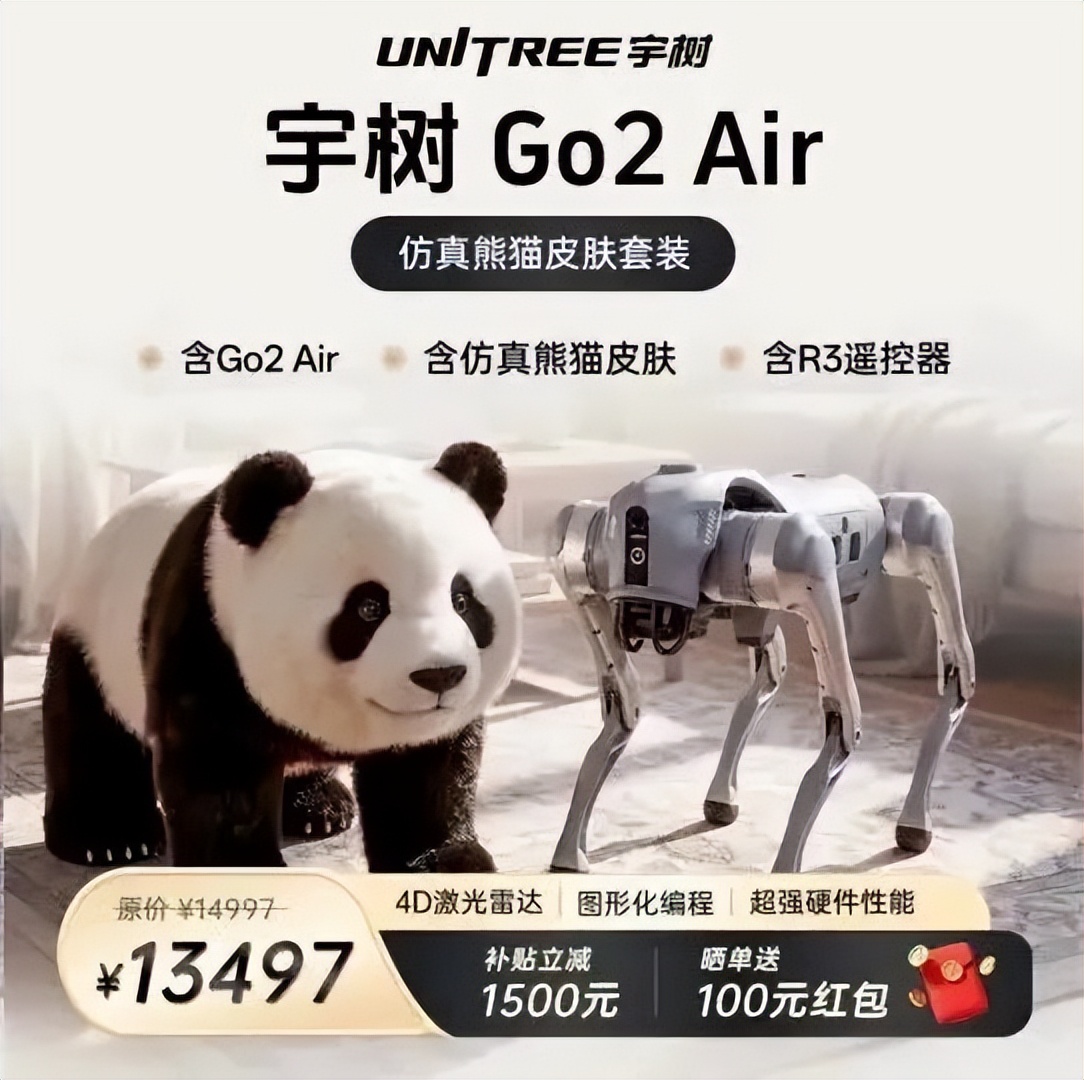
Put on this skin, the Go2 instantly transforms into a cyber national treasure: it can walk, run, sit, lie down, stretch, and also perform exclusive actions such as rubbing its head and wagging its tail with the help of graphical programming.
It sounds like this silicon-based panda, which is mainly for companionship, is much more obedient than my stubborn little dog. But precisely because it is too obedient, it lacks a bit of the "feeling of a real dog". In the eyes of many netizens, although it is cute, it is essentially a high-end toy rather than a real pet for companionship.
However, the capital market and the industrial circle see something completely different under this cute panda skin. On March 20th, the Shanghai Stock Exchange accepted Unitree Technology's application for IPO on the Science and Technology Innovation Board. The data in the prospectus is undisguised: from 2022 to 2024, the revenue of Unitree's quadruped robots (robotic dogs) has always accounted for more than 60%, far outpacing humanoid robots.
It wasn't until 2025, after Unitree's humanoid robot H1 appeared on the Spring Festival Gala stage, that the revenue share of robotic dogs was overtaken by humanoid robots for the first time.
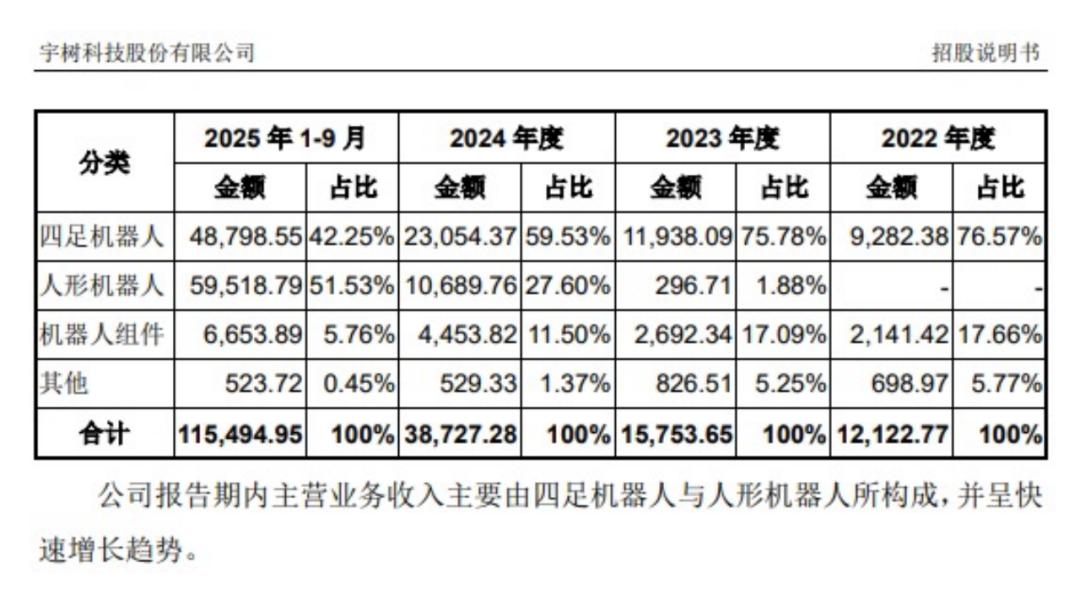
Is it true that the highly anticipated "first humanoid robot stock" has been secretly supported by selling robotic dogs?
It sounds like a joke, but it is the most real and cruel business background of Unitree.
Robotic dogs are the real cash cows
While everyone is focusing on humanoid robots, what Unitree has really been making money from is actually the robotic dog.
In 2025, the shipment volume of Unitree's humanoid robot H1 exceeded 5,500 units, ranking first in the world. However, the sales volume of robotic dogs is even more astonishing, with a cumulative shipment of more than 30,000 units. According to Leopard data, Unitree's quadruped robots account for about 69.75% of the global market share, leading far ahead from 2022 to 2024.
In fact, in the first quarter of last year, it was the robotic dogs that first had a surge in orders. The orders for its industrial inspection robotic dogs increased by 220% year-on-year, including those for power inspection, mines, chemical energy, ports, etc. According to foreign media reports, overseas, Unitree's robotic dogs have entered hydropower stations, refineries, and archaeological sites in 52 countries.
From 2022 to 2024, the use for scientific research and education also accounted for a large proportion of the revenue of robotic dogs, which were 68.61%, 63.02%, and 52.69% respectively. It is reported that Unitree's educational robotic dogs have entered more than 2,000 university laboratories in Europe and the United States, with a market share of up to 68%.
After Unitree's robots appeared on the Spring Festival Gala last year, the revenue share of Unitree's robotic dogs in consumer-oriented commercial uses also rapidly climbed to 42.3% in the first three quarters of last year. The product details page on JD.com shows that more than 3,000 units of Unitree's robotic dog Go2 have been sold.
The prospectus is the most straightforward: In 2024, Unitree achieved an annual profit for the first time, with a net profit attributable to the parent company of 95 million yuan, and the robotic dog was still the largest revenue source that year, accounting for nearly 60%. That is to say, before humanoid robots truly became the focus of the spotlight, robotic dogs had already quietly become the cash cows, supporting the entire company's foundation.
The large shipment volume is not due to sentiment, but to the absolute price slasher strategy.
In the consumer market, the Go2 Air launched by Unitree in 2023 directly brought the price down to 9,997 yuan, becoming the first product in the industry to enter the sub - 10,000 - yuan range, almost opening the mass market at a "bargain price".
In the industrial market, compared with Spot of industry leader Boston Dynamics (priced at about $74,500, approximately 530,000 yuan), Unitree's B2, priced at about 400,000 yuan, is not only cheaper but also has advantages in key indicators such as climbing ability, battery life, and torque.
The confidence to offer such a low price comes from extreme self - research.
According to the prospectus, Unitree has self - developed and self - produced all its core components (motors, reducers, joints, lidar, etc.) in a full - stack manner. The self - research rate of core components exceeds 95%, and the proportion of outsourced components is only 14% - 18%, higher than the industry average. Once the scale effect is released, the unit cost has been halved from 22,300 yuan in 2022 to 12,100 yuan in the first three quarters of 2025.
As the cost decreases and the price remains stable, the profit margin is naturally fully opened up.
The prospectus shows that from 2022 to 2025, Unitree's comprehensive gross profit margins were 44.94%, 44.75%, 56.98% respectively, and further increased to 59.83% in the first three quarters of last year, approaching 60%. This figure not only far exceeds comparable companies such as Ubtech and Yuejiang Technology but also leaves far behind a large number of peers who are still struggling with a gross profit margin of less than 30% or even have not yet achieved profitability.
The business of robotic dogs has become the strongest confidence for Unitree to tell the grand story of humanoid robots to the capital market.
Wang Xingxing once firmly refused to make humanoid robots
Although humanoid robots have now become the most prominent label of Unitree Technology, the real situation is that robotic dogs not only sell more, but for a long time after Unitree was founded, Wang Xingxing only made robotic dogs and firmly opposed making humanoid robots.
In 2009, when Wang Xingxing was still an undergraduate, he spent more than 200 yuan to build a small bipedal humanoid robot. After finishing it, he concluded that "the commercial value or technology of humanoid robots is very difficult."
This judgment laid the early path for Unitree.
In 2016, when Wang Xingxing founded Unitree Technology, the humanoid robot industry in China was already booming, with humanoid group performances on the stage. When investors asked him if he wanted to get involved, he flatly refused.
"At that time, the control technology of global humanoid robots was still not ideal, the performance was not up to par, and there was no practical value in sight." Wang Xingxing believed that quadruped robots are more stable than bipedal ones and have more application scenarios. In 2017, Unitree released its first product: the Laika quadruped robot.
Moreover, Wang Xingxing was once "conservative" to the point of being stubborn in his product strategy.
In the early days, Unitree did not make consumer - grade products at all. He believed that making small toys to cater to the consumer market would waste high - end technology, fail to build a moat, and require a lot of effort to polish the selling points. On the contrary, B - end products targeting scientific research institutions and industrial customers could receive more professional and valuable feedback.
Looking back now, this "conservatism" has instead constituted Unitree's most important ability accumulation.
In the years when robotic dogs were the main products, Unitree established a stable source of income on the one hand and completed long - term precipitation in core components and motion control on the other hand. And these abilities have not been "locked" in the quadruped form.
From an engineering perspective, humanoid robots and quadruped robots are highly isomorphic: the body structure, joint modules, energy system, computing platform, perception, and motion control are essentially different permutations and combinations of a set of general abilities. The components and algorithms verified on robotic dogs can be almost directly reused and migrated.
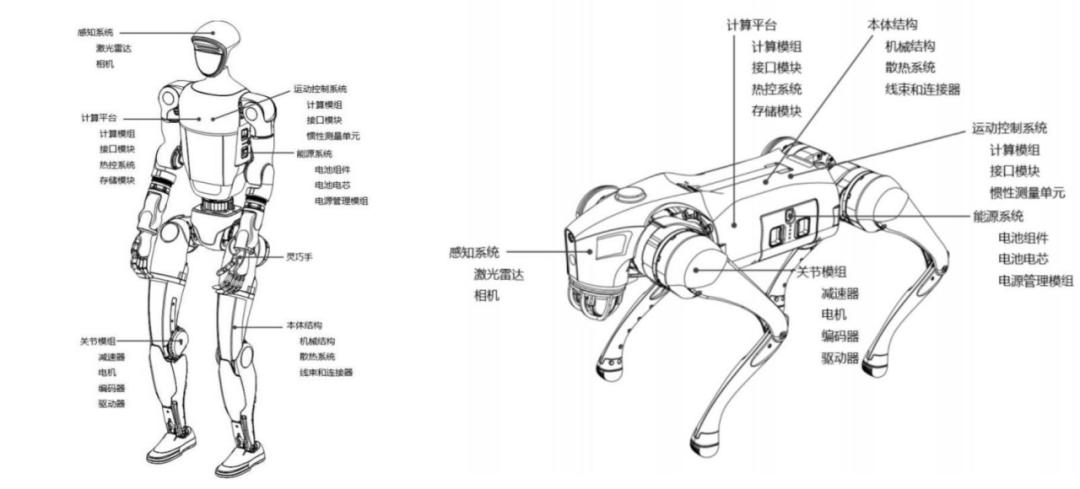
Therefore, when Unitree decided to enter the humanoid robot market in 2023, it was not "starting from scratch". At that time, Unitree Technology only used 3 employees and took 6 months to launch its first humanoid robot H1.
The extremely high parts reuse rate and extremely short R & D cycle have directly brought down the cost. In the first three quarters of 2025, Unitree's R & D expenses only accounted for 7.73% of its revenue. Against the background that the entire industry often invests 20% - 30% of its revenue in R & D, this figure is extremely counter - intuitive.
The full - stack self - research and self - production system further amplifies this advantage.
When the algorithm and hardware come from the same system, motion control no longer requires repeated running - in with external black boxes but can achieve fine - grained collaborative optimization at the parameter level. The result is lower control delay, higher energy efficiency, and stronger dynamic stability.
That's why we've seen Unitree's humanoid robots become popular time and time again: backflips, side flips, Webster flips, robot fights, and finally the group martial arts performance on this year's Spring Festival Gala. The movements are becoming smoother and more amazing.
However, while the fancy moves have put Unitree in the spotlight, it also can't escape the suspicion of the "industry bubble".
The more amazing the surface is, the louder the underlying doubts become.
Humanoid robots rely on robotic dogs
Unitree once pragmatically rejected investors' suggestions to make humanoid robots. Now, Wang Xingxing has to bow to the market.
He said straightforwardly: "There are more people who like humanoid robots than those who don't, and the market is rational." Humanoid robots have become the mainstream choice simply because they are more popular.
More realistically, humanoid robots have now become a truly "pragmatic" business path.
Wang Xingxing publicly admitted that humanoid robots currently have great advantages in data collection, training, and implementation. They can directly imitate human movements and quickly accumulate real training data, thus significantly reducing the learning and deployment costs.
In a sense, Unitree's focus on robotic dogs back then was actually a strategic avoidance of the grand narrative that "humanoid robots are the future". Now, both the market and the technological logic have pushed humanoid robots onto the path of least resistance. The prospectus has provided the most direct evidence: in the first three quarters of 2025, the revenue share of humanoid robots has officially overtaken that of robotic dogs.
But it's far from as simple as it seems for a robotic dog to "stand up" and become a real humanoid robot.
A real dog can be led, and a robotic dog can also make up for its lack of autonomy through external instructions. But once a humanoid robot stands on two legs, it must balance itself, make decisions on its own, and stand firm by itself. Any delay or error may cause it to fall directly.
What's even more troublesome is the "hands". For a dexterous hand to truly do work, it must be deeply integrated with perception systems such as vision and lidar. And this integration ultimately depends on the "big model", that is, the robot's brain. Without a powerful enough brain, no matter how flexible the body is, it's just for show.
Therefore, while the outside world is amazed by Unitree's excellent "cerebellum" (motion control) ability, it has also labeled Unitree as "not having a brain". The big - model ability has become the last shortcoming that Unitree needs to make up for most urgently after its IPO.
The change in priority can be seen from the fund - raising investment directions. According to the prospectus, the raised funds will be mainly invested in four directions: 2.022 billion yuan for intelligent robot model R & D, 1.11 billion yuan for robot bodies, 445 million yuan for new product development, and 624 million yuan for the manufacturing base. Among them, model R & D takes the largest share, clearly locking in Unitree's real battlefield in the next stage.
Although Unitree has achieved a net profit of 600 million yuan after deducting non - recurring items and a gross profit margin close to 60%, the outside world's doubts about its commercialization ability still linger: more than 70% of the sales volume of humanoid robots still comes from scientific research and education. The prospectus also admits that in the short and medium term, scientific research, education, and performances will still be the most important implementation scenarios for humanoid robots.
This means that before the large - scale "factory work" of humanoid robots becomes a reality, Unitree's growth still depends on two - pronged approaches: one is the continuous support from the capital market, and the other is to sell products desperately to the consumer market.
Perhaps that's why we see such a contrastive and real scene:
On one hand, there are the cool humanoid robots shouting about the future on the Spring Festival Gala stage. On the other hand, there is the robotic dog wearing a panda skin and sold for 13,497 yuan on the JD.com shelf.
The story of humanoid robots is really appealing.
But for now, Unitree obviously still needs this 3,500 - yuan panda skin to hedge against the still uncertain future.
Reference materials:
China Newsweek, "The Counter - attack of the 90s Wang Xingxing: The One - Sided Learner's Comeback"
Zhi Dongxi, "What's the Secret of Unitree's Annual Earnings of 600 Million? A Deep Dive into the 300 - page IPO Inquiry Letter"
Deep Blue Finance, "Behind Unitree's Annual Earnings of 600 Million: R & D Investment Less than 100 Million, 70% of Humanoid Robots Sold to Universities"
This article is from the WeChat official account "Jinjiao Finance", author: Jinjiao Finance. Republished by 36Kr with permission.