SpaceX's Starlink project has sparked public outrage: Just as the battle for space computing power has begun, astronomers have issued a "final warning."
Recently, the global astronomy community has once again submitted a strongly - worded opinion letter to the US Federal Communications Commission (FCC).
The signatories of this opinion letter cover the world's major astronomical institutions. Centered around the American Astronomical Society (AAS), it is a joint effort of the International Astronomical Union (IAU), the Royal Astronomical Society (RAS) of the UK, the European Southern Observatory (ESO), etc. This can be regarded as the most large - scale "joint protest" event in the global astronomy community in recent years.
This 12 - page protest document directly points to two "terrifying" commercial space programs of humanity:
One is SpaceX's plan to deploy a total of one million satellites with AI computing capabilities in low - Earth orbit; the other is the plan of the startup company Reflect Orbital to deploy 50,000 orbital mirror satellites in the long term.
The global astronomy community warns that if these programs are implemented without proper supervision, the beautiful starry sky that humanity has been familiar with for millions of years will completely "change color".

Image source: Josh Dury
From Communication to Computing Power: The "Million - Satellite" Blazing Trail of Commercial Satellites
The development history of commercial spaceflight is not long, but its expansion speed is accelerating.
In 2015, SpaceX announced the Starlink project, planning to deploy about 12,000 broadband Internet satellites in low - Earth orbit. At that time, there were already concerns that the starry sky would change as a result. However, no one could have predicted that this was just the prologue.
11 years ago, the original intention of the Starlink project was to provide satellite communication. With the advent of the AI era, SpaceX's vision has evolved towards "space edge computing".
At the beginning of 2026, SpaceX announced a new and more radical plan: to send one million low - orbit data center satellites into space and submitted an application to the FCC. The FCC completed the public consultation on this plan in March.
According to Elon Musk's vision, relocating high - energy - consuming computing infrastructure to space can take advantage of the low - temperature background in outer space and fully unleash the potential of AI. Meanwhile, Reflect Orbital's plan to deploy 50,000 orbital mirrors (each about 10 meters wide) in the long term aims to "send" sunlight to ground customers at night.

Conceptual image of mirror satellites (Image source: CBC)
The scale of these two programs is unprecedented in the history of commercial spaceflight. Coupled with other low - Earth orbit broadband satellite projects (such as Amazon Leo, UK's OneWeb, etc.), the number of global commercial satellites in orbit is transitioning from the "tens of thousands" level to the "millions" level. The steepness of this expansion far exceeds the carrying capacity of the existing human astronomical observation system.
What also makes astronomers uneasy is the attitude of regulatory agencies. The US FCC and others seem inclined to approve these programs and do not mandate that relevant enterprises conduct comprehensive environmental impact assessments, such as EIA. "The current assumption is that these applications should be approved, and opponents need to prove the existing problems," an astronomer said.
The Illuminated Starry Sky: Impacts Beyond the Astronomical Scope
Regarding the attitude of regulatory agencies, some astronomers point out that the large - scale commercial space programs currently being promoted not only affect the astronomical environment but also have a huge impact on the Earth's natural environment. However, regulatory agencies do not conduct comprehensive environmental reviews, which is very worrying.
To understand why astronomers are so angry, Lei Technology (ID: leitech) believes that it is necessary to first understand the specific impacts of commercial spaceflight on the starry sky.
Robert Massey, the deputy executive director of the Royal Astronomical Society (RAS) of the UK, made an intuitive analogy: If you look directly at the orbital mirrors of Reflect Orbital, their brightness will be several times that of the full moon. Even when observed at an oblique angle, their brightness is comparable to that of Venus, the brightest celestial body in the night sky after the moon. "This is tantamount to destroying the core part of human heritage," Massey believes.
Massey also pointed out that although the brightness of each of the one million data center satellites planned to be launched by SpaceX is relatively low, due to the extremely large scale of the constellation, there will be thousands of shining points like stars shuttling across the sky at any time. This means that even on days without mirrors, the Earth's night sky will become "well - lit".
Another astronomer revealed that if SpaceX's plan to launch one million orbital data center satellites comes true, the Very Large Telescope (VLT) built by the European Southern Observatory (ESO) in Chile will lose up to 10% of the pixels in each image, and the pixel loss for some types of observations can even reach 30%. "We usually control the technical loss within 3%, and the total loss caused by weather factors is about 10%," the astronomer pointed out.
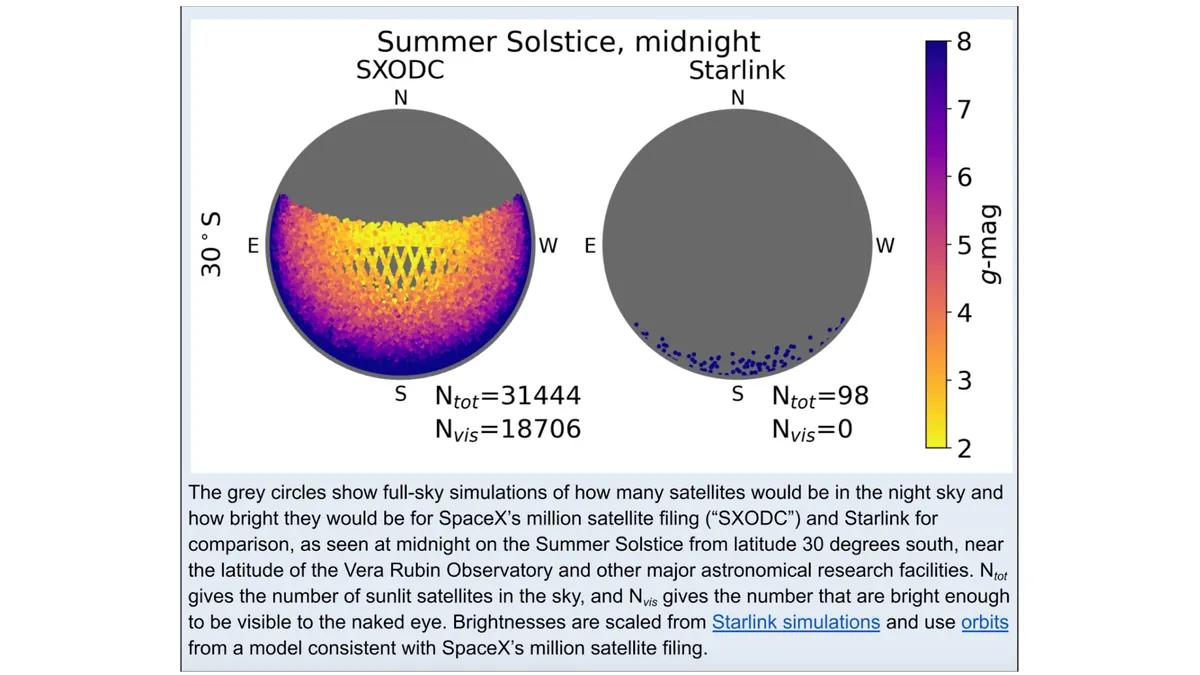
Comparison of the visibility of SpaceX's Starlink satellites and AI data center constellations (Image source: John Barentine)
For astronomical research that relies on the observation of faint celestial signals, this loss is fatal. The overall increase in the brightness of the night sky that may be brought about by the Reflect Orbital mirror constellation will also force astronomers to significantly extend the exposure time of their photographs. Some astronomers said, "We will never be able to observe dim celestial targets again, and the consequences will be catastrophic."
The global astronomy community has launched the most powerful astronomical observation equipment in history in recent years, aiming to expand the limits of human understanding of the universe. The Vera C. Rubin Observatory, which cost $10 billion and was launched last year, and more new large - scale telescopes currently being built in Chile will also be severely interfered with by the operation of a large number of satellites in the future.
Meanwhile, astronomers estimate that currently, about three old satellites or discarded rocket debris disintegrate in the atmosphere every day. More frequent rocket launches will further exacerbate air pollution in space.
In addition to the "catastrophic" increase in the brightness of the night sky and the blocked astronomical view, the light pollution from commercial spaceflight will also bring about a chain reaction in the Earth's ecological environment and human culture.
Astronomers believe that after the large - scale commercial space programs of humanity fundamentally change the night sky, it will not only have a profound impact in the astronomical field but also affect the Earth's ecosystem, human cultural heritage, and the overall connection between humanity and the universe.
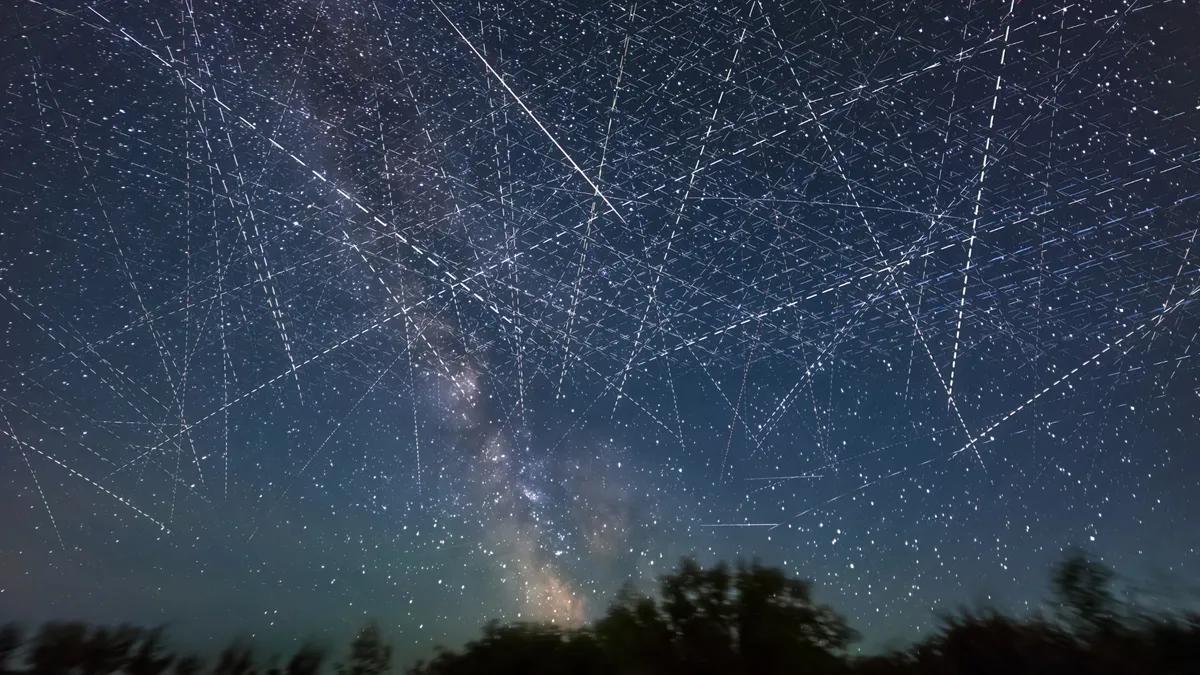
Image source: Getty Images
A large number of studies have proven that artificial light sources can seriously interfere with nocturnal migrating birds, insects, and marine life. When the night sky is significantly brightened by satellites and mirrors, these species that rely on the dark - night ecosystem will face unprecedented survival "anxiety" and even "stress".
Astronomers also point out that launching satellites into space without limit and restraint will also significantly increase the risk of space debris hitting the Earth.
Culturally, the starry sky also has profound significance for human civilization. Whether it is the ancient Greek star - related myths, the 28 lunar mansions in ancient China, or the enlightenment of modern astronomy, the inspiration of countless human civilizations is rooted in the starry sky that has not been polluted by artificial light sources. When this starry sky becomes unrecognizable, the loss may not be measured by economic data.
Multiple Parties Should Work Together to Protect the Beautiful Starry Sky of Humanity
It should be noted that commercial space companies such as SpaceX are also trying to reduce the satellite reflection phenomenon by using coating treatment technologies such as dielectric mirror film. However, astronomers believe that these treatment technologies will only seem insignificant in the face of the huge base of the future "one - million - satellite" matrix.
The relatively radical view in the astronomy community is that "to protect the brilliant starry sky that has existed for billions of years, the only option is to set a red line for the total number of satellites in orbit, just like limiting pollutant emissions."
However, the overall opposition voice in the global astronomy community is relatively "mild". It also acknowledges that satellite technology innovation can indeed bring significant social benefits and beautiful visions such as universal Internet and space computing power to humanity.
A bottom - line principle in the astronomy community is that the "beautiful starry sky" should be regarded as a precious natural environmental resource shared by all of humanity and the Earth's ecosystem, rather than a blank asset that commercial companies can occupy at will.
Neither technological improvement nor soft coordination can replace systematic institutional arrangements. Astronomical observation is a common cause of humanity, and the beautiful starry sky is a common heritage of humanity and nature. When commercial interests conflict with these two, a governance framework that balances efficiency and fairness is needed.
Currently, the global astronomy community is uniting multiple forces and trying to promote the establishment of a forward - looking regulatory and governance system for the space environment (especially the low - orbit environment) at the US FCC level.
In this new regulatory and governance system for the "beautiful starry sky", Lei Technology (ID: leitech) believes that commercial space companies, the astronomy community, regulatory agencies, etc. can all play more active and crucial roles.
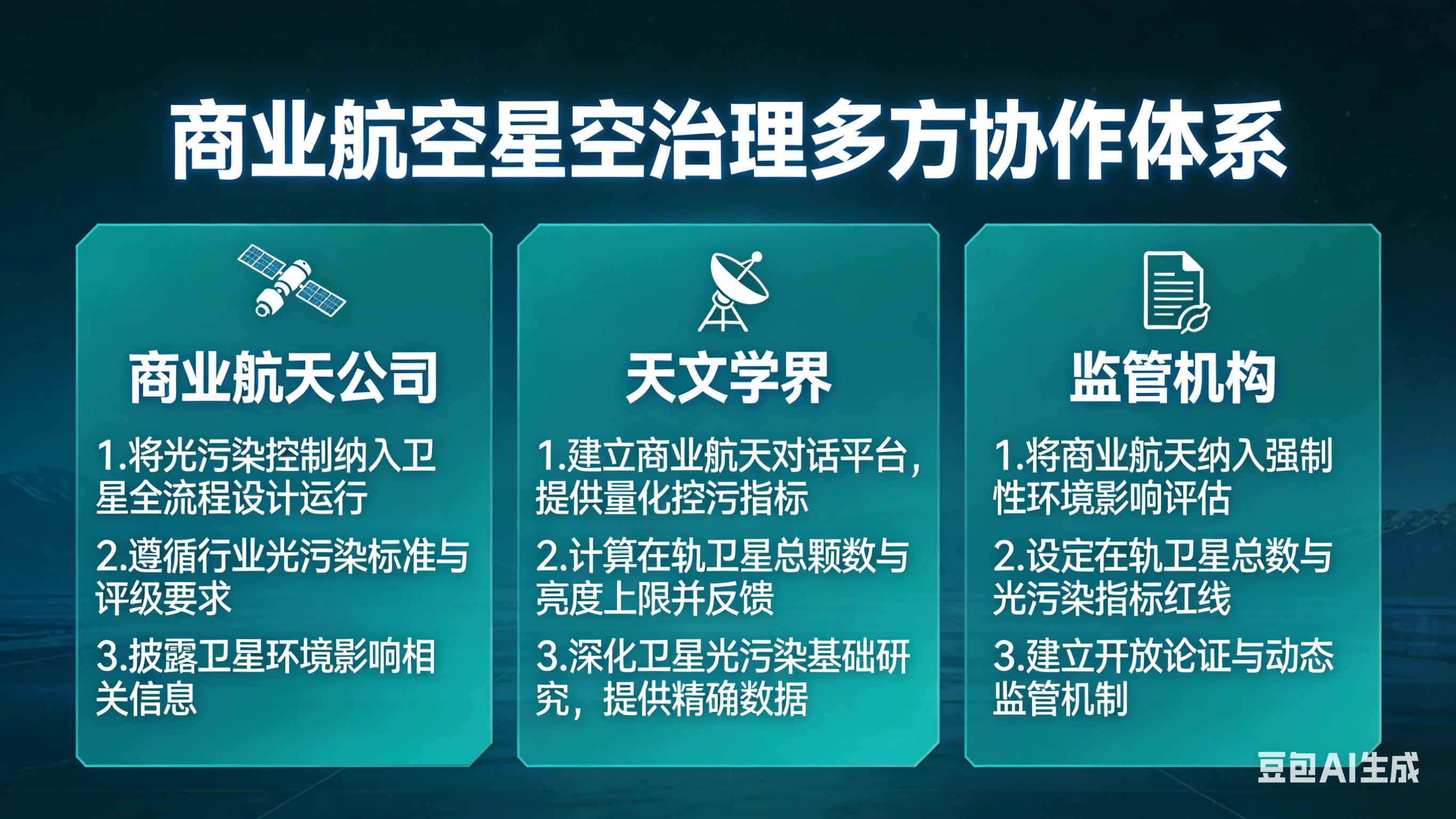
Image source: Doubao AI generation
Commercial space companies should set "light pollution control" as an important or even key indicator in satellite design and operation at the self - discipline level. From satellite surface coatings, attitude control algorithms, orbital height selection to reflectance indicators, the specific impacts on the starry sky environment should be systematically considered at the design stage.
At the heteronomy level, commercial space industry associations can formulate industry - wide satellite brightness upper - limit standards and best - practice guidelines for light pollution control based on the opinions of the astronomy community, and incorporate compliance into the enterprise rating system.
The astronomy community can shift from passive appeals to active participation. For example, it can establish a regular dialogue platform for commercial spaceflight, provide quantifiable light pollution control indicators for satellite design with professional knowledge, and even participate in the formulation of satellite design and deployment rules.
Astronomical research institutions can also calculate the acceptable total number of satellites in orbit or the total brightness upper - limit based on the sensitivity thresholds of different astronomical observation tasks to light pollution, and feedback this data to regulatory authorities and relevant enterprises.
In addition, astronomers need to increase investment in basic research on satellite light pollution. Many current calculation models still have great uncertainties, and the astronomy community has the responsibility to provide more accurate quantitative data to provide a scientific basis for regulatory decisions.
At the regulatory agency level, the current global regulatory framework for commercial spaceflight generally lags behind the pace of technological development. The rapid - advancement attitude of the US FCC and others towards the applications of SpaceX and Reflect Orbital reflects the dilemma of regulatory agencies when facing emerging technologies: overly strict approval may suppress innovation, while overly lenient approval may lead to irreversible damage to public resources such as the night sky.
However, global space regulatory agencies such as the US FCC must also attach great importance to the suggestions of the astronomy community, including whether to include commercial spaceflight in mandatory environmental impact assessments (such as EIA), and whether to set a red line for the total number of satellites in orbit, including light pollution indicators. Necessary restrictive measures should be formulated, just like dealing with other pollutants (sources), and this must be based on full demonstration and open discussion by regulatory authorities.
In terms of specific operations, regulatory authorities can promote the establishment of the following mechanisms:
1. Mandate commercial space enterprises to disclose satellite reflectance, in - orbit lifespan, and decommissioning disposal plans before satellite launches;
2. Establish an independent astronomical and starry - sky environmental impact assessment committee to conduct special reviews of large - scale satellite constellation projects;
3. Establish an international coordination mechanism, as satellite light pollution is a cross - border issue, and the supervision of a single country has inherent limitations.
The beautiful starry sky has guided humanity's voyages and inspired scientific inspiration. As a major event for all of humanity and nature, protecting the beautiful starry sky not only requires all parties to attach greater importance to it conceptually but also requires all sectors to work together to promote the gradual improvement and formation of the global starry - sky regulatory and governance system.
This article is from the WeChat official account "Lei Technology", author: Lei Technology. Republished by 36Kr with permission.