The former NVIDIA employees invested by Lei Jun are going to IPO, aiming for the "first stock in AI glasses".
According to a report by Zhidongxi on April 2nd, last night, XREAL, a leading AR glasses company in Shenzhen, officially submitted its prospectus to the Hong Kong Stock Exchange, aiming for a Hong Kong IPO.
XREAL was founded in January 2017 by Xu Chi, Xiao Bing, and Wu Kejian, three alumni of Zhejiang University. Its core business is to design, develop, manufacture, and sell AR glasses under its own brand and provide related products and services. Since the launch of its first commercially available consumer - oriented AR glasses, the Light series, in 2019, XREAL's revenue last year reached 516 million yuan, and it has established partnerships with global giants such as Google, Bose, and Sony.
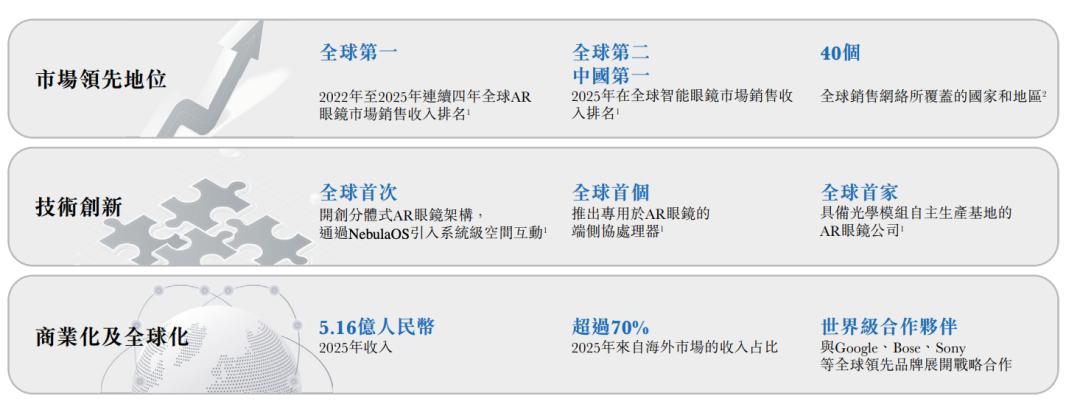
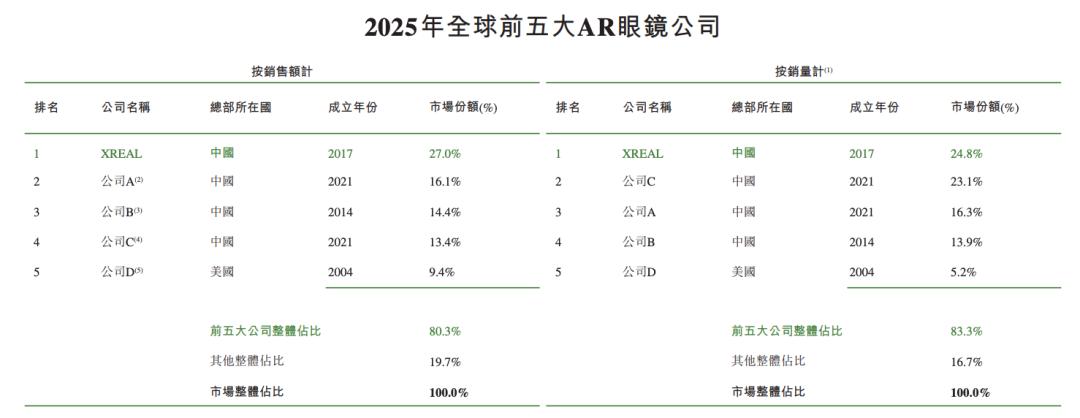
According to data from iResearch, in terms of sales revenue, XREAL ranked first in the global AR glasses market from 2022 to 2025. According to the chart annotations, companies A, B, C, and D may be Viture, Rokid, Thunderbird Innovation, and Meta.
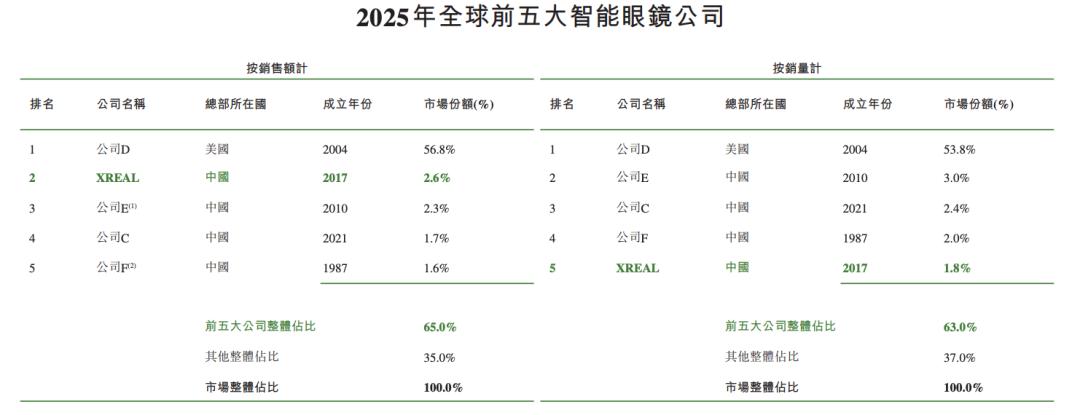
In terms of sales revenue in 2025, XREAL ranked second globally and first in China in the entire smart glasses market, including AR glasses and non - display glasses. According to the annotations, company E is Xiaomi and company F is Huawei.
Among XREAL's major shareholders, Taobao China Holding under Alibaba holds 6.68% of the shares, Cosmic Blue under Kuaishou holds 6.66%, Shunwei Capital under Lei Jun holds 4.33%, Luxshare Precision holds 1.18%. There are also three state - owned assets, namely China Internet Investment Fund, Wuxi New Kinetic Energy, and Pudong Chuangling, holding 2.46% and 1.11% respectively.
Since its establishment in 2017, XREAL has completed dozens of rounds of financing. The investors include Alibaba, Kuaishou, NIO Capital, Hillhouse Capital, Shunwei Capital, iQiyi, etc. After completing the Series D financing in 2024, XREAL's latest valuation reached 833 million US dollars (approximately 5.737 billion yuan).
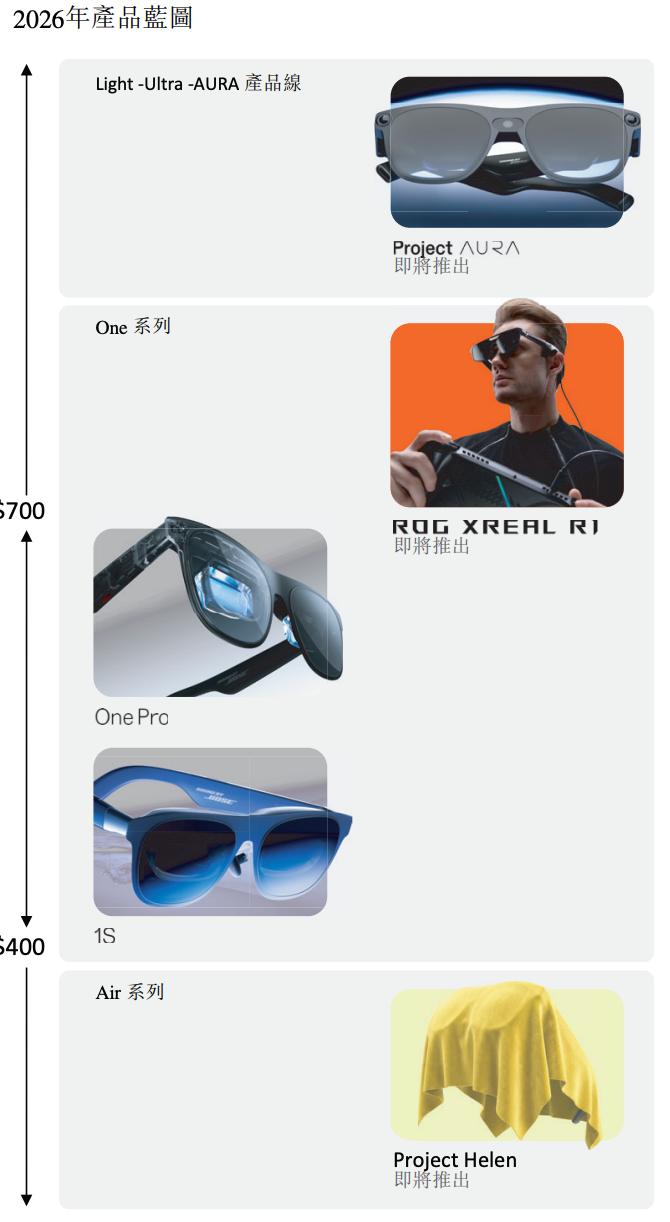
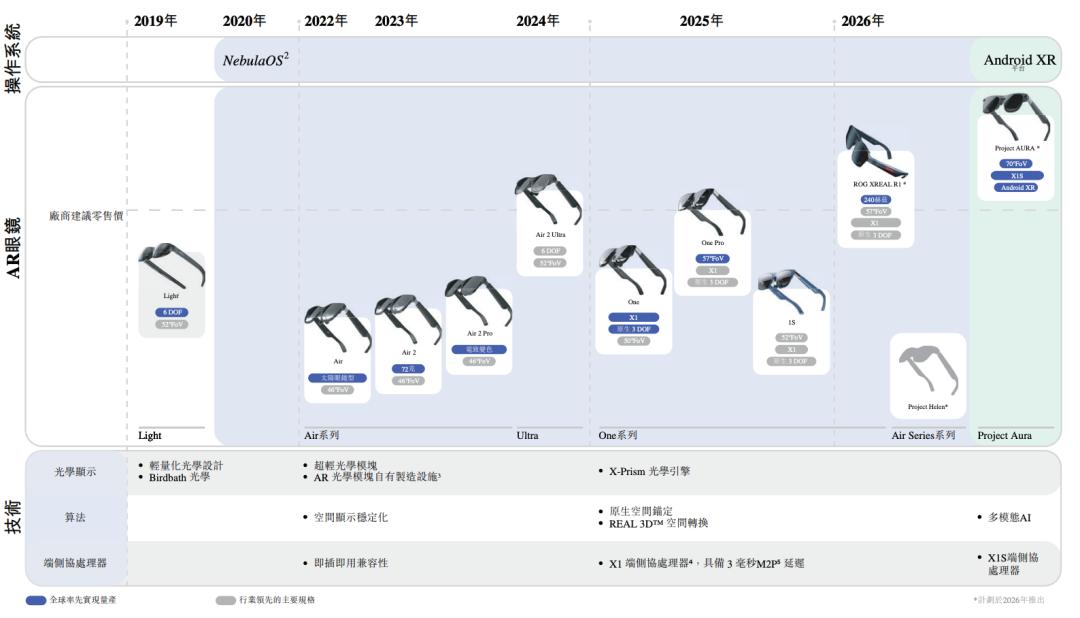
XREAL revealed its new product plans for 2026 in its prospectus, including ROG XREAL R1 in cooperation with ASUS ROG for gaming; Project Helen, a new product in the Air series, aiming to reach a wider range of users at a more competitive price; and Project Aura, the next - generation flagship product developed with Google on the Android XR platform.
The purposes of the fundraising plan for this IPO include continuous R & D investment, global brand building, strengthening of sales and distribution networks, construction of new self - operated production lines and upgrading of existing production infrastructure, deployment and upgrading of internal systems, working capital, and general corporate purposes.
01. Revenue of 516 million yuan last year, 70% from overseas
From 2023 to 2025, XREAL's revenues were 390 million yuan, 394 million yuan, and 516 million yuan respectively, and the net profits were - 882 million yuan, - 708 million yuan, and - 456 million yuan respectively. The R & D investments were 216 million yuan, 204 million yuan, and 183 million yuan respectively, accounting for a decreasing proportion of the total revenue year by year, which were 55.3%, 51.8%, and 35.5% respectively. The prospectus mentioned that this was due to the improvement of R & D efficiency and the continuous expansion of the revenue scale.
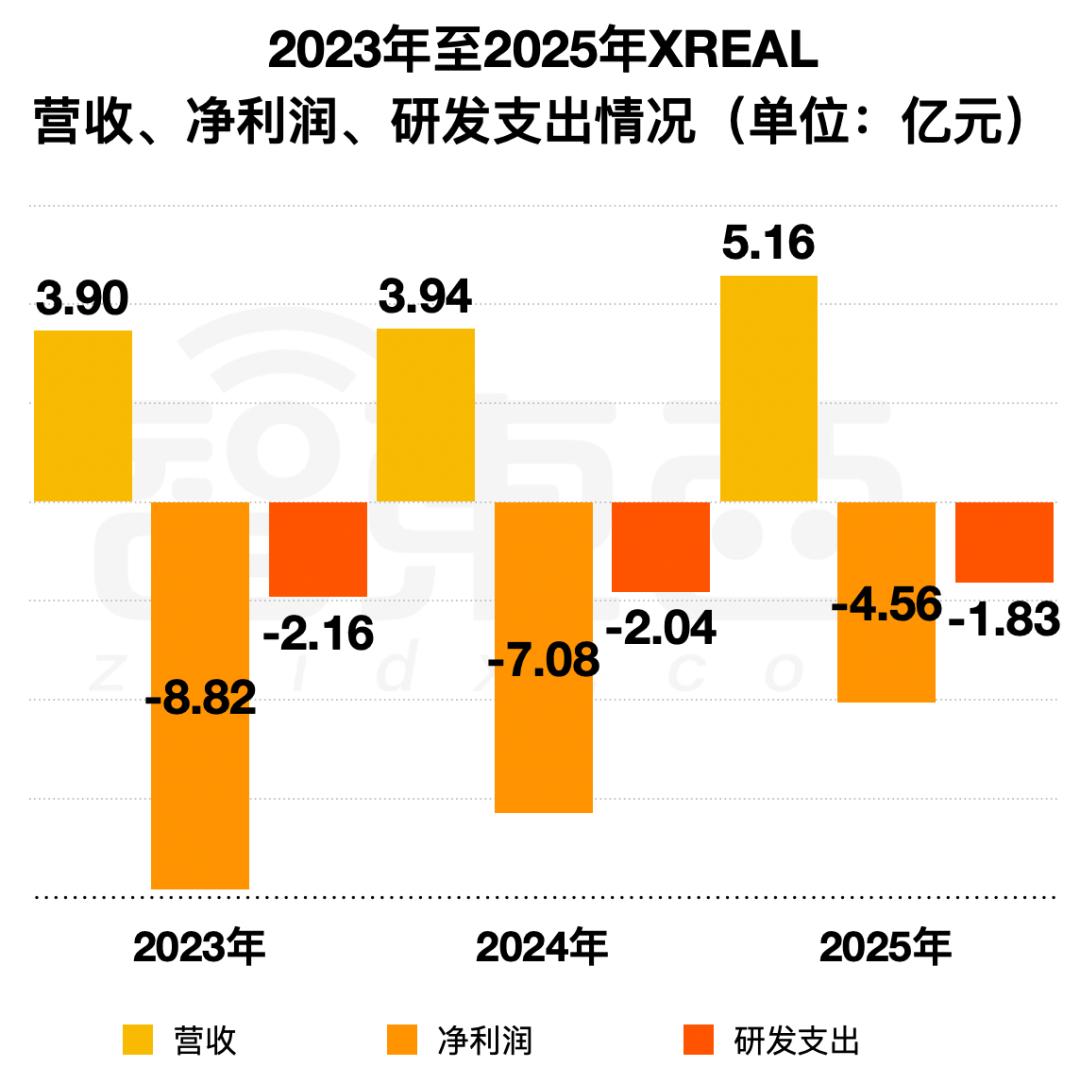
▲ XREAL's revenue, net profit, and R & D expenditure from 2023 to 2025 (Chart by Zhidongxi)
According to the prospectus, there are three reasons for XREAL's losses. One is the non - cash fair value changes of preferred shares, warrants, and convertible notes. The second is R & D expenses. The third is the sales and distribution expenses generated from the global market promotion and channel construction of AR glasses. XREAL's adjusted net profits were - 437 million yuan, - 375 million yuan, and - 250 million yuan.
Currently, the company's main business includes AR glasses and accessories. From 2023 to 2025, the revenue from AR glasses exceeded 77%.
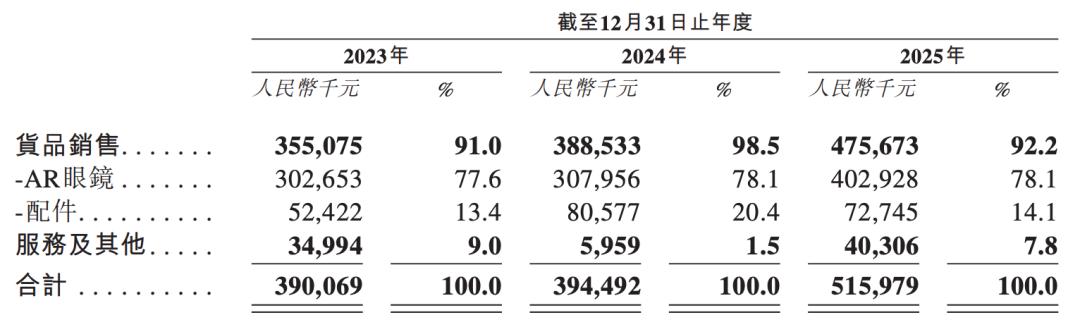
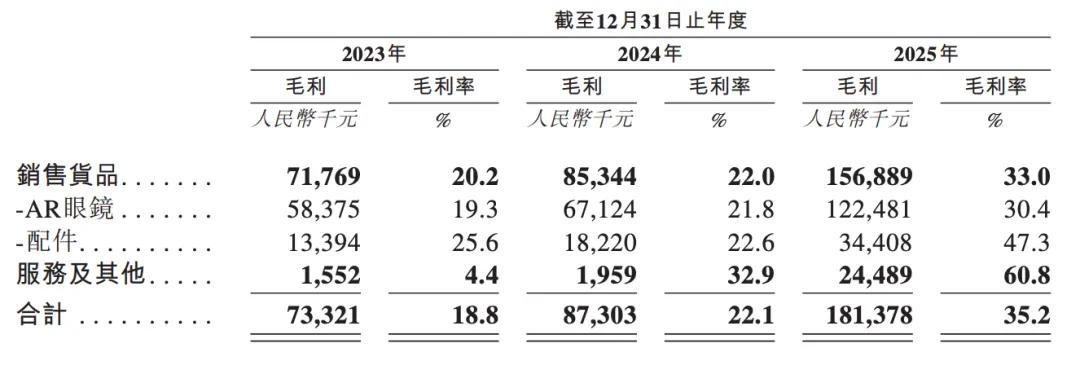
In terms of gross profit margin, it was 18.8%, 22.1%, and 35.2% in 2023, 2024, and 2025 respectively. The significant increase in the gross profit margin in 2025 was due to the increased contribution of high - margin products such as the One series to sales, which brought economies of scale and reduced the average unit production cost. The average gross profit margins of AR glasses were 19.3%, 21.8%, and 30.4% respectively.
In terms of regional distribution, XREAL's overseas revenue accounted for a relatively large proportion, exceeding 65% from 2023 to 2025 and increasing year by year. According to the prospectus, XREAL's sales network has covered 40 countries and regions.
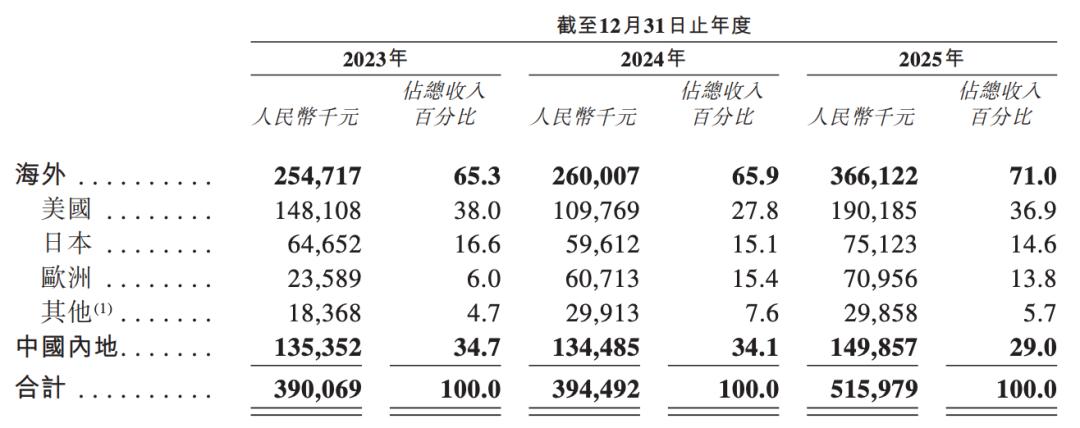
The company's cash and cash equivalents at the end of the three - year period were 181 million yuan, 205 million yuan, and 64 million yuan respectively.
02. Three major product lines are laid out, and the annual sales volume of the One series exceeds 110,000 units
XREAL's AR glasses product lines include the Air series, the One series, and the Light - Ultra - Aura product line.
Among them, the Air series is an entry - level product with a larger user base. This product focuses on high - frequency scenarios such as immersive movie - watching, console gaming, and mobile office. The wearing experience is similar to that of ordinary glasses, and it supports plug - and - play, being able to connect to mobile phones, PCs, and game consoles.
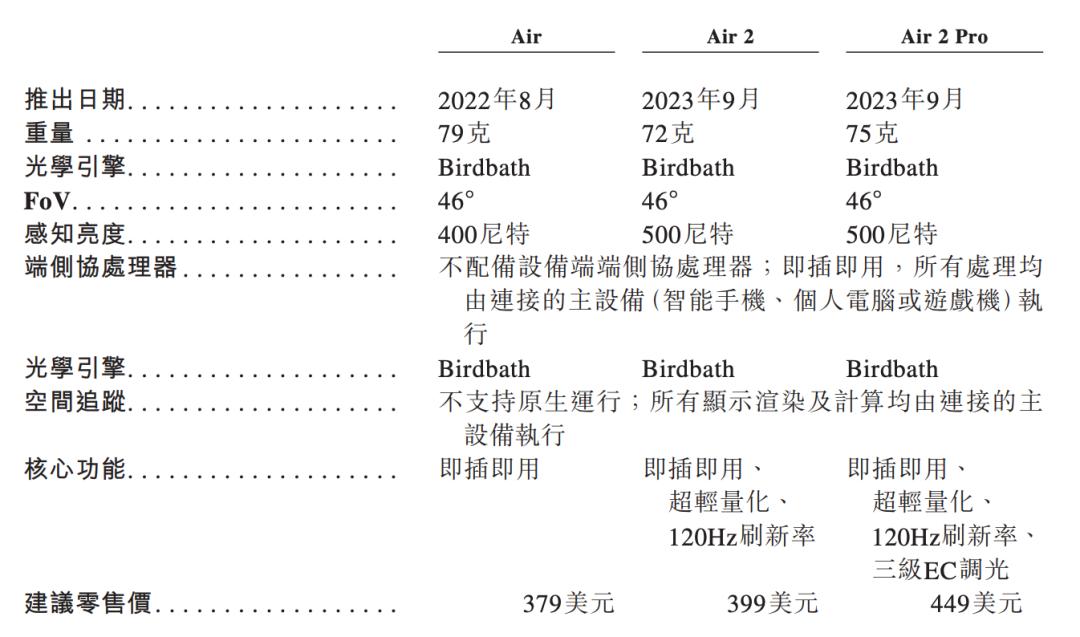
▲ Product specifications of the Air series
The One series further enhances the display and interaction capabilities. Its devices are equipped with Micro - OLED display technology, a customized X1 edge - side coprocessor, and electrochromic lenses that can automatically adjust the brightness according to different light conditions.
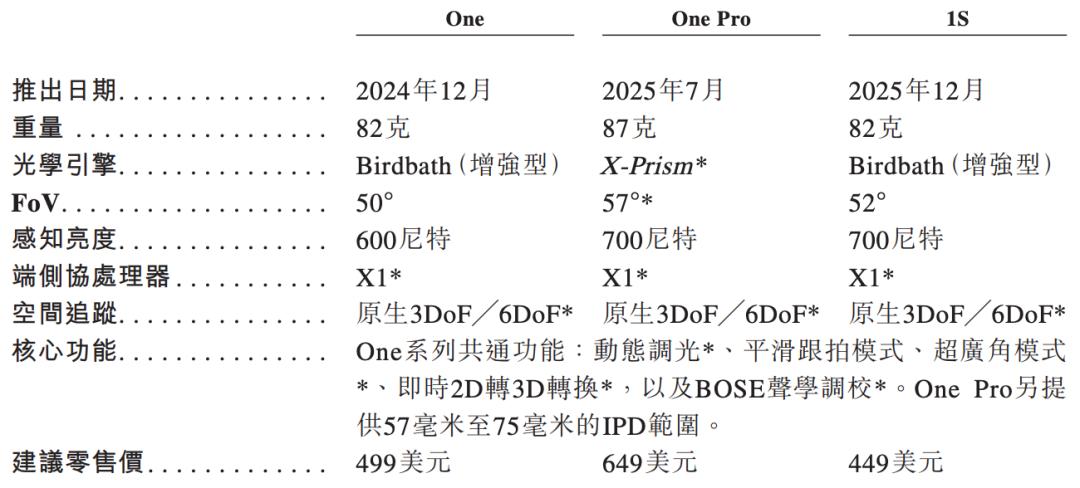
▲ Product specifications of the One series
The Light - Ultra - Aura product line represents the company's progress towards the next - generation spatial computing. The early Light series established its market position, the Ultra introduced spatial perception and complete 6DoF interaction capabilities. The next - generation flagship product, Project Auro, will increase the FoV to about 70 degrees, integrate spatial computing and multi - modal AI capabilities, and is expected to run on the Google Android XR platform.
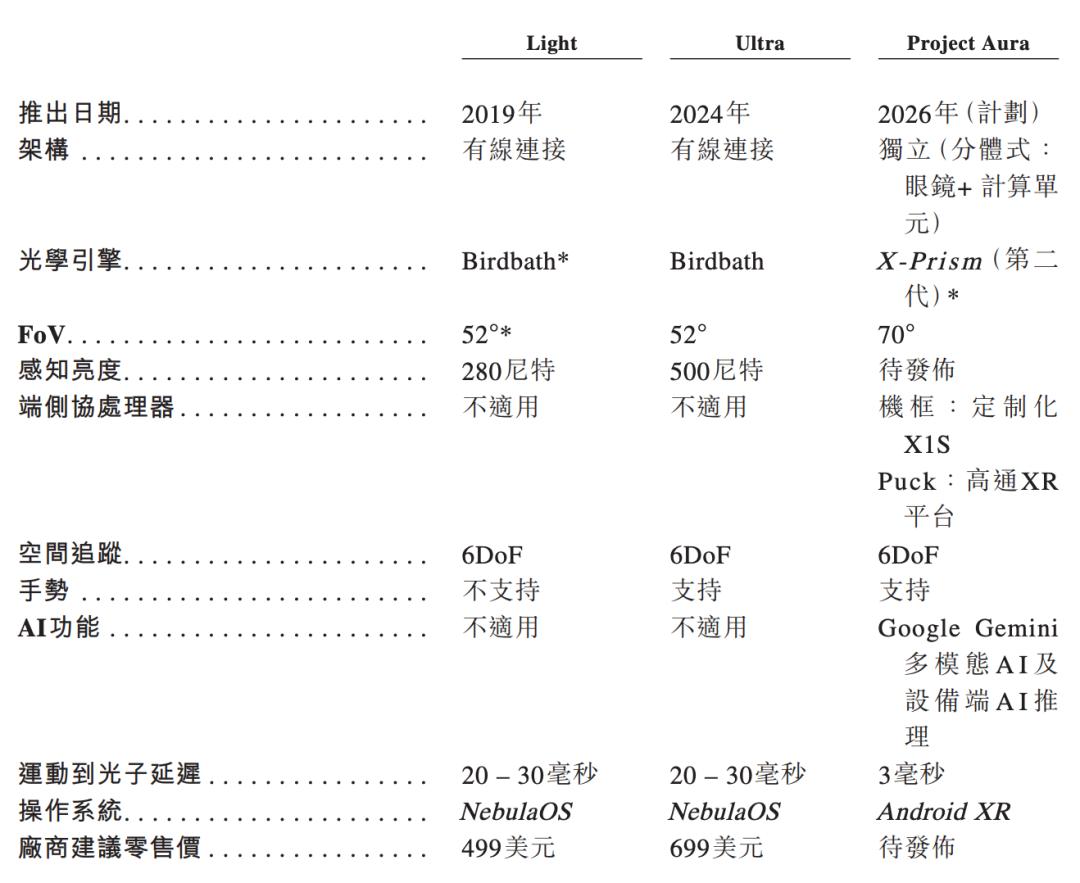
▲ Product line specifications of the Light - Ultra - Aura
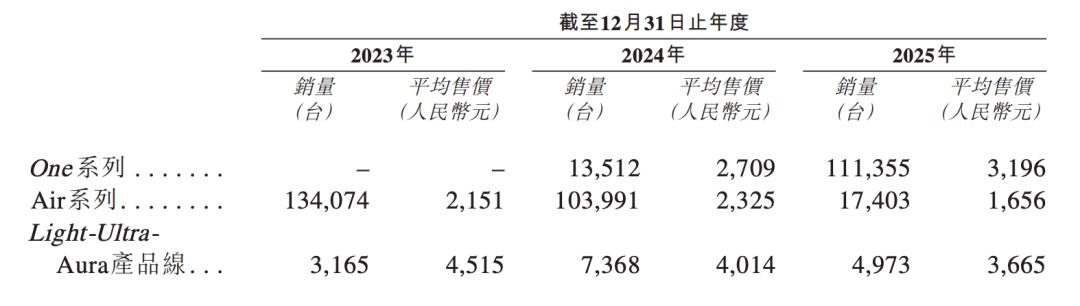
In terms of sales volume and average price, in 2025, the average selling price of the One series was 3,196 yuan, the average unit price of the Air series was 1,656 yuan, and the average unit price of the Light - Ultra - Aura product line was 3,665 yuan. The sales volumes were 111,300 units, 17,400 units, and 5,000 units respectively.
For enterprise customers, the company supports enterprise customers to customize AR - related products for specific application scenarios. The service scope includes optical module design, hardware development, software system integration, and AR application scenario customization.
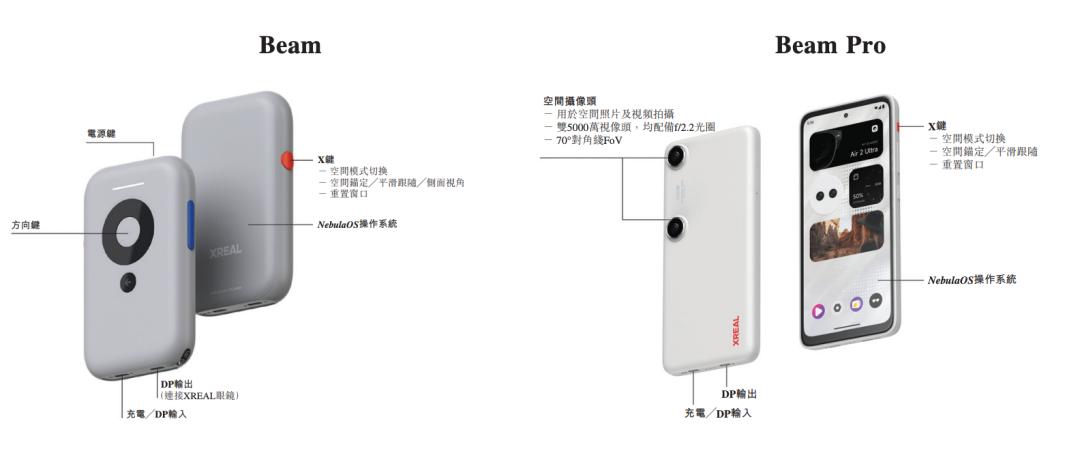
The company's business also includes accessories. Accessories are an extension of the functions of AR glasses, including the Beam series of computing terminals, prescription lens modules, connecting cables, nose pads, and other functional accessories, accounting for 13.4%, 20.4%, and 14.1% of the total revenue in the same period in three years respectively.
03. Supported by four core technologies, the annual production capacity of the Wuxi base reaches 216,000 units
XREAL has four core technology systems:
1. The self - developed X - Prism optical engine, compared with the mainstream Birdbath optical solution in the industry, can provide a thinner module and a wider FoV. Project Auro aims to achieve a market angle of about 70 degrees.
2. The customized X1 edge - side coprocessor designed specifically for AR glasses supports the local operation of spatial algorithms, and the motion - to - photon delay is less than 3 milliseconds.
3. High - performance algorithms can stabilize virtual objects in the physical space and support functions such as real - time 2D to 3D video conversion.
4. The self - developed NebulaOS can serve as a system interface between device capabilities and applications, covering usage scenarios such as entertainment, productivity, and developer tools. NebulaOS is an in - house operating system designed specifically for the AR environment, which can achieve the spatialized display of native 3D Android applications, multi - window management, 3DoF and 6DoF spatial positioning, and intuitive gesture interaction.
As of December 31,