With over 200 TOPS computing power to achieve L4 level, the "new force in the truck industry" incubated by Baidu Apollo really has something special.
It's hard to say where will be the first place for Robotaxi to be put into use, but it's clear where the first place for Robotruck will be -
Inner Mongolia, China:
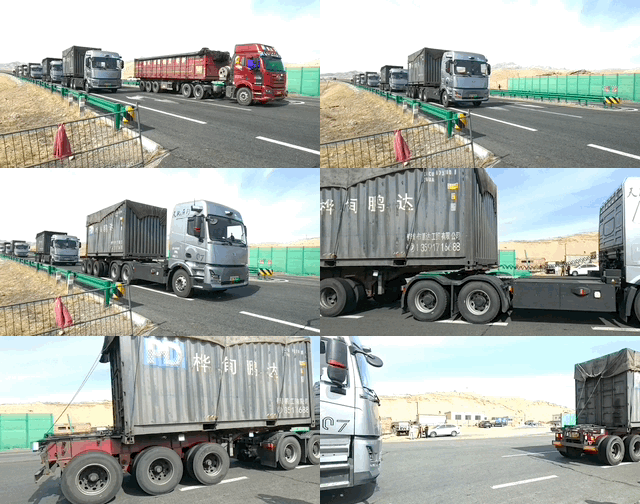
We have analyzed in detail the L4 truck formation running in Ordos. Going north from Ordos, in Bayannur City, which borders Mongolia, the unmanned operation of bulk cargo transportation is also being rapidly realized.
The player behind this is no stranger, an autonomous driving truck company incubated by Baidu: DeepWay.
And DeepWay's technical solution to achieve L4 is like the "Leapmotor" version of L4 trucks -
It also uses L4 formation, but each truck has a computing power of 256 TOPS and the autonomous driving kit costs 30,000 yuan.
Combined with its leading production and delivery of new energy heavy trucks, DeepWay is speeding towards the goal of being the "first stock in L4 truck freight".
Bayannur in Inner Mongolia also has L4
Inner Mongolia becoming the first place for the commercial operation of Robotruck is closely related to its unique natural conditions: the province has a well - developed network of highways and first - class roads, with excellent conditions for long - distance trunk transportation.
Moreover, Inner Mongolia itself is currently the top province in China in the production of bulk commodities such as coal, rare earth, and livestock. The number of heavy trucks in the province accounts for 1/5 of the national total, more than 300,000. The scenarios and demands are perfectly suitable for the implementation of L4 truck trunk logistics.
Also, Inner Mongolia borders Mongolia, another country rich in mineral resources. The Ganqimaodu Port in Bayannur is the main way for importing Mongolian coal.
The commercial operation route of DeepWay's L4 formation is from the Ganqimaodu Port to the coal washing plant in Wuhai, with a total distance of more than 300 kilometers.
The entire formation uses L4 mass - produced vehicles, that is, the second - generation new energy heavy trucks self - developed by DeepWay:
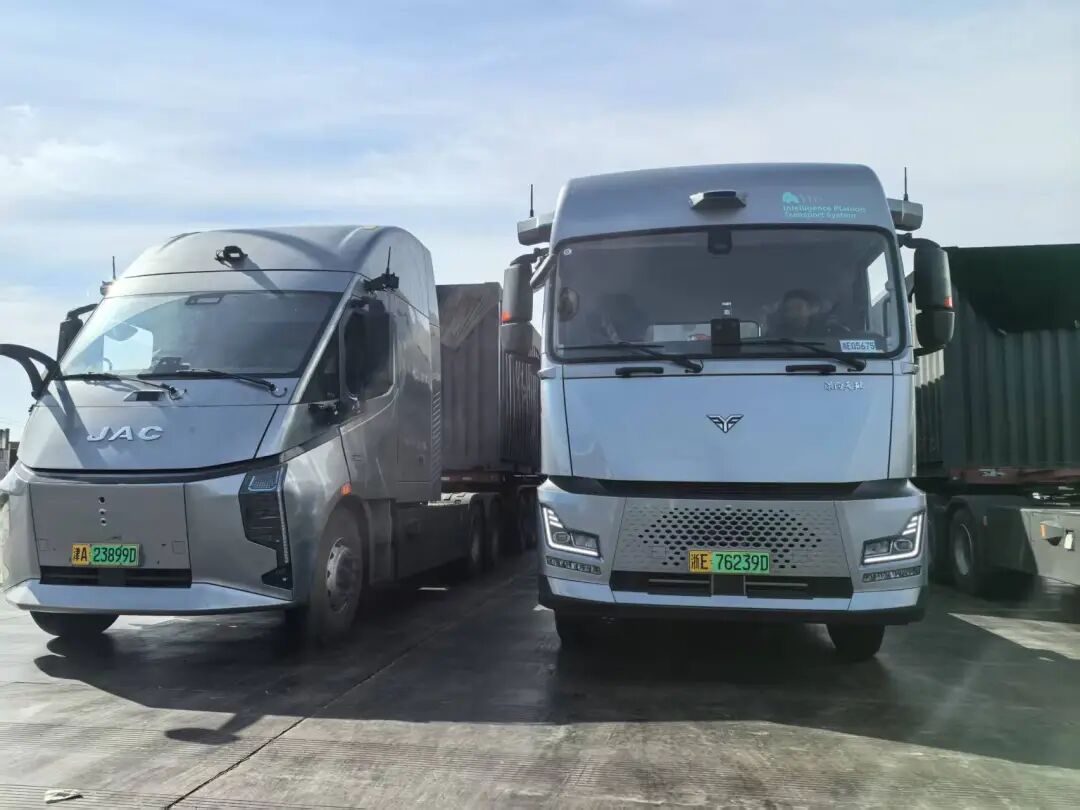
This operation route looks like a highway, but it is actually a first - class national road with toll stations and is not fully enclosed. There are various social vehicles mixed in, traffic lights, and of course, flocks of cattle and sheep crossing the road.
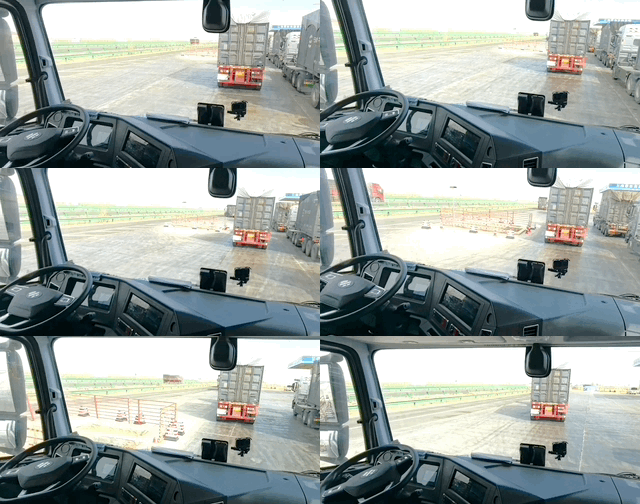
So the outstanding ability of DeepWay's L4 formation is, first of all, the autonomous driving of each truck, which can independently handle unexpected situations on the road:
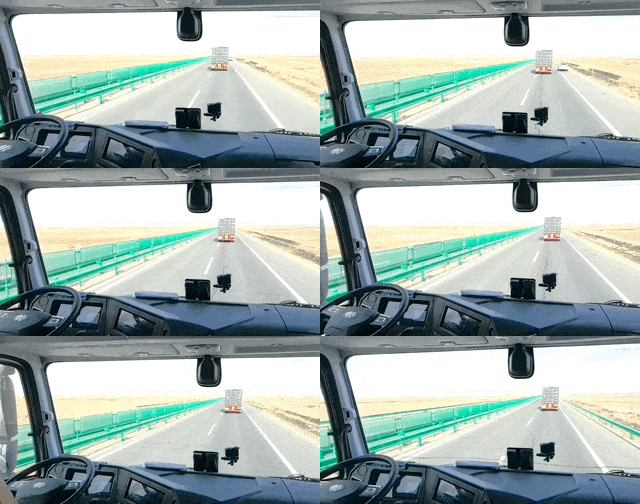
For example, when there are various parked vehicles on the side of the national road, the truck formation will actively avoid them.
Another example is that when a social vehicle suddenly cuts in and interrupts the formation, the following trucks will independently decelerate and avoid:
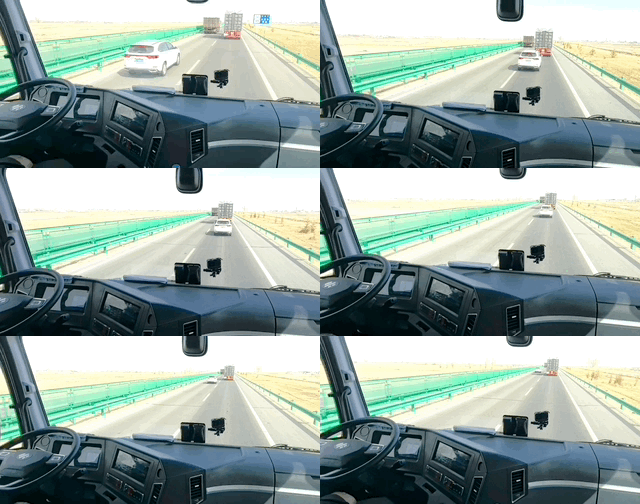
Facing slow - moving vehicles on the national road, the entire formation will overtake them in an orderly manner to ensure traffic efficiency:
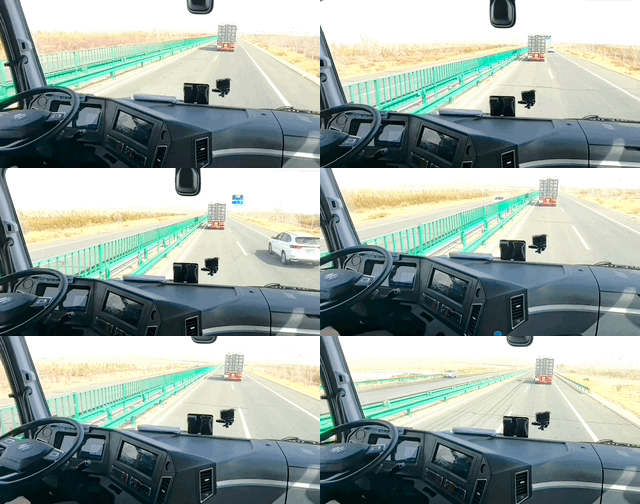
If a truck has a poor opportunity to change lanes, it will not force the lane change. Instead, it will first decelerate and observe. If necessary, it will cancel the lane change and wait for the right time to act.
The second ability is the essence of the "formation" mode: to solve the "breakpoint" problem in L4 operation, such as temporary inspections, flat tires, etc. - for these non - driving tasks, the driver of the leading truck will directly get off the vehicle to negotiate and handle them.
Of course, the leading truck also has other tasks: it shares road information with the entire formation through the V2V system. When there are obstacles such as maintenance areas temporarily separated on the side of the highway, waste tires, and tarpaulins on the ground, while the leading truck avoids them, it will synchronize the signals to the entire formation, and then each truck will choose the right time to detour and avoid according to the situation.
In addition, when the following trucks encounter scene problems beyond the capabilities of the L4 system, the driver of the leading truck can assist the following trucks to get out of trouble through remote instructions -
This is actually one of the signs of true L4 judgment. Not only is there no one in the vehicle, but there is also no 5G cloud - assisted driving at the back - end. Instead, non - real - time guiding instructions are used to assist the vehicle to get out of trouble.
However, DeepWay's solution to achieve L4 operation is different.
How does DeepWay achieve L4 with more than 200 TOPS?
The core hardware idea of DeepWay's L4 formation solution is not to pile up hardware. For example, there are 3 lidars, one in the front and two on each side for blind - spot compensation. The underlying computing chips are from Horizon - dual J6M, with a total computing power of 256 TOPS.
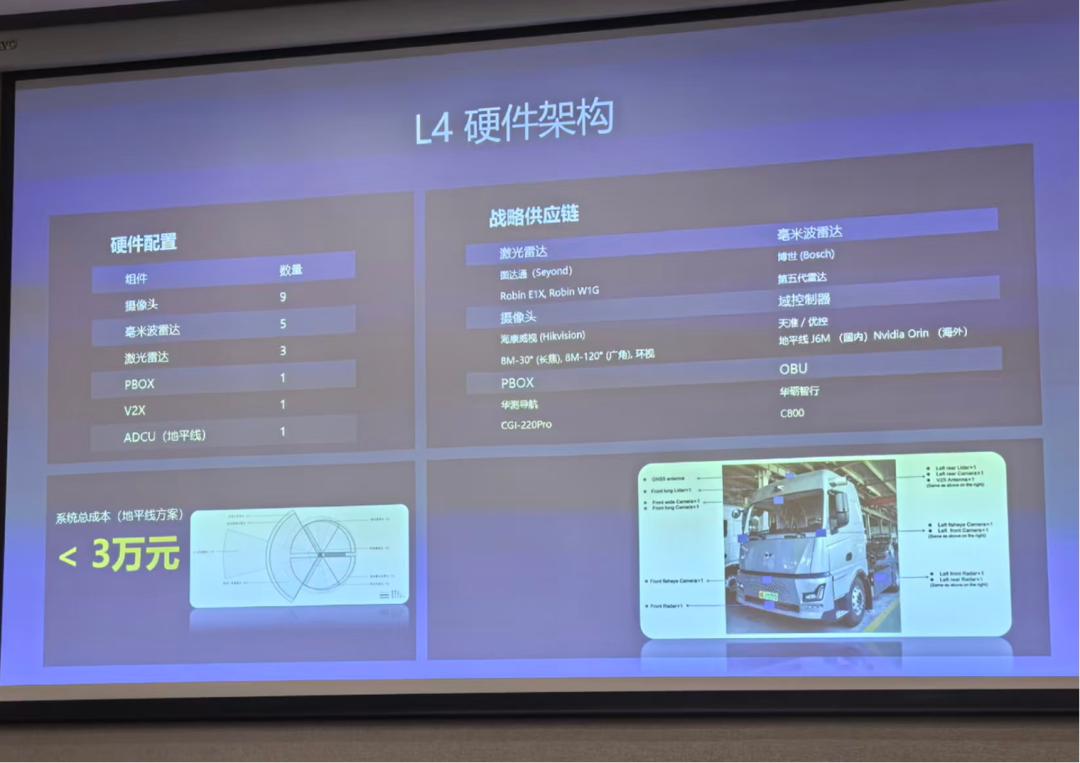
On most passenger cars, this is the configuration to achieve basic L2 functions. Players with strong algorithm capabilities may be able to achieve urban NOA.
But if we start from the scenario, we will find that the solution used by DeepWay is actually a way of "making the best use of everything" under the idea of leaving enough safety redundancy.
The core logic is: first identify all the risk points in unmanned operation, and then "allocate" the risks to different objects (single vehicle, cloud, road - side, navigator) through systematic means, rather than relying on the single - vehicle L4 system to solve all problems.
There is a three - layer safety architecture. The main function layer is the core L2/L4 driving function. The second layer is the active safety layer, such as AEB, FCW, fatigue warning, etc. Based on the accumulation of L2 operation over hundreds of millions of kilometers, it is said to have low false alarms and high reliability.
The third layer is the redundancy and failure response layer, which covers multi - point failures of software and hardware, and even extreme situations (such as brake failure). It can achieve safe parking through formation leading, remote control, etc.
To put it simply, the real road conditions of the heavy - truck operation routes in Inner Mongolia are very different from the morning and evening peak road conditions in Beijing, Shanghai, Guangzhou, and Shenzhen faced by Robotaxi: the boundary conditions are clear, and most of the road conditions are good and smooth, which means that the types and quantities of corner cases are actually limited.
If the goal is the rapid commercial implementation of L4 trucks and the unmanned operation of fixed - route formations, there is really no need for thousands of TOPS of computing power.
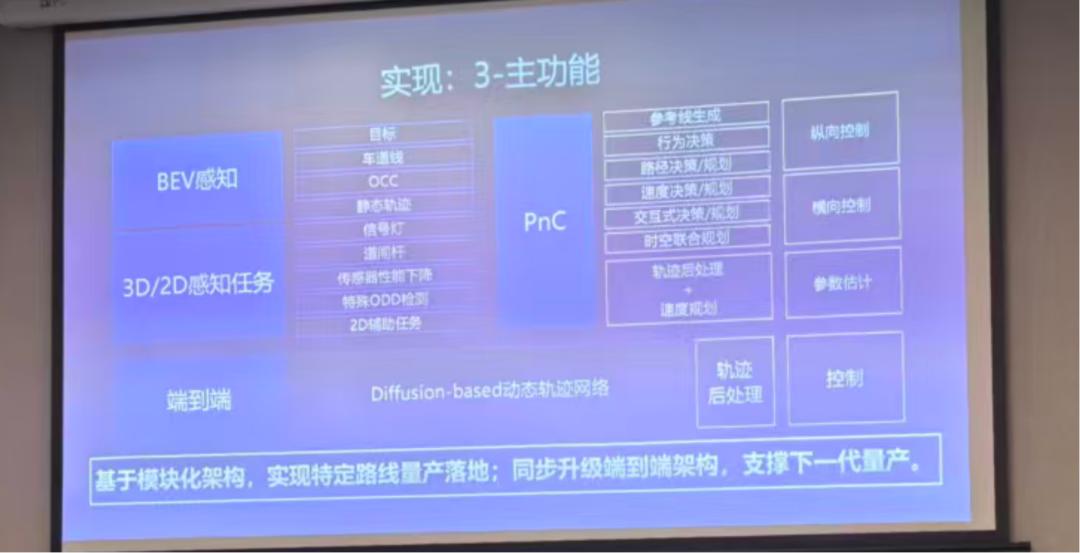
So, currently, DeepWay uses a hybrid architecture of "AI - based perception + engineering - based planning and control" in the main function layer, which is specifically divided into the following links:
The perception layer takes 3D detection and BEV (bird's - eye view) as the core, fuses data from multiple sensors (cameras, lidars, millimeter - wave radars), and constructs a stable environmental model. In sections without high - precision maps (such as national roads and large intersections), the perception module will directly output drivable trajectories, rather than just identifying lane lines, to deal with scenarios where lane lines are missing or blurred.
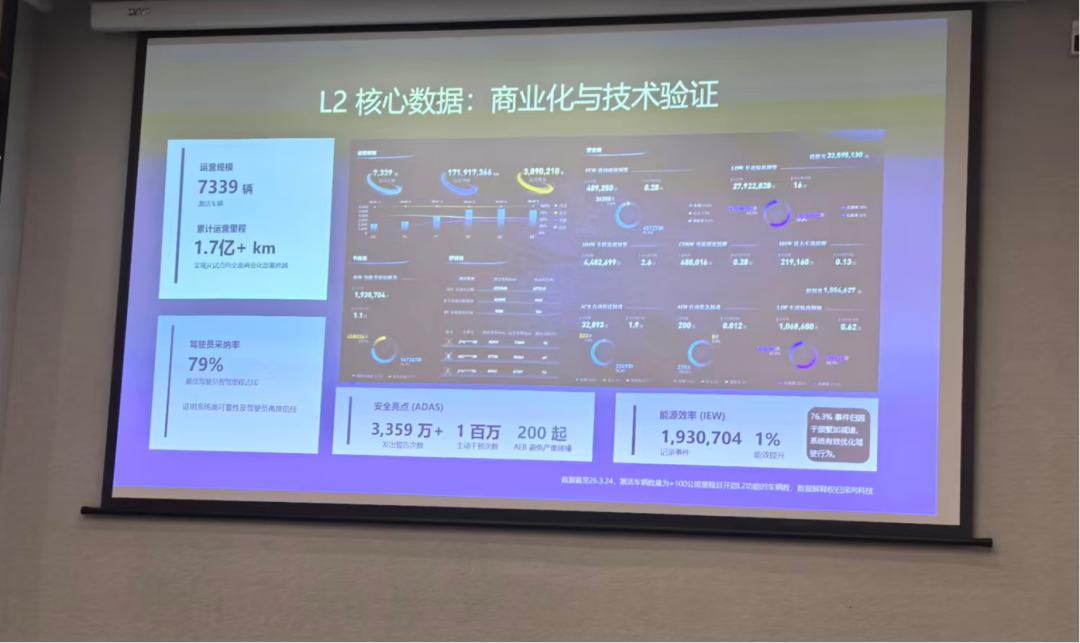
Some auxiliary tasks (such as judging passable areas and identifying obstacle attributes) are already undertaken by AI models, reducing the dependence on rule - based post - processing.
The planning and control layer still mainly uses traditional planning and control algorithms. That is, based on the structured information (lane lines, obstacles, trajectories) output by perception, paths and speed curves are generated through optimization methods and then executed by controllers such as PID and LQR.
This ensures the determinacy, interpretability, and debugging efficiency of the system. Especially for heavy trucks with large inertia and high risks, engineering robustness has a higher priority.
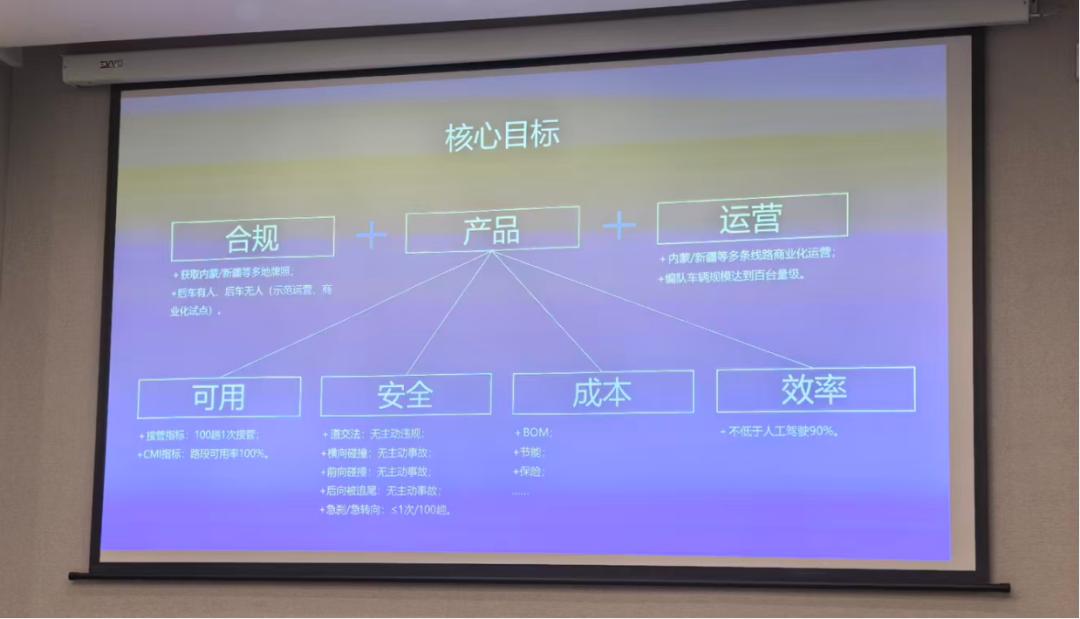
However, DeepWay has not stopped at the modular architecture. Instead, it takes the end - to - end algorithm as a clear technology upgrade path, with distinct scenario - oriented features.
DeepWay believes that the generalization ability of the end - to - end model highly depends on the data scale and distribution. Therefore, it chooses to first promote it on one or a few fixed operation routes.
These routes have high vehicle density, converged scenarios, and clear commercial value, and can accumulate enough high - quality data in a short time to complete model training and closed - loop iteration.
The current goal is to implement the end - to - end algorithm on specific routes in 2026 and then gradually expand it. The core algorithm, vehicle toolchain, and data platform are uniformly reused to ensure that the data and functions accumulated in L2 can be smoothly migrated to the L4 formation.
So, the core of the "Leapmotor" version of L4 trucks is to start from the scenario. At the start - up stage, first make a specific scenario work and generate commercial value, without going all - in on the exploration of unknown technology systems.
This not only ensures the stable operation of the current L4 formation but also reserves a clear path for the next - generation algorithm upgrade.
Is DeepWay the first stock in L4 truck freight?
When DeepWay just started in 2021, its prediction for us was:
The company will put 1,000 vehicles on the market in 2023, followed by 3,000 and 6,000 vehicles each year. After 2026, it is expected that DeepWay's annual sales can exceed 10,000, and at this time, the company will already have positive cash flow.
The actual completion is as follows:
In 2024, DeepWay delivered more than 3,000 self - developed new energy heavy trucks; the prospectus shows that as of June 2025, the actual delivery exceeded 6,400 units.
And the latest data shows that it has exceeded 12,000 units.
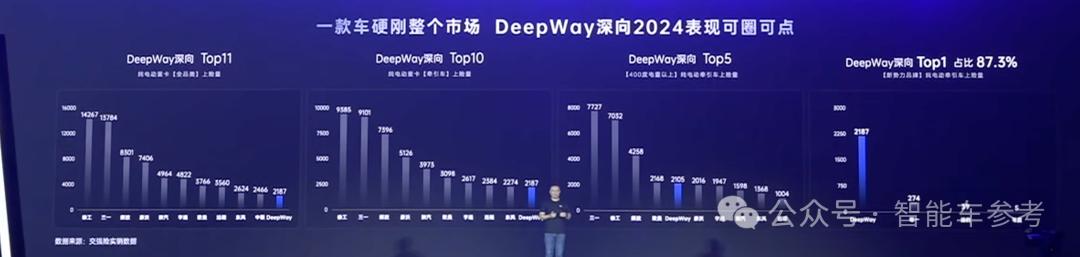
This is one of the earliest recognized labels of DeepWay - the world's first startup company that clearly "realizes the implementation of autonomous driving through positive vehicle definition", also known as a new force in the truck industry.
But at the beginning, the model of self - developing the vehicle body, which seems to be a heavy - asset approach, encountered many doubts.
However, DeepWay, which has reached the critical IPO stage, has not only proved the feasibility of this route with real performance disclosure but also shown unique advantages.
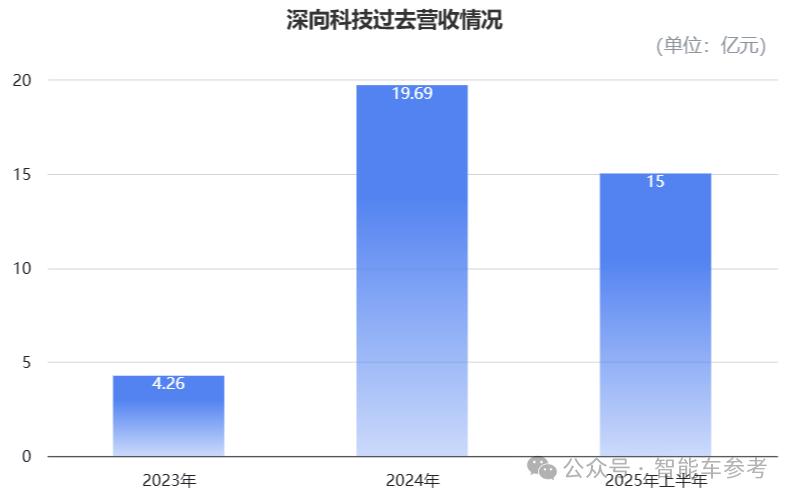
In 2023, the company's revenue was 426 million yuan, and in 2024, it soared to 1.969 billion yuan, a year - on - year increase of 3.6 times; in the first half of 2025, the company's revenue was 1.5 billion yuan, a year - on - year increase of 96.6%.
In terms of profit, the gross profits of DeepWay in 2023, 2024, and the first half of this year were 1.82 million yuan, 9.79 million yuan, and 44.14 million yuan respectively.
