Mit über 200 TOPS Leistung kann es L4-Fahrfunktionen ausführen. Die "neue Kraft im LKW-Bereich", die von Baidu Apollo gefördert wird, hat tatsächlich was drauf.
It is still unclear where the first location for the introduction of robotaxis will be, but it is already clear where the first introduction of robot trucks will take place -
Inner Mongolia, China:
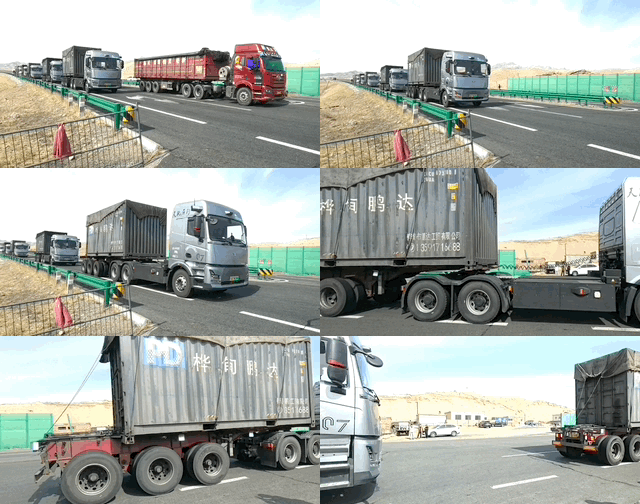
We have already analyzed in detail the L4 truck fleet in Ordos. If you drive further north from Ordos, you will reach the city of Bayannur, which is located on the border with Mongolia. Here, the automation of the freight transport of raw materials will also be quickly realized.
The actor behind this is not unknown: DeepWay, a company founded by Baidu for self - driving trucks.
DeepWay's technology concept for realizing L4 can be referred to as the "Lingpao Auto Workshop" for L4 trucks -
It is also an L4 fleet, but with a computing power of 256 TOPS per vehicle and a self - driving kit for 30,000 yuan.
Together with the already advanced production and delivery of electric trucks, DeepWay is on the way to becoming the "first listed company for L4 truck transportation".
Bayannur in Inner Mongolia has also reached L4
The fact that Inner Mongolia is the first location for the commercial introduction of robot trucks is closely related to the favorable natural conditions: The highways and first - class road networks are well - developed, and the conditions for long - distance transportation are excellent.
In addition, Inner Mongolia is currently the province in China with the largest production of coal, rare earths, livestock and other raw materials. The number of trucks in the province accounts for 1/5 of the national inventory, more than 300,000 vehicles. The scenarios and requirements are a perfect fit for the introduction of L4 trucks in long - distance transportation.
Moreover, Inner Mongolia borders Mongolia, a country also rich in mineral resources - The Ganjimiao Passage in Bayannur is the most important way for coal imports from Mongolia.
The commercial operation route of the DeepWay L4 fleet leads from the Ganjimiao Passage to the washing mine in Wuhai, a distance of over 300 kilometers.
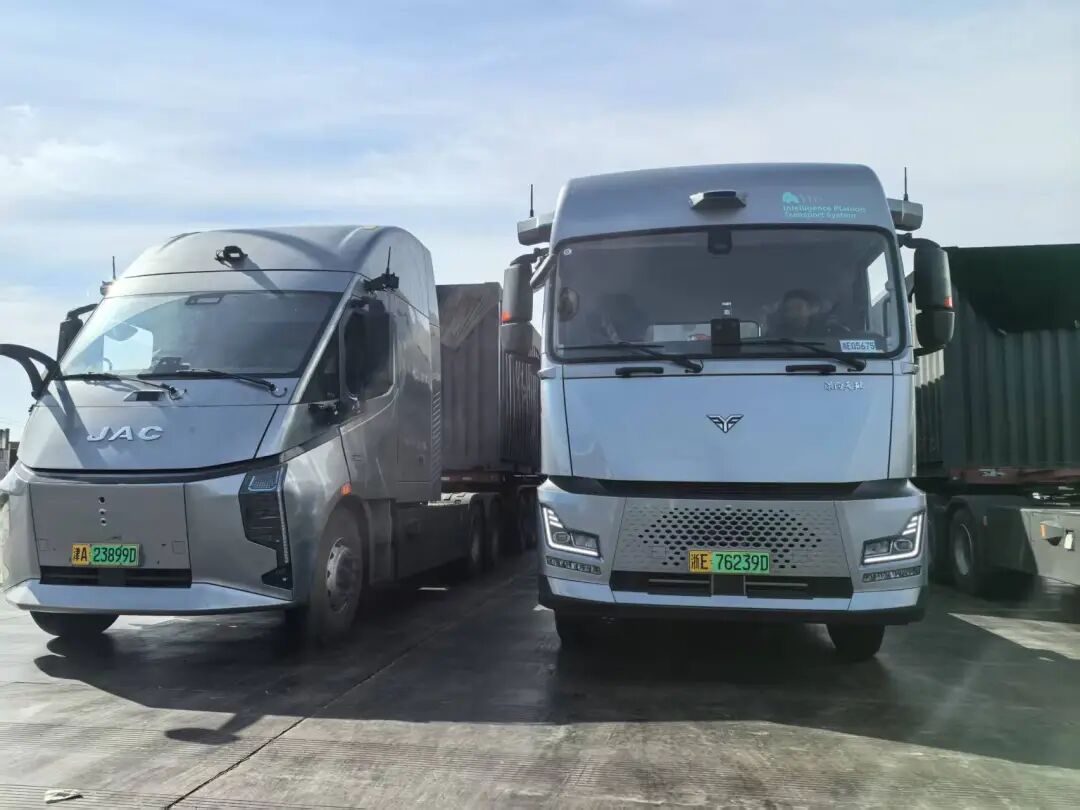
The entire fleet consists of standard L4 vehicles, namely the second - generation electric truck developed by DeepWay itself:
This operation route may look like a highway, but it is actually a first - class road with tolls and not completely closed. There are various other vehicles on the road, traffic lights, and of course also herds of sheep and cattle crossing the road.
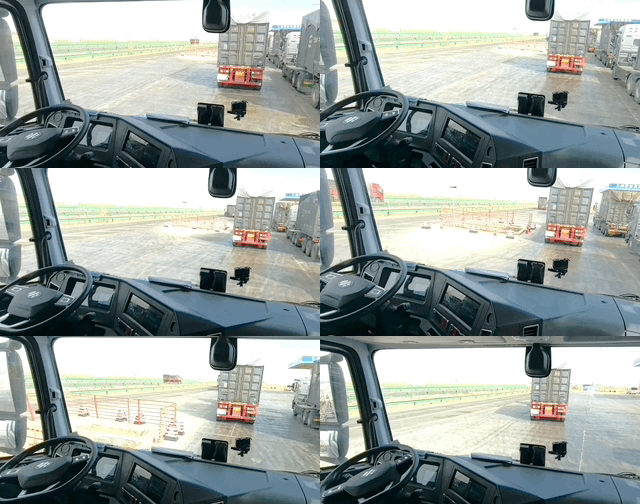
The outstanding ability of the DeepWay L4 fleet lies first in the self - driving ability of individual vehicles and the autonomous handling of sudden situations on the road:
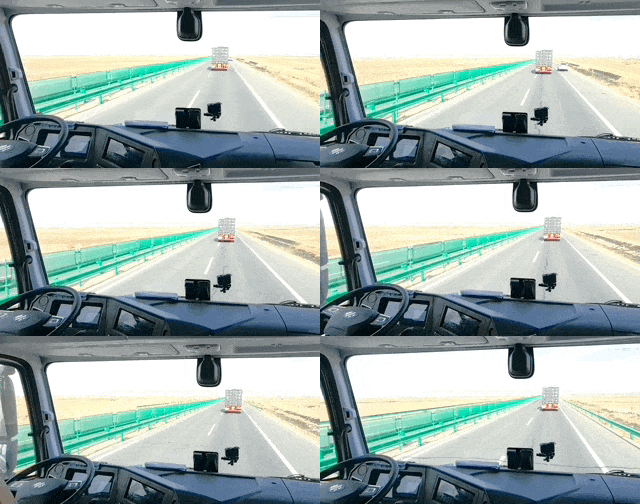
For example, vehicles parked on the side of the road are automatically bypassed by the fleet.
If another vehicle suddenly cuts into the fleet, the following vehicle automatically brakes to avoid a collision:
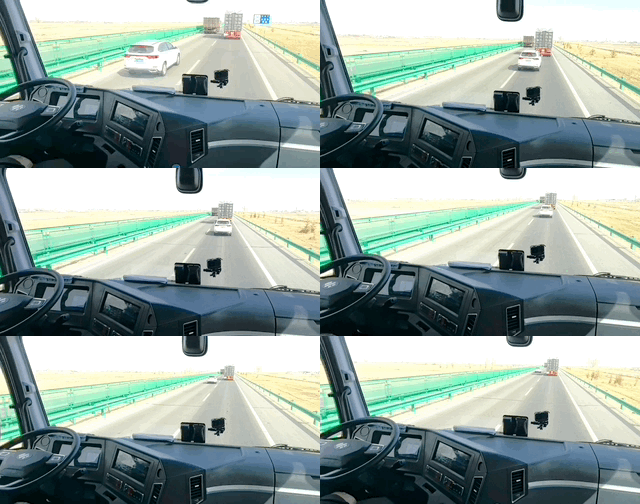
For slow - moving vehicles on the road, the entire fleet overtakes in an orderly manner to ensure traffic efficiency:
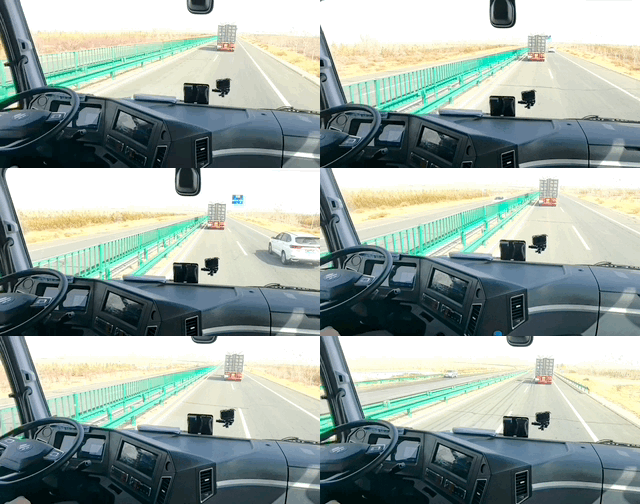
If a vehicle has no good opportunity to change lanes, it will not force a lane change, but first brake and observe. If necessary, it will cancel the lane change and only act when the conditions are favorable.
The second ability is the core of the "fleet" mode: Solving the problem of "interruptions" in L4 operation, such as temporary inspections, flat tires, etc. - The drivers of the first vehicle get out of the vehicle directly and take care of these problems.
Of course, the first vehicle also has other tasks: It shares road information with the entire fleet via the V2V system. If there are temporary maintenance strips, discarded tires, tarpaulins or other obstacles on the highway, the first vehicle avoids them and at the same time sends a signal to the entire fleet. Then, individual vehicles can drive around the obstacles according to the situation.
In addition, if the following vehicle encounters a problem that is beyond the capabilities of the L4 system, the driver of the first vehicle can help via remote commands to free the vehicle from the difficult situation -
This is actually one of the criteria for real L4 capabilities. Not only is the vehicle itself unmanned, but there is also no 5G cloud driver in the background. Instead, non - real - time guidance commands are used to free the vehicle from the difficult situation.
But DeepWay's concept for realizing L4 operation is different.
How does DeepWay manage to realize L4 with over 200 TOPS?
The core idea behind the hardware of the DeepWay L4 fleet concept is not to stack hardware. For example, only three lidar sensors are used: One in the front and two on each side to detect blind spots. The underlying computing chip comes from Horizon - Two J6M chips with a total power of 256 TOPS.
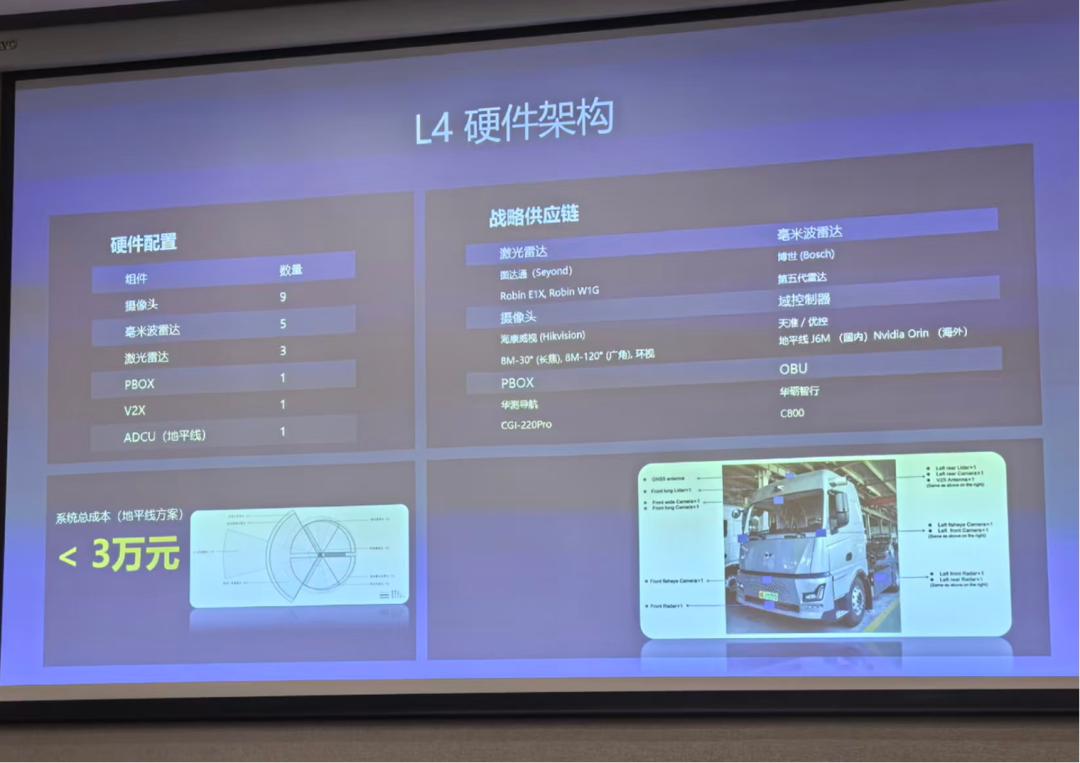
For most passenger cars, this is the configuration for implementing basic L2 functions. Players with strong algorithms may also be able to realize city navigation (NOA).
But if you start from the scenarios, you will find that the concept used by DeepWay actually represents an "optimal use of resources" based on safety reserves.
The core logic is: First, all risk points in autonomous operation are identified, and then the risks are "distributed" through systematic means to different objects (individual vehicles, cloud, road infrastructure, navigator), instead of relying on the L4 system of a single vehicle to solve all problems.
The three - level safety concept consists of a main function layer, which includes the core functions of L2/L4 driving, and a second layer for active safety, such as AEB, FCW, fatigue warning, etc. Based on the L2 operation experience of billions of kilometers, it is claimed that this layer has low false alarm rates and high reliability.
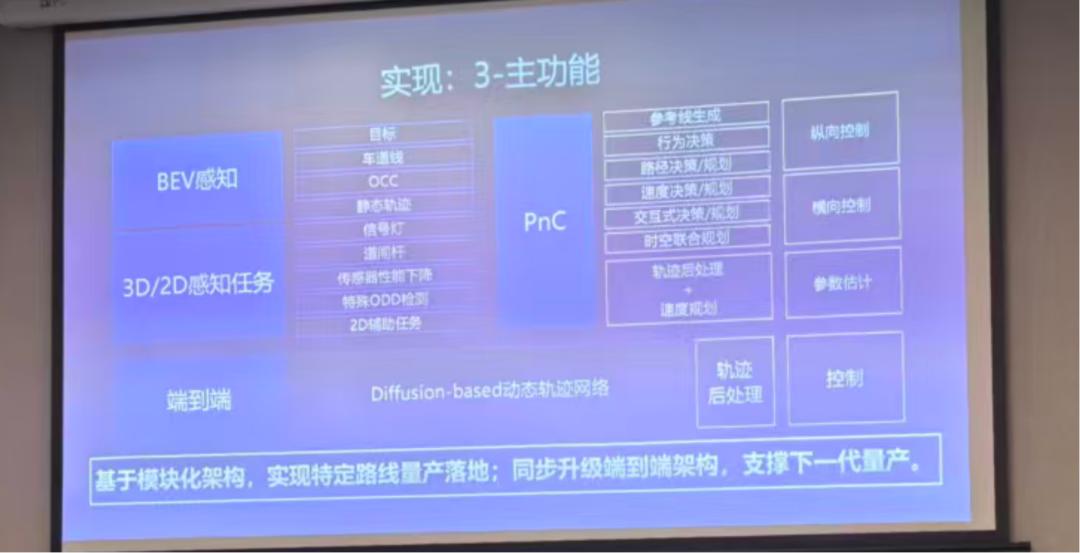
The third layer is the layer for redundancy and reaction to failures. It covers multiple hardware and software failures, even in extreme situations (such as brake failure), and enables the vehicle to stop safely through fleet management and remote control.
Put simply, the real - world road conditions on the truck operation roads in Inner Mongolia are very different from the road conditions in big cities like Beijing, Shanghai, Guangzhou and Shenzhen during rush hour: The boundary conditions are clear, and most road conditions are good and free of traffic jams. This means that the types and number of special cases (corner cases) are actually limited.
If the goal is the rapid commercial introduction of L4 trucks to realize autonomous operation on fixed routes, actually a computing power of thousands of TOPS is not required.
Therefore, DeepWay currently uses a hybrid concept of "AI - based perception + engineering planning and control" in the main function layer, which is divided into the following steps:
The perception layer is based on 3D detection and BEV (bird's - eye view) and fuses the data from different sensors (cameras, lidar sensors, millimeter - wave radar) to create a stable environment model. In sections without high - precision maps (such as on national highways and large intersections), the perception model directly outputs the drivable lanes, instead of only recognizing the lane markings, to handle situations with missing or unclear lane markings.
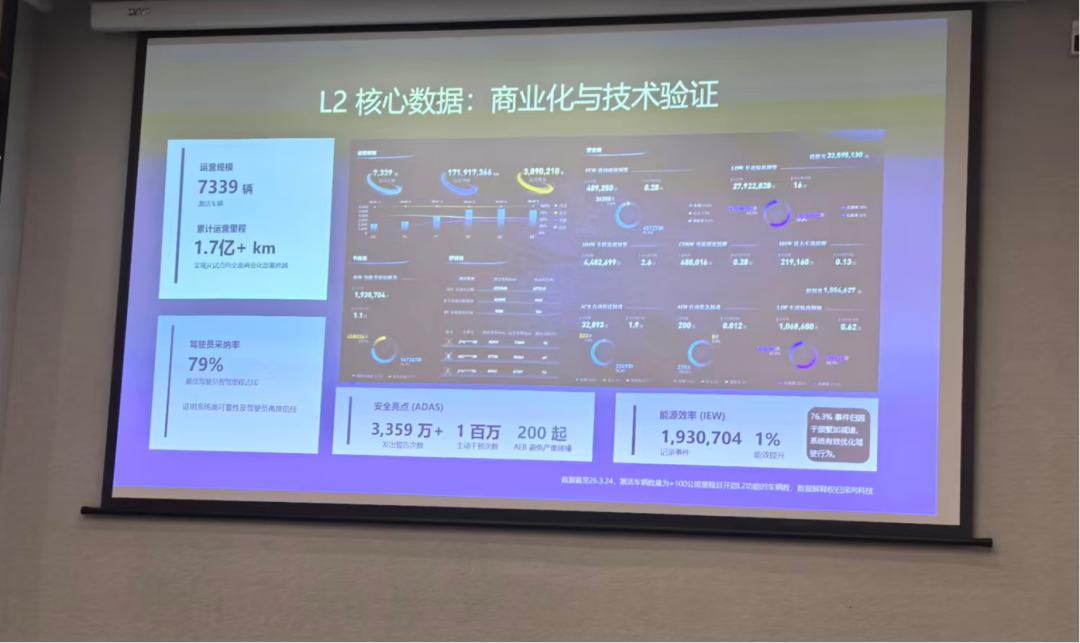
Some auxiliary tasks (such as the assessment of the drivable area and the recognition of the properties of obstacles) are already taken over by AI models, which reduces the dependence on rule - based post - processing.
The planning and control layer still relies on traditional algorithms. Based on the structured information (lane markings, obstacles, lanes) output by the perception layer, paths and speed profiles are created through optimization methods and passed to controllers such as PID and LQR for execution.
This ensures the determinacy, interpretability and debugging efficiency of the system, especially for trucks with high inertia and high risk, where technical robustness has a high priority.
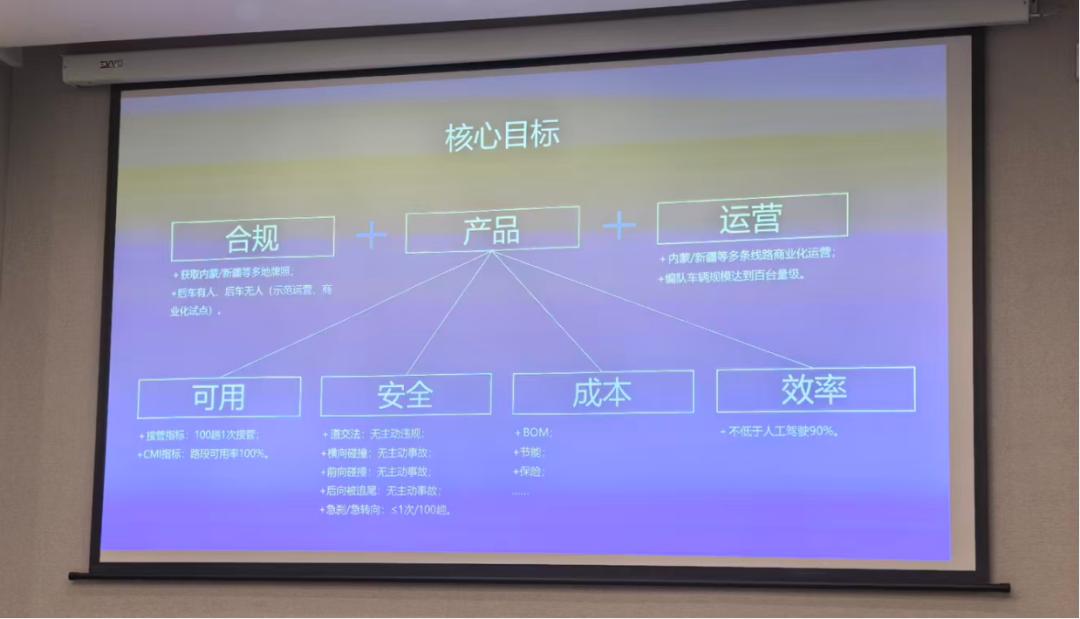
However, DeepWay is not limited to the modular concept, but sees the end - to - end algorithm as a clear technology upgrade direction, with a clear scenario orientation.
DeepWay believes that the generalization ability of the end - to - end model strongly depends on the amount and distribution of data. Therefore, it first operates on one or a few fixed operation routes.
On these routes, the vehicle density is high, the scenarios are convergent and the commercial value is clear. In this way, enough high - quality data can be collected in a short time to train the model and complete the iteration.
The current goal is to implement the end - to - end algorithm in vehicles on certain routes by the end of 2026 and then gradually expand it. The core algorithm, the vehicle toolchain and the data platform will be uniformly reused to ensure that the data and functions collected from L2 operation can be seamlessly transferred to the L4 fleet.
Therefore, the "Lingpao Auto Workshop" for L4 trucks is essentially scenario - oriented. In the start - up stage of the company, a certain scenario will first be successfully implemented to create commercial value, instead of rushing into the research of an unknown technology concept.
This ensures both the stable operation of the current L4 fleet and a clear path for the upgrades of the next - generation algorithm.
DeepWay, the first listed company for L4 truck transportation?
When DeepWay was founded in 2021, it gave us the following forecast:
The company will bring 1,000 vehicles to the market in 2023, then 3,000 and 6,000 vehicles per year respectively. After 2026, DeepWay is expected to sell more than 10,000 vehicles per year, and the company will then already have a positive cash flow.
The actual results are as follows:
In 2024, DeepWay delivered over 3,000 self - developed electric trucks; in the