The truth about consumption in 2026: It's not that people have no money; it's that your products aren't worthy.
Why has the traditional furniture market become increasingly desolate, while Yejiamu Furniture has achieved a ten - fold increase in performance over five years?
Why, in the seemingly barrier - free business of "selling rice", has October Rice been able to define high - end rice and successfully go public on the capital market?
In the highly competitive snack market, why has Snacks Busy been able to open 25,000 stores?
……
In the past two years, the consumer market has been extremely cold. However, since the second half of last year, like the warming water in the river in spring, a number of companies have quietly recovered, and some have even been actively seeking IPOs. At this "chilly yet warming" turning point, almost every entrepreneur and investor in the consumer field is asking the same question:
When consumers tighten their wallets and attention, where exactly is the real engine of growth hidden?
In the past decade, Qichen Capital has been actively involved in the consumer market, walking side by side with more than thirty entrepreneurs, and jointly creating brands that are deeply integrated into daily life. From October Rice and Yejiamu Furniture to Linqingxuan... Through accompanying and practicing, we have gradually found a clear answer:
"Consumption upgrade without price increase."
It is not only the core code driving this new consumption cycle but also an executable and replicable operating system. What kind of model is it? How does it work in practice? And what kind of growth roadmap can it draw for enterprises in difficulties?
Last Saturday, Mr. Chang Bin, the founder of Qichen Capital, delivered an in - depth course "New Solutions for Consumer Goods in 2026: Consumption Upgrade without Price Increase" on the Hundun APP, systematically unpacking these questions for you. We believe it will truly inspire those who are engaged in the consumer field.
01
Review of Cycles and Insight into Trends
I'd like to share a topic about Chinese consumption with you. It summarizes my 20 - year experience in entrepreneurship and investment in the consumer field. I have participated in the exploration and evolution of China's super - consumer platforms, and in the past decade, I founded Qichen Capital, invested in more than thirty companies, and worked with founders to build a new generation of Chinese brands and national chains, accompanying many enterprises to the capital market. We believe that the Chinese consumer market is entering a new cycle, and we'd like to share our views, solutions, and practices regarding this new cycle with you.
When it comes to consumption, in the past few years, whether you are a consumer, an entrepreneur, a business owner, or an investor like us, you might say it's been "tough". Compared with the booming wave of consumer entrepreneurship and investment in previous years, the market has seemed rather "quiet" in the past two years. Summarizing the past two or three years, consumer companies have also faced challenges in going public, and the overall market atmosphere can be described as "cold".
But since the second half of last year, like the warming water in the river in spring, we investors may have been the first to sense the change.
The performance of some of our invested companies has begun to recover: the demand for essential food products has grown rapidly, and sectors such as cosmetics and clothing, which once faced challenges, have also shown growth. Entrepreneurs who were worried in the previous two years have found that their revenues have resumed growth. Everyone has become active again, thinking about expanding product lines, opening new stores, and even exploring the global market.
In just the past six months, I've been to the Hong Kong Stock Exchange twice for listing ceremonies, and three other companies have also submitted their prospectuses. Standing at this "chilly yet warming" point, we believe that in the next six months to a year, the Chinese consumer market will experience a "spring blossom" scenario.
Looking back on the past one or two years, the Chinese consumer market has undergone a "temperature change", but more fundamentally, the underlying logic of Chinese consumption has quietly changed in the past few years.
1.0 Era: Driven by Factories and Brands
Two or three decades ago, upstream entrepreneurs focused on developing products that met the broadest common needs. Then, with the help of the media (such as CCTV and Hunan TV) and eye - catching advertising slogans, they attracted a large number of distributors, who then spread the products across the country, creating national brands. That was the era driven by factories and brands. The core competitiveness was "finding good products and making them available to consumers".
2.0 Era: Driven by Modern Chain Channels
In the 1990s, international chain systems such as Walmart and Carrefour entered China, attracting a large number of consumers; domestic channels such as Suning and Gome also emerged, and the sales of household appliances reached an unprecedented level. The newly upgraded modern chain business reshaped our consumption era.
3.0 Era: The Blossoming of Online Platforms
After 2010, China's online channels exploded. There is Taobao, the "all - purpose" platform where you can buy everything; Tmall, which specializes in high - quality brands; JD.com, which can deliver your ordered goods the next day; if you are price - sensitive, there is Pinduoduo; there is also Douyin for live - streaming bargain - hunting, and Meituan for 30 - minute delivery... In just a decade, we have witnessed the great enrichment of Chinese consumer channels, perhaps going through a channel evolution process that took dozens or even hundreds of years in Europe and America.
China's consumer market is entering an era where "consumers have the final say".
Jeff Bezos once said something very insightful: We should ask "what will not change". When observing consumer needs, there are several core aspects that have remained unchanged for decades:
When making a purchase, consumers first care about performance (whether the product is good), then price (whether it is worth the money), followed by convenience (whether it is fast and easy to obtain), and in the past two years, emotional value (whether they like it and whether it can bring a good feeling) has also become increasingly important. Therefore, a clear and unchanging consumer value formula can be summarized as:
Performance + Price + Convenience + Emotion
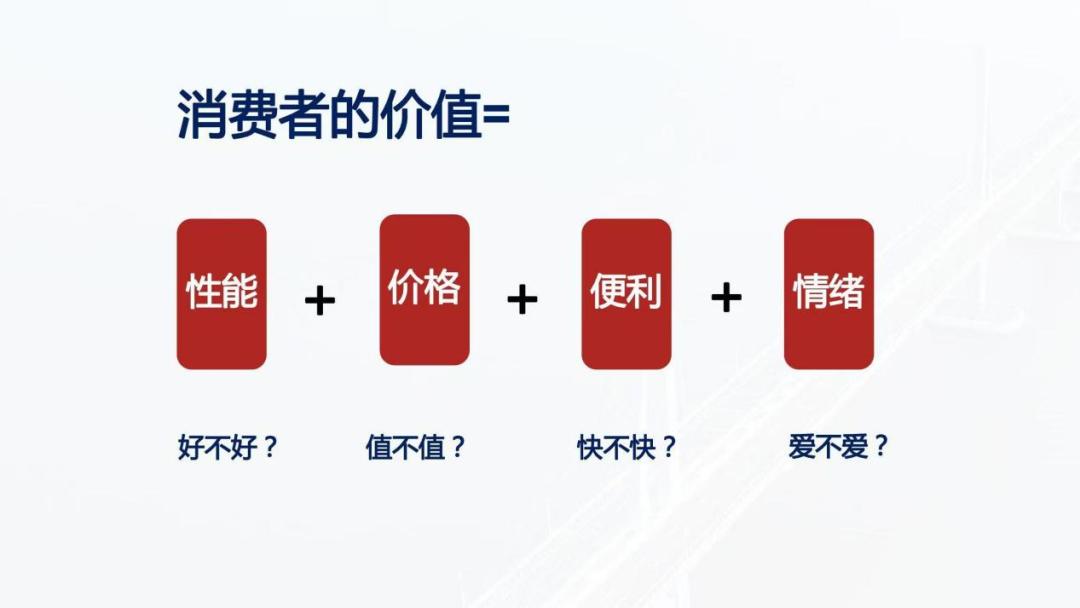
Using this formula to look at today's consumption choices, it becomes much clearer:
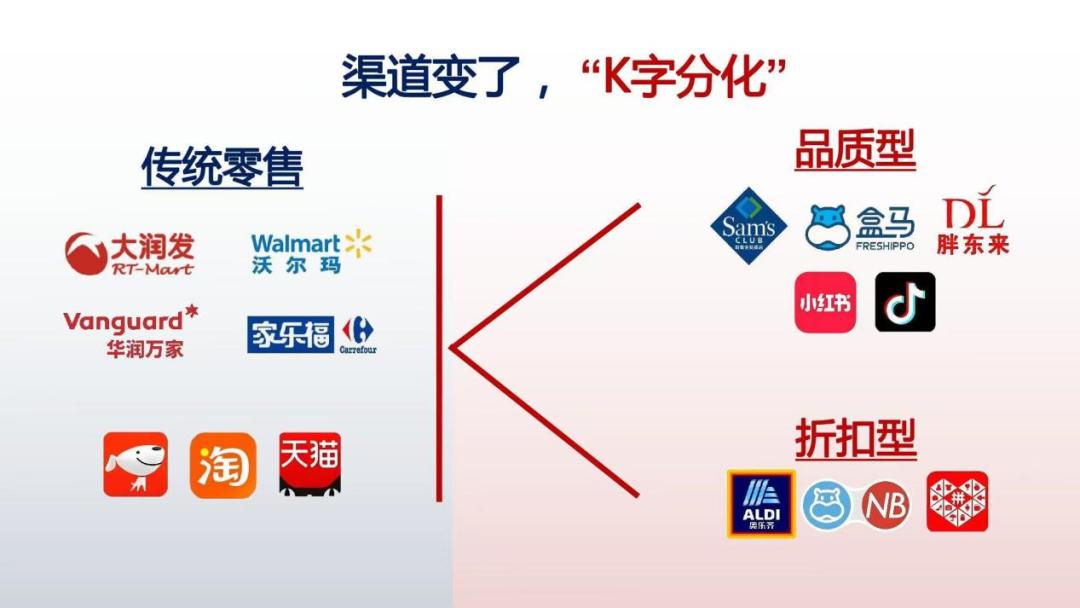
The K - shaped differentiation of channels: In high - tier cities like Beijing and Shanghai, people are now willing to drive to Sam's Club and Hema. In mid - tier cities, Fat Donglai offers better - quality products, unique experiences, and a sense of surprise. At the same time, discount stores such as Aldi and Hema NB offer products of comparable quality at 30% or even 50% off. In cities like Changsha and Changde, snack stores such as Snacks Busy and Zhaoyiming Snacks have opened all over the streets at 30% - 40% off. The same is true for online shopping: those who pursue quality go to Xiaohongshu and Douyin, while those who seek affordability go to Pinduoduo. This is a typical "K - shaped" differentiation - consumers either look for better - quality products or cheaper ones.
The explosion and iteration of brands: A decade ago, people might only have drunk coffee at Starbucks. Now, there are M Stand and Peet's in shopping malls, and Manner and Luckin in offices. In the sports field, in addition to Nike and Adidas, new brands have emerged in niche markets such as professional running, tennis, and outdoor sports. A number of once - familiar brands are regarded as "old - fashioned" by young consumers, while new brands are emerging vigorously.
In the past two years, many bosses of A - share consumer companies I've met have often looked worried - whether it's milk, melon seeds, alcohol, or clothing, their sales have stagnated or even declined, and their market values have also remained unchanged. Meanwhile, some new brands have found their own positions. A number of new companies that went public on the Hong Kong Stock Exchange have shown growth rates of 30% - 100% or even higher in their prospectuses, with even faster profit growth. Despite their excellent performance, when talking to the entrepreneurs of these new brands, I found that they are still worried: How can they achieve sustainable growth in such a competitive market?
Behind all these changes is that consumers have truly gained the right to make their own choices. Consumers are reshaping the landscape of product portfolios, channels, and brands with their choices. The wheels of fate are turning, and a new consumer era is on the horizon.
What are the solutions and practices for this consumption cycle?
02
Solution: Consumption Upgrade without Price Increase
As we mentioned earlier, the demand in the Chinese consumer market has changed, and the market has shifted from an incremental to a stock market. Many entrepreneurs and business owners often ask me: What is the new solution? I would ask them a question in return: Do you think China has experienced a consumption upgrade or a downgrade in the past few years?
Different entrepreneurs will give me different answers. Many people may feel a "downgrade" because the prices of many products are now lower than before, as consumers have less money to spend. However, from our perspective at Qichen Capital, in the process of accompanying a large number of enterprises, we have seen a very definite phenomenon: We are firmly carrying out a "consumption upgrade without price increase". Next, I'd like to unpack our observations for you.
We have classified the successful cases from the more than thirty companies we've invested in into several types for you to understand.
The First Solution: Higher Performance, Lower Price
Case 1: Yejiamu Furniture
In the past few years, if you were to ask which industry has been particularly difficult, I think the real estate industry would top the list. The sales volume of Chinese commercial housing has been declining year after year. However, unexpectedly, a furniture brand we invested in has achieved a 50% growth rate for several consecutive years. Starting from a sales volume of about 1 billion yuan in 2020, it exceeded 15 billion yuan in five years, becoming a dark horse in the Chinese furniture industry. This brand is Yejiamu Furniture.
A few years ago, when we first encountered this company, they mainly sold solid - wood furniture online. We were curious: Who would buy large items like beds and bookcases online all at once? We called many users and asked: Why did you choose to buy online?
In China, most people used to buy panel furniture. It was either the IKEA furniture they bought after graduation or something they saw in furniture stores. But once there are children and the elderly in the family, you start to worry about the formaldehyde in panel furniture. Then you'll find that solid wood, which is free of formaldehyde, is a good choice.
Yejiamu Furniture initially made a 1.8 - meter solid - wood bed. How much did it cost? It was only sold for 1,000 yuan online. This price is almost the same as that of IKEA's panel beds. Many consumers didn't even believe it was real solid wood at first. After buying and installing it, they found that the quality was indeed good.
Consumers may wonder: A bed of the same quality may cost several thousand yuan in a furniture store. Why does it only cost 1,000 yuan online? Behind this is the secret of China's "good and cheap" products. For traditional offline furniture, brands need to go through provincial and municipal agents for distribution, and the cycle can take years. The mark - up rate from the factory to the consumer's home may be 5 to 10 times. However, if you choose Yejiamu Furniture on Tmall, for a product with a cost of 100 yuan, consumers may only need to pay 150 yuan.
The charm of online shopping is that the factory starts production only after you place an order and make a payment, and then the product is directly delivered to your home. The mark - up rate in this process may only be 1.5 times, and yet Yejiamu Furniture still makes a good profit.
When the category shifts from offline to online, consumers can save more than half of the money.
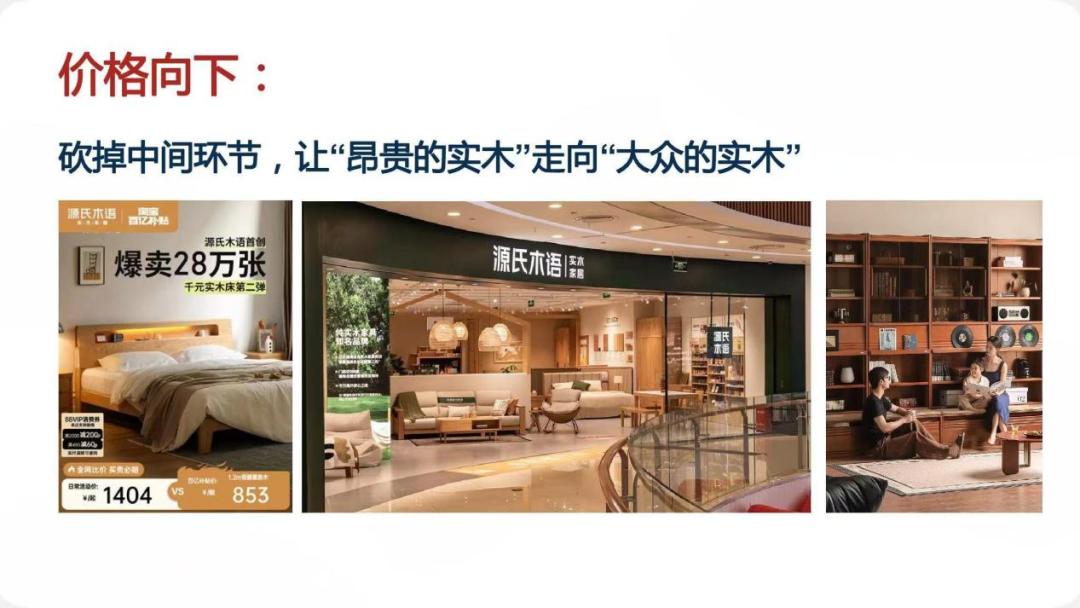
From panel furniture to solid - wood furniture, consumers get better quality.
Yejiamu Furniture has built a large product library with 20,000 - 30,000 SKUs. Consumers like Yejiamu Furniture not only because of the better wood but also because it designs more user - friendly functions for daily life. The latest beds can be wirelessly charged, and the night - light will automatically turn on when you get out of bed at night. In a popular movie last year, all the furniture used in the protagonist's home was from Yejiamu Furniture. In such a scenario, it can give people a great and relaxing home feeling.
Later, to meet consumers' demand for "seeing and touching the products in person", Yejiamu Furniture also opened stores in furniture malls and shopping centers. So, when consumers go shopping, they may think: It's difficult to change my house in the past two years, but it's still great to change a set of such wonderful furniture. This has become a natural choice for young people.
In the past five years, after our investment, Yejiamu Furniture has achieved a ten - fold growth.
They have firmly achieved higher performance (upgrading from panel to solid wood) while lowering the price (reducing the mark - up rate from 5 - 10 times to 1.5 - 2 times). Starting from online sales, they now have 1,500 offline experience stores, and also bring the emotional value of "a greener home" to consumers. This is a typical case of "consumption upgrade without price increase".
Case 2: October Rice
Another case we invested in is October Rice. They are in the business of selling rice, which we eat every day. Rice has been consumed for thousands of years. What changes can there be? Well, in just a little over a decade, they have become the top brand of mid - to high - end rice in China.
The founder couple sold their house in Northeast China and came to Beijing with 200,000 yuan. They first opened a stall in a farmers' market. Later, they found JD.com and registered the brand "October Rice", specializing in selling better long - grain fragrant and fragrant rice from their hometown. They transported the freshly milled rice from the factory to JD's warehouses across the country in three days. With JD's distribution network, the rice can be quickly delivered to users' homes. This is the experience brought by better rice varieties and fresher quality. In just a few years, they became the top online rice brand.
October Rice not only brings better long - grain fragrant and fragrant rice from Northeast China to consumers across the country. More importantly, it allows you to enjoy good - quality rice at a price of about five or six yuan per catty. For example, the organic fragrant rice from Longfengshan, Wuchang, Heilongjiang, which is considered the best rice in China, can be bought for about ten yuan per catty on JD.com today. This is the advantage of October Rice's business model: better products, fresher quality, and a reasonable price.
When we helped them enter the offline market and communicate with Sam's Club, Sam's Club asked what these rice varieties meant to consumers. October Rice said that the biggest benefit is that consumers have the opportunity to buy their rice as fresh as buying fresh produce, rather than eating last year's rice. Sam's Club thought this was a very good selling point, so they defined this product as "90 - day fresh", and it became a hit in Sam's rice category.
Behind this is the joint effort of the brand and the channel. October Rice stores