The era of a 3.5 trillion yuan IoT dividend has begun: The "Internet of Things Action Plan" jointly issued by nine government departments drives AI to take over the physical world.
The Internet of Things (IoT) industry is undergoing a fundamental restructuring of its foundation, transitioning from "quantitative change" to "intelligent transformation."
On March 31st, nine government departments, including the Ministry of Industry and Information Technology, jointly issued the "Action Plan for Promoting the Innovative Development of the IoT Industry (2026 - 2028)" (hereinafter referred to as the "Action Plan"). This significant document sets ambitious quantitative targets: By 2028, the number of IoT terminal connections is expected to reach the scale of tens of billions, and the scale of the core IoT industry is expected to exceed 3.5 trillion yuan.
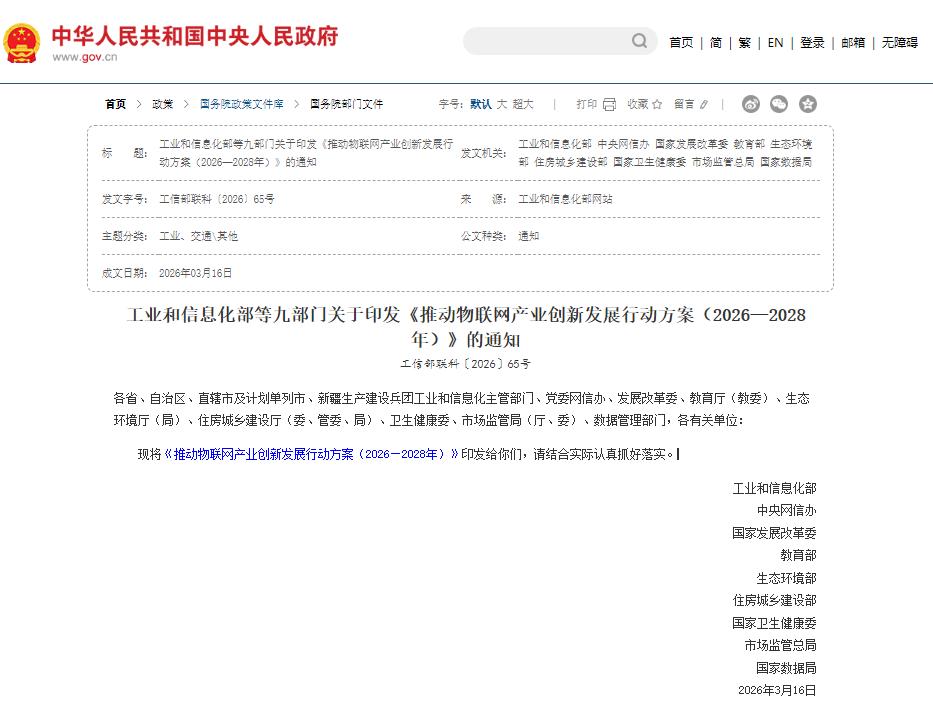
If we only focus on the two figures of "tens of billions of connections" and "3.5 trillion yuan," it's easy to fall into the old mindset of competing for module shipments and the number of connected terminals in the past.
After a careful reading of the "Action Plan" and peeling away the surface data of tens of billions of connections, the real trump card for reshaping the industry has been revealed to the market: The two - way empowerment and integrated development of the IoT and artificial intelligence are driving human society to transform from "intelligent interconnection of all things" to "intelligent operation of all things." It can be said that this is an ultimate roadmap for the IoT to officially leap from the data collection layer to an intelligent infrastructure, with the AI large - model fully taking over the entrance to the physical world.
Setting the Tone for New Infrastructure: Saying Goodbye to Single - Point Connections and Reconstructing the "Terminal - Edge - Cloud" System - Level Intelligence
For a long time, the biggest pain point in the IoT industry has been fragmentation and the existence of isolated systems. Devices from different manufacturers operate independently, and data is trapped in isolated islands and cannot flow. As a result, the massive connections only stay at the primary stage of "being able to access the Internet," making it difficult to generate a global chemical reaction.
The core of the "Action Plan" is to elevate the IoT to the strategic height of a new type of infrastructure, aiming to build a new IoT infrastructure with full - domain perception, ubiquitous intelligent interconnection, multi - network integration, and security and reliability, providing solid support for accelerating the advancement of new - type industrialization and building a manufacturing powerhouse and a network powerhouse.
1. From "Independent Operations" to "Terminal - Edge - Cloud" Full - Domain Collaboration
To achieve intelligent data flow across society, a unified "high - speed highway" must be built first. The "Action Plan" clearly proposes to build a "Terminal - Edge - Cloud" platform architecture that enables efficient resource aggregation, efficient data processing, and efficient cross - platform information sharing. This architecture is compatible with fixed and mobile network connections such as gigabit optical networks and 5G, aiming to provide services such as device interconnection, heterogeneous data access, integrated governance, application development, and integration.
The focus of the policy has shifted from simply "how to connect devices to the Internet" to "how to enable tens of millions or hundreds of millions of device groups to work collaboratively under the same architecture." More groundbreakingly, the Action Plan encourages the research and development of technologies such as micro - kernels, virtualization, and security architectures to create an open - source, secure, energy - efficient, and customizable IoT operating system. The unification of the operating system is the ultimate weapon to break the fragmentation of the hardware ecosystem, indicating that the competition for the ecological discourse power of the underlying OS will enter a white - hot stage.
2. Multi - Network Integration and a Pragmatic Foundation of "High - Low Combination"
As a national - level infrastructure, the network foundation must balance technological advancement and commercial implementation costs. The "Action Plan" presents a very pragmatic network deployment strategy: to build a mobile IoT ecological system based on a high - low combination of 4G (including LTE - Cat1, a 4G network with a rate category of 1) and 5G (including NB - IoT narrow - band IoT and RedCap lightweight).
This is not a blind pursuit of full - scale 5G coverage but a precise stratification after seeing through the business essence. NB - IoT is responsible for a large number of low - power underlying connections, Cat.1 undertakes high - cost - performance interactions at medium and low speeds, and 5G RedCap significantly reduces costs while retaining low - latency and anti - interference characteristics, jointly meeting the communication requirements of the IoT for large - scale connections, low latency, anti - interference, and low power consumption. In addition, the policy also strongly promotes the collaborative deployment of multiple networks such as mobile IoT, wireless local area networks, and wired networks, accelerating the processes of fixed - mobile integration and wide - narrow combination in the IoT to improve the integrated service capabilities of the full - scenario IoT network.
The Arrival of Variables: The Descent of Large Models and the Awakening of "Advanced Intelligent Agents"
If the network is the skeleton, then AI is the variable that gives the IoT a soul. The most technologically explosive and industry - disruptive statements in the "Action Plan" are concentrated on the in - depth integration of the IoT and AI large models.
1. The Evolution of "Blind Antennas" and the Upgrade of Senses
In the past, most IoT terminals were just passive sensors of cloud computing power, playing the role of "blind antennas." Now, the policy requires accelerating the in - depth integration of technologies such as artificial intelligence, 5G, human - machine interaction, and edge computing with IoT application terminals in the direction of intelligent and networked terminal development, enhancing the accurate analysis, intelligent decision - making, and convenient interaction capabilities of application terminals.
To support such intelligent decision - making, the sensory systems of terminals must be comprehensively upgraded. The "Action Plan" proposes to accelerate the research and development of technologies such as passive IoT, multi - modal perception, high - precision positioning, and swarm intelligence perception, and improve the independent innovation level of mid - to - high - end sensors such as micro - nano displacement sensors, flexible tactile sensors, and high - resolution visual sensors. When devices have high - resolution vision and flexible touch comparable to humans, their perception of the physical world will undergo a qualitative leap.
2. The "Descent" of Large Models and the Era of Embodied Intelligence
In terms of industrial ecological layout, the "Action Plan" significantly proposes to accelerate the development of technologies such as intelligent perception and multi - modal data fusion, and create a number of advanced intelligent agents with autonomous perception, control, and execution capabilities. More importantly, it clearly requires promoting the lightweight deployment of AI large models at the terminal and edge, and jointly improving the platform resource scheduling capabilities.
These statements send a strong industrial signal: the identity of IoT terminals is changing. Lightweight large models with hundreds of millions or billions of parameters will no longer be confined to expensive cloud computer rooms but will be integrated into industrial robotic arms, intelligent gateways, autonomous vehicles, and even household cleaning robots. Advanced intelligent agents mean that terminals are no longer just passive nodes for collecting information but are evolving into intelligent units with autonomous perception, judgment, control, and execution capabilities.
In specific business scenarios, its forms are full of imagination:
Industrial scenario: An edge control system that can identify abnormalities in real - time, automatically adjust parameters, and link devices to optimize processes.
Logistics scenario: A warehousing terminal that can autonomously schedule and execute collaboratively.
Urban governance: An infrastructure node with environmental perception, risk early - warning, and emergency linkage capabilities.
Consumer field: Smart home and terminal devices that provide more proactive services and have a stronger understanding of scenarios.
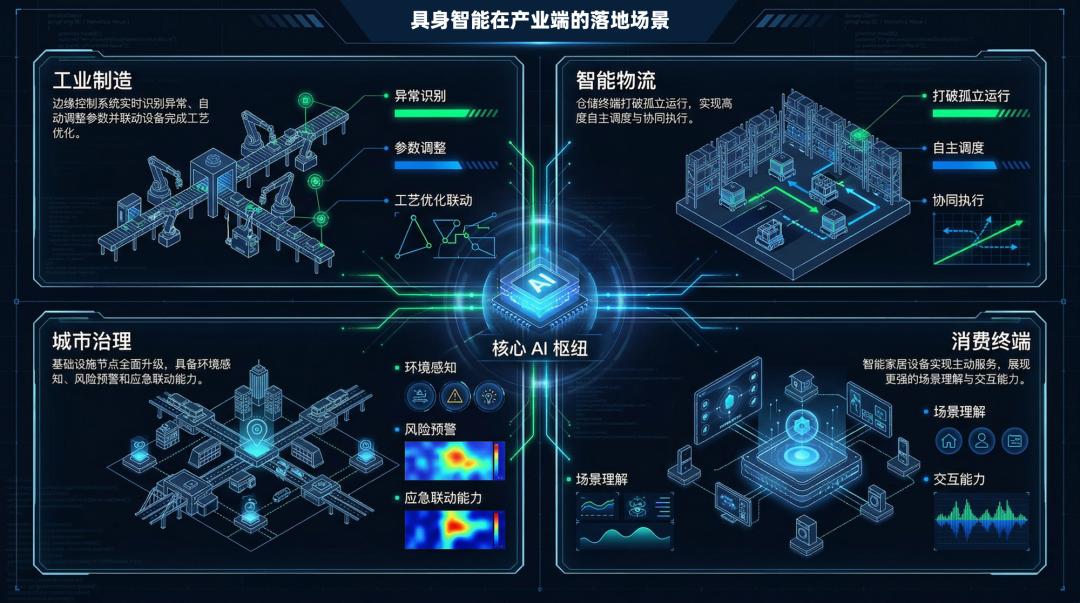
This is the official expression of the currently hottest embodied intelligence in the industrial field. The core of embodied intelligence is that the intelligent system not only understands information but also understands the environment through sensing devices, acts on the environment through executive mechanisms, and continuously corrects its behavior through feedback. In the second half of the IoT era, it may not be a story where all things turn into robots first, but more likely a story where a large number of devices gradually acquire the characteristics of embodied intelligence. IoT terminal devices are officially evolving from "perceiving the physical world" to "operating the physical world."
Redefining the Profit Distribution: Who Can Reap the Dividends of the "Intelligent Execution Layer"?
As the number of connections approaches the ceiling of tens of billions, the moat of pure hardware manufacturing is irreversibly disappearing. The era of meager profits from "selling modules/selling connections" is coming to an end. The profit center of the 3.5 - trillion - yuan core industry scale will inevitably shift to the "intelligent execution layer" and the "comprehensive service layer." When the industry moves from the "connection layer" to the "intelligent execution layer," the profit distribution of the entire value chain will also change accordingly.
In the future, those who are more likely to have bargaining power are the players who can form a closed - loop of "perception - connection - data - model - execution":
1. Terminal - side AI chip and edge computing hardware manufacturers
As the capabilities of large models begin to migrate to terminals and the edge, the demand for computing power will also spill from the cloud to distributed nodes. Whether it is industrial gateways, smart cameras, or smart home devices, they all require stronger local computing and reasoning capabilities. This means that the computing power architecture is shifting from "centralized supply" to "terminal - edge - cloud collaborative supply."
2. Vertical service providers who excel in "industry - specific models"
General large models thrive in consumer - level scenarios, but in complex and demanding manufacturing scenarios, their accuracy and stability often fail to meet the requirements of engineering verification. The "Action Plan" clearly points the way: to cultivate a number of industry - specific models for key application scenarios, build an open - sharing IoT application model library, and spawn new products, new scenarios, and new models for the integrated application of the IoT and artificial intelligence.
Real industrial needs are distributed in a large number of fragmented scenarios. Empowering application service providers who understand intelligence and are familiar with the industry can develop small models and industrial intelligent agents focusing on predictive maintenance and quality traceability by deeply integrating industry mechanisms and expert experience in oilfield operations, chemical processes, etc. These will become the source of huge profits in various niche markets because they solve not only the networking problem but also directly help customers achieve results and reduce costs.
3. High - end sensor and multi - modal perception enterprises
For an intelligent agent to "be able to work," it must first "see clearly, hear accurately, and touch precisely." The independent innovation level of high - end hardware such as high - resolution visual sensors, flexible tactile sensors, inertial navigation, and environmental perception needs to be improved urgently. These perception capabilities will be re - evaluated as intelligent agents are upgraded.
4. System - type enterprises with a full - closed - loop operation of "perception - model - execution"
In terms of business model reconstruction, the "Action Plan" innovatively proposes a practical methodology:
In the production field: Encourage the exploration of the application model of "solution + product + service" to promote the formation of industry solutions with large - scale promotion value.
In the social governance field: Deepen the application of IoT technology, improve the City Information Model (CIM) platform, and build a "digital twin city"; explore the model of "solution + construction + operation" to achieve full - life - cycle management.
The biggest winner in the future will not be a single device supplier but a system - type enterprise that can connect the entire operation chain. Whoever can make devices run continuously, collaborate effectively, and generate verifiable ROI in real scenarios and build a business closed - loop will be able to cut the richest slice of the 3.5 - trillion - yuan cake.
Overcoming the Implementation Threshold: Data Ownership Confirmation, Computing Power Collaboration, and Security Foundation
When any technological narrative enters the industrial stage, it ultimately cannot avoid real - world constraints. For the AI - controlled physical world to be established, three major thresholds must be overcome:
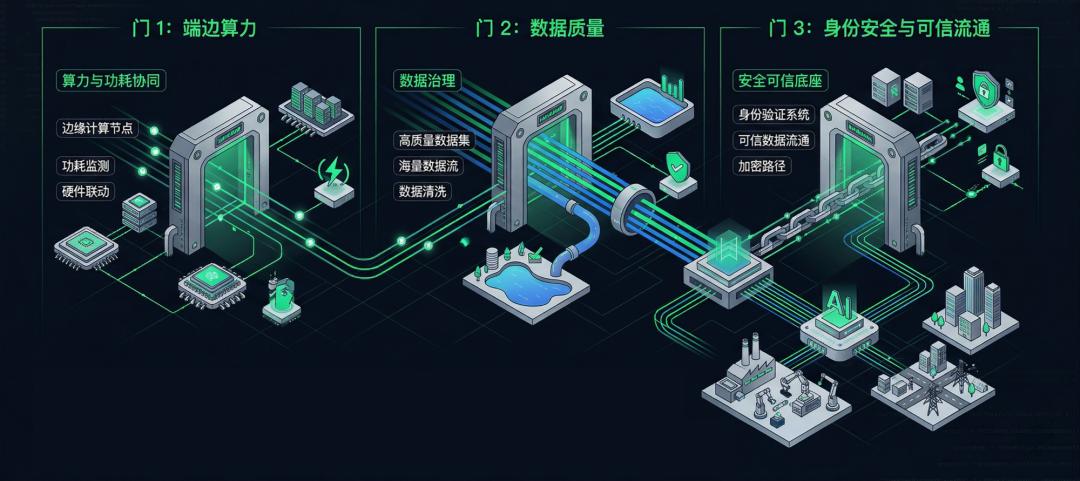
1. Collaborative innovation between computing power and power consumption
Terminal and edge devices are naturally limited by size, power consumption, cost, and heat dissipation conditions. For the capabilities of large models to truly sink, it is not about simply moving the cloud models to the devices intact but relying on the joint cooperation of chip architecture, model compression, inference frameworks, operating systems, and edge computing platforms. Terminal - edge deployment is a collaborative innovation of hardware, systems, and algorithms.
2. Breaking data silos and creating high - quality data sets
To completely solve the problem of difficult data reuse, the "Action Plan" takes strong measures: to promote the formulation of unified IoT data standards to facilitate the interconnection of product data across brands, terminals, and platforms.
This is not only about breaking hardware barriers but also about preparing ammunition for AI large models. The Action Plan then proposes to promote the construction of high - quality industry data sets and improve the capabilities of data aggregation, processing, analysis, and sharing services. Only high - quality data sets that are cleaned, labeled, and meet the requirements of normativity, integrity, accuracy, and timeliness can truly train error - free industrial intelligent agents. Requiring IoT - related enterprises to fulfill responsibilities such as data classification and grading and important data identification and reporting is like putting a safety lock on data circulation.
3. "One Object, One Code, One Number" and the Prelude to Assetization
How to ensure the uniqueness of the identity and data credibility of hundreds of billions of devices? The "Action Plan" starts from the network infrastructure, accelerating the large - scale deployment of IPv6 and promoting new industry application terminals to support and default to the IPv6 protocol. This is equivalent to issuing a globally unique "digital ID" to each physical terminal.
More significantly, the policy clearly states: to promote the implementation of network security identification management. Strengthen the management of IoT devices accessing the network, promote the integrated development of the IoT and the identification and resolution system, build a management system of "one object, one code, one number, one data" to improve the refined management level of networked devices. At the same time, based on the blockchain - based distributed digital identity service system, build a distributed identity authentication mechanism for IoT devices.
This is not only a national - level security supervision defense line but also the core infrastructure for the IoT to move towards the assetization of data elements. When each physical device has an unalterable identity and confirmed data in the digital world, the ultimate outcome of the IoT will surely be a large and prosperous data element trading market.
Conclusion
The real value of the "Action Plan for Promoting the Innovative Development of the IoT Industry (2026 - 2028)" is that it systematically presents a new direction for the evolution of the IoT for the first time: intelligent perception, multi - modal integration, terminal - edge deployment, industry models, and advanced intelligent agents. This is truly an industrial leap from the bottom to the top. From connecting all things to driving all things, from the data entrance to the execution entrance, the second half of the IoT era is becoming the main battlefield for AI to take over the physical world.
This article is from the WeChat public account "Internet of Things Think Tank" (ID: iot101), written by Soda and published by 36Kr with authorization.