YC's leader exclaims: This is AGI! In just 4 days and without reading the code, AI ported a 37-year-old antique software.
Revived a 37-year-old codebase in 4 days with a cost of less than $30.
This is a rehearsal that is sufficient to reprice the software industry.
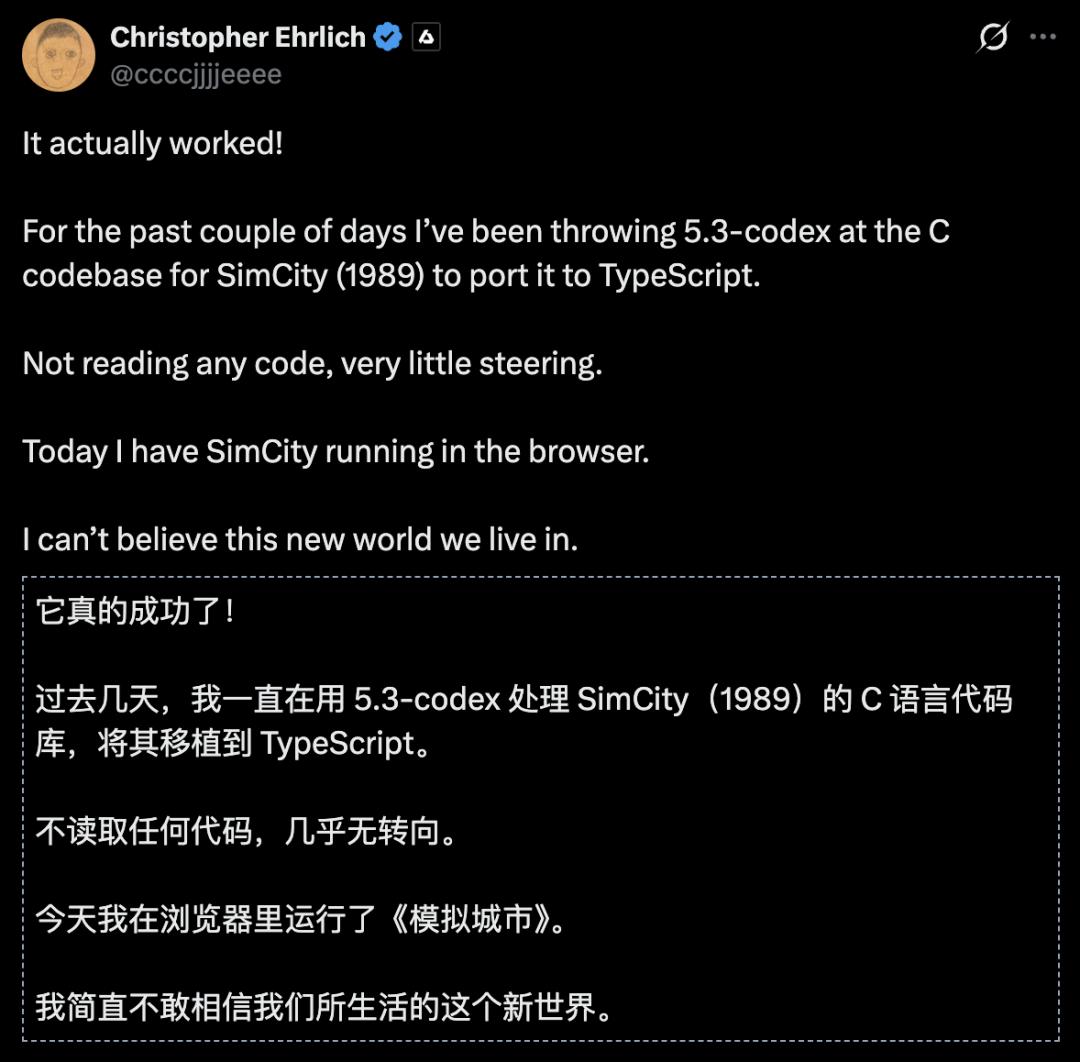
When developer Christopher Ehrlich pointed OpenAI's 5.3-codex at the 1989 SimCity C codebase, set the goal, and walked away, he presented a new answer for future software engineering:
Humans no longer have to understand legacy code first to be qualified to modify it. As long as they can define behavior, establish verification, and iterate continuously, AI can bring complex systems with decades of history back to modern platforms.
Replicated a 37-year-old codebase in 4 days with AI
When Christopher Ehrlich hit the Enter key, he might not have realized that he was rewriting the rulebook of software engineering.
What he did was simple: point OpenAI's 5.3-codex at the 37-year-old (1989) C codebase, set the goal, and leave.
Four days later, this classic city simulation game was revived in the browser. There was no need for humans to read the code. There was very little human intervention. All it needed was a specification and an AI that wouldn't give up.
“I didn't even look at the code,” Ehrlich wrote on X. “I only checked if the tests passed.”
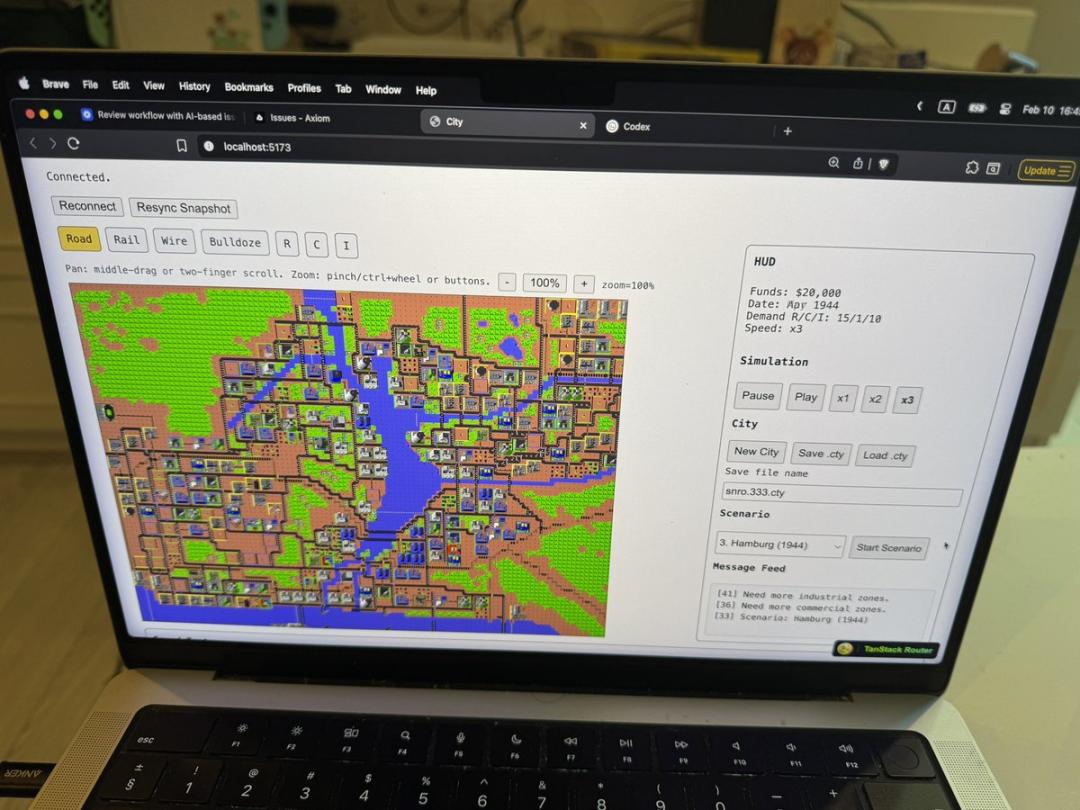
This code has a long history. It was originally written in assembly code by Will Wright for the Commodore 64 and later ported to C. All the mathematical operations rely on bitwise operations, the variable names are like passwords, and the structure terrifies experienced engineers.
The entire porting process ran on a $200-per-month ChatGPT subscription without ever triggering the rate limit. Cost? Less than $30. Time? Half a week.
In contrast, the traditional method would require at least a skilled team to work for months, deeply understand each module, and convert the code line by line.
Think about what this means.
Now, every existing legacy codebase has the potential to be easily ported, whether it's a COBOL banking system, ancient government software, or classic games trapped on old platforms. All it needs is a clear specification.
What's truly scarce is no longer the people who can write code line by line, but those who can clarify requirements and verify results.
The focus of developers is shifting from coding itself to specification design and verification systems.
Specifically, Ehrlich wrote a “bridge layer” that can call the original C code, and then ran property-based tests, requiring the TypeScript ported version generated by AI to produce exactly the same behavior. The AI generates code, then the code is tested and verified, and then automatically iterated. This cycle continues.
This method can be regarded as a new engineering paradigm of using AI as the engine and verification as the steering wheel.
The SimCity porting project gives us a preview of AGI: when a system can complete work in complex domains without fully understanding the domain knowledge, we enter a new paradigm.
It's like when we first saw compilers. In the past, we wrote assembly code by hand, and now we only need to describe the logic.
The time humans spend reading and understanding code often exceeds the actual writing time.
When the code is as obscure as SimCity, the understanding cost may account for 80% of the project. Once we insisted that “understanding the code” was the prerequisite for porting, but now it seems that we only need to understand the behavior of the code.
Traditional software engineering education may need to be completely restructured. Previously, it taught students how to write code, and now it needs to teach them how to build systems without writing code.
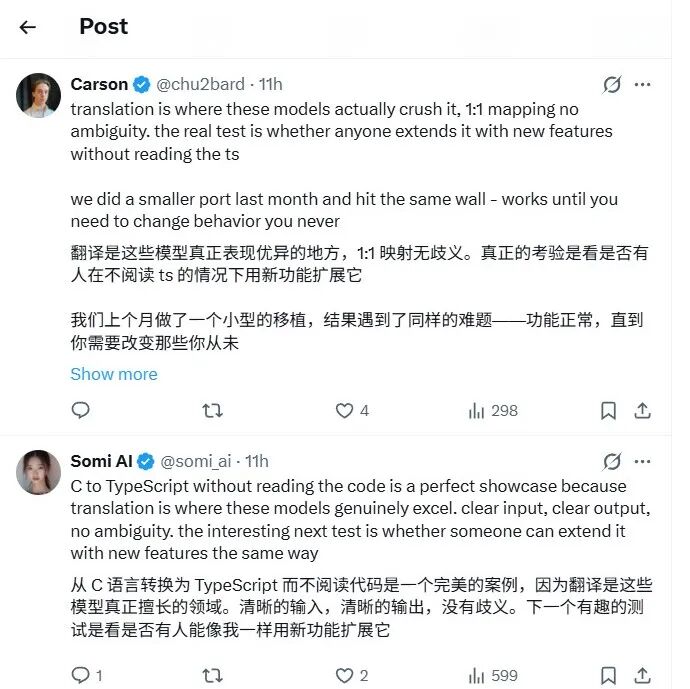
However, not everyone is so optimistic. After all, fully replicating existing functions is just a well-defined task. What's really testing the vibe coding ability is whether it can add new functions.
YC startups have fully embraced vibe coding
According to the latest report from CNBC, 25% of current Y Combinator startups have 95% of their code written by AI. These companies with teams of less than 10 people achieve revenues of $10 million, and their capital efficiency has reached a historical peak.
“If you're still skeptical about AI coding, it means you're not paying attention,” a Silicon Valley venture capitalist said bluntly. “The question is no longer whether AI will change the way we build software, but whether you use it to build or watch from the sidelines.”
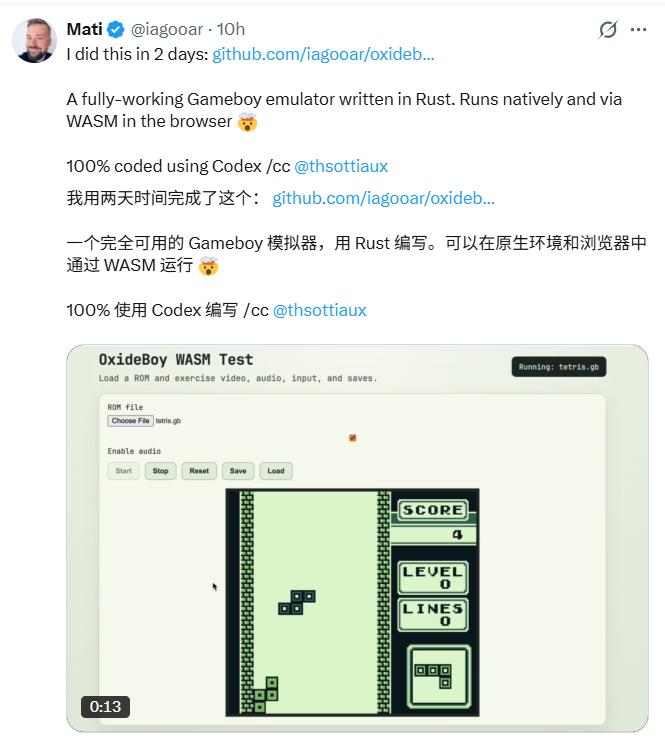
In the comments on the 4-day replication of SimCity, another case was mentioned: the chess game KingsGambitGame “was entirely programmed by AI, demonstrating that this model has expanded from small-scale experiments to full-fledged product development.
The example of a music producer turned developer creating an AI coding framework that was adopted by tech giants further strengthens the narrative of AI empowering individual creativity, meaning that professional background is no longer a barrier to technological implementation.
“App developers can offload or automate repetitive tasks and use large language models to generate new code,” CNBC reporter Kate Rooney wrote in the report. “In some cases, AI can write entire applications.”
Y Combinator CEO Garry Tan said more bluntly in an interview: “What used to require a team of 50 or 100 engineers can now be done by 10 people. You don't have to raise as much capital, and the capital endurance time is greatly extended.”
Data supports this: the companies in the YC 2025 winter batch achieved a 10% weekly growth rate at the aggregate level. “It's not just one or two top companies - the entire batch is growing at a 10% weekly growth rate,” Tan emphasized. “This has never happened in the history of early-stage venture capital.”
Considering that there are still trillions of dollars' worth of COBOL banking systems, government software, and industrial control systems trapped on outdated hardware globally. AI porting means that these systems can be adapted to modern hardware without being fully understood.
When AI can handle countless bugs and function backlogs that humans have never touched. The scale of future codebases may increase by 10 - 100 times, and the factor constraining the growth of codebases is shifting from “human resources” to “computing power.”
Facing the rise of AI coding, there are two voices in Silicon Valley:
The anxiety narrative worries that the number of junior engineer positions will decrease, the value of programming will decline, and the traditional career path will be broken.
The opportunity narrative depicts a more attractive picture. Engineers who couldn't get jobs at Meta or Google can build companies with annual revenues of $10 million or $100 million with a team of 10 people.
YC data shows that 80% of the companies on Demo Day are focused on AI, and the rest are robotics and semiconductor startups. Different from previous generations, these companies get commercial validation earlier.
You can call real customers, and if they say, “Yes, we use this software every day.”
This is a project worth investing in.
References:
https://x.com/garrytan/status/2021260964838940789
https://x.com/ccccjjjjeeee/status/2021160492039811300
https://garryslist.org/posts/ai-just-ported-simcity-in-4-days-without-reading-the-code
https://cnbc.com/2025/03/15/y-combinator-startups-are-fastest-growing-in-fund-history-because-of-ai.html
This article is from the WeChat official account “New Intelligence Yuan”. Author: New Intelligence Yuan. Editor: Peter Dong. Republished by 36Kr with authorization.