The price has soared by 1000 yuan, and vivo is very helpless.
On March 30th, vivo launched its dual flagships, the X300 Ultra and X300s, but received polarized reviews.
On one hand, the digital circle hailed the sky - high imaging configuration as the "Year's Imaging Gatekeeper". On the other hand, ordinary consumers complained about the across - the - board price increase, saying that "the threshold for flagship phones is out of reach".
For the mainstream 16 + 512 version, compared with the previous generation, both the X300 Ultra and X300s saw a substantial price increase of 1000 yuan.
Some netizens joked that Huawei and Apple, the two brands that didn't follow the price - hike trend, seemed to have cost - effectiveness for the first time.
Against the backdrop of rising prices in the semiconductor and memory supply chains, vivo's significant price increase was a last - resort move.
On the other hand, it also reflects that vivo, which relies heavily on smartphones for revenue, doesn't have a good way to deal with industry fluctuations.
Unwilling to follow the crowd, vivo previously announced its entry into the MR, robotics, and handheld camera sectors, vowing to develop a second growth curve.
This is a series of breakthrough battles for the future.
Forced Price Increase
"Is the upgrade substantial enough?" and "Is the price increase worth it?" are questions that arise with each new phone iteration.
As the first manufacturer to launch a "super - sized" flagship model after the Spring Festival this year, vivo was the first to be scrutinized.
vivo calls the X300 Ultra the "Professional V Single". This naming is quite interesting - it aims to blur the line between phones and cameras.
The specifications are indeed top - notch: The 35mm portrait lens uses the LYTIA 901 sensor jointly developed by BluePrint and Sony, with a large 1/1.12 - inch sensor. The 85mm telephoto lens is equipped with a 200 - megapixel Samsung HP0 sensor, supporting CIPA 7.0 - level anti - shake. In terms of video, it's fully loaded - 4K 120fps 10bit Log output across all focal lengths, and it's also compatible with the ACES professional post - production process.
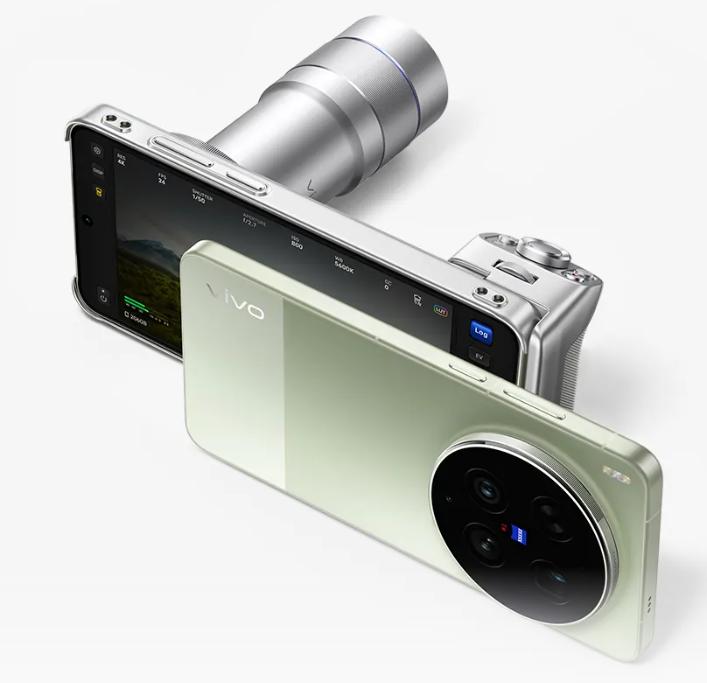
To some extent, this is no longer just "making a phone", but stuffing a professional camera into a phone case.
The X300s is positioned as the "Super - capable Small V Single" and follows the straight - screen flagship route. It's powered by the Dimensity 9500 processor and a 7100mAh battery, supporting 144 - frame native gameplay in "Honor of Kings". The imaging configuration includes a rear 200 - megapixel Samsung HPB main camera, a 50 - megapixel Sony LYT - 602 periscope telephoto lens, and a 50 - megapixel ultra - wide - angle lens, and it can also be paired with a teleconverter.
Although the configuration upgrade is obvious, the core of the controversy is still the price increase.
Compared with the previous - generation product, the 12 + 256G version of the X300 Ultra is priced at 6999 yuan, a 500 - yuan increase from the 6499 - yuan price of the X200 Ultra with the same configuration.
The more mainstream 16 + 512G version is priced at 7999 yuan, with a staggering increase of 1000 yuan.
The top - end 16 + 1TB version (8999 yuan) also saw a 1000 - yuan increase.
The price of the X300s also increased significantly. The 12 + 256G version is priced at 4999 yuan, an 800 - yuan increase from the 4199 - yuan price of the previous - generation X200s. The top - end 16 + 1T version saw a direct increase of 1500 yuan.
In the eyes of ordinary consumers, the prices of domestic flagship phones are gradually exceeding their psychological expectations: Once, a sub - flagship phone could be bought for 4000 yuan, but now the entry - level models cost 5000 yuan, and high - end flagships are approaching the 8000 - yuan mark.
vivo's price increase this time has become the most prominent example of the collective price - hike wave of domestic flagships in 2026.
But can vivo justify such a high price? It's hard to be optimistic.
According to a Counterpoint report, in the first half of 2025, vivo was not on the list of the global market for phones priced over $600 and was classified as "other".
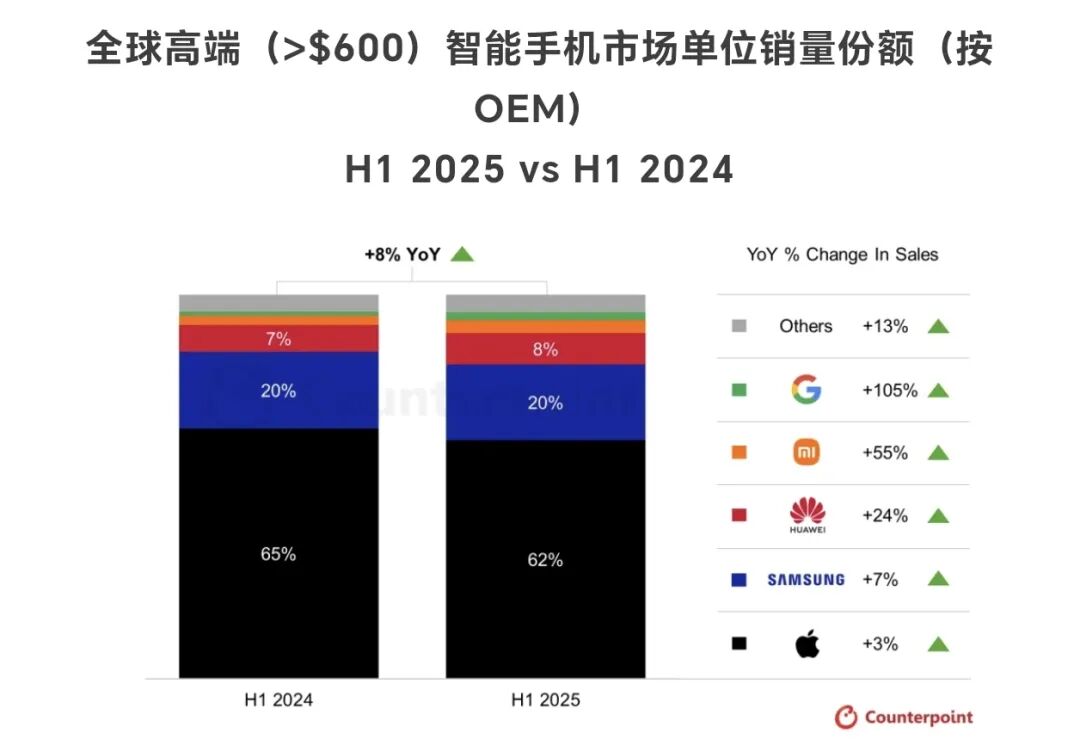
However, ultra - high - end flagship phones are not the main volume - drivers, and they have relatively sufficient profit margins. But mid - and low - end phones not only need to drive sales volume but also have their profit margins compressed to the limit by rising costs, and it's even difficult to maintain profitability, which may lead to a further contraction of the product line.
Vivo's past sales success relied on mid - and low - end cost - effective models and a large - scale product strategy.
The mid - range S50 and S50 Pro mini series launched in December last year saw a 400 - yuan price increase compared with the previous generation.
In recent years, the prices of domestic flagship phones have been rising year after year. If the prices take another big step this year, sales will only decline further.
This price - hike wave undoubtedly reveals the pressure and risks of vivo's main business.
The Defects of "One - Legged Walking"
These days, it's really tough for mobile phone manufacturers.
According to Counterpoint data, in January this year, the sales volume of smartphones in China decreased by 23% year - on - year. Except for Apple, which maintained year - on - year positive growth, most domestic brands suffered double - digit declines.
Among them, vivo's sales volume dropped by 29% year - on - year, second only to Xiaomi. Looking at the whole year of 2025, vivo's domestic shipments were 46.1 million units, a 6.6% decline, the largest among the top five manufacturers.
Since reaching the top of the domestic market in 2021, more than four years have passed, and vivo has been on a downward trend: Shipments have dropped from 71 million units to 46.1 million units, a staggering 35% decline, far exceeding the 13% decline in the total domestic smartphone shipments during the same period, and its market share has been continuously eroding.
In such a fierce competitive environment, the price increase of the X300 U and X300s series is not a capricious move but a choice that vivo had to make under the industry - wide supply - chain price - hike wave.
Data from TrendForce shows that affected by the explosive demand for AI terminals and the contraction of global memory chip production capacity, the contract price of general - purpose DRAM (running memory) in the first quarter of 2026 will increase by 55% to 60% quarter - on - quarter, and the price of NAND (flash memory) products will also rise by 33% to 38%.
The doubling of costs has made the already sluggish mobile phone market even worse.
Only Apple and Huawei, with huge profit margins, can withstand the pressure of soaring costs. Recently, there were reports that Apple agreed to Samsung's request for a 100% memory price increase without bargaining. The 16 + 512G version of Huawei's flagship Mate 80 Pro MAX can now be bought for 7399 yuan in third - party stores, a 600 - yuan reduction from the release price.
But other domestic mobile phone manufacturers with meager profits are suffering greatly under this high - intensity pressure test. Meizu, a small manufacturer in Zhuhai, couldn't hold on and has suspended the development of new phones, and the Meizu 23 never saw the light of day.
Other domestic manufacturers have to swallow their bitterness - they can't stop their business, they need to maximize the configuration, and the only way is to raise the price.
Vivo must feel this pain more acutely than its competitors.
Currently, competitors have opened up new battlefields: Huawei is building a full - scenario ecosystem, Xiaomi has crossed into the automotive industry and has become a rising star in the market, and Honor has also publicly announced its entry into the humanoid robot field.
Xiaomi's automotive business sold over 300,000 units in 2025, which not only brings new revenue growth points but also allows it to share supply - chain resources with its mobile phone business, reducing R & D and procurement costs.
Huawei's HarmonyOS ecosystem covers the full scenario of mobile phones, cars, home appliances, etc. The mobile phone business is just one part of the ecosystem, and the impact of supply - chain fluctuations is greatly dispersed.
In contrast, vivo's business is relatively single, relying heavily on the smartphone business. It hasn't made significant cross - border moves and doesn't have a rich portfolio of smart ecological products. In deeper - level technological competitions such as AI large models, operating systems, and cross - terminal ecosystems, it lacks a voice. The only thing it can be proud of is its good reputation in the imaging field.
This is also the reason why 90% of the press conference was spent promoting the imaging capabilities and the teleconverter set.
This "one - legged walking" model can expand rapidly through economies of scale during the industry's upswing, but it becomes the most fatal shortcoming during the down - cycle of the industry - wide supply - chain price increase.
The price increase of the X300 dual flagships is essentially vivo's most helpless balance between maintaining profits and market share.
Taking Others' Market Share
While its main mobile phone business is under pressure, vivo is also exploring new battlefields. In 2025, vivo announced that it would bet on the MR and home robot sectors, two cutting - edge fields.
Hu Baishan, the president of vivo, regards MR as the bridge between the physical and digital worlds and the "eyes" and "brain" of future robots. These two fields have stronger synergy with vivo's existing technological reserves.
Vivo can transfer its algorithm capabilities in the mobile imaging field, which it has been developing for many years, and its chip - design capabilities in the AI field to the XR and robot fields.
However, these two paths are obviously long and arduous.
Some time ago, vivo stopped its AI glasses project that had been in preparation for half a year, citing "difficulty in creating significant differentiation at present" as the reason.
Obviously, these two fields rely on the overall construction of operating systems, developer ecosystems, content applications, and service systems. Whether vivo can establish this new ecosystem is a big question mark.
A more realistic option is to take market share from DJI.
In February this year, vivo announced its entry into the handheld camera sector, directly targeting DJI's Osmo Pocket series and entering DJI's long - established territory.
On the surface, mobile phones and cameras belong to two completely different industries, but from a fundamental technological perspective, vivo's entry is not "straying from its core business" but rather a logical move.
The ceiling of the mobile phone market has been firmly set. Vivo must find a new growth curve. The domestic mobile phone market has been in a stock - game state for five consecutive years, with annual shipments remaining between 250 and 300 million units, leaving no room for growth. The competition among top brands is a zero - sum game. If you sell one more unit, I'll sell one less. If vivo wants to continue growing, it has to step out of the mobile phone sector and find a new blue ocean.
Of course, in this cross - border battle, vivo has its aces but also obvious shortcomings, with both advantages and disadvantages being extremely prominent.
With its years of in - depth development in imaging technology, the optical support of Zeiss, self - developed imaging chips, and deeply refined portrait and night - scene algorithms, vivo understands the imaging needs of ordinary Chinese users better than DJI and GoPro. Users can take pictures with pleasing colors and clean images without adjusting parameters, which is extremely attractive to ordinary users.
But the shortcomings cannot be ignored.
For example, there are technical barriers in professional hardware. The core of handheld gimbal cameras lies in mechanical gimbals, physical anti - shake, and sports - scenario tuning. DJI has been in this field for more than a decade and has tens of thousands of patents. Vivo's micro - gimbal and electronic anti - shake technologies accumulated in mobile phones are in a completely different league from professional mechanical gimbals, and it's difficult to catch up in a short time.
From the price increase of the X300 series to the exploration of new fields, vivo's 2026 is marked with the imprint of "breakthrough".
The pressure of supply - chain price increases forces it to raise the prices of its flagships to maintain profits, but it also has to face the risk of declining sales. The ceiling of the mobile phone market's stock forces it to step out of its comfort zone, enter a completely unfamiliar field, and go head - to - head with industry leaders.
For vivo, which has always been steady, this is not a simple product upgrade but a high - stakes gamble for the future.
This path is destined to be difficult. Whether it can successfully find a second growth curve will determine whether it can grow from a smartphone giant to a true full - scenario consumer electronics brand.
This article is from the WeChat official account "AI Blue Media Hub", author: Feng Hua. Republished by 36Kr with permission.