Under overall pressure, the new energy layout of joint-venture brands is breaking away from the old logic.
Ten years ago, joint-venture brands dominated half of the Chinese auto market with their mature fuel vehicle technologies and brand reputations. Volkswagen's TSI+DSG golden powertrain combination and Toyota's THS hybrid system became market benchmarks. In contrast, domestic brands were confined to the low-end market below 100,000 yuan, and their attempts to move upmarket were often frustrated.
Ten years later, the wave of new energy and intelligent technologies has rewritten the rules of the auto industry. According to data from the China Passenger Car Association in February 2026, the new energy penetration rate of mainstream joint-venture brands is 4.5%, and in some statistical scopes, it is as low as 3.1%. Meanwhile, domestic brands have exceeded 60% of the new energy market share. Giants such as Honda, Volkswagen, and Stellantis have fallen into a performance slump, while domestic brands like BYD, Geely, XPeng, and Leapmotor are rapidly rising in the global market.
Shackled and Lost in the Transformation
On the dual tracks of new energy and intelligent technologies, joint-venture brands have neither maintained their technological advantages from the fuel vehicle era nor kept up with the rapid changes in the Chinese market. Previously, multinational automakers shouted the slogan of "full electrification." General Motors announced a $35 billion electrification budget, and Volkswagen even set the goal of having 80% of its sales be electric vehicles by 2030. However, these plans overestimated the sustainability of global policy incentives, misjudged consumers' acceptance speed, and simply equated electrification with "converting fuel vehicles to electric ones," lacking innovation in the underlying architecture.
After the United States cancelled the $7,500 electric vehicle tax credit and the European Union relaxed the ban on the sale of fuel vehicles in 2035, the demand for electric vehicles in the European and American markets dropped sharply. Multinational automakers had to urgently shrink their strategies: Porsche terminated its battery self-production plan and recorded a special loss of 4.7 billion euros; Honda even suffered its first annual loss in 69 years due to the adjustment of its electrification strategy, with an expected net loss of 690 billion yen in the fiscal year 2026 and related losses reaching up to 2.5 trillion yen.
The generational gap in intelligent technologies has made joint-venture brands lose the favor of mainstream consumers. If electrification is a revolution in power, intelligentization is the reshaping of the soul of automotive products, which is precisely the core competitive point in the Chinese auto market. Generation Z has become the main car-buying group, and they list "intelligent driving ability" and "cockpit technological sense" among the top three decision-making factors. Joint-venture brands are relatively cautious in the implementation of intelligent technologies.
In terms of hardware, domestic brands have already popularized NVIDIA Orin chips with a computing power of 254 TOPS, and even higher-level NVIDIA Thor chips are gradually being installed in vehicles. However, many joint-venture models are still using Mobileye Q4 chips, resulting in a generational gap in intelligent driving hardware. More importantly, the "headquarters decision - local execution" mechanism of joint-venture brands makes it difficult for them to quickly respond to changes in the Chinese market: domestic new energy vehicles can be updated every 1 - 2 years, and some brands can achieve quarterly upgrades through OTA. In contrast, some joint-venture brands take 5 - 7 years to complete a model replacement. While joint-venture brands are still discussing the next-generation platform planning, domestic brands have completed two rounds of product upgrades. This gap in rhythm has always kept joint-venture brand products behind the market mainstream. At the same time, the brand premium that joint-venture brands rely on is also constantly disappearing.
The strategy of trading price for volume and the imbalance between huge investment and return have worsened the survival situation of joint-venture brands. In 2026, a new round of collective price cuts began again, with the maximum price reduction per vehicle reaching 300,000 yuan. The official guide price of the BMW i3 is 350,000 yuan, but the terminal bare car price has dropped to about 200,000 yuan. New energy models of brands such as Toyota and Honda have also cut prices.
However, "trading price for volume" is by no means a long-term solution. For example, in November 2025, the average discount of new energy models reached 18.7%, but the sales volume of passenger cars decreased by 8.1% year-on-year. After the price cut of the BMW i3, the monthly sales volume was still only one or two thousand. The annual sales volume of the FAW Toyota bZ3 in 2025 was 22,600, a year-on-year decrease of 55.6%.
It is worth noting that joint-venture brands are not reluctant to invest. General Motors has invested 70 billion yuan in electrification in China, and Volkswagen has invested 2.4 billion euros to form a joint venture with Horizon to strengthen the research and development of intelligent driving. However, in 2025, Volkswagen's operating profit decreased by 53%, Porsche's sales profit plummeted by 92.7%, and Honda's electrification-related losses were equivalent to the total profit of the past three years.
In addition, the market share of joint-venture brands has also been continuously shrinking. In 2025, the sales volume of passenger cars of mainstream joint-venture brands was 5.77 million, and the market share decreased from 51% in 2020 to 24%, more than halving in five years.
Change and Opportunities in New Tracks for Joint-Venture Brands
Although in a difficult situation, joint-venture brands are not without a fight. Their decades of accumulated technological foundation, global channel resources, and strong will to survive still leave room for breaking the deadlock. Since 2025, joint-venture brands have started a multi-dimensional self-rescue path, from decentralizing power locally, deeply cooperating with Chinese enterprises, to deploying in the hybrid track and exploring reverse exports. The unique advantages of the Chinese new energy market also provide new development opportunities for joint-venture brands. This self-rescue is not only to defend the Chinese market but also to find a new position in the global auto industry restructuring.
The in-depth exploration of local decentralization has become a crucial step for joint-venture brands to adapt to the Chinese market. For a long time, the product planning of joint-venture brands has been dominated by foreign parties, and Chinese parties have lacked the right to speak, resulting in products being out of touch with the needs of Chinese consumers. Now, more and more joint-venture brands are starting to delegate R & D decision-making power to the Chinese local market. Toyota has established the "China Chief Engineer (RCE) system" and handed over the core power of vehicle development to the Chinese team. The transformation of joint-venture brands from "in China for China" to "by China for China" has become an irreversible trend. The shortening of the decision-making chain and the strengthening of local R & D are gradually enabling joint-venture brands to get rid of the problem of "acclimatization," which is also the foundation for their continuous foothold in the Chinese market.
The "reverse binding" with Chinese enterprises has also enabled joint-venture brands to catch the express train of Chinese intelligent technologies and supply chains. Now, BMW and Huawei are jointly developing in-vehicle systems, Ford is cooperating with CATL in the battery field, and the joint development between Volkswagen and XPeng is a typical example - the first cooperative model, the Yuzhong 08, has started pre-sales, and the Yuzhong 07 equipped with the jointly developed CEA electronic and electrical architecture is also about to be launched.
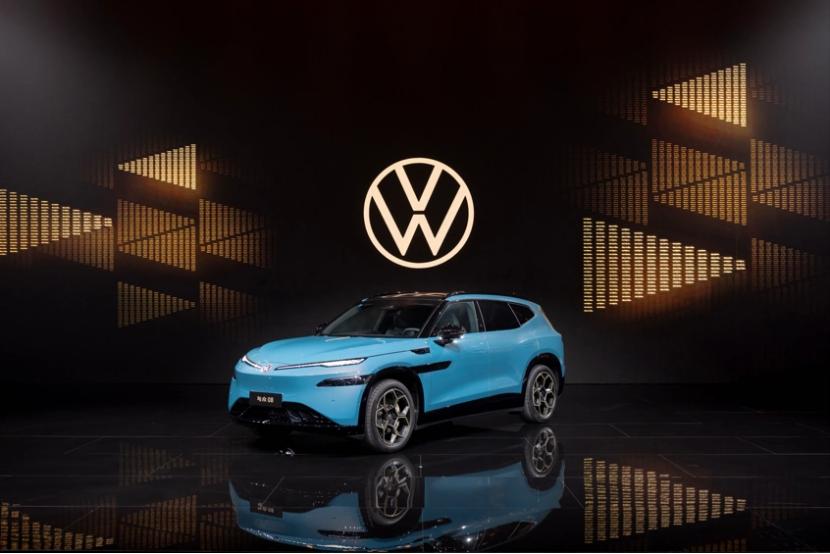
It can be predicted that such cooperation will continue. In the field of intelligent technologies, China has become the global innovation origin, and in the field of electrification supply chains, the cost and technological advantages of Chinese enterprises have formed a moat. Joint-venture brands can quickly make up for their shortcomings in intelligent technologies and batteries through in-depth cooperation with Chinese technology enterprises and domestic brands, while Chinese enterprises can achieve technology output through the global channels of joint-venture brands. This win-win cooperation model is becoming an important path for the transformation of joint-venture brands.
The global layout of reverse exports has enabled joint-venture brands to find new market growth points. In 2025, the global share of Chinese new energy passenger cars was 68.4%, and China's new energy manufacturing advantages have become an important support for joint-venture brands. Joint-venture brands can use China's new energy supply chains and production bases to achieve the layout of "in China for the world," which can not only digest domestic production capacity but also explore overseas markets with China's technological advantages. Behind this model is the transformation of the Chinese auto market from "product import" to "product export" and from "technology introduction" to "technology output," and joint-venture brands have also become participants and beneficiaries of the globalization of the Chinese auto industry.
In addition, the accumulation of joint-venture brands in product quality control, safety, and global service networks is still an advantage that cannot be ignored. Although they are temporarily behind in intelligentization and electrification, the production processes, quality control systems, and global sales and service networks accumulated by joint-venture brands over decades are difficult for domestic brands to surpass in the short term. When joint-venture brands combine these advantages with China's intelligent and electrification technologies, they can form new product competitiveness.
For joint-venture brands, to break the deadlock, they must truly achieve in-depth "localization" integration. This integration is not only about product localization but also all-round localization of R & D, decision-making, and culture. Chinese teams should have real decision-making power, and products should truly meet the needs of Chinese consumers. At the same time, joint-venture brands need to increase R & D investment in the underlying architecture of electrification and core intelligent technologies, quickly make up for their shortcomings through cooperation with Chinese enterprises, combine their traditional advantages with China's new energy technologies, and form differentiated product competitiveness. In addition, joint-venture brands also need to grasp the changes in the global auto market, use China's new energy manufacturing advantages to achieve the layout of "in China for the world," and find new growth points in overseas markets.
This article is from the WeChat official account "Insight into the Auto Market," author: Yang Shuo. Republished by 36Kr with permission.