Former ByteDance executives have raised hundreds of millions in financing.
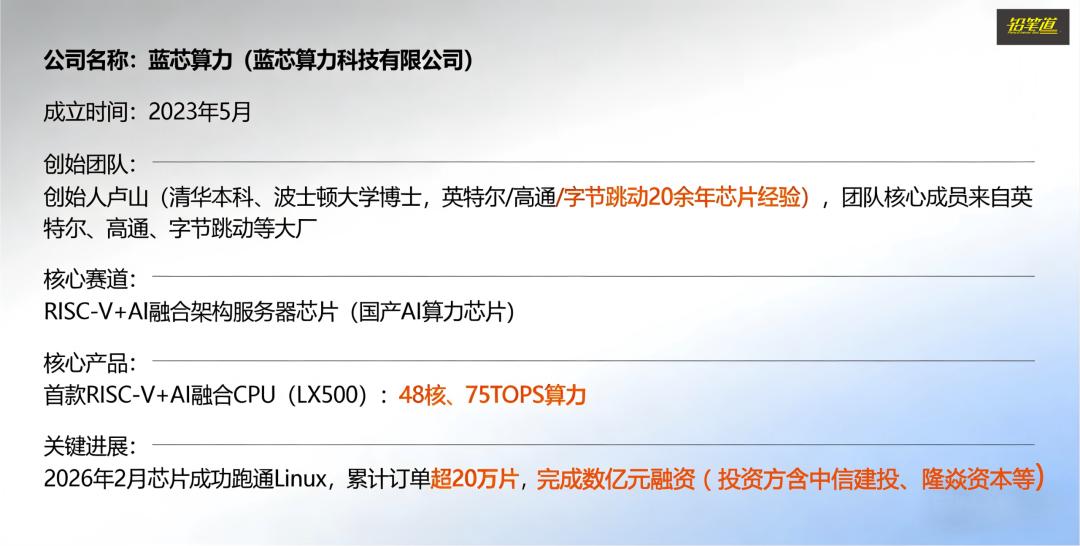
Lu Shan, a former senior executive at ByteDance, founded a chip company called BlueCore Computing, which has just raised hundreds of millions of yuan in financing.
BlueCore Computing focuses on RISC-V (the fifth-generation instruction set architecture) AI computing power chips, which are particularly suitable for large model inference.
Currently, BlueCore Computing has received orders for over 200,000 chips from Lenovo, China Mobile, Tencent Cloud, and other companies.
Starting from an Unpromising Place
It's another story of an alumnus from Tsinghua University starting a business.
Lu Shan, the founder of BlueCore Computing, graduated from the Department of Automation at Tsinghua University with a bachelor's degree and later obtained a doctorate in Electrical and Computer Engineering from Boston University in the United States.
Early in his career, he worked at international top - tier chip companies such as Intel and Qualcomm, spending more than twenty years in the field of high - performance CPU and SoC (System - on - a - Chip) design.
In 2019, Lu Shan joined the chip team at ByteDance's San Diego office in the United States, specifically in charge of RISC - V architecture and server chip - related work.
The pain points in the domestic computing power industry are obvious: the high - end server chip architectures are almost entirely controlled by ARM and X86, and companies need to pay licensing fees for each chip. In his view, the open - source, free, and scalable RISC - V is a practical way to break the existing pattern.
RISC - V has no licensing fees, and the architecture can be used freely. Enterprises can customize it according to their needs and design different instruction set combinations for different application scenarios. For the Chinese chip industry, it can reduce dependence on external architectures and enhance autonomy.
At that time, the industry generally did not believe that RISC - V could support high - performance AI servers. The reason is simple: RISC - V was mostly used in low - power scenarios, such as Internet of Things devices, with limited performance ceilings. Meanwhile, the software ecosystem was not yet perfect, and there were deficiencies in toolchains and application support.
In May 2023, he resigned to start a business and founded BlueCore Computing, determined to pursue the integration of RISC - V and AI.
Based on the RISC - V open - source instruction set, BlueCore Computing has developed a new chip architecture: combining a general - purpose computing CPU and a dedicated AI computing unit to handle different tasks simultaneously with a single chip, filling the gap in mid - to high - end computing power.
There are mainly two breakthrough points.
First, in terms of performance and energy consumption. The team has deeply optimized the instruction set, achieving about a 30% performance improvement under the same power consumption. This means it can support more demanding tasks, such as large model training.
Second, it offers "customization on demand". The chips are designed in a modular way rather than a one - size - fits - all approach. Different customers can have different versions. For example, in cooperation with Gaoweida, it developed a CPU for banks, focusing on solving low - latency and security issues to meet the requirements of domestic substitution.
The commercialization process is also progressing relatively quickly.
In May 2025, the multi - core SoC has been successfully run in the simulation environment, and tape - out is planned within the year. By 2026, the orders corresponding to the mass - production target have exceeded 200,000 chips. Customers include the fintech company Gaoweida, the cloud provider Tencent Cloud, and the operator China Mobile.
If the progress goes smoothly, it may enter the centralized procurement stage in 2027. In a market long - dominated by x86 and ARM, this company is trying to find a differentiated path.
The Explosion of Computing Power Demand
The reason why BlueCore Computing was able to secure multiple rounds of financing within a year and was determined to pursue the RISC - V + AI track is that it has just caught up with several key trends in the entire industry.
1. The demand for AI computing power has exploded, and the gap continues to widen.
Whether it's using AI chat or enterprises using large models for work, it all depends on "computing power", just as we rely on electricity.
Data from IDC and Inspur Information shows that in 2024, the computing power required for domestic AI increased by 74% compared to the previous year, more than three times the growth rate of ordinary computing power. It is estimated that by 2026, the required computing power will double, and the market size will reach $33.7 billion.
The most obvious example is that in February 2026, the weekly usage of domestic AI models exceeded that of the United States for the first time, exceeding 5 trillion times. Among them, "inference computing power" used to process these AI requests accounted for more than 70%.
Previous chip solutions were expensive and slow, unable to keep up with such large - scale demand. The market is eager for more cost - effective and user - friendly computing power chips, which is exactly what BlueCore Computing is doing.
2. Domestic substitution is extremely urgent.
For a long time, server chips have been mainly dominated by the x86 and ARM architectures. A large number of high - end chips in domestic data centers rely on imports.
RISC - V provides an alternative path. It is an open - source instruction set that does not require high licensing fees. Enterprises can conduct independent research and development based on it and master core technologies.
Its development speed is also very fast. It took only 10 years for RISC - V to reach a cumulative shipment of 10 billion chips. This speed is about 11 years faster than ARM and about 20 years faster than x86.
By 2024, the global shipment of RISC - V chips reached tens of billions, with more than half coming from Chinese manufacturers. The application scenarios are also moving up, entering higher - end fields such as servers and intelligent computing centers.
The policy level is also promoting it. In 2026, independent computing power and intelligent computing clusters were included in the key directions of new infrastructure. RISC - V is gradually becoming a more certain technological route for domestic substitution.
Breaking the Deadlock of Domestic Computing Power Chips
Today's computing power competition is no longer just about competing on chip parameters.
More importantly, it's about the architecture, ecosystem, and the capabilities of the entire industrial chain.
In the server chip field, ARM remains the mainstream choice. Its advantage lies not in single - point performance but in a mature ecosystem. Most servers and cloud platforms can use it directly without additional adaptation.
Market data also reinforces this point. In the second quarter of 2025, ARM's share in the global server chip market reached 25%, an 8 - percentage - point increase from the previous year.
ARM's barrier is not just technology but a complete and proven ecosystem.
However, ARM is too expensive.
The licensing fee for a complete architecture can easily reach tens of millions of dollars, which is a significant burden in the long run. More importantly, it's about control. Since the core technology is in the hands of overseas companies, domestic enterprises have difficulty making in - depth modifications and customizations, and many capabilities are restricted.
The domestic computing power camp is no longer just about making a single chip but is extending to the entire chain: from design, manufacturing, software adaptation, to final implementation, and is starting to form a complete system.
Specific products are also emerging: BlueCore Computing's LX series, Alibaba's Xuantie chips, Sanneng's dedicated chips, and Huawei Ascend are all representatives of this camp.
The focus of the domestic camp is not only on the chips themselves but also on the ecosystem.
BlueCore Computing cooperates with Lenovo to launch RISC - V - compatible whole - machine devices; Sanneng Technology is deeply bound to Alibaba Cloud to enable chips to be more quickly integrated into the cloud platform; Huawei Ascend has integrated everything from chips to servers and then to applications, directly targeting various industries.
The production side is also being improved. Wafer fabs like SMIC provide stable manufacturing capabilities, ensuring continuous mass production of chips and reducing dependence on overseas foundries.
Compared with ARM, the advantages of domestic solutions lie in three aspects: more controllable, lower cost, and flexible adjustment according to demand.
Different companies are also finding their own positions. BlueCore focuses on key industries such as banking and power; Sanneng targets industrial scenarios; Huawei Ascend focuses on high - end computing power.
Some small and medium - sized enterprises and data centers have started to switch to domestic solutions. On the one hand, the cost is lower, and on the other hand, the security is more controllable.
This article is from the WeChat official account “Pencil News” (ID: pencilnews), written by Song Ge, and is published by 36Kr with permission.