BYD: Losing the Throne, Will It Be the Overseas Version of Toyota in the Future?
BYD (1211.HK) released its financial results for the fourth quarter of 2025 after the Hong Kong stock market closed on the evening of March 27th, Beijing time. The key points are as follows:
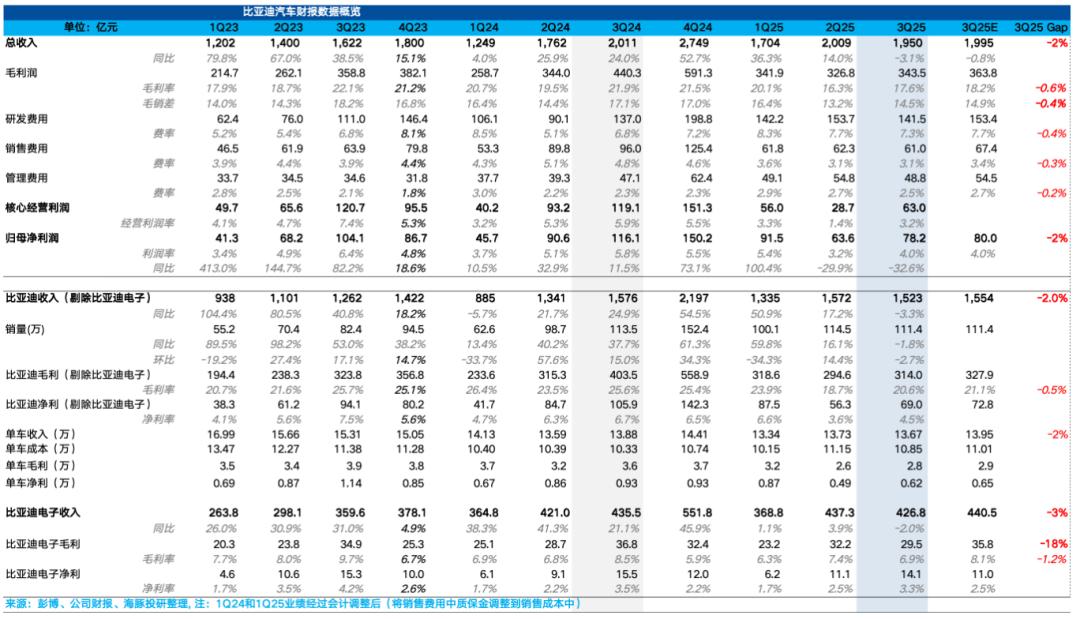
1. Although revenue exceeded expectations, it was driven by BYD Electronics, and vehicle sales revenue was basically in line with expectations: In the fourth quarter, the total revenue was 237.7 billion yuan, slightly exceeding the expected 236.7 billion yuan. However, this was mainly due to the significant sequential growth of non-core businesses.
In the most crucial vehicle sales revenue segment, this quarter's figure was 181.5 billion yuan, in line with market expectations. However, the average selling price of vehicles continued to decline.
2. The average selling price of vehicles remained on a downward trajectory: In the fourth quarter, the average selling price of BYD vehicles decreased by 1,500 yuan sequentially to 135,000 yuan. This was mainly because inventory clearance discounts offset the benefits of structural improvement (such as the increasing proportion of high - end models and overseas sales).
In the fourth quarter, in response to the increase in the technical threshold for new energy vehicle purchase tax in 2026 (the pure - electric range requirement for plug - in hybrid vehicles was raised from 43 kilometers to 100 kilometers), BYD adopted a combination of promotional measures such as "substantial terminal discounts" and "covering the purchase tax" for models facing elimination. The price cuts of these models directly offset the improvement effect on the average selling price (ASP) brought about by the increasing proportion of high - end models and overseas sales.
4. Although the gross profit margin of vehicle sales was recovering, the increase was insufficient: The market originally expected that due to the slowdown of the price war under the "anti - involution" trend, the partial release of the scale effect in the fourth quarter, and the contribution to the profit side from the rapid growth of overseas vehicle sales, the gross profit margin of vehicle sales would increase by at least 2 percentage points sequentially to 22.5%.
However, the actual gross profit margin of vehicle sales was only 21.6% (a sequential increase of 1 percentage point). This was mainly because of the rising supply - chain costs and the fact that BYD was forced to implement the strategy of "adding features without increasing the price" for its main DM - i models (such as the Qin and Song series) to meet the new purchase - tax exemption threshold in 2026, which increased the bill of materials (BOM) cost.
5. The average selling price and gross profit margin of overseas vehicle sales increased sequentially, but the domestic market still faced significant pressure: When analyzing by region, the high - price nature of the overseas market was the main contributor to the structural optimization. In the second half of 2025, the ASP of BYD's overseas models reached as high as 186,000 yuan (a sequential increase of 30,000 yuan), approximately 1.5 times that of domestic models (the ASP of domestic models decreased by 30,000 yuan sequentially to 127,000 yuan).
As the proportion of overseas sales rapidly increased to 26.3% in the fourth quarter, these high - price models became the "ballast stone" to prevent the overall ASP from a significant decline.
6. The net profit per vehicle was 6,700 yuan, lower than market expectations: The net profit per vehicle was only 6,700 yuan. The insufficient decline in vehicle sales cost, the significant sequential increase in selling expenses, and the decrease in other income (presumably due to reduced government subsidies) restricted the release of profits. Moreover, the pressure on vehicle sales in the domestic market in the fourth quarter remained high.
Dolphin Jun's view:
Overall, BYD's performance in the fourth quarter still fell short of expectations. Although revenue exceeded expectations, it was mainly due to the rapid growth of the non - core BYD Electronics business. In the core vehicle sales business, the average selling price of vehicles remained on a downward trajectory, the decline in vehicle sales cost was insufficient, and finally, although the gross profit margin of vehicle sales recovered, it was still lower than market expectations.
The "culprit" that caused the net profit and gross profit per vehicle to be lower than expected was still the poor performance of vehicle sales in the domestic market. In the second half of 2025, both the average selling price and the gross profit margin of domestic vehicle sales continued to decline sequentially. The pressure on vehicle sales remained high, and BYD found it difficult to maintain its former "throne." Its market share also continued to decline, while the rapid growth in overseas sales became the "ballast stone" to stabilize the performance.
However, most of the pressure on vehicle sales in the fourth quarter and the decline in the first quarter have already been factored into market expectations. Therefore, the most crucial thing is the outlook for BYD in 2026.
From BYD's strategic layout in 2026, the chip and energy replenishment press conference held in March focused on updating the megawatt - level fast - charging technology and the second - generation blade battery technology. It can be seen that BYD's product strategy for this year has clearly emerged:
① Reshape the competitiveness of pure - electric vehicles with "long - range" and "ultra - fast charging"
BYD is trying to achieve the energy - replenishment experience of "the same speed as refueling" through technological iteration (it only takes 5 minutes to charge from 10% to 70% and 9 minutes from 10% to 97% at room temperature). On the basis of a 5% increase in energy density, the second - generation blade battery, combined with the full - domain 1000V high - voltage platform and high - efficiency motor, has achieved a significant leap in range (for example, the pure - electric range of the Denza Z9GT has exceeded 1,036 kilometers).
At the same time, BYD has supplemented with aggressive infrastructure and marketing strategies (planning to build 20,000 flash - charging stations by the end of 2026 and offering one - year free flash - charging privileges). More importantly, it will systematically introduce the 6C - level flash - charging technology to its main models priced between 150,000 and 200,000 yuan (such as the Song Ultra EV and Sea Lion 06 EV), directly targeting the layout of Geely and XPeng in the 800V low - end market.
In addition, the pure - electric range of plug - in hybrid models (such as the Song Pro DM - i) is approaching 200 kilometers, and the range of BYD's models in 2026 is expected to increase significantly.
② The "equalization of intelligent driving" continues to penetrate downwards, and the core verification period is in the second quarter
To make up for its weaknesses, BYD's intelligentization strategy has clearly shifted to "self - research of hardware and software" to reduce its dependence on external suppliers and gain technological autonomy and cost advantages.
The Tian Shen Zhi Yan 5.0 system launched in January 2026 achieved a significant improvement in AEB performance and the implementation of map - free urban NOA through an end - to - end large model. However, the press conference at the beginning of the year did not send a clear signal that urban NOA would be fully extended to the core market of models priced between 100,000 and 150,000 yuan.
Dolphin Jun believes that the key to BYD's intelligent driving battle in 2026 lies in whether its self - developed urban NOA algorithm, which is planned to be mass - produced and installed in vehicles around April, can truly achieve the "equalization of intelligent driving for 100,000 - level models." This will be the core measure to consolidate its moat in the mainstream market.
③ Prepare for DM 6.0 to defend the basic market of plug - in hybrid vehicles
According to industry chain research, the thermal efficiency of the new - generation DM 6.0 platform is expected to exceed 48%. With the support of the variable - flux motor, not only will the comprehensive range with full fuel and full charge be further increased, but the fuel consumption under power - depleted conditions is also expected to reach as low as 1.8 - 2.79L/100km (a substantial improvement compared to the 2.9L/100km of the DM 5.0 in 2024). However, since this technology is likely to be launched in the second half of 2026, it cannot provide immediate relief for the current pressure on plug - in hybrid vehicle sales.
Dolphin Jun believes that given the long construction cycle of the ultra - fast charging network, the expiration of the purchase tax exemption, and the new round of national subsidy policy favoring mid - to high - priced models above 167,000 yuan (which is extremely unfavorable to BYD's absolute main models priced between 100,000 and 150,000 yuan), the domestic basic market is facing great challenges.
Combined with the pricing at previous press conferences, BYD has shifted its strategy for main models below 200,000 yuan to "protect profits and stabilize the basic market" and has not adopted the previous aggressive "price war" strategy.
Dolphin Jun expects that BYD's domestic sales volume in 2026 will be difficult to achieve a reverse high - growth. Under a neutral - to - optimistic scenario, the sales volume is expected to increase slightly by 5% - 10% to 3.75 - 3.92 million vehicles (with a stable market share), while under a pessimistic scenario, it may decline by 5% to 3.39 million vehicles.
Against this background, the overseas market has become the biggest performance support and highlight in 2026:
BYD's overseas business sold 350,000 vehicles in a single quarter in the fourth quarter of 2025. In January - February 2026, when the domestic market was under pressure, overseas sales accounted for as high as 51% of the total sales volume. More importantly, the much higher ASP and gross profit margin in the overseas market than in the domestic market have made it the real "profit ballast stone":
In the second half of 2025, the ASP of BYD's overseas models reached as high as 186,000 yuan (a sequential increase of 30,000 yuan), approximately 1.5 times that of domestic models (the ASP of domestic models decreased by 30,000 yuan sequentially to 127,000 yuan).
As the proportion of overseas sales rapidly increased to 26.3% in the fourth quarter, these high - price models became the "ballast stone" to prevent the overall ASP from a significant decline.
If BYD successfully achieves its export target of 1.5 - 1.6 million vehicles in 2026, based on the estimated net profit of about 20,000 yuan per vehicle overseas, the overseas business will directly contribute a net profit of 30 - 32 billion yuan. This means that the proportion of overseas profits in the total vehicle profits will approach two - thirds, providing a solid "profit safety cushion" for the involution in the domestic market.
Dolphin Jun believes that although the intelligent driving press conference to be held in April can be a potential catalyst for the stock price, the real space to break through the valuation ceiling in the future still highly depends on whether the release of overseas local production capacity and sales can continuously exceed expectations. A more detailed value analysis has been published in the article with the same title in the "Dynamic - In - Depth" section of the Changqiao App.
PS: BYD is a company with a complex business structure, covering businesses such as automobiles, mobile phone components and assembly, secondary rechargeable batteries, and photovoltaics. However, the in - depth articles on BYD completed by Dolphin Jun in July last year, "BYD: The Automobile Manufacturer Best at Making Batteries" and "BYD: Seeking Steady Wealth After a Sharp Rise," have helped everyone identify the core. Although the company has many and complex businesses, the core still lies in the automobile business. Those who need to understand this company can first review our above two analyses.
The following is a detailed analysis
1. Although the gross profit margin of vehicle sales recovered, it fell short of expectations
Every time the financial results are released, the market still pays the most attention to BYD's gross profit margin of the automobile business.
In the fourth quarter, since the vehicle sales volume was already known, BYD continued to comply with the "anti - involution" policy and did not implement large - scale promotional discounts. Therefore, BYD's vehicle sales volume in the fourth quarter was only 1.34 million vehicles, a year - on - year decrease of 12%.
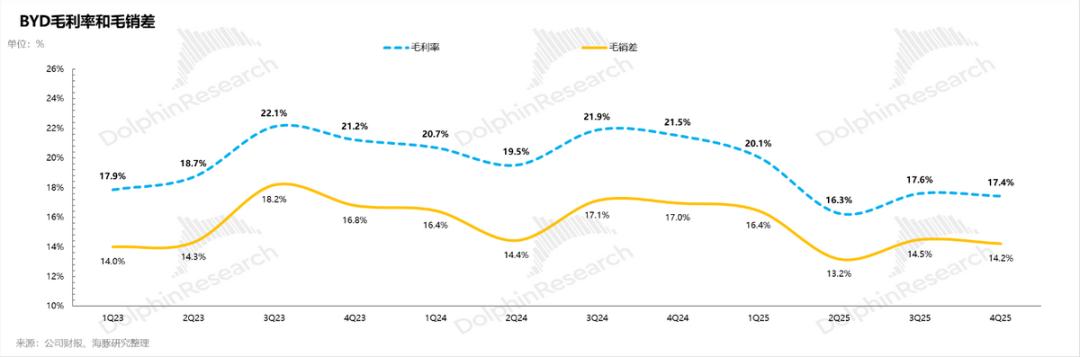
From BYD's gross profit margin performance, since no large - scale promotional discounts were implemented in the fourth quarter, and the proportion of overseas and high - end models in the sales structure increased in the fourth quarter, combined with the partial release of the scale effect (the sales volume increased by 20.5% sequentially to 1.34 million vehicles), the market expected that BYD's gross profit margin of vehicle sales (including the battery business) would show an upward trend sequentially (an increase of 1.9 percentage points sequentially to 22.5% in the fourth quarter).
BYD's actual gross profit margin of vehicle sales in the fourth quarter was 21.6%, only a sequential increase of 1 percentage point, lower than the market expectation of 22.5%. Moreover, the average selling price of vehicles this quarter was 135,000 yuan, a decrease of 1,500 yuan compared to 137,000 yuan in the third quarter, indicating that the average selling price of vehicles was still on a downward trajectory.
The gross profit margin of vehicle sales this quarter was 21.6%, only a sequential increase of 1 percentage point, also lower than the market expectation of 22.5%, mainly because the decline in the cost per vehicle was insufficient.
Specifically from the perspective of the economics per vehicle:
1) Vehicle price: Inventory clearance discounts offset the benefits of structural improvement In the fourth quarter of 2025, BYD's average selling price (ASP) per vehicle continued to decline. While the sales structure was continuously optimizing towards high - price models, the overall ASP decreased by about 1,500 yuan sequentially to 135,000 yuan, mainly because inventory clearance discounts offset the benefits of structural improvement.
Still clearing old - model inventory in the fourth quarter: In response to the increase in the technical threshold for new energy vehicle purchase tax in 2026 (the pure - electric range requirement for plug - in hybrid vehicles was raised from 43 kilometers to 100 kilometers), to avoid a significant depreciation of old - model vehicles after the new year, BYD adopted a combination of promotional measures such as "substantial terminal discounts" and "covering the purchase tax" for models facing elimination. The price cuts of these models directly offset and temporarily masked the price - increasing effect brought about by the product - structure upgrade.
Increasing proportion of high - end and overseas models: Despite the pressure on ASP, the company's sales structure has improved. In the fourth quarter, the combined sales volume of "overseas models" and "high - end brand models" (excluding the Denza, Yangwang, and Fangchengbao Titanium 3) with higher unit prices increased by 10 percentage points sequentially, reaching 37.2%.
When analyzing by region, the high - price nature of the overseas market was the main contributor to the structural optimization. In the second half of 2025, the ASP of BYD's overseas models reached as high as 186,000 yuan (a sequential increase of 30,000 yuan), approximately 1.5 times that of domestic models (the ASP of domestic models decreased by 30,000 yuan sequentially to 127,000 yuan).
As the proportion of overseas sales rapidly increased to 26.3% in the fourth quarter, these high - price models became the