China Association for Science and Technology strikes back forcefully. The prestige of NeurIPS drops to zero overnight. Is the top AI conference dead?
[Introduction] The sanctions clauses of NeurIPS have triggered a strong backlash! The official's move of "banning first and then consulting lawyers" has been ridiculed, and the China Association for Science and Technology has taken significant action to institutionally reduce its prestige to zero. As top scholars such as Tsinghua professors collectively withdraw from the review process, this storm is not only a tough counter - attack but also completely tears off the fig leaf of the so - called "top AI conference, in name only".
NeurIPS is in big trouble now!
The discriminatory policy under the pretext of "compliance" has sparked strong dissatisfaction and protests in the academic circles in China and around the world.
On March 23, the sanctions clauses were quietly added to the NeurIPS 2026 handbook.
On March 25, the Chinese academic circle was in an uproar, and the CCF issued a statement overnight.
On the afternoon of March 26, after three days of silence, the NeurIPS official finally posted a statement on X.
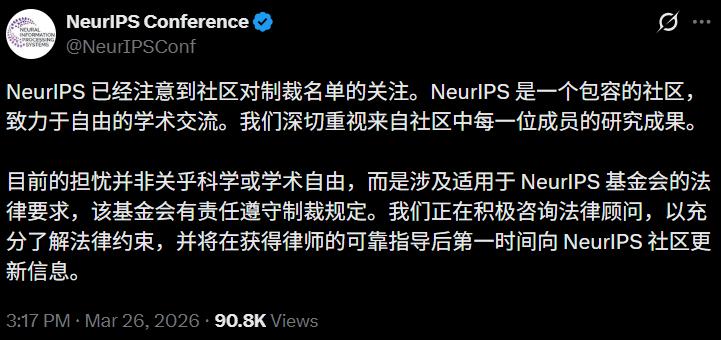
The whole statement is not long, and the core consists of two paragraphs:
The first paragraph says that "NeurIPS is an inclusive community committed to free scientific exchange."
The second paragraph says that "the current controversy is not about scientific or academic freedom, but about the legal requirements that the NeurIPS Foundation must comply with, and we are actively consulting lawyers."
This response was supposed to douse the flames, but instead, the fire burned even more fiercely.
The China Association for Science and Technology Steps In: NeurIPS's Prestige Reduced to Zero
Less than 24 hours after NeurIPS issued its response, the China Association for Science and Technology stepped in directly -
From now on, stop accepting applications from scholars for funding to attend the 2026 NeurIPS conference. All relevant applications will be redirected to domestic academic conferences or other international conferences that "respect the rights and interests of Chinese scholars and adhere to the principle of open cooperation."
An even more severe measure is that: Papers included in this year's NeurIPS will not be recognized for any projects applied to the China Association for Science and Technology as representative works.
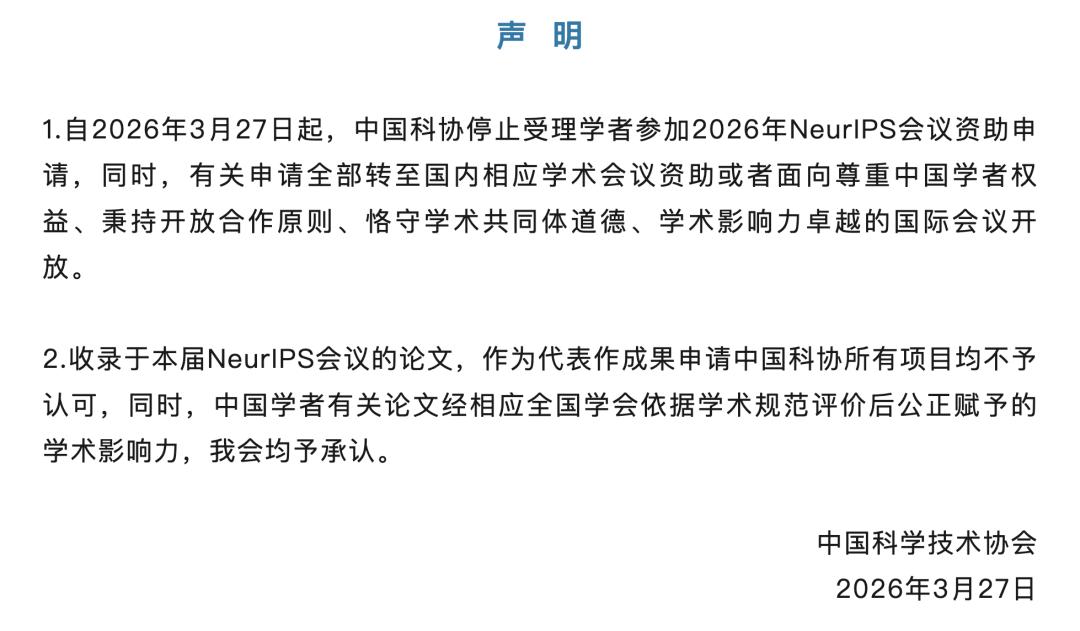
In other words, the "prestige" of NeurIPS 2026 in the Chinese academic evaluation system has been institutionally reduced to zero overnight.
The Self - Contradiction in a Tweet: "Ban First, Then Ask"
The reaction of the community was almost instantaneous.
The most upvoted comment in the comment section directly criticized: "So you issued the ban first and then went to consult lawyers? An interesting workflow: ban first, then ask if it's legal."

More comments poured in.
Some people said that it was ironic to call a "community that excludes researchers from nearly a thousand institutions" an "inclusive community".

Some people suggested that NeurIPS move its registration location to a neutral country, "just like the Eclipse Foundation left the United States."

A researcher said more forcefully: "When you enforce a rule that directly determines who can participate in research, it has already become an issue of academic freedom. You can't separate 'legal compliance' from its consequences."
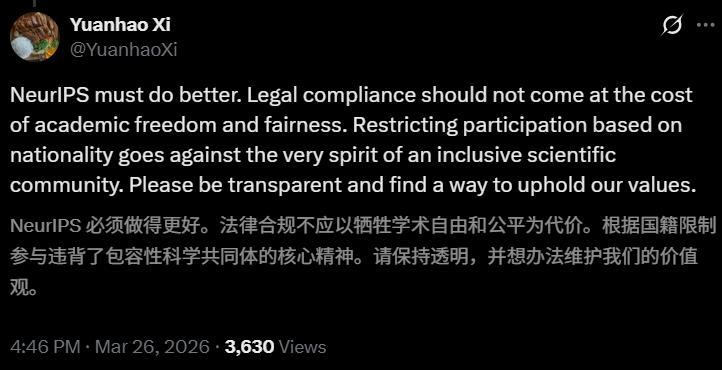
With 100,000 views, the comments were almost all critical.
NeurIPS tried to distance itself by using the words "legal compliance", but the community didn't buy it.
The Loss of Reviewers Is More Fatal Than the Loss of Submissions
What really hurt NeurIPS was what happened next - scholars began to decline invitations in large numbers.
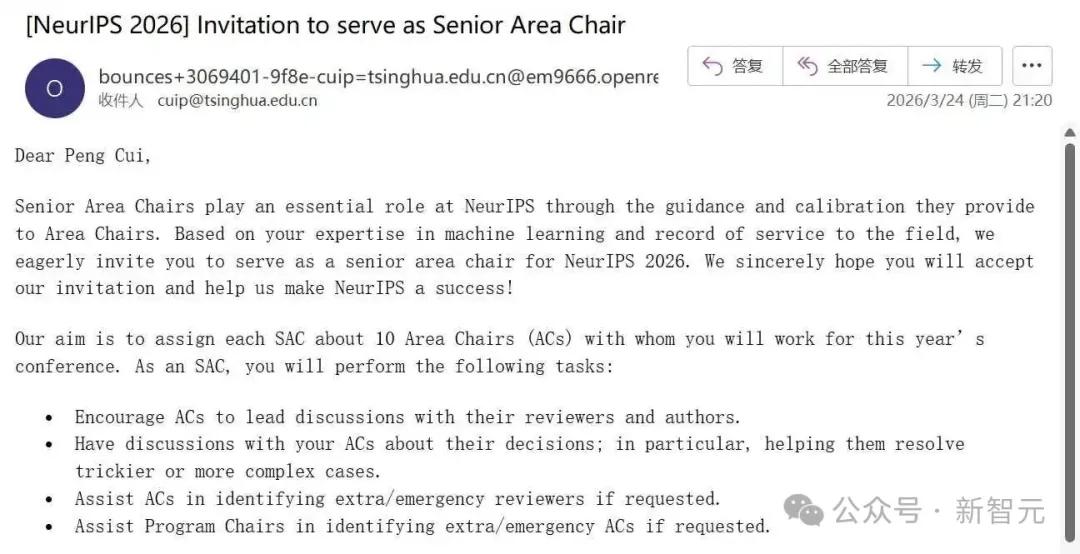
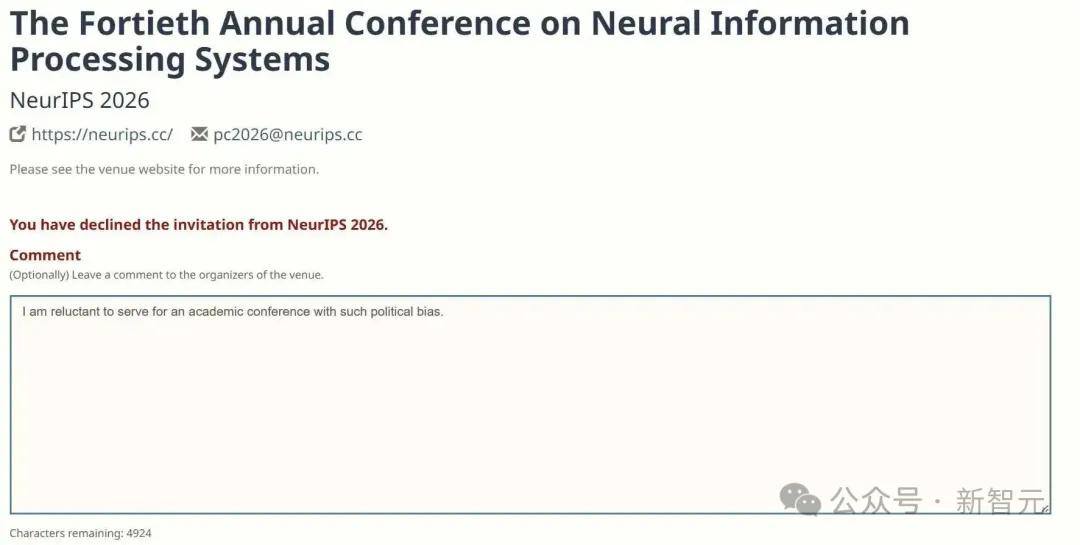
Professor Cui Peng from Tsinghua University directly declined the invitation to be the Senior Area Chair for NeurIPS 2026 and left a message in his reply:
I am reluctant to serve for an academic conference with such political bias.
(I am not willing to serve an academic conference with such political bias.)
It should be noted that the SAC is a core role second only to the Program Chair in the NeurIPS review system. Each SAC is responsible for managing the work of about 10 Area Chairs. This level of refusal is a substantial blow.
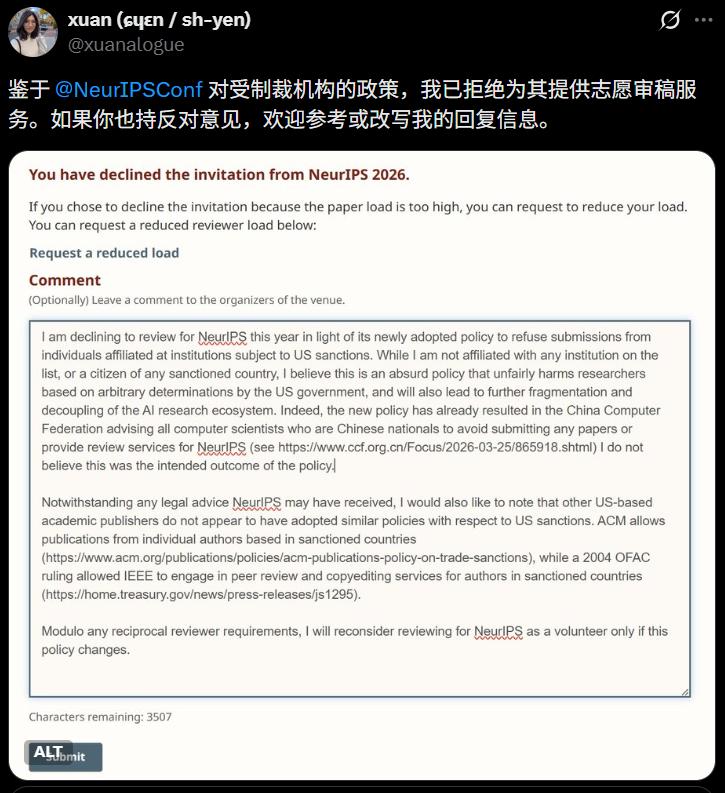
Assistant Professor Tan Zhi Xuan from the National University of Singapore also publicly posted his letter of withdrawal from the review on X and added, "If you also oppose this policy, you can directly use my template."
This post has now received nearly 100,000 views.
The industry is also withdrawing.
It is reported that many researchers from major domestic companies have resigned from their senior positions at NeurIPS 2026.
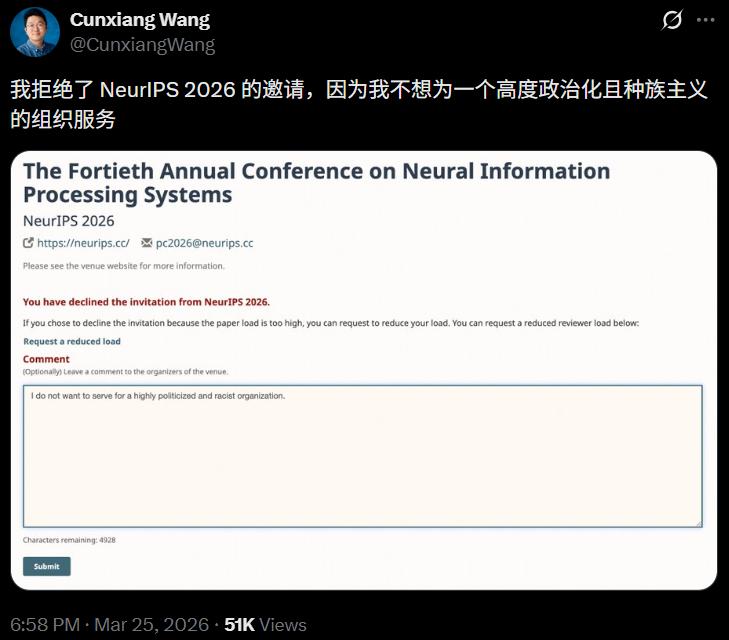
AI researcher Wang Cunxiang announced on X that he would decline to be a reviewer, stating bluntly: "I am not willing to serve a highly politicized and racist organization."
When an academic conference starts to lose its reviewers, the problem is not just the number of submissions.
NeurIPS relies on thousands of volunteer reviewers for its normal operation every year, and these people are unpaid volunteers.
The only driving force for them is their sense of identity with the academic community.
When this sense of identity is shattered by the sanctions clauses, the loss of reviewers may be more fatal than the loss of submissions.
Time Is Running Out for NeurIPS
There are two paths in front of NeurIPS now.
One is to follow the example of IEEE in 2019. That year, under similar pressure, IEEE banned Huawei researchers from reviewing papers. After the CCF initiated a boycott, IEEE withdrew the ban within a week.
The other is to hold out and bear the long - term consequences of being removed from the CCF recommended list, a sharp drop in the number of submissions, and a shortage of reviewers. Don't forget, many major Chinese companies were the main sponsors of NeurIPS 2025, and none of them has stated whether they will renew their sponsorship.
A bigger question mark is: Will ICML and ICLR follow suit?
The operating entities behind the three top conferences are all registered in the United States and face exactly the same legal constraints. NeurIPS was just the first to show its hand.
The submission deadline for NeurIPS 2026 is May 6.
They don't have much time left to make a decision.
Is the Top Conference Dead?
The storm of sanctions is still raging, but a deeper rift has emerged in the same week - the review system of top conferences is collapsing from within.
ICML 2026 has just announced the review results, and there are scathing criticisms all over the internet.
Ravid Shwartz Ziv, a researcher at Meta, said that the quality of the reviews was so poor that he "would rather the comments were generated by AI."
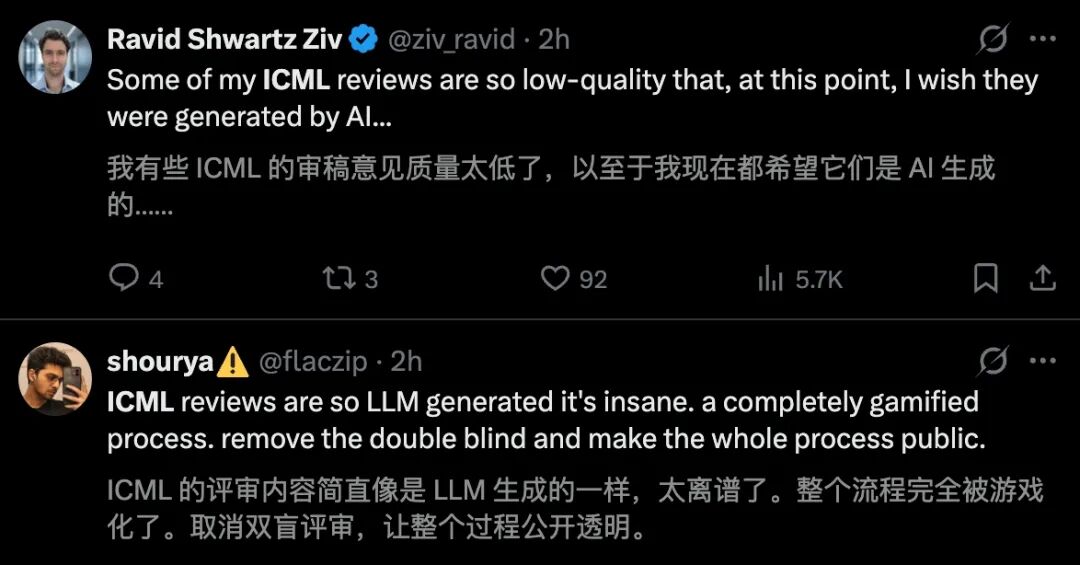
Some reviewers attached the wrong review comments to papers, some asked for experiments that were already in the appendix, and some fabricated non - existent defects in papers.
ICML received about 24,000 submissions this year, and there were obviously not enough reviewers. Quality control has failed.
More ironically, data shows that the scores given by AI reviewers are generally higher than those by human reviewers - machines are actually more "serious" than human reviewers.
Assistant Professor Guanya Shi from CMU posted a long thread on X, which has received more than 90,000 views.
He said that he was "really tired of writing" rebuttal letters against review comments such as "lack of innovation".
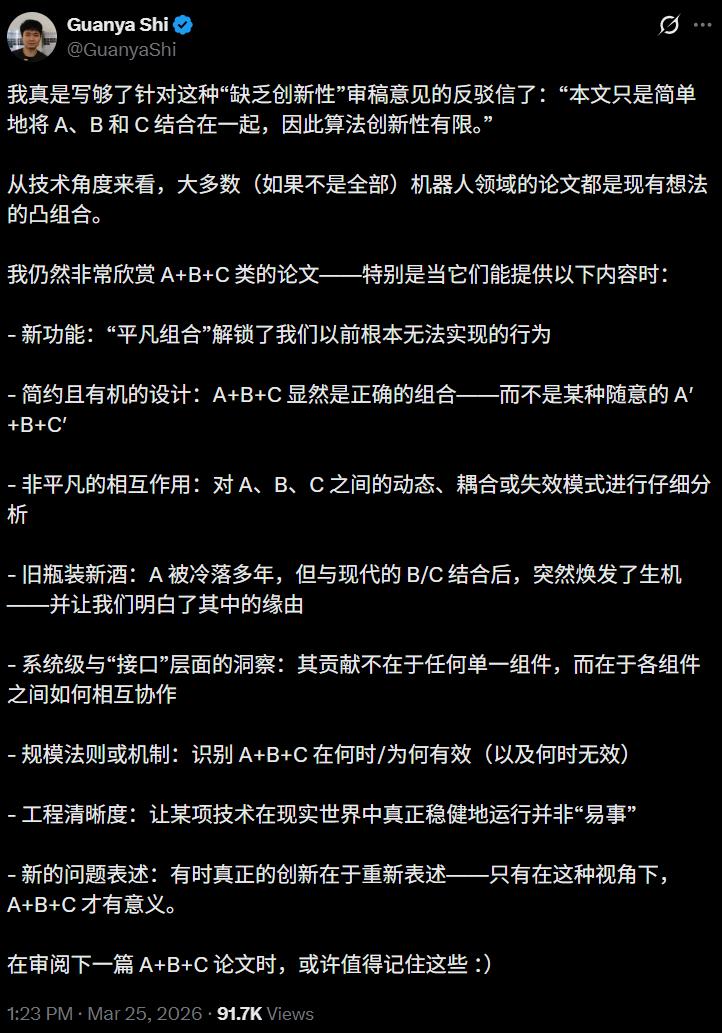
The most common comment from reviewers is: "This paper simply combines A, B, and C, and has limited innovation."
Guanya Shi listed eight real values of A + B + C type papers in one breath and refuted them one by one -
Most papers in the field of robotics are "convex combinations" of existing ideas. The real contribution lies in what new capabilities the combination unlocks, what non - trivial interaction mechanisms it reveals, and what old ideas that have been neglected for years are revitalized.
Jim Fan, the AI director and distinguished research scientist at NVIDIA, directly lashed out under this post:
I don't care about conference paper reviews anymore. At the current eve of AGI, it's meaningless.

As more and more top researchers start to post their papers directly on arXiv, share their results on X, and push their code to GitHub, the role of top conferences as academic gatekeepers is being bypassed.
The sanctions have accelerated this process, but even without sanctions, this rift would have been exposed sooner or later.
Perhaps what NeurIPS should be most worried about is not the sanctions or the boycott, but that more and more top researchers are starting to think that it doesn't matter whether there is such a platform as you.
Reference materials:
https://x.com/NeurIPSConf/status/2037066494983426374
https://x.com/DrJimFan/status/2036782363318059461
https://x.com/xuanalogue/status/2036804752265372142
https://x.com/CunxiangWang/status/2036759558996300015
https://x.com/GuanyaShi/status/2036675367117725951
This article is from the WeChat official account "New Intelligence Yuan", edited by: Hao Kun, Allen. Republished by 36Kr with permission.