A doctoral student from Zhejiang University has created a "Formula 1 in the robot world": Instead of competing in intelligence, it competes in physical performance and aims to run faster than Usain Bolt.
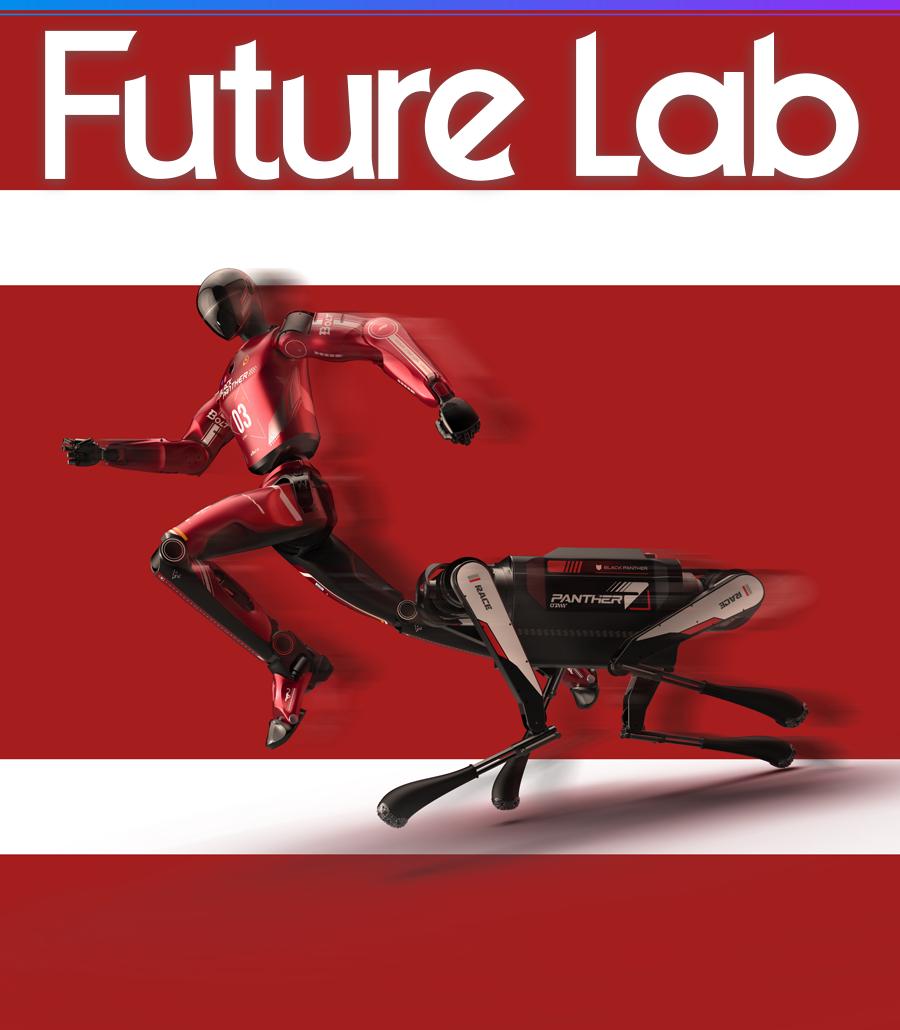
The biggest bottleneck lies not in algorithms but in the response capability of hardware.

Written by | Ba Rui
Edited by | Wei Weizi
Cover image source | Provided by the interviewee
Jingshi Technology seems to be the "king of anti-consensus" in the humanoid robot industry.
This company, founded in May 2024, has made a series of choices that are completely opposite to the industry mainstream in less than two years -
While others are already pursuing making robots smarter, they focus on making robots run faster;
Small humanoid robots are favored by capital and have a fast delivery rate, but they insist on making full-size ones;
They know that choosing the VLA (Vision-Language-Action Model) route can lead to better financing and is more likely to lead to the final goal, but they choose teleoperation;
While others are eager to send robots into factories and homes, they want to send robots onto the track first - a real sports track.
So far, the results of these anti-consensus choices are quite astonishing.
In November 2025, the quadruped robot Panther II of Jingshi was invited to race with Noah Lyles, the 100-meter champion of the Paris Olympics. On the 50-meter track, Lyles almost crossed the finish line being chased by Panther. "With another 10 meters, Panther could have beaten (Lyles)," said Jin Yongbin, the co-founder and CTO of Jingshi Technology. The video of this sprint battle between humans and the robotic dog has been viewed over 100 million times across the internet.
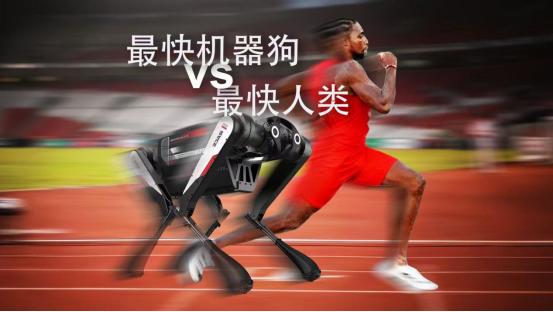
Just one month later, the speed of Panther II increased from about 11m/s during the competition to 13.4m/s, breaking the world record for the running speed of quadruped robots set by Boston Dynamics 12 years ago - even faster than the maximum speed (about 40km/h) of a new national standard electric vehicle after secretly removing the speed limit.
In February 2026, Jingshi released its first full-size humanoid robot, Bolt, which is 175cm tall and weighs 75kg. Its peak speed on the treadmill can reach 10m/s, making it the fastest full-size humanoid robot in the world at present.
This has obviously attracted the attention of the industry. At the Yabuli Forum on March 17th, Wang Xingxing, the founder of Unitree, also mentioned that by mid-year, a humanoid robot would run 100 meters in less than 10 seconds, with the core evidence being Bolt's performance.
According to the two main schools of humanoid robots at present, robots with good running performance generally don't look good - most of them have enlarged joints and exposed motors, and don't look human at all; while those that look human still have a performance gap compared with humans.
However, Jingshi's Bolt is the most human-like in terms of body structure among robots with good functionality . It has smooth overall lines, no extra components exposed, and its feet are carefully designed with an obviously bendable sole, rather than a straight board that needs shoes to reduce friction. According to Jin Yongbin's explanation, this additional degree of freedom can relieve the impact and obtain greater force when the robot runs at high speed.
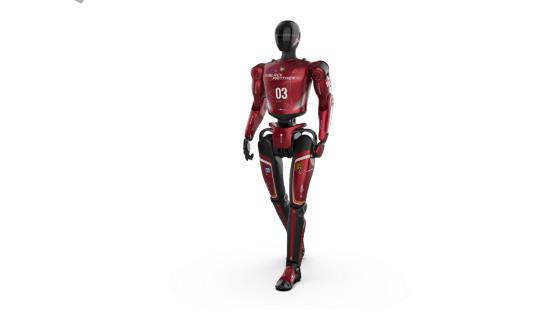
Bolt
While most of its peers are competing in the "brains" of robots, Jingshi is competing in the "body".
According to Jin Yongbin's judgment, with the progress of AI algorithms, the control ability of robots has approached the limit of the hardware itself. What really restricts the development is not that the "brains" are not smart enough, but that the "bodies" of robots are not good enough to use.
Jin Yongbin, born in 1995, studied mechanics at Zhejiang University since his undergraduate years and began researching high-speed legged robots after starting his doctoral studies in 2017.
“When we started researching robots 10 years ago, they asked why they should fund us. So much money was spent on researching a robot, but its performance was still worse than that of a hound.” This was the most fundamental confusion deep in Jin Yongbin's heart. “The power density of human muscles is about 300W/kg, while that of motors can reach 3000W/kg or even higher, an order of magnitude better than biological performance. But overall, the performance of robots is still inferior to that of living organisms.”
So Jin Yongbin's solution is to push the hardware capabilities to the limit with speed, and correct the shortcomings of machinery in the most efficient way of exposure, so that the physical capabilities of robots can match the intelligence they will carry in the future.
As Wang Xingxing said, “Breaking through these physical limits is not only a display of speed but also a sign of the maturity of robot hardware performance and control algorithms.”
Since 2023, Jin Yongbin has noticed that robots are gradually being applied in various industries, and more and more open-source algorithms and hardware are quickly catching up with their technological advantages in the laboratory. So in May of the following year, he and his teacher, Wang Hongtao, the executive director of the Cross-mechanics Center of Zhejiang University, jointly founded Jingshi Technology, focusing on the R & D of AI-enabled high-maneuverability legged robot movement.
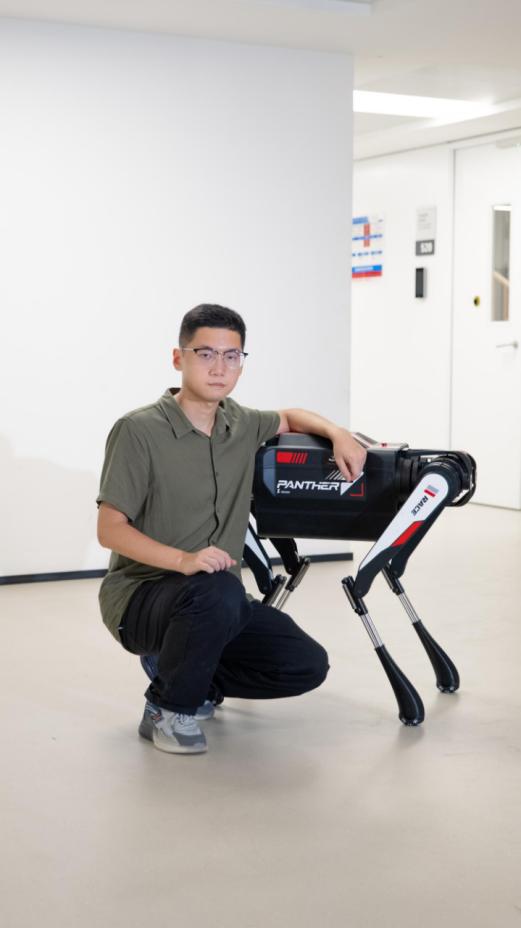
Jin Yongbin and the quadruped robot Panther
A completely academic founding team. According to the view of the venture capital circle in the article "Sorry, we won't invest in professors' startups anymore" that went viral in October last year, this kind of founder is no longer favored by capital. Their biggest problem is that they don't like commercialization - they are obsessed with technology and ignore the market, and they can never complete the journey from the laboratory to the shelf.
However, Jingshi may have achieved more than many people think. The driving technology developed in the process of pursuing the ultimate speed has been applied to the industrial quadruped robot Apollo - it can carry 70kg, run at 8m/s, and has won the Guinness World Record. It is already on sale. There is also a wheel-legged dual-mode robotic dog with a screen that can serve as a smart speaker and is now ready for mass production. It was officially launched at the recently concluded AWE.
We're not sure if Jingshi's approach will ultimately succeed, but on a track that's becoming increasingly homogeneous, a completely different answer is at least worth listening to seriously. The following is a conversation between the "Future Human Laboratory" and Jin Yongbin in mid-February, published after being organized -

Fast is not just about speed
Future: Why does the robot have to run fast?
Jin Yongbin: Fast is far more than just speed. It is a comprehensive combination of strength, density, intensity, smoothness, and a series of other abilities.
When we buy a car, we usually care about the 0 - 100km/h acceleration time. The shorter the time, the better the car's structure and the stronger the engine's ability. The same goes for robots. When there is a weak link, it will affect the improvement of the maximum speed.
The earliest meaning of "Fast" in Old Germanic was "firm". Because if you are firmly unobstructed, you will naturally be fast. What we pursue is unbreakable hardware, and fast is just a result.
Our positioning is the F1 of robots.
The speed pursued by F1 racing cars is of little use to ordinary people, but the technologies accumulated from it can help civilian cars become better and better. For example, the optimization of aerodynamic layout and active suspension technology all evolved from F1.
We also hope to do the same thing. Based on it, we can improve the aspects where robots are inferior to humans and make them truly become assistants that can enter households.
Future: But now people don't really care about speed anymore. They think robots should be more intelligent.
Jin Yongbin: Just like cars. In the early days, people pursued safety and reliability. Now these have become default options, and people are increasingly pursuing interior decoration and entertainment features. The same is true for robots.
But to develop intelligence, a large number of robots are needed to accumulate data. The prerequisite is that robots must be truly usable. I think it's just one step away.
In 2022, there was a global Avatar robot competition. We counted that the highest teleoperation efficiency in that competition was only 10% of that of humans. Its performance is far inferior to that of humans. It would be annoying to have a slow-moving robot doing housework at home.
We want to improve its external characteristics to be on a par with humans, or at least reach 80% of human performance. That would be much more comfortable.
Currently, the robots that perform well and move more nimbly are generally small in size, about 1.3 meters tall. Because of their small size, the physical requirements are much lower, and a series of problems such as motor heat dissipation will also be much less.
Future: In February, you just released a full-size humanoid robot. The peak speed shown on the treadmill is 10m/s, which is already the fastest humanoid in the world at present. Isn't that enough?
Jin Yongbin: 10m/s is about the 100 - meter speed of a national second - level athlete. It still doesn't have the ability to provide running services for professional athletes. In the early stage, we hope it can be used in competitive sports and accompany people in running. In the later stage, through technological precipitation, we can transfer its application to households.
So we are still improving its performance, aiming to make it reach the level of a first - level athlete or even an international master.
Bolt running
Future: What is the ultimate speed goal you've set for it?
Jin Yongbin: In an outdoor scenario, if it can outperform Usain Bolt (with a peak speed of 12.4m/s and a 100 - meter time of 9.58 seconds), then we won't focus on improving its speed for humanoid robots anymore.
Our goal is to replicate human sports behavior. It would be quite exciting for anyone to be able to compete with Bolt, right?
Future: You just said that the small humanoid robots perform better at present. Then why don't you make them?
Jin Yongbin: There are already many small humanoid robots in the robot industry. If we enter this field, we will always be one step behind.
When formulating the development plan at the beginning of 2025, I said that we must make full - size humanoid robots. It is challenging and difficult, and we need to overcome these difficulties.
Currently, we hope to precipitate robot technology and explore some more potential technological barriers.
Future: Won't that slow down your commercialization process?
Jin Yongbin: But if a robot doesn't have its own characteristics, its commercialization will also be very limited. Moreover, we already have industrial quadruped robots and consumer - grade wheel - legged dual - mode robots on sale.
I've been thinking, with so many small humanoid robots around, for example, if someone wants a robot for a performance, why would they choose us instead of a more mature company whose robots have danced in many shows?
But full - size humanoid robots are different. Since October 2025, a batch of full - size humanoid robots have gradually emerged in the industry, and we are right in the middle of this wave. We also have our own characteristics. Our robots are even 2 to 3 times faster than others, so we can establish a foothold in our own niche market first.

What's the use of running so fast?
Future: You position your robots as the F1 of the robot world. Has this approach been questioned?
Jin Yongbin: Yes. At first, as soon as I introduced that our robot was currently the fastest, everyone would immediately ask, "What's the use of running so fast?" No matter how strong my mental core was, I couldn't stand it.
As long as it reaches the upper limit, it can handle all speed - related tasks. In fact, there are some customers who hope to have an ultra - fast robot for rapid response in special scenarios. It's just that we don't directly engage in this area for now.
Future: How did you discover the application scenario of running companions?
Jin Yongbin: In October last year, we gradually noticed it during the competition between Panther and professional athletes. It seems that athletes are like this. If you push them a little, they can immediately reach a new level of potential.