Early-stage investor's self-narration: Why did I dare to invest in Unitree six years ago?
Now, when people look at Unitree, it's likely that everyone in the country knows: it's pretty great. But this opinion isn't worth much today.
What truly holds value is the group of investors who dared to bet real money when Unitree and Wang Xingxing were nobody – 5 - 6 years ago, they already thought Unitree was great.
This kind of insight is what's valuable. Recently, Unitree is gearing up for an IPO, with a valuation of about 42 billion yuan, and it made a net profit of 600 million yuan last year.
PencilNews recently had a chat with its early investor, Zhao Nan, trying to uncover how this investment decision was made when Unitree was still unknown.
- 01 - Meeting Unitree, Thanks to Quadruped Robots
I first met Unitree in April 2020.
It wasn't an accidental encounter. Since 2019, I've been systematically researching the robotics industry, covering almost all the directions available at that time: quadruped robots, underwater robots, food - delivery robots, and even some consumer - oriented products.
After that round of research, I had a fairly clear judgment in mind: for the robotics industry, the question isn't "if it will happen" but "when it will happen."
The real question is: which directions have been proven and which are just in the realm of imagination.
In my view, quadruped robots are one of the few directions that have been proven.
Look at Boston Dynamics. It has developed robotic dogs, and there are already customers using them. This shows a very crucial point: robots are no longer just science fiction; they've entered the real world.
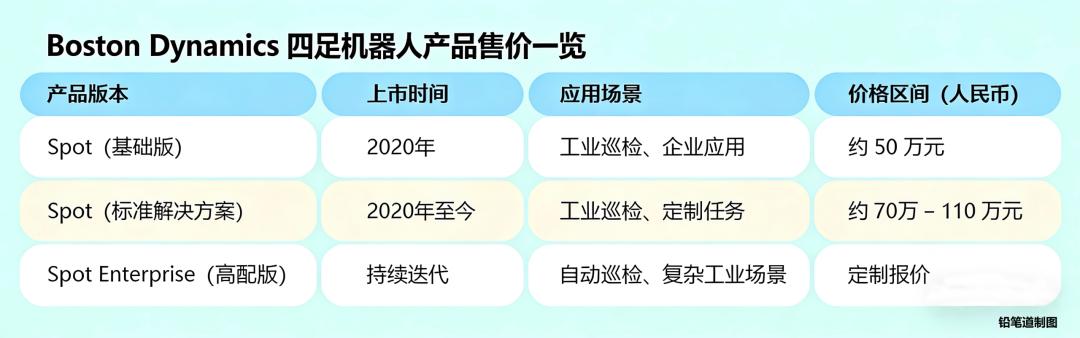
However, at the same time, it also exposes a more fundamental problem – the cost issue: high labor costs, heavy R & D investment, and an immature supply chain.
At that time, Boston Dynamics' problems were quite typical: it had the world's top - notch team, with extremely high labor costs; the R & D cycle was long, and the investment was huge; even its early products used diesel instead of lithium batteries; and finally, it was sold by Google to the SoftBank Vision Fund.
But this doesn't mean there's no demand for quadruped robots; it's just that the cost is unaffordable.
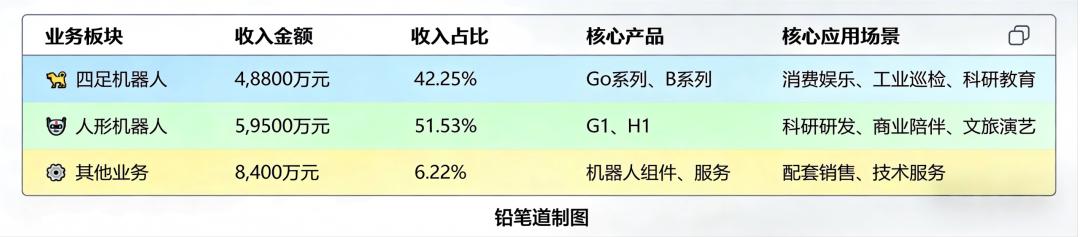
Even today, quadruped robots remain Unitree's core business.
So my judgment at that time was: whoever can bring down the cost will have a chance. Obviously, Chinese teams have an opportunity because we have a supply - chain advantage.
- 02 - Why Invest?
Based on this judgment, I went to Hangzhou for the first time in April 2020 and met Wang Xingxing (the founder of Unitree).
That meeting quickly made me realize that this wasn't a "new - start" team.
It was 2020, and they had already been in business for three years.
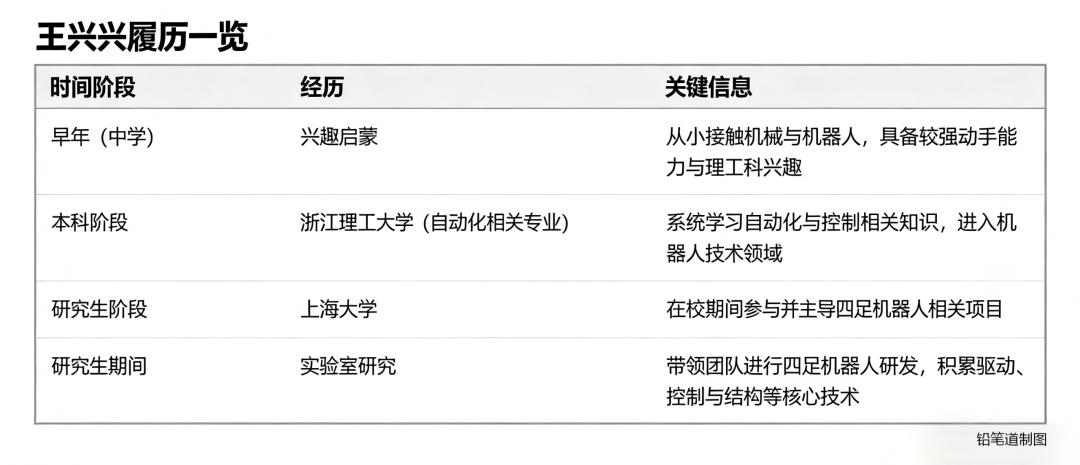
When Wang Xingxing was a graduate student at Shanghai University, he was already leading a quadruped robot laboratory and started working on the XDog algorithm at that time.
By the time we met him, he had a deep understanding of every detail of the functions and programs of quadruped robots. In other words, while many teams were still "exploring the market," they were already accumulating technology.
This is particularly crucial in the robotics industry because it's a typical industry where "time is exchanged for capabilities." Many things can't be achieved by just throwing money at them; they have to be accumulated bit by bit.
What really made me make up my mind were several more specific things.
First, they have mastered the most core underlying capabilities of robots.
Many people think robots are just "finished products," but in fact, what really determines the height of a robotics company are three things: drives, sensors, and controllers.
If you don't have these three in your own hands, you'll always just be a system integrator.
By 2020, Unitree had already accumulated technology and patents in these three areas. This means it's not just assembling products but building underlying capabilities. This basically determines its upper limit.
Second, it's about the customers.
Many robotics companies "develop products first and then find customers," but Unitree did the opposite – they already had customers in 2020, and they weren't ordinary customers.
At that time, their customers included companies like Apple, Nvidia, Meta, and Google. These companies bought their robotic dogs for AI training and algorithm training. Domestic customers were mainly universities.
This is very crucial because it shows two things: first, the product is already usable; second, the technology has been recognized by top - tier technology companies.
Wang Xingxing has always been pushing everyone to do one thing: develop simple products that customers can accept and sell them first. It's not for making money but for training the company's entire R & D, production, and sales system. By communicating with customers, they can also identify problems and iterate on the products.
Third, it's about mass - production capabilities.
When I visited their company, I noticed a very detailed thing – there was a warehouse next to their office building, which housed a press machine for forming parts. At that time, Wang Xingxing introduced that for a quadruped robot, except for the chips, all the other core components were designed by Unitree itself.
Why does a robotics company need to do these things on its own?
Doing it on their own, the cost is very low, and the integration can be very high. Wang Xingxing has always wanted to integrate everything that can be integrated in the industrial chain to compress the cost of each component.
Moreover, at that time, there was no mature supply chain in the industry, and no factory was willing to take on these non - standard products. So they had to do it themselves.
This detail shows me another thing: they've been solving the "mass - production problem" from the very beginning, rather than just making laboratory products.
At that time, there were several domestic companies working on quadruped robots. Some were still at the laboratory stage, and some were exploring the home - companion direction, but Unitree was one of the few teams with real mass - production capabilities. At that time, Unitree's product - development rhythm was very similar to DJI's ten years ago.
Fourth, it's about the market path.
At that time, many teams were working on home - companion robots, trying to enter the consumer market directly. But my judgment at that time was that this path was too early. Users weren't ready, the cost hadn't come down, and the scenarios weren't urgent enough.
Instead, the B2B market was more realistic. For example, in security inspections and industrial scenarios, there are real budgets and demands.
So I was more optimistic about a path: first establish a foothold in the B2B market and then gradually penetrate into the consumer market.
This was also the path Unitree chose at that time.
But just these reasons weren't enough for me to decide to invest.
What really made me think "this company might go a long way" was Wang Xingxing himself.
When I talked to him, I had a very strong feeling: he wasn't very interested in business topics, but when it came to robots, he was a completely different person.
He told me that he's loved robots since childhood, watched Iron Man, and his idol is Elon Musk. He has a typical science - and - engineering mindset, loves physics and mathematics, and doesn't care much about Chinese and English. He even built a turbojet engine in junior high school.
This kind of person has a very important characteristic: they don't enter an industry just because it's popular; they do it out of love.
In a technology - driven industry, this is very important. Because many things require long - term investment and long - term perseverance, and without love, it's impossible to persevere.
Interestingly, although he's a technology believer, his decision - making style is actually very practical.
He's not the kind of person who "builds a factory first and then looks for customers." Instead, he first gets customers, then expands production, and then makes investments.
In 2020, he already had dozens of university customers and overseas customers. These orders gave him enough confidence to buy equipment and build production lines. Without these customers, I believe he wouldn't have done so.
Another point that many people overlook but I think is important is Unitree's developer ecosystem. Many people only see Unitree selling robots, but in fact, it's more like building an ecosystem.
They started sharing technology, writing papers, and communicating with developers early on. These things don't yield immediate returns, but in the long run, they'll lead to a very strong result: a group of top - tier global developers are using your products.
This is also why, at such an early stage, companies like Apple, Nvidia, and Google chose Unitree over other companies.
What's even more interesting is that they've hardly done any overseas marketing, large - scale PR, or brand promotion, but they have a good reputation in the overseas technology circle.
This shows one thing: recognition in the technology circle is itself the strongest brand.
Later, many people would ask a question: why do many humanoid robot companies need to raise so much money (in the order of 1 billion yuan), while Unitree doesn't seem to have spent that much?
The answer is actually very simple: it didn't start from scratch.
It already has core capabilities such as drives, controllers, and sensors, as well as mass - production experience. So when it enters the humanoid robot field, it's essentially adding to an existing system rather than building a new one from scratch.
- 03 - Humanoid Robots: Believe First, Then See
When it comes to humanoid robots, I can be very honest and say that when I invested in them in 2020, I didn't see them venturing into humanoid robots.
At that time, Wang Xingxing also thought this was too early: at that time, humanoid robots weren't resistant to falls; secondly, the requirements for AI, mobility, and human - machine interaction were very high, and there was also the "uncanny valley effect." He thought it was unrealistic for customers to pay for humanoid robots within five years.
He judged at that time that the cost of quadruped robots would soon drop significantly. In 2023 and 2024, there would be more and more individual players of quadruped robots, and there would be significant growth after 2024, and they might even enter households.
But by 2023, the situation changed. The progress of AI has enabled robots to have "learning abilities."
This is a watershed moment.
If a humanoid robot can only perform mechanical tasks, its significance is limited. But once it can learn and generalize, its potential becomes completely different.
Many people now ask: "What can humanoid robots do besides dancing?" I'll be very direct and say: currently, they can't do much. But what we're betting on isn't the present but the future.
This future can be roughly divided into three steps.
The first step is to have physical capabilities close to those of humans, such as walking, balancing, and grasping. This step alone is very difficult.
The second step is for AI to enable it to learn to do things, just like AlphaGo started as a Go - playing program and later became a general - purpose AI.
The third step is to enter real - world scenarios, such as dangerous environments, complex terrains, and industrial scenarios.
Why do we have to develop humanoid robots?
Because the human world is designed for the "bipedal structure." Stairs, mountains, and obstacles are scenarios that wheels can't handle, but two legs can.
So, if you ask me what the biggest reality in this industry is now, I'll say: commercialization is still in its early stages.
Unitree's current revenue still comes mostly from quadruped robots, and humanoid robots haven't really been mass - deployed. But this doesn't mean they have no value. Because the development of technology isn't linear; it will explode at a certain point.
Just like AI, it took many years from playing Go to changing the entire industry, but once it crossed the critical point, it experienced exponential growth. The same is likely to happen with robots.
If I were to summarize why Unitree has reached this point, I'd say three things:
First, it's a long - term player, not a follower.
Second, it has built a developer ecosystem, which is an invisible but very strong barrier.
Third, it has the ability to continuously iterate, rather than making one - time products.
They're not just making a robot; they're constantly defining a technological path.
So, if you ask me: why did I invest in Unitree in 2020? My answer is actually very simple: it's not just a robotics company; it's a company building the infrastructure for the robot era.
This article only represents the independent views of the interviewee and does not constitute any investment advice.
This article is from the WeChat official account "PencilNews" (ID: pencilnews) . Oral account: Zhao Nan, Interview: Zou Wei, Writing: Song Ge. Published by 36Kr with authorization.