AI software is included in the integrated automotive-grade standard for the first time, and another recommended national standard is seeking public comments.
When the intelligent driving system suddenly malfunctions on the highway, and when the intelligent cockpit experiences blackouts, freezes, or even affects vehicle operation due to software bugs, automotive software has evolved from an "auxiliary tool" to a core issue related to life safety.
Complaint data from the Auto Quality Network shows that from January to December 2025, the proportion of complaints about new energy vehicle models exceeded 40%. Among them, "malfunctions in the driving assistance system", a newly emerging pain point, saw a significant increase in complaints, and "system upgrade issues" topped the list of service - related complaints.
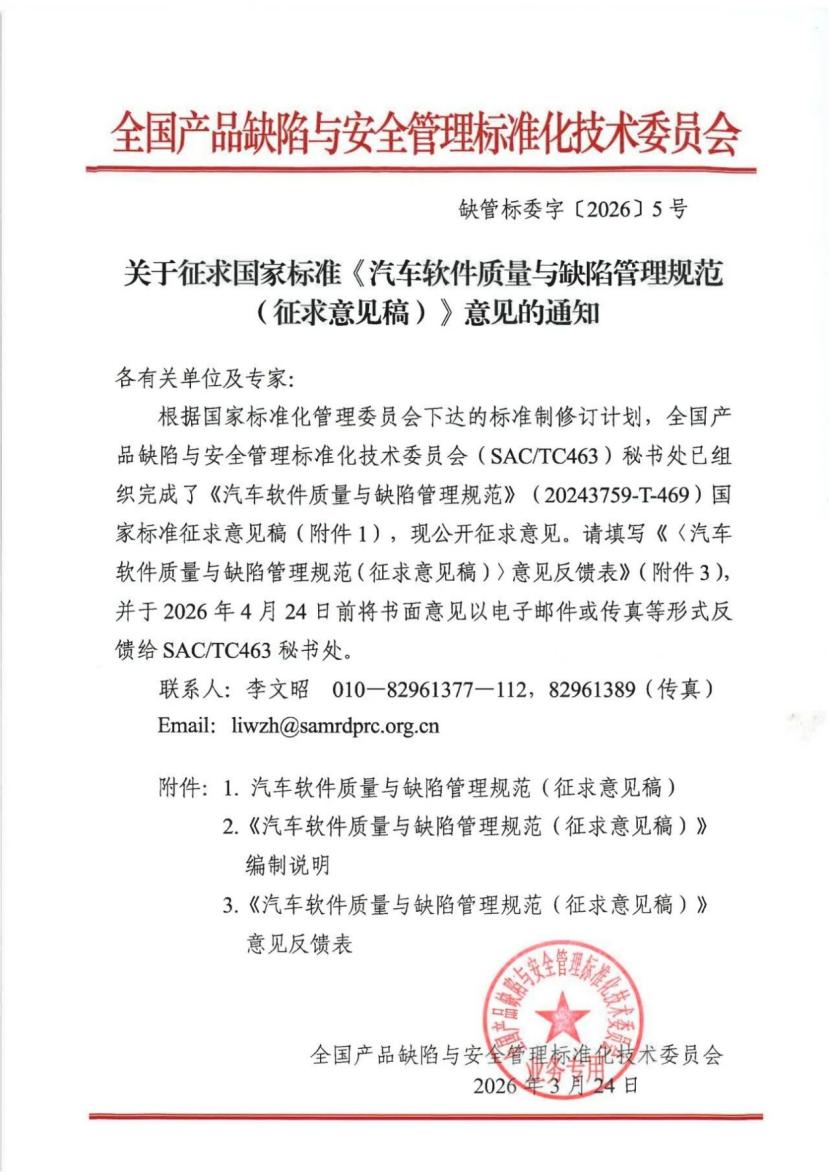
Recently, the Defect Product Recall Technology Center of the State Administration for Market Regulation, in collaboration with professional associations, 8 domestic mainstream vehicle manufacturers, 7 leading enterprises in the automotive electronics and technology fields, 3 well - known universities and research institutions, as well as authoritative vehicle testing and certification agencies, jointly drafted the "Specifications for Automotive Software Quality and Defect Management (Draft for Comment)" (hereinafter referred to as the "Draft for Comment"), which has officially started soliciting public opinions. As the world's first vehicle - grade standard integrating functional safety, safety of intended functionality, information security, and artificial intelligence security, it not only fills the domestic gap but also reconstructs the logic of automotive software quality management with the concept of "risk pre - control" - shifting from "putting out fires" to "preventing fires" comprehensively.
From "Code Stacking" to "Quality Pre - control"
In the era of traditional fuel - powered vehicles, automotive quality issues were more concentrated on mechanical components. In the era of intelligent connected vehicles, the code volume of a single vehicle can reach hundreds of millions of lines. Software malfunctions, algorithmic bugs, and data security issues have become new sources of risk. The core breakthrough of this draft for comment lies in breaking away from the fragmented management mode of "treating the symptoms rather than the root cause" and constructing for the first time an integrated management system covering the entire life cycle of automotive software, providing a solution for the era of "software - defined vehicles".
From a management logic perspective, the "Draft for Comment" incorporates a risk - based management concept, moving quality control to the initial stage of software development. In the "quality planning" stage, automobile manufacturers and suppliers are required to establish full - dimensional safety goals covering functional safety, safety of intended functionality, information security, AI security, and data security. At the same time, quantitative process indicators such as unit verification coverage, defect density, and safety level achievement rate should be formulated to avoid "development with defects" from the source. This means that the past development model of "launch first, then fix" will be changed. Software quality is no longer a "post - event remedy" in the testing stage but a requirement throughout the entire process of requirement analysis, design and implementation, integration and verification, and release and maintenance.
More notably, the "Draft for Comment" for the first time puts forward specific control requirements for machine - learning/AI software. Currently, more and more new energy vehicle models are equipped with advanced driving assistance systems. The "unexplainability" of such AI software is precisely the core source of quality risks - misjudgments of algorithms in extreme scenarios, biases in data sets, and compatibility issues after model updates may all lead to safety accidents.
In response, the "Draft for Comment" clearly requires that AI software should have a separate design and implementation specification, and "value alignment control" should be added to ensure the robustness of the model and the integrity and timeliness of the data set. At the same time, full - link traceability of requirements, models, and data sets should be achieved. This regulation also addresses pain points such as "malfunctions in the driving assistance system" encountered by consumers, providing a clear path for solving the problem of the quality stability of intelligent driving algorithms.
In terms of process control, the "Draft for Comment" sets up a "key process review" stage, requiring mandatory reviews of the five core stages of software development (project planning, requirement analysis, design and implementation, software integration, verification and validation). The review team must include experts from various safety fields, and the review results directly determine whether the software can enter the next stage.
In terms of risk assessment, the "Draft for Comment" establishes a clear grading mechanism: through a matrix of "severity + probability", the comprehensive risks of software problems are divided into 5 levels. For software defects in on - sale vehicles at level 5 (high risk) and level 4 (relatively high risk), the recall procedure will be compulsorily initiated. This provides clear decision - making basis for regulatory authorities and automobile manufacturers and offers more rigid protection for consumers' safety rights and interests.
Make Software Quality Issues "Traceable, Repairable, and Recalled"
Complaint data from the Auto Quality Network in 2025 shows that the proportion of complaints about new energy vehicle models exceeded 40%. "Malfunctions in the driving assistance system" became a new core pain point, and "system upgrade issues" topped the list of service - related complaints. The number of complaints about pure - electric and plug - in hybrid vehicle models increased by 76% and 65.7% year - on - year respectively. Behind these data, there are also consumers' concentrated voices regarding unstable software quality, opaque upgrade services, and untimely fault repairs. This draft for comment is precisely the "prescription" for these real - world problems.
First, in response to the frequent occurrence of software malfunctions, the "Draft for Comment" establishes a complete defect management process from information collection to recall effect evaluation. In the past, software problems reported by consumers often faced the dilemmas of "difficulty in providing evidence, difficulty in tracing, and slow repair": for example, misjudgments of the driving assistance system in specific scenarios were difficult to accurately reproduce and locate; new malfunctions after OTA upgrades were often shirked as "user operation problems".
According to the new requirements, automobile manufacturers must establish a multi - channel information collection platform, integrate data such as market feedback, public opinions, regulatory information, and recall cases, and quickly identify and trace the root causes of common problems. At the same time, all software problems, changes, and risks must be uniquely identified and recorded to achieve full - link traceability. This means that in the future, "malfunctions in the driving assistance system" reported by consumers can be accurately located to specific code versions, data sets, or algorithmic logics, fundamentally solving the problems of "unclear faults and unclear responsibilities".
Second, the standard also provides clear constraints for the chaotic situation of software upgrade services. Data from the Auto Quality Network shows that "system upgrade issues" topped the list of service - related complaints, reflecting many problems in current OTA upgrades: for example, untimely push of upgrade packages, vehicle malfunctions caused by interrupted upgrade processes, and reduced functionality after upgrades.

In response, the standard clearly requires that in the "release management" and "upgrade and maintenance" stages, a detailed version description, including the version number, existing problems, and software and hardware dependencies, must be generated before software release. At the same time, the deliverables should be accompanied by a complete verification report. In the upgrade and maintenance stage, automobile manufacturers are required to formulate clear maintenance plans and division of responsibilities to ensure upgrade support throughout the software life cycle. This means that future OTA upgrades will be more "transparent". Consumers have the right to know the specific content, risks, and verification status of the upgrades, and automobile manufacturers must take clear responsibility for quality problems after upgrades.
More importantly, the "Draft for Comment" sets a strict recall threshold for high - risk software defects. According to the regulations, if the software defects in on - sale vehicles are evaluated as level 5 (high risk) or level 4 (relatively high risk), the recall procedure will be compulsorily initiated. Automobile manufacturers are required to report the recall plan to the regulatory authorities within 5 working days after confirming the defects, publicly release information within 5 working days, and inform vehicle owners of specific emergency disposal methods and solutions within 30 working days.
In the long run, this "Draft for Comment" will promote the transformation of China's intelligent connected vehicle industry from "scale expansion" to "quality improvement". In the past, in order to seize the market, some automobile manufacturers over - pursued the stacking of intelligent configurations and ignored the stability of software quality. The "Draft for Comment" will force automobile manufacturers and suppliers to pay attention to software quality and safety, and integrate the concept of "quality pre - control" into every link of product development.
For consumers, this means that intelligent connected vehicles purchased in the future will have more reliable software quality, more transparent upgrade services, and more rigid safety guarantees, truly enjoying the convenience brought by "software - defined vehicles". China's intelligent connected vehicles will reach a new level in terms of "safety, reliability, and stability".
This article is from the WeChat official account "Automotive Market Insights". Author: Automotive Market Insights. Republished by 36Kr with permission.