TuoZhu and Pop Mart have reached a settlement, and the days of free 3D printing of well-known brand IPs are counting down.
Author | Zhang Ziyi
Editor | Yuan Silai
After several years of wild growth, the "grey rhino" that players in the 3D printing track have been avoiding finally rushed through the door.
In mid-March, Bambu Lab, a 3D printing company, issued a statement apologizing to Pop Mart, a leading figure in the trendy toy industry, for the IP infringement issues on its MakerWorld platform. The two parties reached a settlement, and relevant unauthorized models such as LABUBU were completely taken off the shelves.
The lawsuit originally scheduled for April ended with a "lightning settlement." However, the copyright alarm it rang for the entire consumer-grade 3D printing industry has just begun to reverberate.
This is not the first time Bambu Lab has faced infringement disputes. Luo Xiaohei Studio (officially named Beijing Hanmu Chunhua Animation Technology Co., Ltd.) filed a lawsuit against Bambu Lab at the end of 2025, alleging infringement of the right of information network dissemination of works. The latest information shows that the case was reopened on March 20th.
In the consumer-grade 3D printing industry, a new consensus has been formed - good hardware parameters are just the entry ticket, and the community ecosystem can build a deeper moat. A large number of high-quality models that can be directly clicked and printed are the key to breaking into millions of households.
In this regard, Bambu Lab has already outpaced its peers by a large margin. Its Maker World is currently the 3D model community with the highest monthly active users globally, with its monthly active users reaching tens of millions. There are more than 200,000 active creators in the community, and the total number of 3D models has exceeded one million.
This huge user base and high activity level are also important reasons why Bambu Lab was sued for model infringement on its platform.
Yingke searched several 3D model communities operated by hardware manufacturers, including Maker world, CrealityCloud of Creality, Nextprint of SmartPie, and Printables of Prusa. Searching for keywords such as Zootopia, Frozen, and Marvel shows a large number of 3D models uploaded by users.
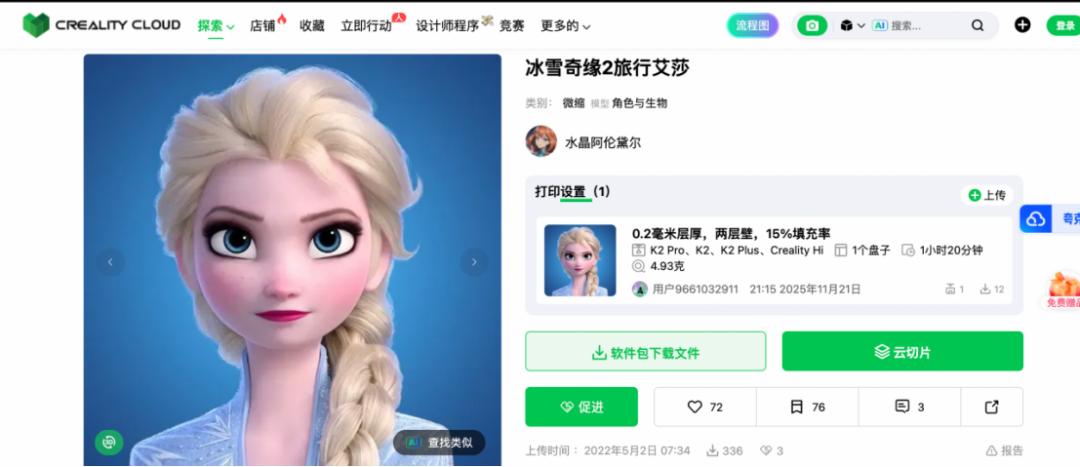
Screenshot of the CrealityCloud webpage
You Yunting, a senior partner at Shanghai Dabang Law Firm, told Yingke: Such highly functional communities operated by hardware manufacturers have a high duty of care for the infringing content posted by users in terms of law. If copyright holders such as Disney file a lawsuit, as the platform manager, there is a relatively high legal risk of bearing the liability for contributory infringement due to such negligent management.
Disney's legal department is known as the "strongest legal department on earth." In the current era of the booming AI video generation, Disney has filed lawsuits against several AI video generation companies. The global release of ByteDance's AI video generation model Seedance 2.0 was postponed because it received an infringement warning letter from Disney.
Currently, since most of the models related to IP are only for personal use by players and have not entered the market, Disney has taken no action for the time being. However, as the number of community users continues to grow globally, it is hard for Disney not to notice this phenomenon.
For the 3D model communities of hardware manufacturers, in order to encourage users to share and upload models more actively, their handling of IP infringement in the forum is usually not too strict. Take the Maker World forum as an example. Many models are marked with "Standard Digital File License."
However, You Yunting told Yingke: "This (Standard Digital File License) may be a restriction on downstream users, but if the upstream has not obtained the authorization from the copyright holder, no matter how the rights of downstream users are stipulated, it does not affect the infringement risk of the upstream (model manufacturers) for not obtaining authorization."
The leeway for 3D model forums to play on the edge of IP copyright will become increasingly narrow.
This is also the starting point for the 3D printing industry to shift from hardware competition to content competition. Ultimately, exclusive IP may become the decisive factor.
01 The Necessary 3D Model Community
For a long time in the past, 3D printing was quite niche. Apart from the high threshold of using the machines themselves, it was actually difficult to get started with printing works. Users had to download STL model files from third-party websites, adjust the parameters in slicing software, and finally achieve printing.
3D printing manufacturers at that time had not yet realized the closed-loop business value behind the 3D model forum. After all, they were mainly targeting geeks and small B entrepreneurs, rather than ordinary consumers.
Therefore, 3D printing users were scattered in various communities and model forums. Among them, model websites were mainly third-party websites and independent studios. They did not make money in the early days and adhered to the ancient and pure Internet sharing spirit. Thingiverse, the oldest model website in the industry, was once an absolute pioneer in 3D models. With free and open-source sharing of models, it was sold several times, and its operation came to a standstill.
In 2022, Prusa, a Czech 3D printing company, renamed its platform Printables. They introduced a highly successful gamification incentive mechanism. Users can earn points by uploading models, having them downloaded, or even getting likes. The points can be exchanged for Prusa's official consumables for free. This mechanism attracted a large number of 3D model designers globally.
Bambu Lab further refined and closed the loop of the 3D model forum gameplay.
In 2023, MakerWorld was launched. The platform provides high economic rewards to designers and model printing parameter sharers in the form of internal forum points, which can be exchanged for consumables and coupons.
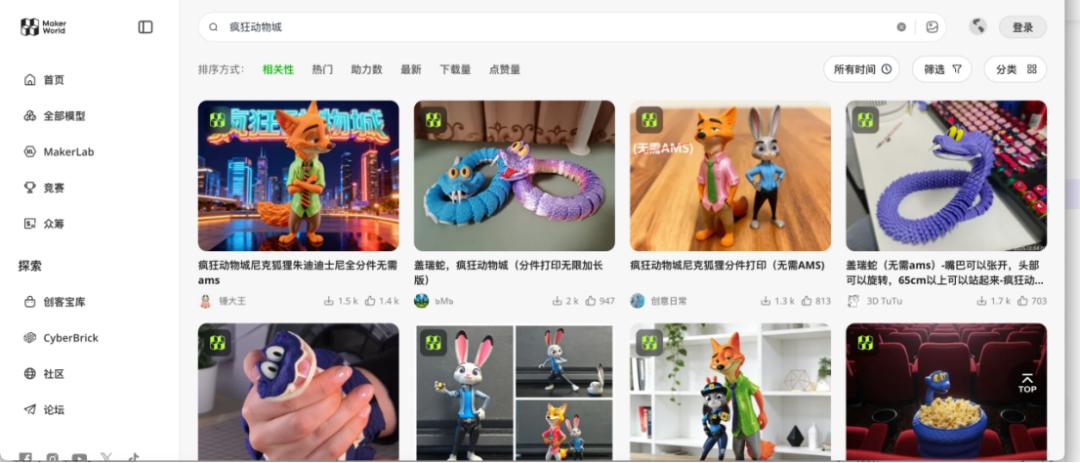
Screenshot of the Maker world forum
In terms of printing format, Maker World weakens the traditional STL model and instead promotes the complete sliced file (3MF) that includes the printing model, printer model, consumable parameters, and support settings.
Printing with STL models requires users to figure out parameters such as support, temperature, and printing speed by themselves, which still has a certain threshold. The creators on the Bambu Lab forum have optimized the models for specific machines and specific consumables when uploading, enabling other users to achieve "one-click printing." More importantly, Maker World strongly binds the model files and slicing parameters to its own hardware, indirectly building a strong user barrier.
"I used to look for models on other model websites. Compared with them, it's easiest to find the 3D models I want on Maker World, and its Bambu Studio function can be opened with one click without having to adjust the parameters again." Avi, a user of Bambu Lab, told Yingke.
On the MakerWorld platform, various theme design competitions are held almost every month to encourage users to design 3D models and reward a large number of points or Bambu Lab's 3D printers.
Some insiders in the 3D printing industry believe that Bambu Lab has spent at least hundreds of millions of dollars on operating Maker World.
The generous investment in operation and the smooth user experience have enabled Maker World to become the 3D model community with the largest monthly active users globally in a very short time. The nearly closed-loop business model in the community has made all people in the 3D industry re-recognize the importance of operating a model community.
"If other hardware manufacturers want to achieve one-click printing on Maker World, they need to share the same protocol with the platform, have a unified account, ensure the interoperability between devices, and synchronize the device status across several terminals... It requires strong integration capabilities to achieve this, and Bambu Lab has no motivation to do so." An insider in the 3D printing industry told Yingke. "Maker World currently supports printing from other brands, but it only allows users to download models. It's still difficult to achieve smooth functions. Moreover, if the platform decides to block a certain manufacturer, manufacturers without their own communities will be very passive."
Currently, hardware manufacturers must build their own 3D model communities. However, the following questions arise: Where do the models come from? And how to solve the IP problem?
02 The Risk of Infringement Still Exists
Can the 3D model communities operated by hardware manufacturers completely avoid IP infringement issues?
The answer is yes. However, at this stage, they have no motivation to implement relevant measures.
On the popular and trending lists of MakerWorld, the models with the highest download and printing volumes are mainly concentrated in the following four categories: The first category is practical storage and functional tools; the second category is integrated printing toys and stress-relieving toys; the third category is accessory products for printer upgrades; the fourth category is well-known IP characters and trendy collectibles, including Marvel, Star Wars, Pokémon, Gundam, and various trendy collectibles. This is the area most prone to infringement disputes and also the area where users can most easily achieve economic monetization.
In June last year, a large number of experience posts about "achieving Labubu freedom with a 3D printer" emerged on social media and received wide attention and dissemination. Data shows that there were thousands of Labubu-related models on the MakerWorld platform that month, and the highest download volume of a single model exceeded 50,000 times.
Behind the tens of thousands of downloads of the Labubu models is the loss of traffic and market for Pop Mart. With such huge losses, it's hard for the IP owner not to take up legal weapons.
Yingke learned that some 3D printing companies believe that uploading IP models on the platform is a good marketing strategy, which is in a gray area. However, they are willing to use legal costs to exchange for market space.
"In the short term, these 3D printing ecological communities will probably continue to use IP products for promotion, both openly and secretly, to encourage people to buy 3D printing equipment. However, in the future, if the sales volume threatens the sales of these IPs, it will depend on whose business influence is stronger to negotiate the sharing ratio." An investor who pays attention to the 3D printing industry told Yingke.
In fact, 3D models of well-known IP characters and trendy collectibles have always existed on model websites. However, at that time, the volume of 3D printed products was extremely small, so IP copyright holders didn't pay much attention.
However, the situation is different now. In addition to individual users, a large number of 3D printing farm owners are also involved in 3D printing. They make a profit by printing products. Some industry insiders told Yingke that some people can even use 3D printers to make drone parts.
This is already a market with a scale of over tens of billions, and IP owners will no longer turn a blind eye.
This is not good news for startups. In the view of people in the 3D printing industry, the 3D model community will evolve into different ecological niches in the future. Third-party websites are very likely to decline, and there will also be model communities for professional content (such as oymake, which specializes in designing mecha 3D models). In the future, the 3D model communities operated by hardware manufacturers may need to try to develop exclusive models and become content producers of 3D models, rather than just platforms. This involves the company's capital and marketing strength.
"The era of 3D printing, which used to be centered around open source and sharing for fun, is over. Now that copyright is being discussed, it means that 3D printing will become more and more mature and commercialized in the future."