In 2026, the AI hardware industry has found the proven playbook for creating breakout hit products.
In the early spring of 2026, when we re-examine the development trajectory of China's AI industry, we will find an interesting phenomenon:
This generative AI wave that started in 2023, after going through the initial parameter competition and computing power race, is seeing all eyes accelerating to penetrate into vertical scenarios.
On the software side, Agents represented by Manus and OpenClaw are redefining the value delivery method of AI;
On the hardware side, there are emerging rising stars in the robotics field such as Unitree and Agibot, and dark horses like FuZai have emerged in the children's toy sector. Even the smart watch track, which is considered to be extremely saturated with fierce competition, has seen the rise of Xiaoshui Intelligence, which records an annual shipment of millions of units, focuses its capabilities on the AI Agent middle platform, and is deployed in various hardware products such as elderly companion robots and smart crutches.
All these new players in their respective tracks share a common profile: small in scale, shallow in background, and not born with a silver spoon in their mouth.
Then the question arises: Why these startups? At the same time, in the face of sky-high traffic costs, how do they find their own way to survive under the tight encirclement of industry giants?
Xiaoshui Intelligence may be the best observation sample.
01
How Children's Watches Achieve the Flywheel Effect
To understand why Xiaoshui Intelligence has stood out, we must first recognize a basic fact: among many hardware markets, the children's watch track is a typical sector with two completely contrasting extremes of performance.
From the overall market perspective, this is a seemingly very attractive business. Public data shows that the global children's smart watch market size has exceeded 5 billion US dollars in 2024. The data comparison from Counterpoint Research is more intuitive: the children's smart watch market achieved a 7% counter-cyclical growth in 2024, while the overall smart watch market declined by 4%.
In addition, in China, the world's largest consumer electronics market, the penetration rate of children's smart watches continues to rise - especially in the sinking markets and tier 3 to tier 5 cities.
The "cold side" comes from the competitive landscape. Xteel, Huawei, Xiaomi, 360... Giants are all around, each with a mature supply chain, huge channel network and abundant marketing budget. Price wars break out every once in a while, but very few players can launch truly differentiated products.
Most manufacturers have fallen into a dangerous comfort zone: they stick to the stock market relying on channel advantages and brand recognition, but ignore the hidden worry that product definition and new technology integration have stagnated.
As a product that accompanies children 24 hours a day, for parents, the core demand of children's smart watches is to know where their children are at any time, and other functions are only icing on the cake. This security anxiety drove the first wave of growth of children's watches, but it did not go further than that.
Because the actual users of the watches are children, and their core demand is fun: entertainment interaction, peer socializing, and exploring the world.
When the conflict between the two demands cannot be reconciled, most children will throw the watch into a drawer and leave it unused after the novelty wears off in a few days. Industry data shows that the average monthly active users of the entire children's watch industry is less than 10, even on the basis that some superstar products are equipped with call functions.
This is a huge structural pain point, as well as a huge neglected structural opportunity.
Thus, at the beginning of 2025, Xiaoshui Intelligence took the lead in completing the private deployment of the DeepSeek large language model, developed a vertical small model suitable for children's interaction, and launched the AI children's watch that better understands children.
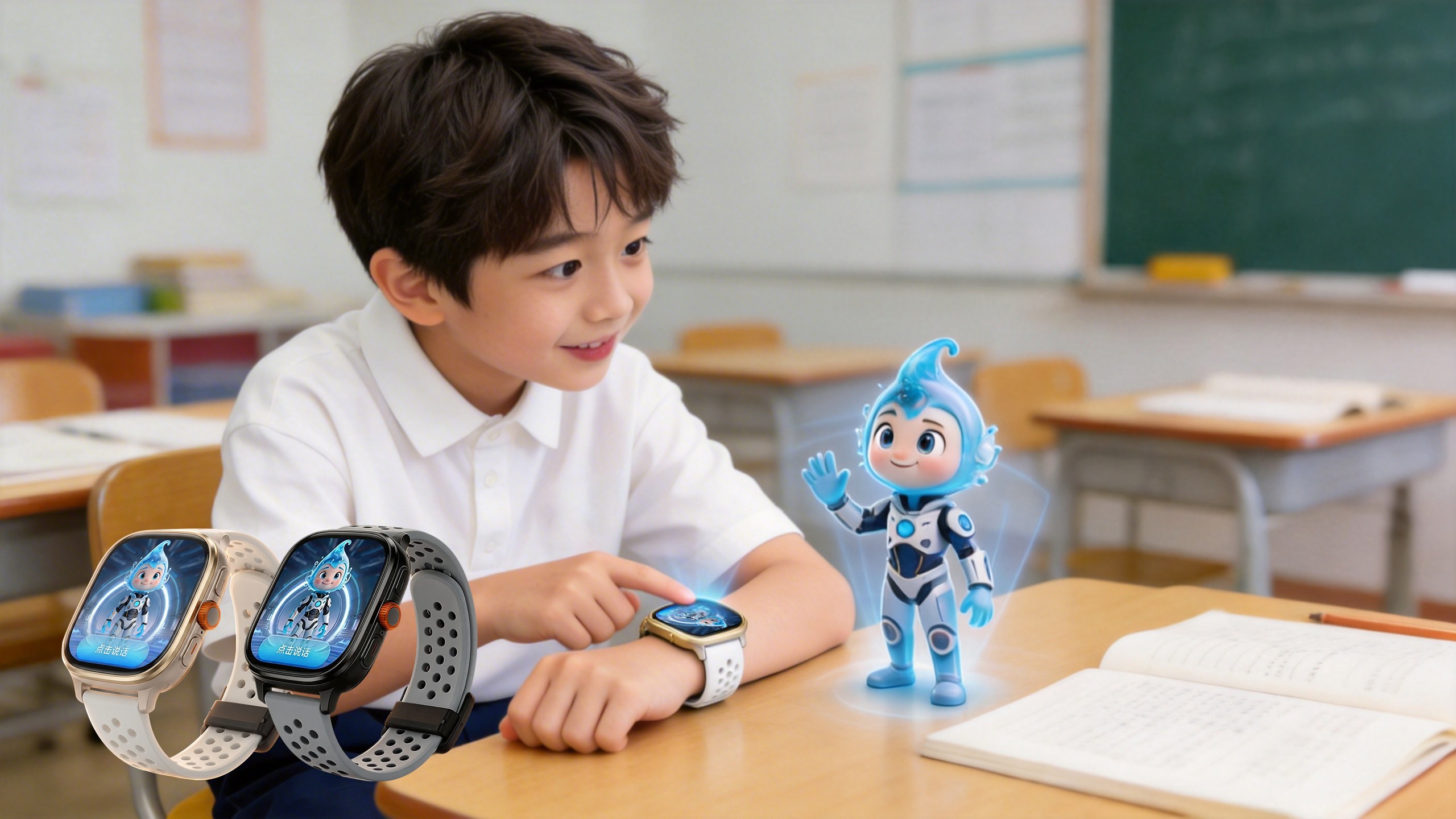
Based on the DeepSeek model, Xiaoshui Intelligence has carried out a series of development work, building it into a 24-hour accompanying AI housekeeper, children's AI growth partner, safety sentinel that can help parents take care of children's safety at any time, and a digital friend that can remember children's interests and learning progress. The hit intelligent agent "Mood Tree Hole" in the watch has been recognized by the majority of children as soon as it was launched, with a maximum single-user dialogue volume of 15,000 times per month.
In previous public interviews, Sun Xuefeng, CEO of Xiaoshui Intelligence, reviewed several important version iterations of the company's products:
"At the very beginning, it was voice interactive, children could talk to the watch; later we made AI picture books, because it is difficult to answer questions like 'what does a Tyrannosaurus rex look like' through voice, and AI picture books can directly generate pictures on the watch for children to see; then we developed video forms, which can make dinosaurs move and make sounds; the current 4.0 version is already a super AI assistant for children, and children have an AI partner with long-term memory and growth that can solve learning and life problems."
However, making children love using smart watches through fun functions is only the superficial logic. The deeper logic is: the preference data generated when a child interacts with the AI story-telling intelligent agent can be seamlessly transmitted to the AI learning tutoring intelligent agent, and the knowledge learned in the tutoring intelligent agent can be reviewed and strengthened in, for example, the popular science intelligent agent.
The data generated by these children's voice dialogues, Q&A and stories several times, even dozens or hundreds of times a day, after being fed into the middle platform, can further optimize the performance of the Agent, which is a scarce resource that no general large model can replace.
Thus, the smarter the AI Agent is, the more users cannot do without it; the more users cannot do without it, the more data is generated; the flywheel of user experience starts to rotate.
02
How to Turn the Tough Hardware Business into a High-margin Attractive Business
Although the annual shipment of watches has exceeded 1 million units, Xiaoshui Intelligence's internal positioning of itself is far more than an AI watch company, or even an AI hardware company.
Sun Xuefeng emphasized on many occasions that Xiaoshui Intelligence is essentially an enterprise-level AI Agent ecological empowerment platform that outputs AI Agent middle platform capabilities.
The fundamental reason is that the charging and business models of the two are completely different: the fate of hardware is one-time transaction, while the subscription model is a business model that can support stable and continuously growing cash flow for enterprises.
An early investor recalled: In the past consumer electronics era, to earn a sum of money from hardware, you had to produce one device, but each device corresponds to supply chain, yield, inventory turnover, and a lot of tedious and tiring work. No matter in terms of profit, cash flow or scale effect, it is not an attractive business.
The highly asset-heavy nature of hardware companies also determines that their expansion is limited. Accordingly, the valuation logic of the capital market is relatively conservative, and the PE multiple is usually between 10 and 20 times.
But after the emergence of large models, the story began to change.
With the support of AI Agent, selling hardware is just the beginning, and the AI Agent can continuously charge monthly fees in the form of value-added subscriptions. This means that every hardware unit sold will generate an entry that continuously produces cash flow.
The essence of this model is that the Internet logic of "stickiness is asset" is embedded in hardware products.
Let's do the math: assuming that a subscribing user pays 20 yuan per month (for basic AI services), even if there are only 500,000 paying users, the annual subscription revenue will be 120 million yuan. This does not include the revenue from advanced services (such as AI computing power boost packages, character IP intelligent agents, customized stories, etc.).
Once this logic is verified, the valuation logic of all smart hardware companies will also undergo fundamental changes: The continuous paid subscription module can be valued as a PaaS/platform company, evolving from a 10-20x PE valuation to a 10-20x PS multiple.
In fact, there are countless successful cases of "hardware + subscription" around the world.
The smart ring Oura is the most typical sample. This small device weighing only 3.3 grams is priced at 349 US dollars, and charges a monthly subscription fee of 5.99 US dollars. In 2024, the cumulative sales of Oura exceeded 2.5 million units, the revenue reached 500 million US dollars, and the valuation was as high as 5.2 billion US dollars.
There are many similar stories: the AI card recorder Plaud Note with a monthly subscription fee of 9.9 US dollars has an annualized revenue of 100 million US dollars; the smart pet tracker Tractive has an annualized subscription revenue of more than 100 million US dollars...
In essence, they are all conveying a concept: The business model of AI hardware lies in AI, not hardware.
This is the second layer logic of the flywheel: turning continuous interaction into continuous subscription and cash flow, and turning hardware companies into platform companies.
But Xiaoshui Intelligence's ambition goes far beyond that.
03
Expand in Multiple Directions: How to Replicate Hit Products
In a gold rush, the most profitable people are often the water sellers.
All hardware companies have the ambition to evolve from selling products to selling capabilities, and even selling solution standards.
Xiaoshui Intelligence is no exception. And to sell capabilities, it is necessary to first show the outside world that it has the ability to create hit products in batches.
Over the past year or more, the AI war has almost turned into an advertising traffic investment war. During the Spring Festival alone, ByteDance invested more than 1 billion yuan, Doubao deeply participated in the interaction of CCTV Spring Festival Gala, and distributed hundreds of millions of red envelopes and gifts; Alibaba sponsored the Spring Festival Galas of four local satellite TV stations, and cooperated with its AI assistant Qianwen App to spend 3 billion yuan on Spring Festival promotion; Tencent invested 1 billion yuan and Baidu invested 500 million yuan to divert traffic for AI applications.
The sharp rise in traffic costs has made small and medium-sized hardware enterprises miserable. At this time, the traditional offline channel business has ushered in a moment of value re-evaluation.
And this is exactly the basic skill that Xiaoshui Intelligence has practiced hard for three years.
Since 2023, Xiaoshui Intelligence has continuously invested and accumulated channel resources of more than 17,000 offline communication stores across the country. This is an asset that is severely underestimated by the Internet circle, and it is also the most ready-made distribution network for many small and medium-sized hardware enterprises that do not have the resources to carry out online traffic investment.
Take the silver economy business that Xiaoshui Intelligence has recently laid out as an example. At present, China is entering an aging society at an alarming speed. It is expected that by 2035, the population aged 60 and above will exceed 400 million, accounting for more than 30% of the total population. In 2023, the market size of China's silver economy reached about 7 trillion yuan, accounting for about 6% of GDP; it is expected to exceed 12 trillion yuan in 2025, and is expected to reach 30 trillion yuan in 2035.
However, traditional elderly-friendly hardware faces an awkward reality: the elderly are not good at online shopping, and to influence the minds of such groups, scenarios like offline communication stores are the best choice.
In addition, traditional smart devices for the elderly are too unintelligent.
No matter it is smart crutches, smart bracelets, or health monitoring equipment, the underlying logic of these products is data collection. But according to the collected data, how to improve diet, how to control the amount of exercise, how to remind medication? Few people have explored these issues. Not to mention how to add the most needed companion functions for the elderly to these 24-hour close-fitting products.
Xiaoshui Intelligence saw this opportunity.
They deployed AI Agent into products such as smart wheelchairs and smart crutches, upgraded the hardware to considerate children who understand the elderly and all-weather health sentinels, and solved the substantive problems of the elderly such as loneliness, forgetfulness and health monitoring.
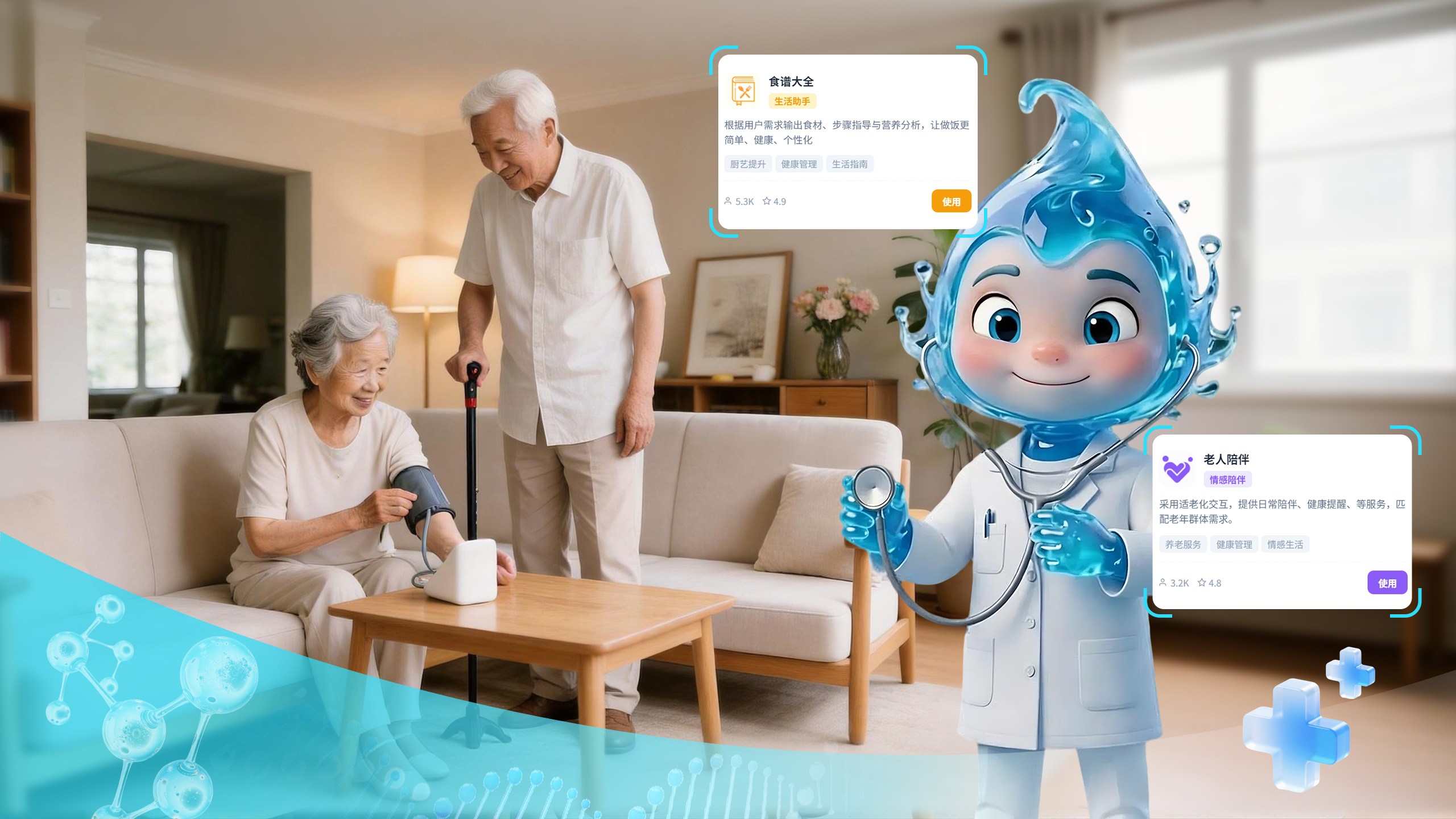
For example, to accompany the elderly to chat, or in response to the elderly's hobby of singing red songs, Xiaoshui Intelligence launched the red song teaching Agent - the first few songs are taught for free, and fees are charged according to the number of uses after a certain number. Similar logic can be continuously expanded, such as medication reminder Agent, emergency call Agent, children's video reminder Agent.
Of course, the long-term vision goes far beyond that. The successful experience of AI children's watches can be replicated to elderly health equipment; the solution of smart wheelchairs can be migrated to smart desk lamps; the data insight of one scenario can nourish the product iteration of another scenario.
Xiaoshui Intelligence started from cloud communications in its early years, served the three major operators, cooperated with Hikvision and Dahua, and helped many Huaqiangbei enterprises create AI hit products. Now it has an annual shipment of 1 million children's watches as a hit product demonstration sample. Based on the AI Agent middle platform, the company's AI capabilities are crossing from self-use to empowering partners.
This is a larger market narrative.
In the past two decades, 80% to 90% of most smart hardware products including children's watches in the world are manufactured in China, especially in Huaqiangbei. These hardware merchants with strong hardware manufacturing capabilities often have certain shortcomings in software capabilities.
The simplest example is that if an open-source model wants to be well adapted to smart wearable devices in the cloud, it often needs to be distilled into a 7B version, which will lead to a sharp increase in the hallucination rate of the model. This requires enterprises to fine-tune the model or customize the knowledge base according to the needs of different scenarios. But most enterprises have no relevant capabilities at all.
What Xiaoshui Intelligence does is to modularize the output of the underlying middle platform capabilities, providing the latest enterprise-level technology combinations including end-side hardware execution, efficient AIGC generation, operating system-level intelligent collaboration and workflow, to help large, medium and small enterprises completely automate complex creative, analysis and execution work.
In other words, any company with hardware capabilities can privately deploy Xiaoshui Intelligence's AI Agent middle platform, and quickly obtain the ability to produce AI hardware.
And this is exactly the "terrifying" advantage of platform-based enterprises: through a set of AI Agent middle platform polished by real interactions of millions of users, plus a set of mature and low-cost offline channels, products can penetrate into almost any required scenario.
With the help of such a platform, in the AI era, Xiaoshui Intelligence can not only survive, but also survive with high value.