Xiaomi takes on "old people's scooters"
In the past two days, Xiaomi has once again made it onto the hot search list in the automotive circle.
Just as Xiaomi has just launched its new-generation SU7 and its automotive business is booming, an obscure small factory in Shandong - Shandong Yanlu New Energy Vehicle Industry (hereinafter referred to as "Yanlu") - has actually filed a request with the National Intellectual Property Administration to invalidate three core design patents of Xiaomi's cars. This "elderly mobility scooter" manufacturer with only about 20 employees is trying to undermine the designs of Xiaomi's front headlights and front and rear bumpers.
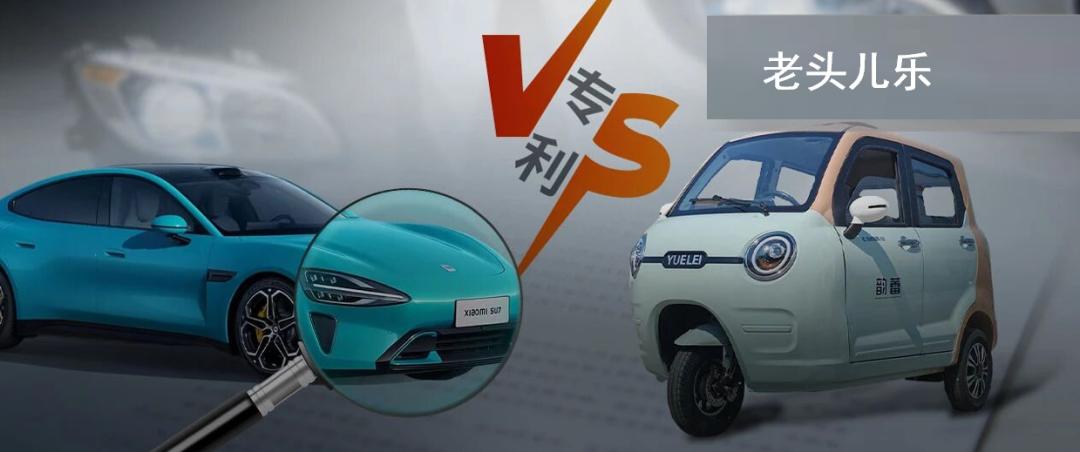
Image source: Graphic by Yema Finance
This sensational topic is more surreal than a TV drama.
01 Hotspot Review
A notice from the National Intellectual Property Administration that triggered this nationwide hot discussion quietly went online.
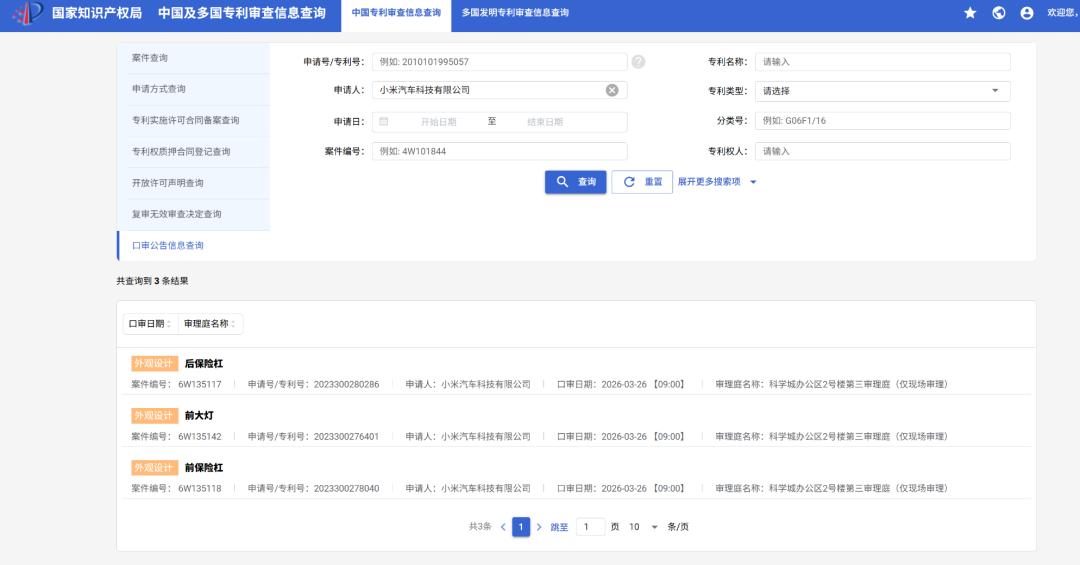
The information shows that a request to invalidate three design patents of Xiaomi's cars has been filed, and the oral hearing is scheduled for March 26th.
This is not a simple infringement lawsuit, but a move to strike at the root - the other party directly requests to invalidate Xiaomi's patents.
The three patents involved are for the rear bumper, front bumper, and front headlights respectively.
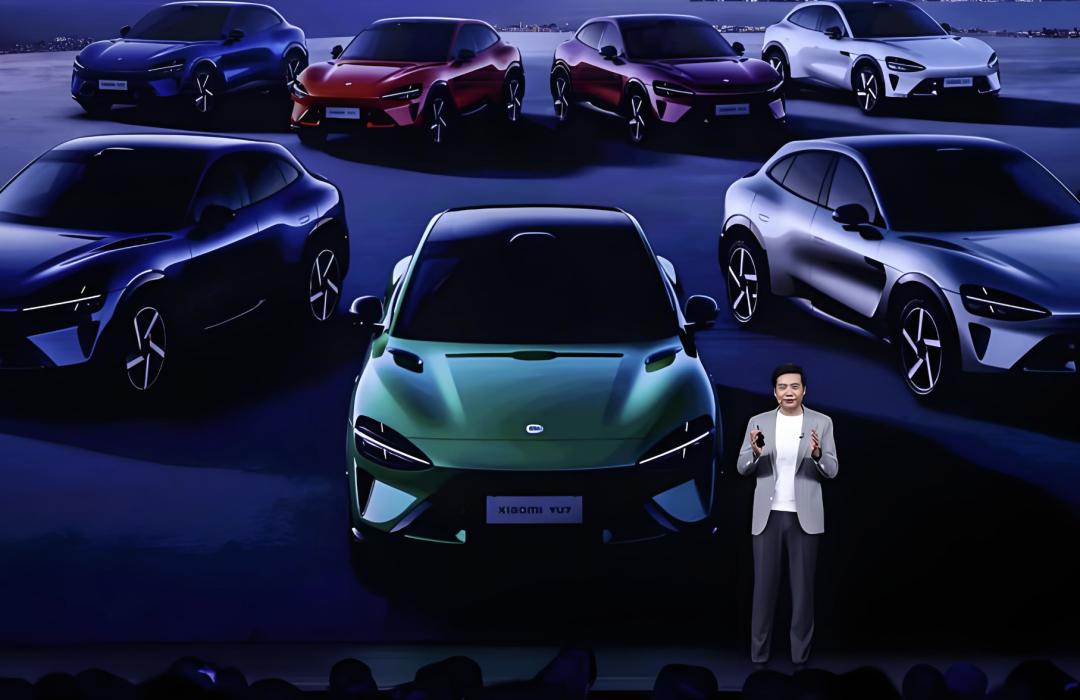
After comparing the patent drawings with the product pictures of Xiaomi's cars, it is possible that the design solutions of the three involved patents have all been used in Xiaomi's main car products, the SU7 and YU7.
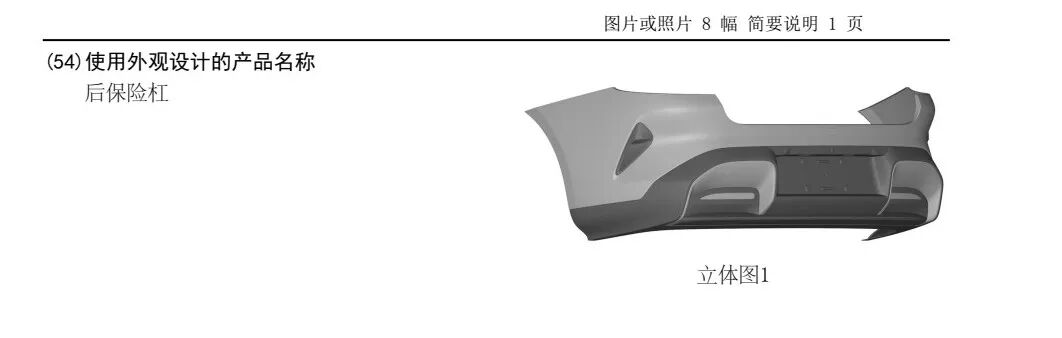
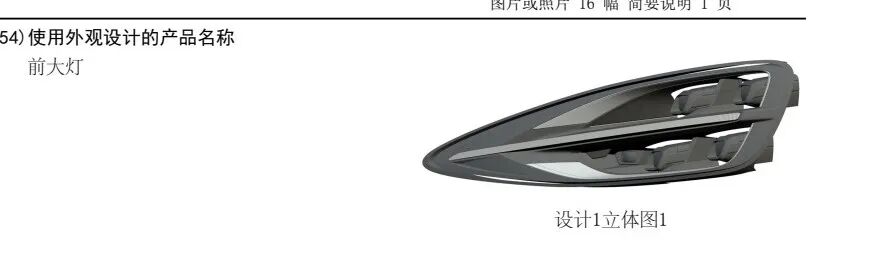
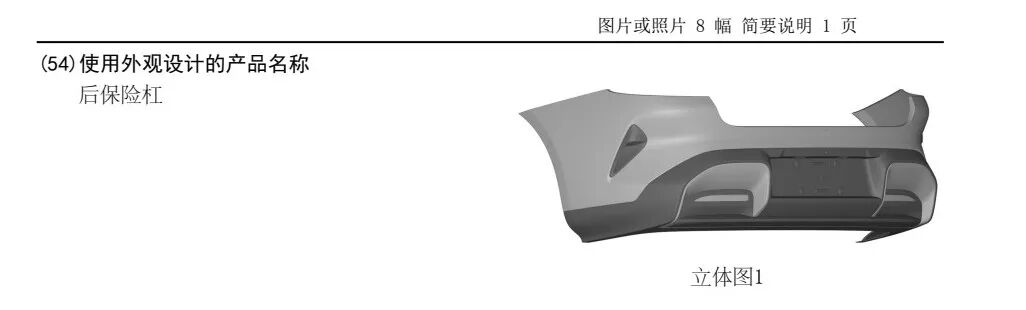
Anyone who knows a little about cars knows that these are the most eye-catching and recognizable parts of the SU7 and YU7's appearance. If these three patents are invalidated, the moat of Xiaomi's cars in terms of "design language" will be torn open.
Yanlu New Energy, which filed the request, is located in Liaocheng, Shandong. It mainly produces "Yunlei" brand electric three-wheeled motorcycles, which are what we commonly call "elderly mobility scooters". It has a registered capital of 10 million yuan and 20 employees. The sole - owner boss only has this one enterprise under his name.
This is not the first time Xiaomi has faced off against "knock - offs".
From the early "Lei Jun Electric" trademark case, to the "Lishui Xiaomi" infringement case accepted by the Supreme People's Court in early 2026, and then to the recent case where a self - media was ordered to pay 5 million yuan in compensation for spreading false rumors about Xiaomi's car crash tests, Xiaomi's fight for intellectual property rights has never stopped.

But this time, the opponent is an "elderly mobility scooter" manufacturer, and the battlefield is a patent invalidation request. The situation is different.
02 Focus of Dispute
The core of this lawsuit actually boils down to one question: Does it count as infringement for low - speed electric vehicles to imitate the appearance of passenger cars?
Yanlu's logic is clear:
First, we produce low - speed electric vehicles, which are not in the same category as Xiaomi's passenger cars, so consumers will not be confused.
Second, Xiaomi's designs are too similar to those of Porsche and Audi and lack novelty.
Third, even if it is an infringement, paying some compensation is better than stopping production. Just drag it out for as long as possible.
It sounds reasonable? But the law doesn't think so.
According to the "Patent Law" and judicial practice, the criterion for determining design patent infringement is "whether an ordinary consumer would be misled", rather than the product category. That is to say, even if you are selling toy cars, as long as they look too similar to real cars and make consumers think they are from the same brand, it still counts as infringement. Moreover, these three patents of Xiaomi have all undergone substantive examinations by the National Intellectual Property Administration, and a patent evaluation report has been issued, indicating a high level of stability.
More importantly, Yanlu chose a very delicate timing. Xiaomi just launched its new car on March 19th, and the court hearing is on March 26th. This is clearly an attempt to put pressure through public opinion and disrupt Xiaomi's rhythm.
Unfortunately, this kind of strategy may not work in an increasingly strict intellectual property protection environment.
03 Mixed Fortunes for Xiaomi's Car - Making
To understand why Xiaomi dares to take on an "elderly mobility scooter" manufacturer, just look at its achievements in the past two years.
Table: Comparison of Key Operating Data of Xiaomi's Cars (2024 - 2026)
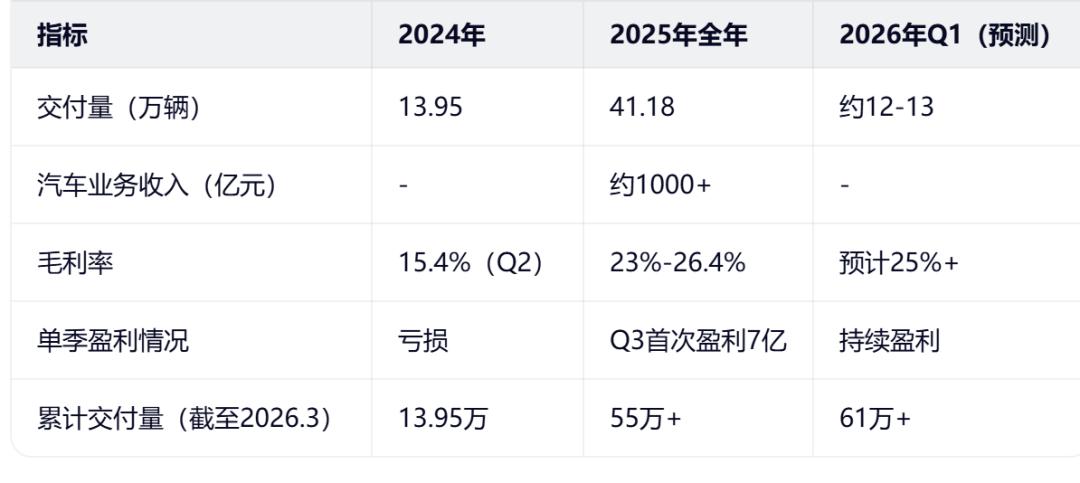
Data source: Xiaomi Group's financial reports, public research reports, and industry media compilations
Highlights are worthy of recognition:
First, explosive growth in delivery volume. In 2024, Xiaomi's car business was just starting, with less than 140,000 units delivered. In 2025, it soared to 410,000 units, almost tripling. In the first two months of 2026, nearly 60,000 units have been delivered, and it is expected to be even higher in March. This growth rate is unparalleled among new - energy vehicle startups.
Second, profitability exceeded expectations. Many people think that making cars is just a money - burning business, but Xiaomi actually achieved an operating income of 700 million yuan in a single quarter in Q3 2025, with a gross profit margin of 26.4%, far exceeding the industry average. What does this mean? It means that Xiaomi's supply - chain management and cost - optimization capabilities are truly strong, not a false prosperity built on subsidies.
Third, rapid iteration of product lines. In 2026, Xiaomi plans to launch six new car models, covering the price range from 200,000 to 550,000 yuan. The new - generation SU7 will be launched in April, with a pre - sale price starting at 219,900 yuan, and its battery range and intelligent driving capabilities will be comprehensively upgraded. Traditional car manufacturers simply can't keep up with this pace.
With such a strong foundation, how could Xiaomi, with its 7,000 - strong legal team, tolerate others copying its designs at will?
You know, appearance is one of the core competitiveness of Xiaomi's cars. From the "Porsche - Xiaomi" jokes about the SU7 to the market's enthusiastic reception of the YU7, the design language has become an important label that distinguishes Xiaomi from other brands. If even this is copied, what's the point?
However, the road is not smooth for Xiaomi Group and its car - making business. In addition to the negative public opinion storm involving Lei last year, which had a great impact on Xiaomi's brand reputation and sales, recently, affected by various market factors, some institutions have also given cautious forecasts.
Huatai Securities predicts that due to the rising prices of storage, the group's gross profit margin in Q4 2025 may decline by 2.4 percentage points quarter - on - quarter, and the gross profit margin of the automotive business will also fluctuate due to the decrease in the delivery proportion of the SU7 Ultra.
More seriously, Bocom International has directly lowered Xiaomi's target price to HK$37 and downgraded its rating to "Neutral", citing the unexpected impact of rising storage prices on the mobile phone business. It is expected that the gross profit margin of Xiaomi's mobile phones may drop to 6.8% in 2026.
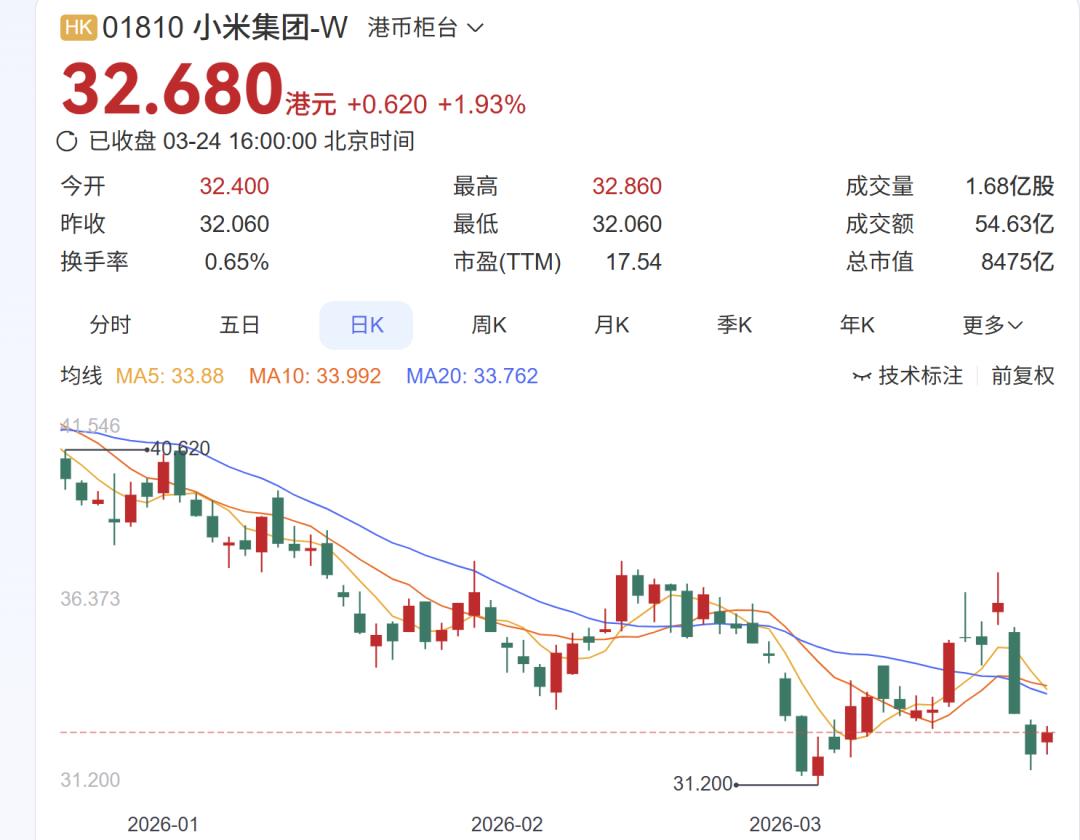
What does this mean?
Xiaomi's "cornerstone" mobile phone business is going through a difficult period, and although the automotive business has increased in volume, it still takes time to repair its profit margins.
Lei Jun said that "scale is far more important than the profit of a single car", which is true. But in the capital market, it is becoming increasingly difficult to tell a story that only focuses on scale and ignores profit.
04 Courage or Speculation?
To be honest, I'm not unfamiliar with the strategy of small factories like Yanlu. Low cost and high potential returns - that's their calculation (well, it's just my cynical thought. What if Xiaomi copied its patents?).
Filing a patent invalidation request only costs a few thousand yuan. If it succeeds, they can continue production and make a profit. Even if it fails, they can delay time, create public opinion, and ride on Xiaomi's coattails.
This kind of "the bare - footed are not afraid of the shod" approach has indeed caused many enterprises to suffer losses in the past.
But the times have changed.
First, the judicial environment is becoming stricter. In recent years, the Supreme People's Court has repeatedly emphasized the need to crack down on malicious litigation and protect innovation. In the typical cases released at the end of 2025, there were cases where enterprises were rejected and punished for abusing litigation rights. Yanlu's obviously speculative behavior is unlikely to be supported by the court.
Second, consumers' awareness is improving. In the past, people might have thought that "it doesn't matter if it looks similar, as long as it's cheap", but now more and more people are willing to pay for original designs. The success of Xiaomi's cars itself proves this point.
Finally, and most importantly, Xiaomi is no longer what it used to be. With over 600,000 car owners, tens of billions in revenue, and billions in profit, along with the moat of its "smart ecosystem of people, cars, and homes", Xiaomi has enough resources and patience to go the distance with any infringer. The 5 - million - yuan compensation judgment is just the beginning, and there may be more in the future.
Many netizens may not like Xiaomi or Lei, but they have to admit its strength and influence in the industry.
Of course, this incident also serves as a reminder: In the critical period of China's manufacturing industry's transformation and upgrading, intellectual property protection can no longer be a "soft constraint".
Enterprises that rely on copying and imitating to take shortcuts will eventually be eliminated by the market.
05 Conclusion
The oral hearing on March 26th may just be a small episode in this battle. But its symbolic meaning far exceeds the case itself.
When a small factory with 20 employees dares to challenge an industry giant, what we see is not only a legal game, but also the pain and hope during the transformation of China's manufacturing industry from "imitation and following" to "original innovation and leadership".
If Xiaomi wins, it's a victory for innovation; even if it loses temporarily, it can't change the general trend.
This topic also sounds an alarm for the entire industry: In the second half of the new - energy era, patents are not only the weapons of large enterprises but also the shields of small enterprises. When the "Porsche - Xiaomi" meets the "Xiaomi - style elderly mobility scooter", the real show is just beginning.
Reference materials and data sources:
Xiaomi Group's Q3 2025 performance announcement, Sina Finance, November 19, 2025, https://finance.sina.com.cn/roll/2025 - 11 - 19/doc - infxxfvz3714729.shtml
"Summary of Xiaomi Group in 2025!", NetEase Finance, January 27, 2026, https://m.163.com/dy/article/KK85KFOF0556I990.html
"Xiaomi's Cars Caught in Patent Dispute! Why Does a 20 - Employee 'Elderly Mobility Scooter Factory' Attack a 'Giant'?", Yema Finance/NetEase, March 20, 2026, https://m.163.com/dy/article/KOGBNAI00519875F.html
"Xiaomi's Car Patents Challenged by an Elderly Mobility Scooter Factory", Toutiao, March 21, 2026, https://m.toutiao.com/w/186024330