Are selfie shops with a 50% gross profit margin and an area of 2 square meters quietly making money?
Nowadays in the venture capital circle, investments in technological trends far outweigh those in the consumer sector. Most of the hot money has flowed into robotics and large models, and the cold winter in consumer investment shows no sign of improvement. Investors who have been sticking to the consumer sector have, in the past two years, started to allocate their limited funds and energy to consumer products that offer emotional value, such as trendy toys and various consumer projects that provide emotional value to young people.
The business of 2-square-meter selfie shops has caught the attention of investors.
Selfie shops are not a new concept. They can be found in almost every consumer scenario in cities, including shopping malls, scenic spots, and subway stations. Some are relatively large selfie studios, while others are just 1 - 2 square-meter self-service photo booths.
These seemingly unremarkable small shops have produced several leading players, and they seem to be making money quietly. A consumer investor revealed that the top three players in the selfie shop sector are JUST.FOTO, Paicube, and photoism. The industry leader has about 1,800 stores. These selfie shops are relatively small in scale, with an area of about 1 - 2 square meters, and the rent and franchise fees are not high. According to her, most single stores of these brands have achieved profitability.
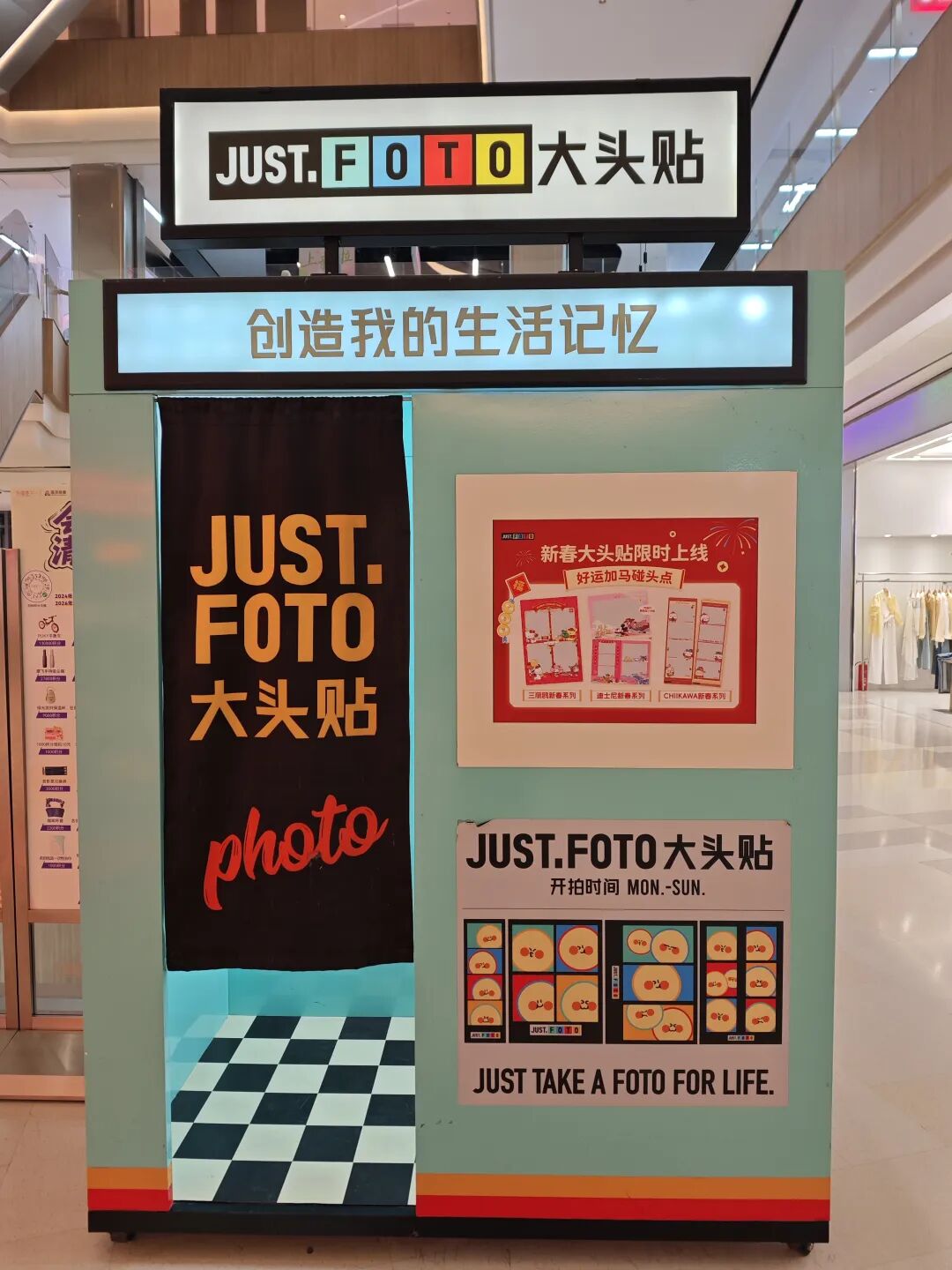
Caption: JUST.FOTO selfie shop. Photo taken by Tech Planet.
Is self-service photo-taking really a good business?
Selfie shops are flooding into the core business districts of first-tier cities
Major shopping malls like Joy City, Hopson One, and Wanda in the core business districts of first-tier cities such as Beijing, Shanghai, and Guangzhou are almost all covered by selfie shops.
Different from the heavy - model portrait photography studios like Haimati, selfie shops are usually small satellite stores. They have a small area, no in - store staff, and no other photo - taking props. Customers can take photos completely on their own. For a single consumption of 29.9 - 49.9 yuan, they can take multiple photos and print one photo in the end.
This small selfie scenario has attracted young people. On social media, many people post their four - grid photos taken in selfie shops or group photos with their favorite stars. In southern cities where selfie shops are more popular, some people are even willing to queue for hours to take a selfie.
Consumer demand determines the rise of consumer projects. Among the leading players in the selfie shop sector, JUST.FOTO has the largest scale, with the most stores including equipment. Paicube has received a round of financing. Last year, Wanda Film made a strategic investment in Paicube to layout a new scenario for image - social consumption. Photoism is a South Korean brand, focusing on taking group photos with South Korean idol stars.
All three selfie shop brands claim to be the market leader in their external promotions. A staff member in charge of investment promotion and franchising at JUST.FOTO told Tech Planet that the company currently has more than 2,000 sets of equipment, covering more than 1,600 locations (including shopping malls, scenic spots, and blocks) across the country, achieving full coverage of all provinces. The main user group is young women aged 15 - 35. As of February, the number of registered users on the mini - program has exceeded 10 million. Currently, in terms of machine scale, revenue, and product strength, it is in the leading position in the industry.
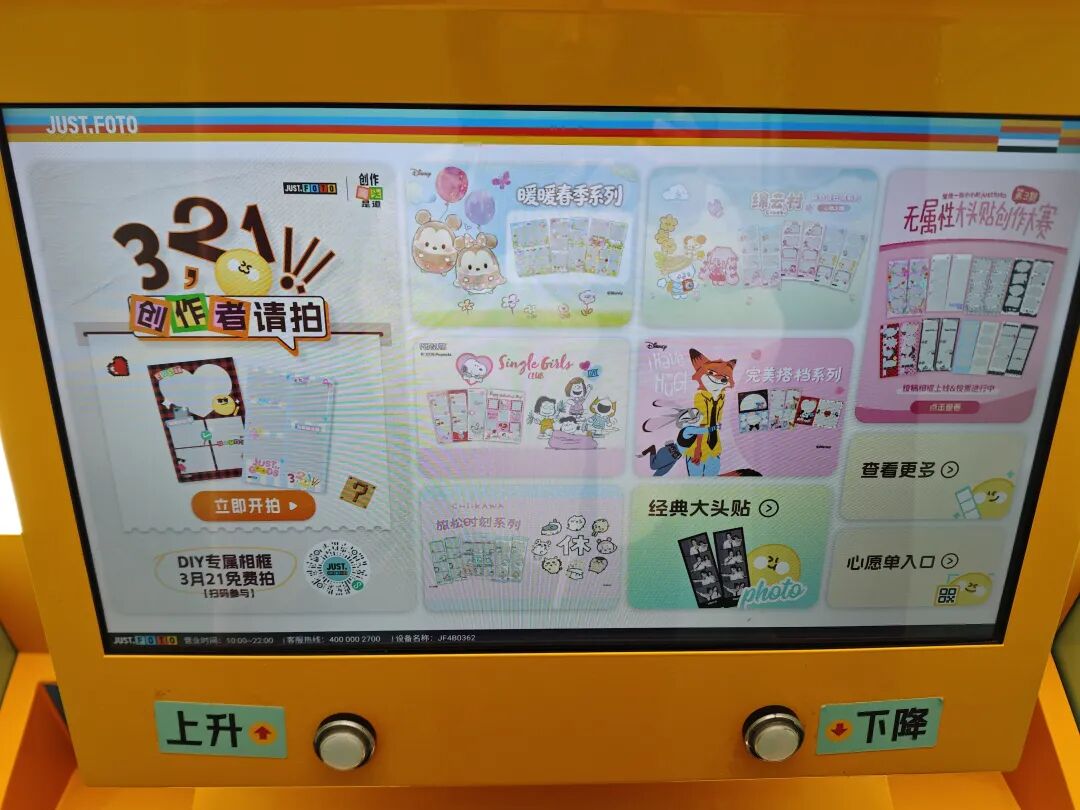
Caption: JUST.FOTO selfie shop. Photo taken by Tech Planet.
Since its operation in June 2020, another selfie shop brand, Paicube, has covered more than 160 core cities across the country, with more than a thousand sets of equipment put into use, and the cumulative number of service person - times has exceeded 10 million. It claims to be the number one in the domestic market share of operating equipment. Photoism, a South Korean brand established in 2019, according to its franchise manual, has opened nearly 1,000 stores in four years. Currently, more than 770 stores are in operation in 15 countries and regions around the world, claiming to be the number one global self - service photography brand.
All three selfie shops in the self - service imaging field adopt both direct - operation and joint - operation models. JUST.FOTO's direct - operation stores are directly contracted with shopping malls by the company for equipment placement; for joint - operation (i.e., franchising), the cooperation partner is responsible for site negotiation and rent payment, while the company is responsible for equipment placement. Photoism does not offer franchising in some cities, and all stores in Beijing are directly operated.
However, the three brands have different focuses on IP co - branding. JUST.FOTO's cooperative IPs mainly include well - known IPs under companies such as Sanrio and Disney; Paicube's co - branded IPs include well - known IPs like Chibi Maruko - chan, I'm Not Fat Tiger, and Capibara, as well as movie IPs; photoism focuses on South Korean star IPs for star co - photos.
It is worth mentioning that the IP co - branding in the selfie shop industry is as competitive as that in the coffee and milk tea industry, with a very fast new product launch speed. A JUST.FOTO employee said that the company has a high product update frequency, basically launching new products every week, and will also launch limited - edition photo frames according to festivals and holidays (such as Valentine's Day and the Chinese New Year).
50% gross profit, and the pay - back period for leading players is 3 - 12 months
Tens of thousands of selfie machines from leading players and other less - well - known selfie shops have flooded the market across the country.
Profitability and the pay - back period are the most concerning issues.
The pay - back period for JUST.FOTO is about 10 - 12 months. A JUST.FOTO staff member told Tech Planet that to open a franchise selfie shop, an initial investment of about 80,000 yuan is required, including brand authorization fees, material and equipment costs, and a deposit. In addition, franchisees need to pay the brand 1,000 yuan per month for software management fees and a 30% IP royalty fee. In terms of the revenue level of a single machine, the average monthly turnover of more than 2,000 sets of equipment across the country is about 12,000 yuan. Calculated in this way, the pay - back period is about 10 - 12 months.
Photoism is more aggressive, with a pay - back period of 3 - 9 months. The franchise manual provided by photoism's investment promotion staff shows that for single - machine operation (2.5 - 3 square - meter site area), a one - time investment of 75,000 yuan is required, with a monthly turnover of 20,000 - 50,000 yuan, a gross profit margin of up to 50%, and a pay - back period of about 3 - 9 months. For single - store operation, due to the larger area, a one - time investment of 250,000 yuan is required, with an estimated monthly turnover of 100,000 - 150,000 yuan, a pay - back period of 5 - 9 months, and a gross profit margin of 47%. The case shown in the franchise manual shows that a franchisee made a one - time investment of 75,000 yuan for single - machine operation, with a monthly turnover of 44,000 yuan, a monthly gross profit of 22,000 yuan, a pay - back period of 4 months, and an estimated profit of 700,000 yuan during the contract period (3 years), with an average annual profit of more than 200,000 yuan.
For leading players, the franchise model provides sufficient cash flow. Single - store and single - machine franchisees may not make money, but the brand owners may achieve profitability.
Besides the leading players, other mid - tier and lower - tier selfie shop entrepreneurs are also working hard to make money. Li Jun started his business of self - service photo studios in 2024. In just over a year, he has opened four stores in cities like Chongqing and Chengdu. He told Tech Planet that most of the selfie studios in China are introduced from South Korea, where the related industry of selfie studios is already very developed. There are about 4 - 5 selfie shops on one street, and each shop is full of people waiting in line to take photos. Moreover, the selfie studios in South Korea are very competitive, with a single - consumption price starting from 5,000 won (equivalent to about 25 yuan in RMB), which is even cheaper than in China.
The threshold for the selfie shop business is not high, the investment is controllable, and the risk is not great. Unlike the coffee and milk tea industry, where franchising requires a starting investment of 500,000 yuan. Li Jun said that the selfie studio basically requires a one - time investment, with a gross profit margin of over 50%. Li Jun invested 100,000 - 200,000 yuan in each of his four stores on average. The single - time charging price of the selfie studio is 39 yuan, and customers can choose to take 8 photos and print one 6 - inch photo in the end, while the cost of the photo paper is less than 2 yuan.
According to Li Jun, the fastest - paying - back store among his four stores achieved pay - back in 5 months. The store area affects the customer flow. Smaller stores have about 40 orders per day, with an average customer price of 39 yuan, and a monthly turnover of about 40,000 yuan, with a profit of about 20,000 yuan.
The selfie studio business also heavily depends on the location. Li Jun said that the success of a selfie shop depends on its location, and some stores become popular as soon as they open. His stores are mainly located in shopping malls and blocks where young people like to take photos.
Compared with the leading selfie shops with strategic site placement and capital operation, mid - tier and lower - tier players need to build their own differentiated advantages. Li Jun said that his stores focus on vintage filters, and the core competitiveness is the filters. "Producing good photos is the top priority."
How high is the ceiling of the selfie business?
Research shows that the self - service imaging market has formed a huge global market worth over 100 billion yuan. According to the analysis report of Yanjing Biz Intelligence, the market size of photo studios in China reached 50 billion yuan in 2020. Among them, the market demand for self - service photography accounted for nearly 30%, that is, a selfie market worth 3 billion yuan. Data from iiMedia Research shows that the selfie studio industry in China is still in its early stage, and the market size of selfie studios in China was about 3.17 billion yuan in 2021.
The rise of the 29.9 - yuan selfie business is essentially the explosion of emotional value consumption, IP economy, and second - dimension economy among modern young people. Compared with the photo - taking model of Haimati, which provides makeup, professional shooting, and excessive photo retouching, young people prefer to take photos with no social pressure, taking group photos with their favorite stars, anime, and second - dimension IP frames. Moreover, the latter is cheaper and can provide instant satisfaction, with the whole process from taking photos to printing taking less than 5 minutes.
The selfie business without a photographer has no high - cost and rent pressure, but it may lack a stable customer source and requires stronger brand operation ability. Selfie shops have certain limitations. Since they cannot provide personalized customization services (such as customized scenes, clothing, and makeup), the repurchase rate is extremely low. Many selfie shops even have poor photo - taking quality, with unclear and low - quality printed photos. In addition, there are bugs such as black screens and automatic shutdowns. The customer flow is unstable, and consumers usually only visit a good - looking scene once.
Moreover, for selfie beginners, there is still a certain threshold for self - service photo - taking. Some consumers said that they wasted 29.9 yuan during their first visit to JUST.FOTO because they didn't know how to use the equipment. Since the selfie machine is self - service, each step has a time limit. Once the system starts printing photos, there is no chance to retake. Even if the photo is not taken well, it cannot be retaken, and it is difficult to get a refund.
The competition in the selfie sector is very fierce. Many selfie - related businesses have emerged around the selfie scenario, and consumers have too many alternative choices. In addition to the popular sticker photo selfie shops, there are also newspaper - machine photo - taking services available in most scenic spots, as well as the previous Polaroid selfie studios. A selfie shop owner said that the selfie business can also be developed into a beauty economy. Now many selfie studios can turn photos into glowing pearlescent ticket stubs, providing young people with a sense of ceremony and emotional value.
Many selfie shops have a short lifespan. On platforms like Dianping, many stores of the same - type selfie shop PIGGYOO's four - grid comics have been closed.
Even the three leading players that have emerged are gradually turning the selfie business into an IP co - branding business. Each brand is competing in terms of the number of IP co - brandings and the speed of IP updates. However, the youth consumption driven by the IP effect to a certain extent increases the cost of the brand.
In terms of scale, selfie shops that have covered the core business districts of first - tier cities can only meet light - scenario consumption, with a relatively single scenario. They do not have the ability to provide high - premium services in the selfie business, which also determines that their ceiling is not very high.
This article is from the WeChat official account “Tech Planet” (ID: tech618), author: Zhai Yuanyuan, published by 36Kr with authorization.