The mid-game battle of China's new energy vehicles has begun. How to anchor the path in the 2.0 era?
In the Chinese automotive market in 2026, there is a contradiction between excitement and confusion. On one hand, there is a shift from price war to value war. City NOA has become a standard feature in 100,000 - level family cars, and the 800V high - voltage platform has been fully popularized. Technological configurations are rapidly spreading to lower - end models. On the other hand, the debate on the industry's technological routes has never ceased. There are different voices regarding the development prospects of hybrid vehicles, hydrogen - fuel vehicles, and fuel - powered cars. Joint - venture brands are accelerating their transformation by embracing Chinese intelligent driving solutions, and new - energy vehicle startups are continuously deepening their presence in the fields of intelligent driving, vehicle cockpits, and overseas markets. The current development stage and future direction of China's new - energy vehicle industry have become the core questions jointly pursued by the industry.
At the 2026 Auto Hundred Conference Research Institute Expert - Media Exchange Meeting, Ouyang Minggao, an academician of the Chinese Academy of Sciences, gave a speech and made a clear judgment: China's new - energy vehicle industry is at a mid - stage juncture, and the end - game of this industrial revolution has been targeted at pure - electric drive from the very beginning.
From 1.0 to 2.0, Model Reconstruction Leads Industrial Competition
The market generally regards the penetration rate of new - energy vehicles in China exceeding 50% in 2025 as the end - point of the first half of the industry's electrification. However, Ouyang Minggao defines this stage as the New - energy Vehicle 1.0 era, whose core features are the explosion of electrification, the cultivation of intelligence, and the start of low - carbon development.
In 2010, the state established the "pure - electric drive" strategy and launched a pilot subsidy program for new - energy vehicles, kicking off the industrial marketization. In 2018, the annual sales volume of domestic new - energy vehicles exceeded 1 million, marking a crucial step in the marketization process. In 2021, a breakthrough in the lithium iron phosphate battery system technology for passenger cars pushed the industry into the explosive period of electrification, with the annual sales volume reaching 3.52 million. In 2025, the production and sales of domestic new - energy vehicles reached 16.626 million and 16.49 million respectively, with year - on - year growth of 29% and 28.2% respectively, completely transforming from a "follower" to a "leader".
Currently, the industry is in a critical transition period from the 1.0 era to the 2.0 era. Ouyang Minggao proposed that the New - energy Vehicle 2.0 era is the era of intelligent electric vehicles, whose core features are the explosion of intelligence, the optimization of electrification, and the acceleration of low - carbon development. The core of industrial competition has shifted from the question of "whether an electric vehicle can be produced" in the electrification era to the question of "whether an intelligent electric vehicle with core competitiveness can be produced" in the intelligent era.
China's position as the core of the global new - energy vehicle industry is inseparable from the innovation and reconstruction of industrial models. Currently, five industrial models with clear development paths have been formed in China, which are reshaping the global automotive industry's rules of the game. There is no absolute superiority or inferiority among these five models, and their collision, integration, and iteration will be the core of competition in the 2.0 era.
The first type is the vertically integrated model dominated by electrification, represented by BYD. BYD's excellent cost - control ability stems from its full - chain vertical integration layout. It has completed the full - industrial - chain coverage from the three - electric systems to vehicle - grade chips, semiconductors, and vehicle manufacturing, achieving self - control and self - development and production of core components. Relying on its scale advantage, it has built a solid cost moat.
The second type is the horizontally integrated model dominated by intelligence, represented by the Huawei ecosystem. Breaking out of the closed - loop of traditional automakers, it builds a cross - automaker brand alliance centered around intelligent capabilities. Through the smart - selection vehicle model, it has in - depth cooperation with many automakers such as Seres and Chery, constructing a full - market brand matrix. The localization capabilities of the Hongmeng intelligent cockpit and ADS high - level intelligent driving are its core competitiveness.
The third type is the Internet - based vehicle - building model of new - energy vehicle startups, represented by NIO, XPeng, Li Auto, and Xiaomi. Centered around Internet thinking, relying on intelligent terminal marketing and user - ecosystem operation, it takes electrification as the entrance to intelligence, breaking away from the traditional profit - making logic of vehicle sales. By deeply operating users, it builds a brand ecosystem and user stickiness, and has formed exclusive core advantages in the field of intelligence.
The fourth type is the dual - wheel - drive model of self - owned brands, represented by Geely, Chery, and Great Wall. These enterprises have accumulated profound experience in the fuel - vehicle era. During the new - energy transformation, they choose the dual - wheel - drive strategy of "fuel vehicles + electric vehicles" and the two - way layout of "domestic + international". In the future, they need to maintain a dynamic balance in the trends of fuel vehicles developing towards large - battery HEVs and new - energy vehicles developing towards pure - electric vehicles.
The fifth type is the reform and transformation model of state - owned enterprises' self - development + joint - venture, with central automotive state - owned enterprises and local state - owned enterprises as the main body. Relying on the resource - integration and industrial - chain coordination capabilities of state - owned assets, it integrates the advantages of various models, releases vitality through institutional and mechanism reforms, and combines the "ballast - stone" role of state - owned assets with the innovation ability of the entrepreneurial team.
Ouyang Minggao said that these five development models are all feasible paths explored by Chinese automakers in the industrial transformation, and there is no absolute superiority or inferiority. The competition in the New - energy Vehicle 2.0 era is essentially the collision, integration, and iteration of these five models. Whoever can first make their own model work smoothly will take the initiative in the industrial competition in the next decade.
Why is the End - game Definitely Pure - Electric Drive?
In recent years, there have always been differences in the industry's discussion on the technological routes of new - energy vehicles. Some believe that hybrid models have no range anxiety and are the optimal solution for the current domestic market. Others propose that hydrogen fuel is the real zero - emission technological route, and pure - electric is only a transitional solution. There are also views suggesting that electro - synthetic fuels can extend the life cycle of fuel - powered cars, and it is too early to judge that pure - electric drive is the end - game.
In response to this core industry dispute, Ouyang Minggao gave a clear conclusion in his speech: The end - game of the new - energy vehicle industry must be pure - electric drive. The future industry pattern will surely be an energy - transportation integration system with pure - electric vehicles as the main body and the wide application of vehicle - grid interaction.
First, pure - electric vehicles have the highest green - electricity utilization efficiency in the industry, with an energy - efficiency advantage that other technological routes cannot match. The core data provided by Ouyang Minggao shows that the green - electricity utilization efficiency of pure - electric vehicles is twice that of green - hydrogen vehicles and four times that of internal - combustion - engine vehicles using electro - synthetic fuels. With the same scale of green - electricity supply, the driving range that pure - electric vehicles can achieve far exceeds that of other technological routes. In the context of the global dual - carbon strategy, energy - utilization efficiency directly determines the long - term viability of a technological route.
Second, pure - electric vehicles are the only type of vehicles that can be deeply integrated with the new - energy system. There have been several vehicle - grid interaction demonstration projects launched in domestic cities. Users can offset or even gain additional income from charging costs through the peak - valley electricity price difference. In the future, pure - electric vehicles will have the functions of power generation, energy storage, and power consumption, and will truly integrate into the new - energy system.
Third, pure - electric vehicles have a significant advantage in usage cost. Currently, the electricity cost per kilometer of most models is less than 0.1 yuan, only one - fifth of that of fuel - powered cars of the same level. In the future, with the popularization of green electricity, the implementation of distributed photovoltaics and vehicle - grid interaction, the energy cost will further decrease, and it is expected to achieve zero - cost or even negative - cost vehicle usage.
Fourth, pure - electric vehicles are naturally suitable for high - level autonomous driving and are the best carriers in the intelligent era. The core of high - level autonomous driving is the precise control of vehicles in milliseconds. The motor and electronic control system of pure - electric vehicles can achieve a control response speed of milliseconds, far exceeding the response speed of the engine and transmission of fuel - powered cars, and can perfectly meet the control requirements of high - level autonomous driving systems. Ouyang Minggao predicted that by 2030, L4 - level autonomous driving passenger cars based on advanced end - to - end large models will achieve large - scale commercialization in the mid - to - high - end passenger car market. The implementation of this goal will be based on pure - electric drive, with a deep connection between pure - electric and intelligence.
Fifth, pure - electric vehicles are the most competitive automotive category for China in the global market. In 2025, China's new - energy vehicle exports exceeded 2.615 million, of which pure - electric vehicles accounted for about 62.9%. They are the core means for China to transform from a large automotive country to a powerful automotive country.
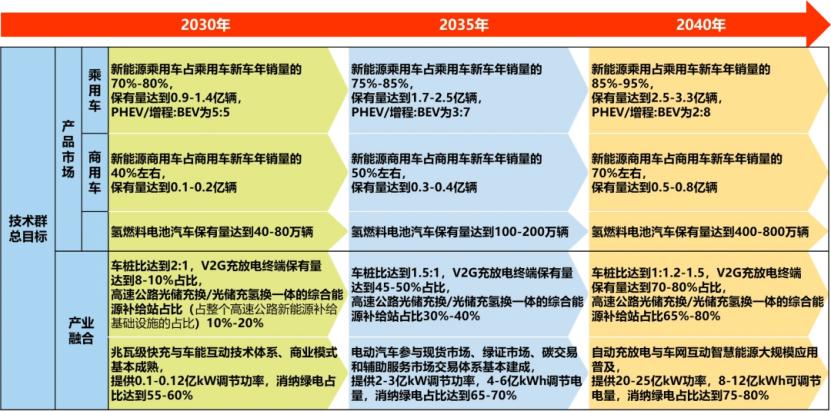
Based on the end - game judgment of pure - electric drive, Ouyang Minggao also provided a clear timeline for industrial development. By 2030, the industry will enter the New - energy Vehicle 3.0 era, that is, the era of new - energy intelligent electric vehicles, whose core features are the explosion of low - carbon development, the optimization of intelligence, and the deepening of electrification. By then, the non - fossil energy power generation in China will exceed 50%, all - solid - state power batteries will achieve large - scale mass production, and the vehicle - grid interaction model will start to be popularized. By 2035, the penetration rate of new - energy passenger cars in China will reach 75% - 85%, of which pure - electric vehicles will account for more than 70%. Green electricity will become the main power source for charging new - energy vehicles, the total scale of vehicle - grid interaction energy storage will exceed that of fixed - battery energy storage, and the number of domestic electric vehicles in use will reach 200 - 300 million. By 2040, the penetration rate of new - energy passenger cars will further increase to 85% - 95%, and the remaining market share will be mainly occupied by large - battery hybrid models, which are used in remote areas and special scenarios with limited charging conditions.
Some in the market believe that the industrial competition in the new - energy vehicle industry is basically settled. However, in fact, after the barriers of electrification have been fully broken, the industry is facing a broader development space. Aiming at the end - goal of low - carbon development, it is necessary to promote the deep integration of new - energy vehicles and the new - energy system and create a new ecosystem of transportation - energy integration.
This article is from the WeChat official account "Auto Market Insights", and is published by 36Kr with authorization.