Among the "Five Little Dragons" in the commercial space industry, who will be the Chinese version of SpaceX?
In 2026, commercial space stations are emerging as a new frontier.
The IPO of SpaceX, the largest in global history, is drawing closer. Its latest round of valuation has soared to a staggering $1.75 trillion, surpassing Meta and approaching Amazon.
Meanwhile, China's "SpaceX equivalents" and related industrial chains are also experiencing a capital frenzy. From the end of last year to the beginning of this year, the commercial space sector on Flush once saw a cumulative increase of over 40% in 12 trading days. Although it later went through a "roller-coaster" adjustment, the increase since the beginning of the year is still nearly 10%.
The primary market is equally vibrant. According to IT Juzi statistics, there were 67 commercial space financing deals in 2025, nearly twice the number in 2024. Entering 2026, private commercial space company Interstellar Glory completed a financing of 5.037 billion yuan, setting a new record for a single - round financing of a private rocket company in China.
"Before the Spring Festival, Interstellar Glory's valuation in the primary market was just a little over 1 billion yuan. After the Spring Festival, it rose to 1.6 billion yuan. Even so, the shares were in short supply," Li Li, an investor in the commercial space track who has directly participated in the mid - to - late - stage financing of several private rocket companies, told "Focus One".
In the commercial space industrial chain, launch vehicles are the most fundamental link. Only by launching satellites into space and completing the network through rockets can continuous commercial value be generated. Therefore, private rocket companies have become the focus of the entire commercial space track. Moreover, they are the "potential stocks" closest to SpaceX in terms of business models.
Currently, there are a total of five Chinese private rocket companies with clear listing processes, namely Landspace, Tianbing Technology, CAS Space, Interstellar Glory, and Galaxy Power. The total valuation of these five companies exceeds 100 billion yuan.
Landspace has entered the listing review process on the Science and Technology Innovation Board, and its current status is "under inquiry"; the other four are still in the listing guidance stage. Among them, CAS Space has the fastest progress and has completed the guidance work; Tianbing Technology, Interstellar Glory, and Galaxy Power are still in the filing and guidance stage.
A group of the most aggressive investors in the primary market even believe that the upper limit of the total valuation of these five companies should be equal to that of SpaceX.
However, the reality is not that optimistic. Landspace, which has submitted its prospectus, has accumulated losses of over 3.5 billion yuan from 2022 to the first half of 2025. In its latest launch mission, the Zhuque - 3 successfully entered orbit, but the first - stage recovery failed.
Amid the gap between the capital frenzy and the fundamentals, who will be the first Chinese - style SpaceX?
"China's Starlink" Takes Off, and the "Five Little Dragons" of Private Rockets Benefit First
SpaceX has blazed a successful commercialization path: significantly reducing launch costs through reusable rocket technology and obtaining continuous cash flow through Starlink services and operations.
There are two key words in this commercial closed - loop: reusability and Starlink.
A reusable rocket refers to a rocket whose first - stage booster can return to the ground and be reused after completing the launch mission, thereby reducing the cost of a single launch. SpaceX's Falcon 9 rocket has achieved multiple reuses.
Starlink refers to the low - orbit satellite internet system built by SpaceX. It forms a communication network through thousands or even tens of thousands of satellites to provide broadband internet services globally. This business not only brings continuous subscription revenue but also creates a stable demand for rocket launches.
Simply put, reusability solves the cost problem, and Starlink solves the demand problem.
However, by this standard, before 2025, China's commercial space industry and private rocket companies were lacking in both aspects.
"Throughout 2023 and 2024, the sentiment in the primary market of the commercial space track was generally quite pessimistic," a commercial space investor told "Focus One". "On the one hand, the reusable technology had not been realized. Another important reason was the slow progress of the large - scale deployment of 'China's Starlink'."
According to the plans of China Satellite Network Group's "GW Constellation" and Yuanxin Satellite's "Thousand - Sail Constellation", 12,992 and 15,000 low - orbit satellites are respectively planned to achieve initial global coverage in 2027 and complete the networking of the Chinese - style Starlink in 2030.
However, as of December 2025, the total number of on - orbit satellites of the GW Constellation and the Thousand - Sail Constellation was only 244, accounting for less than 1% of the overall plan.
The turning point occurred at the end of 2025.
The official website of the International Telecommunication Union (ITU) shows that in December of that year, China filed a one - time application for frequency and orbit resources for 203,000 satellites, setting a record for the largest - scale international orbital position centralized application at that time. Public information shows that the low - Earth orbit can accommodate approximately 175,000 satellites at most, and the total number of satellites applied for by countries around the world to the ITU has far exceeded this upper limit.
The ITU follows the "first - come, first - served" rule, and the scramble for orbital resources places higher requirements on the deployment speed of "China's Starlink".
With such a clear increase in satellite launch demand, private rocket companies in the commercial space industrial chain are the first to benefit.
In Li Li's words, during the period before this year's Spring Festival, there was no valuation logic at all for the five private rocket companies queuing for listing in the primary market. "As long as a price was set, there would definitely be someone to grab."
The Hurun Global Unicorn List shows that as of January 1, 2025, the total valuation of the "Five Little Dragons" of private rockets was approximately 67.5 billion yuan, with Landspace having the highest valuation of 20 billion yuan.
Based on the information provided by multiple investors participating in the primary - market financing of the commercial space industry, the total post - investment valuation of the five companies at the end of February this year has reached at least 100 billion yuan, an increase of over 32.5 billion yuan in just over a year, with an average increase of 6.5 billion yuan in valuation for each company.
Li Li told "Focus One" that the most optimistic investors even said that as long as the total valuation of the five companies does not exceed $1.5 trillion (the highest valuation of SpaceX reported before the Spring Festival), it cannot be considered overvalued.
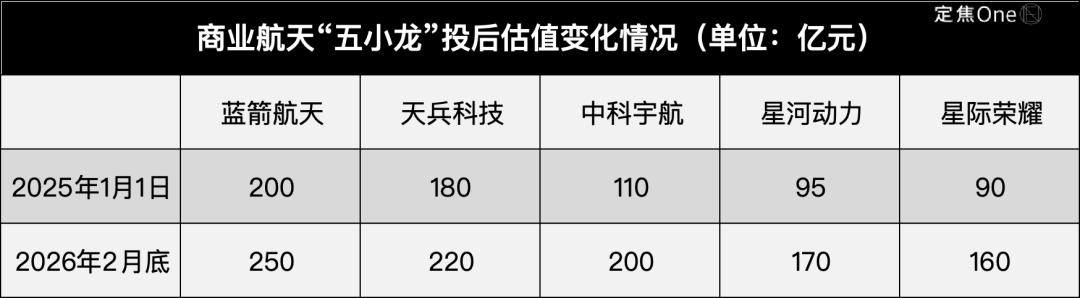
It is worth noting that in the latest post - investment valuations of the "Five Little Dragons", since Landspace has no shares available in the primary market, its valuation is basically stable in the short term. According to "Focus One", Interstellar Glory's pre - investment valuation in the new round has soared to 23.5 billion yuan, an increase of over 50% compared to the post - investment valuation of the previous round.
In terms of technical routes and business models, these five companies are slightly different. Landspace and Tianbing Technology adopt the pure liquid rocket route, while the other three follow the liquid + solid rocket route.
Let's first look at the pure liquid camp. Landspace is the company with the highest valuation and the fastest listing process among the five. Its core products are the "Zhuque" series of liquid oxygen methane launch vehicles, including the medium - sized Zhuque - 2 series and the medium - to - large - sized reusable Zhuque - 3.
As of now, its liquid rockets have been launched a total of 7 times, with 2 failures and 5 successes.
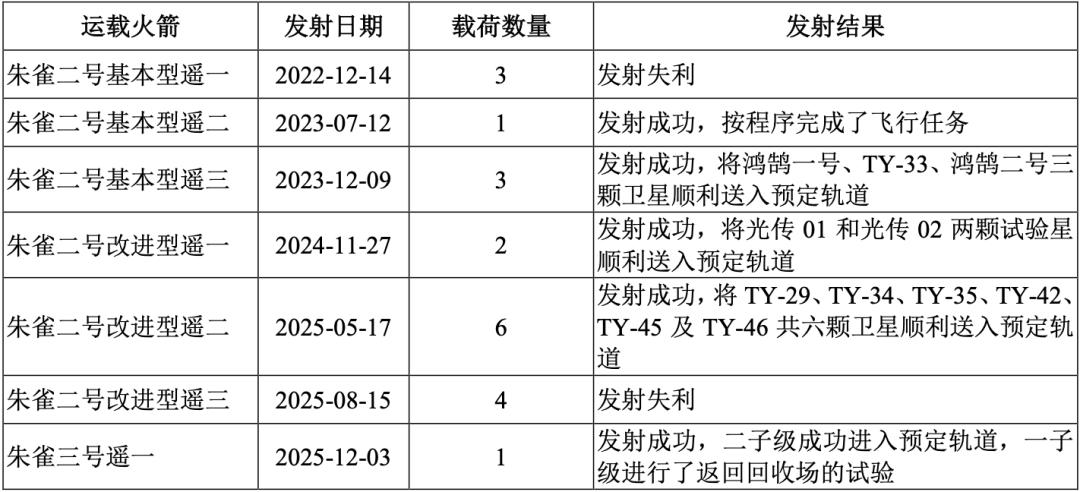
Source: Landspace's prospectus
The other company in the pure liquid camp, Tianbing Technology, currently has the liquid oxygen kerosene launch vehicle "Tianlong - 2" in service. As of December 28, 2025, it has been launched once and was successful. It is currently developing the "Tianlong - 3" liquid oxygen kerosene launch vehicle, and the power system test has been completed.
The advantages of liquid rockets lie in their large thrust, good controllability, and the ability to be ignited multiple times. Moreover, they are the only choice under the current reusable rocket model. SpaceX's Falcon 9 and Starship are both liquid rockets. However, liquid rockets are mostly large - scale rockets, and if the issue of recovery is not considered, the cost of a single launch is relatively high.
In contrast, the technology of solid rockets is relatively more mature, with relatively lower manufacturing costs and technical thresholds. Commercial rocket companies often choose solid rockets as their first - launch models in the early stage. However, the limitations of such rockets are also obvious. They have relatively small thrust and poor controllability, and cannot be used for large - scale satellite deployment and rocket recovery.
CAS Space's in - service rocket, "Lijian - 1", is a solid rocket, and the "Lijian - 2" currently under development uses liquid oxygen kerosene technology.
Interstellar Glory's "Hyperbola - 1" and Galaxy Power's "Ceres - 1" currently in service are also solid rockets. The former has been launched 8 times in history, with 4 successes; the latter has been launched 22 times, with 20 successes.
In addition, both companies are also developing liquid rockets simultaneously.
Multiple commercial space investors told "Focus One" that Interstellar Glory has recently abandoned the solid rocket route and switched to the pure liquid rocket route.
This also reflects an industry consensus. Due to their reusability, liquid rockets are recognized as the future technical route. At present, solid rockets mainly play the role of fulfilling launch orders and providing a certain amount of cash flow. In the future, they can be used to meet the flexible network - supplementing needs of constellations and the requirements for emergency, scattered, and special launches.
In addition to these five private rocket companies in the first echelon of the commercial space listing, companies in the second echelon, such as Dongfang Space and Deep Blue Aerospace, are also quite active in the capital market.
Dongfang Space has previously stated that it is intensively promoting the listing preparation work and will consider applying for listing on the Science and Technology Innovation Board at an appropriate time in the future; Deep Blue Aerospace's valuation in the primary market has reached 7 billion yuan and is approaching the first echelon.
The Chinese - style SpaceX will most likely be born among these companies.
Has the Account of Commercial Space Been Calculated Clearly?
The capital market bets on the imagination of the future, but in the face of commercial reality, even the most optimistic investors have to sit down and calculate the accounts clearly first.
From the perspective of the industrial chain, launch vehicles are the most core link in the commercial space industrial chain. They are responsible for connecting the entire process from upstream raw materials to downstream satellite applications. They are technology - intensive and require large capital investments, making them the link with the highest barriers.
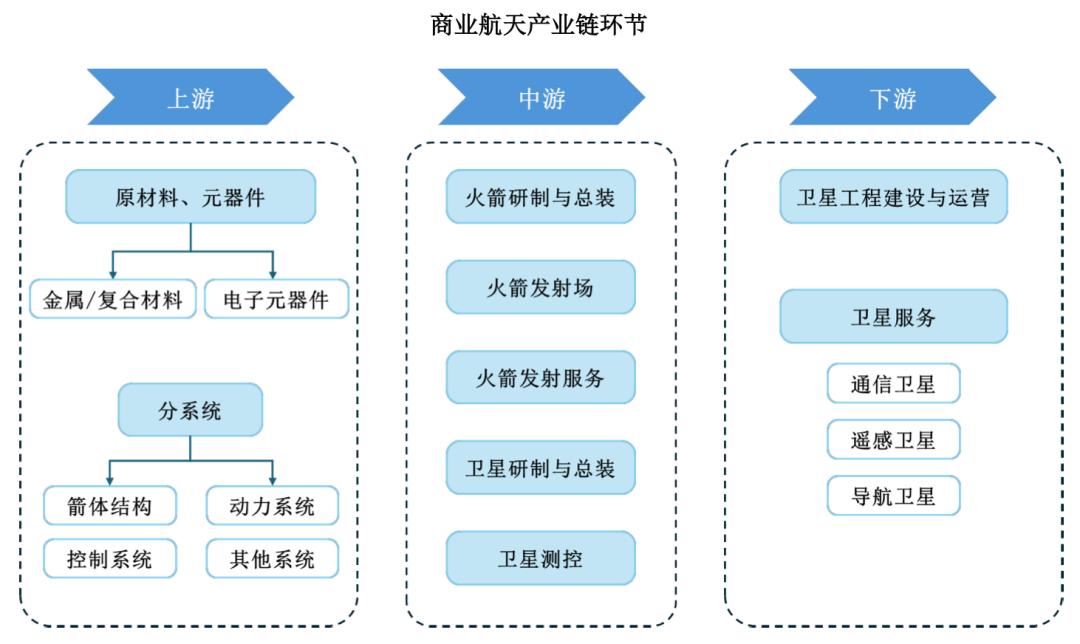
Source: Landspace's prospectus
Most private rocket companies cover the system control link in the upstream of the industrial chain and the rocket R & D, assembly, and launch service links in the middle of the industrial chain.
A research report from CICC shows that launch cost is the main cost in the commercial space industry. In a typical low - orbit constellation construction, launch costs account for 30% - 40% of the total cost.
In the entire rocket launch process, the cost of the engine accounts for the majority. Taking SpaceX's Falcon 9 as an example, the cost of its first - stage engine accounts for 54.3% of the cost of the first - stage rocket, and the cost of the rocket body structure accounts for 23.5%. This means that if the first - stage rocket can be recovered and reused, nearly 80% of the cost can be saved.
If we expand our perspective to the entire rocket, a typical launch vehicle usually includes a first - stage rocket (responsible for providing the maximum thrust at the initial stage of launch to send the rocket out of the atmosphere), a second - stage rocket (continuing to accelerate at a higher altitude to place the satellite precisely into the predetermined orbit), a fairing (the protective shell outside the satellite, which will be discarded after entering space), etc. According to the calculation of AJ Securities, taking the launch cost of the non - reusable Falcon 9 at $50 million per launch as a reference, the cost of the first - stage rocket accounts for 60%, and the second - stage rocket accounts for 20%.
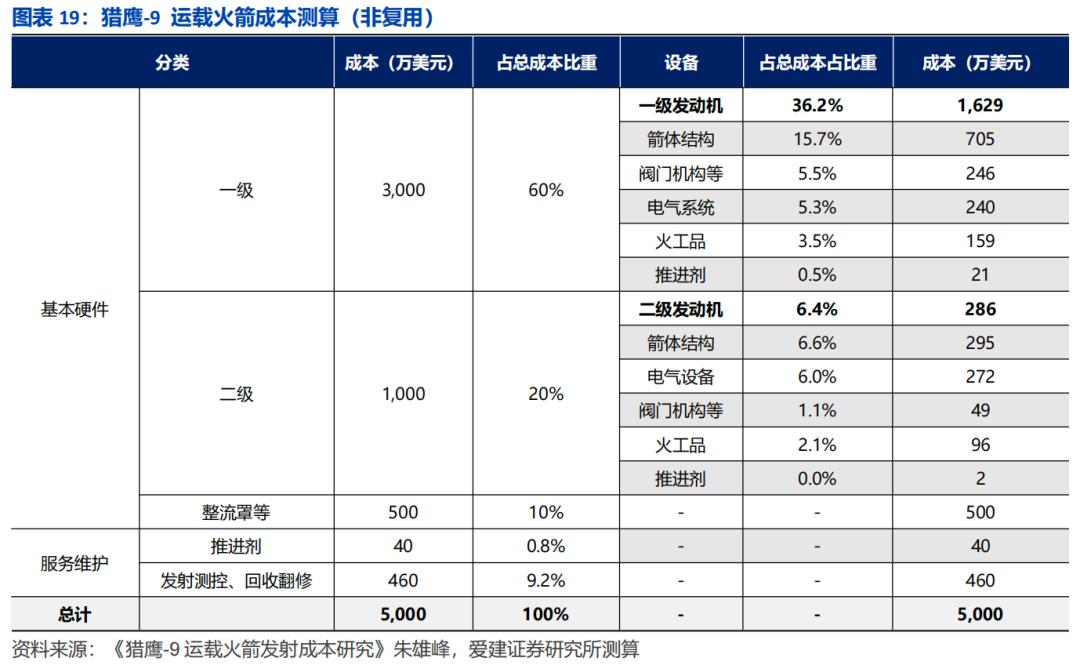
If the first - stage rocket can be recovered and reused 5 times, the cost of a single launch can be reduced from approximately $50 million to $13 million, saving 74% of the launch cost.
That is to say, the first - stage rocket reusable technology is the foundation for the entire commercial space industrial chain to achieve economic benefits.
However, it is not easy to achieve this.
The difficulty of rocket recovery lies in that after experiencing ultra - high - speed flight and high - temperature re - entry, the rocket still needs to be able to stably ignite for the second time to decelerate and accurately return to the ground. The entire process involves complex propulsion control, attitude control, thermal protection, and navigation algorithms.
It took SpaceX 13 years from its establishment in 2002 to the first successful recovery of the Falcon 9's first stage in 2015. Before that, SpaceX experienced multiple recovery failures.
In contrast, Chinese private rocket companies are currently still in the technology investment stage as a whole. At present, the private rocket companies in the first echelon have the ability to launch satellites into orbit, but as of now, none of them has achieved the successful recovery of the first - stage rocket, and no significant economic benefits have been generated.
Taking Landspace, which has detailed its operating conditions in the prospectus, as an example, from 2022 to the first half of 2025, the company's net losses were 821 million yuan, 1.216 billion yuan, 916 million yuan, and 635 million yuan respectively.
In the first half of 2025, Landspace's operating income was 36.4319 million yuan, of which 35.69 million yuan was from "single rocket launch services", accounting for 97.96% of the total operating income. However, the operating cost was as high as 155 million yuan, and even without considering operating expenses, the company was already in a loss state of over 100 million yuan.
Coupled with high R & D and management expenses, the loss has expanded to over 600 million yuan.
Landspace needs to reduce the launch cost by more than 70% through repeated recovery and reuse like the Falcon 9 to break even on the cost side.
Therefore, private rocket companies, including Landspace,