Why is it so difficult to be the fourth-largest player in China's mobile phone industry?
Is it equivalent to standing on the brink of survival if a company fails to rank among the top three in the context of industry reshuffle?
"In the long run, it's unlikely that all seven Chinese smartphone manufacturers can survive." This was Lei Jun's previous statement about the outcome of the competition among domestic smartphone manufacturers.
This means that the fierce competition and involution in the mobile phone industry chain show no sign of subsiding.
However, among all the manufacturers in the intense competition, the most frustrated one is the "fourth place" in the rankings. This ranking means that, on one hand, there are several leading brands with absolute control over the market, making it difficult to overtake; on the other hand, it's not completely in the "others" category, and there is still hope for rescue.
Seeing the hope of returning to the leading position while being on the verge of a free - fall, this is the biggest embarrassment for the fourth - ranked company.
In the past three years, at least several manufacturers have taken turns to be in the fourth place. In the eyes of many mobile phone industry insiders, "Few industries are as brutally competitive as the smartphone market. In most other industries, once the industry structure of the leading, middle - tier, and tail - end players is formed, it's difficult to change. However, the smartphone industry is one of the few where the rankings can change every quarter."
For each manufacturer, hardly anyone can relax. In the context of a highly saturated and mature industry, anyone could accidentally fall to the fourth place.
Now that the consumer electronics industry is facing the problem of continuously rising prices of memory chips, is the fourth - ranked company close to victory or closer to death?
In any case, a new round of reshuffle in the mobile phone industry has arrived.
The fourth - ranked companies taking turns all face survival anxiety
The competition for share rankings among domestic smartphones is like a life - and - death struggle.
According to IDC's statistical criteria, from 2023 to 2025, within three years, VIVO, Huawei, Xiaomi, OPPO, and Honor have all been in the difficult fourth place.
In 2023, VIVO ranked fourth with a 16.5% share (some statistical criteria claim that VIVO has maintained the top position in China for many consecutive years). If only domestic manufacturers are considered, the fourth place went to Huawei. That year, although Huawei became a synonym for "leading by a large margin" with the emergence of the Mate 60 series and its shipments soared by 50%, it still didn't reach the top - five threshold. The production capacity of its self - developed chips had not fully recovered, and it was still at the tail end of the mainstream camp.
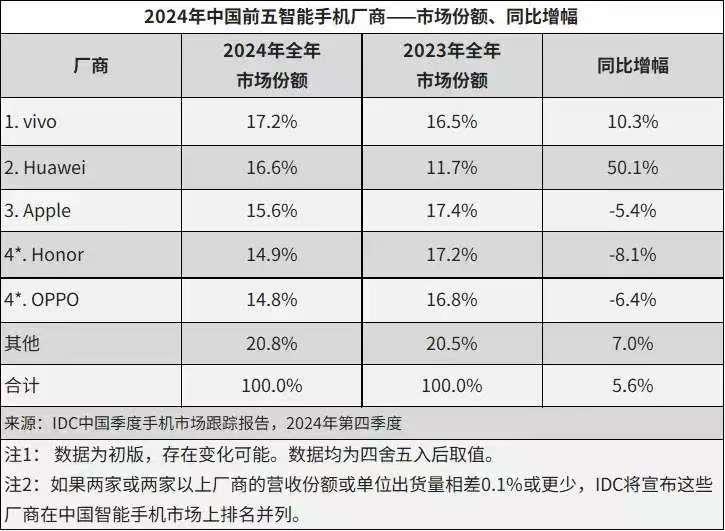
This situation changed drastically in 2024 when the market trend completely reversed. Honor began to lag behind in the second half of 2024 and became the fourth - ranked company for the whole year. OPPO was tied with it, and Xiaomi disappeared from the top - five camp. In 2024, the most difficult mobile phone manufacturer in China was Honor. After major personnel changes, the market shrank sharply, and its shipments dropped to the lowest point since its independence.
Just one year later, in 2025, the situation reversed again. Last year, Apple achieved reverse growth, vivo ended its previous glorious period, and Honor returned to the top five in the third quarter. However, looking at the whole year, Honor replaced Xiaomi from the fourth place in 2024 and became an "other" on the IDC list. Xiaomi became the fourth - ranked company, and Huawei topped the domestic list.
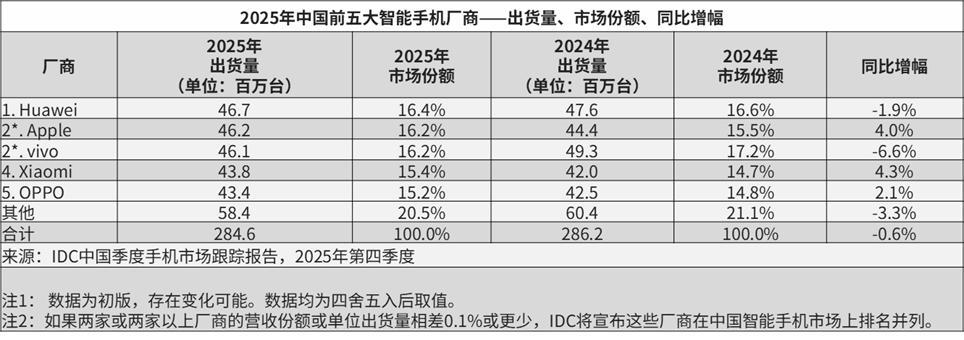
Looking back at the fluctuations in the industry structure in the past three years, the fixed positions of the leading players have hardly ever been truly stable, and the fourth - place position can change hands at any time.
As a senior industry insider, Mr. Zhu told Lujiu Business Review that some people outside the industry think that the current domestic mobile phone industry is gradually forming a "Huawei - VIVO - Xiaomi" pattern, but this view is hard to hold. The data released by IDC in 2025 shows that Huawei, Apple, vivo, Xiaomi, and OPPO are ranked in the top five. It's worth noting that there is no significant absolute difference among the top - five companies on the list, and their market shares are all above 15%. The difference in shipments between the first - ranked and the fourth - ranked companies is less than 3 million units.
Even if we look back at 2024 and 2023, the differences in share and shipments between the first - ranked and the fourth - ranked companies were not large. The extremely small gap proves the intensity of market competition.
However, even so, in the incremental era, as the market cake grows larger, the fourth - ranked company can benefit from the industry by catching up. But in the stock era, every bit of market share has to be snatched from competitors. The fourth - ranked company stands on the edge of the leading camp. There are insurmountable barriers ahead and eager pursuers behind, and every step is taken with trepidation.
What difficulties does the fourth - ranked company in the mobile phone industry face with new changes?
The difficulties of the fourth - ranked company are largely related to the industrial characteristics of the industry in recent years. Being in this situation, it is surrounded by crises.
On a macro level, the smartphone industry has ended its previous high - growth stage, and the red - ocean market has gradually entered the "stock meat - grinder" era. Specifically, in the past three years, the total shipments of the domestic mobile phone market have been hovering around 270 - 280 million units. Last year, it even decreased by 0.6% year - on - year, and it is expected to decline by more than 10% this year.
The overall industry has weak demand. The previous consumer subsidy policies and the hype of the AI - phone concept have failed to drive a large - scale replacement wave. The average replacement cycle of domestic users has been extended to at least 36 months, and the market has completely entered the zero - sum game stage of stock competition.
In this context, the fourth - ranked company often has difficulty obtaining incremental growth from the overall market. Its situation is precarious, and it can only compete for stock users in the leading camp.
However, the market segmentation characteristics on the product side have become more and more obvious. In the high - end market above 4,000 yuan, Huawei and Apple, relying on the moats and brand awareness established in the system, self - developed chips, etc. many years ago, have always accounted for nearly 80% of the industry, forming an unshakable duopoly pattern. Moreover, Apple's shipments increased by 4% in 2025, making it the second - ranked growing company in the Chinese market, and the pressure on other manufacturers is becoming more and more obvious.
The remaining market share is divided among various manufacturers, but no single manufacturer can obtain more than 20% of the high - end market share. For example, although the OPPO Find X9 Pro was the first to launch the Hasselblad 8K ultra - clear photo function, these products with a high sense of technology are not enough to support it to reach the high - end leading position. Last year, there was even a quality - control problem with green lines on the screen.
Similarly, as the fourth - ranked company on the IDC list in 2025, although Xiaomi's car business has brought sufficient momentum and incremental growth to its flagship mobile phones, and the Xiaomi 14, 15, and even 17 series have performed well, it still lacks the strength to shake the leading oligarchs.
The mid - end market, which accounts for more than 50% of the total market shipments, is the basic market for all manufacturers and the most involuted battlefield. With the mature development of the domestic mobile phone industry chain, mid - end mobile phones still have the characteristics of cost - performance competition and innovation in different directions as in the past. Configurations such as flagship chips, 100 - watt fast charging, and large - sensor imaging, which previously only appeared in high - end mobile phones, have now been fully introduced to mid - end models. The parameters have been pushed to the extreme, but the differentiation is getting smaller and smaller. Coupled with the annual price adjustments and promotional incentives, the profit margin has been compressed to the extreme, and the net profit margin of some mid - end models is less than 15%.
This then forms an inescapable vicious circle. Without brand premium in the high - end market, there is not enough profit to invest in core R & D. Without continuous technological breakthroughs, it's impossible to gain a foothold in the high - end market. Manufacturers can only rely on mid - end models to increase sales and maintain market share. However, the involution in the mid - end market further compresses the profit margin, and finally, they fall into an embarrassing situation of being neither high - end nor low - end, facing bottlenecks in both profitability and growth.
Therefore, whether it's OPPO, Honor, or other companies that have been in the fourth place, the fourth - ranked companies in the industry all face the problems of "unsuccessful breakthrough in high - end market share and involution in mid - end parameters and profits".
As for the outcome, just like the PC industry, after several rounds of reshuffle, Lenovo, HP, and Dell firmly occupy the leading positions. Manufacturers after the fourth place are either acquired or completely withdraw from the market. Once they fall behind, there is no chance of making a comeback. The former Fangzheng, Tongfang, and TCL computers are all in the past. The occasional emergence of Huawei and Xiaomi laptops only occupies a "niche market brought by mobile communication brands".
Now, the same is true for the mobile phone industry. Each manufacturer has actually formed some unique characteristics, and their abilities to bear risks vary to some extent.
Huawei has the pure - blooded HarmonyOS, Kirin chips, and the automotive business as a second growth curve. Xiaomi has self - developed Pengpai chips and a growing automotive business. They have sufficient ecological synergy and the ability for long - term investment. Vivo, relying on user experience, imaging functions, and the unique positioning of the IQOO gaming phone, has a relatively stable consumer group.
Apple is launching a counter - attack in the Chinese mainland market with the rapid development of technologies such as the display and camera system of the iPhone 17. It is expected to maintain a more saturated investment in the Chinese market in the next step. However, OPPO and Honor have no industrial scale support other than mobile phones. They can only rely on the profits from mobile phones, wearables, tablets, and other businesses to maintain R & D. Once their market share declines and profits decrease, their ability for long - term investment will inevitably be affected, and the risk of falling behind and bearing pressure is greater.
In other words, the market never leaves much room for error for pursuers. The difficulty for the fourth - ranked company is not that it can't grab more market share, but that it hasn't found a moat to stand firmly. Once it falls into the dilemma of market share and profit, it's difficult to break out of this vicious circle.
Although according to IDC's statistical criteria, Xiaomi is currently the fourth - ranked company in the industry, the story is far from over. It can be predicted that in the future, the fourth - place position is very likely to change again, just like in the previous few years.
On the eve of technological and industry reshuffle, the survival space of the fourth - ranked company is still being continuously compressed
Li Ming has his own judgment on the evolution of the future mobile phone industry. He believes that in the long run, the current mobile phone industry is undergoing an unprecedented technological reconstruction, and the brand concentration will inevitably increase in the future. In the future, manufacturers will not only compete in traditional mobile phone business but also continuously compete in new businesses.
If a company becomes the next fourth - ranked company, the involution of new and old businesses will make its survival space even narrower.
"AI - powered mobile phones have evolved from parameter - based hype to real user - experience upgrades. The in - depth integration of large - scale models and mobile phones is redefining the value of smartphones."
Li Ming also emphasized that AI has increased the intensity of industry competition. The cooperation between Doubao and ZTE has brought the smartphone industry into a new stage where large - scale model companies and hardware manufacturers jointly define products. Honor has launched a robot - powered mobile phone, promoting the combination of embodied intelligence technology and mobile phones. Mobile phones are becoming users' personal intelligent assistants and even control terminals for embodied intelligence.
Currently, there is no absolute blockbuster AI - powered mobile phone with large - scale sales. Once a manufacturer takes the lead, it will be a time bomb for other manufacturers, including the fourth - ranked one.
In terms of new businesses, opening up the industrial boundary is indeed a particularly obvious characteristic of the current smartphone industry, and both new and old forces are surging in this field.
For example, Huawei's automotive business has entered the profit - making cycle. Xiaomi's monthly car delivery volume has reached the threshold of 40,000 units, and the ecosystems of robots and smart homes are becoming more and more perfect. OPPO has been reported to have launched a project for handheld intelligent imaging devices, and the products will directly compete with GoPro and DJI. Vivo is deploying in the fields of MR (mixed reality) and humanoid robots.
However, the commercialization progress of new businesses and their impact on mobile phone manufacturers still need time to prove. Even so, there are still new uncertainties in the market.
On one hand, Internet giants are entering the mobile phone market across industries, and tail - end manufacturers such as ZTE may regain the mainstream market in the future. On the other hand, since 2025, the prices of memory and storage chips have been continuously rising, and the market may enter an adjustment period of "high costs, adjusted product roadmaps, and slow - down in sales growth".
The hardware costs of manufacturers are constantly rising. To maintain market share, many manufacturers are now raising prices. However, according to past practices, it's not ruled out that they will have to choose price - cut promotions later, further compressing the profit margin. If they adopt the "phone - sea" strategy and launch a large number of mid - end models, although it can boost market share in the short term, it will lower the brand positioning and completely lose the opportunity for high - end development. If they shrink the product line and focus on the high - end market, they will face the risk of market - share decline.
Therefore, once a manufacturer becomes the next fourth - ranked company on the eve of technological and industry transformation, it can only waver between short - term interests and long - term development, and its survival space will only be compressed smaller and smaller.
Looking back, Lei Jun's words are somewhat credible.
After all, in the past decade or so, the Chinese smartphone industry has eliminated brands such as Meizu, Lenovo, Gionee, Coolpad, and Smartisan. Similarly, in the past three years, the fourth - place position on the IDC list has changed hands one after another. This ranking will continue to change in the future. But no matter who is in the fourth place, the challenges they face will only become greater.
In this stock - competition market, there is no permanent leading player, nor a permanent pursuer.