With billions on the books but losses causing panic: Unicorns worth billions are "seeking wealth in dangerous situations".
With a halo above the head and shackles on the feet, every step on the tightrope is nerve - wracking.
In the spring of 2026, the humanoid robot track reached its peak moment, but also stepped onto the cliff of the bubble.
On one hand, there is a capital frenzy. Embodied intelligence was written into the government work report and became a future industry hotly discussed during the Two Sessions. Capital is pouring in crazily. In just over two months since the beginning of the year, the total financing in the domestic embodied intelligence field has exceeded 20 billion yuan, and the "billion - valuation" club has rapidly expanded to nearly 10 companies.
On the other hand, there are undercurrents. Yushu Technology's revenue exceeded 1.7 billion yuan in 2025, and its net profit after deducting non - recurring items reached 600 million yuan, becoming the first large - scale profitable example in the industry. However, UBTECH Robotics, the "first humanoid robot stock" in the Hong Kong stock market, has accumulated losses approaching 3 billion yuan in three years and is still deeply mired in difficulties.
Xu Huazhe, the co - founder of Xinghai Map, resigned from his entrepreneurial position after the company reached a billion - yuan valuation. Wu Changzheng, the founder of Magic Atom, one of the "Four Robot Stars" at the Spring Festival Gala, left the company due to differences in concepts on the eve of the IPO. Overseas peer Cartwheel Robotics withdrew from the market sadly due to a broken financing chain.
Some are advancing vigorously, while others are leaving dejectedly. Some hold a billion - yuan valuation but can't produce a profit statement.
Is the billion - yuan valuation a ticket to the future or a capital - inflated bubble? Behind the dazzling halo, what inexpressible risks are those companies with high valuations burdened with?
I. The Coveted Billion - Yuan Valuation: The Entrance Ticket for the Top and the Watershed of the Industry Pattern
As of March 2026, 8 - 9 domestic companies have successfully joined the "billion - valuation club". Among them, Galaxy Universal has a valuation of 21.1 billion yuan, Zhipu Robotics has a valuation of over 15 billion yuan, Yushu Technology has a valuation of 12 billion yuan, and companies such as Qianxun Intelligence, Zhipingfang, Xinghai Map, Independent Variable Robotics, Xingdong Jiyuan, and Pasini Perception Technology have also entered this rank one after another.
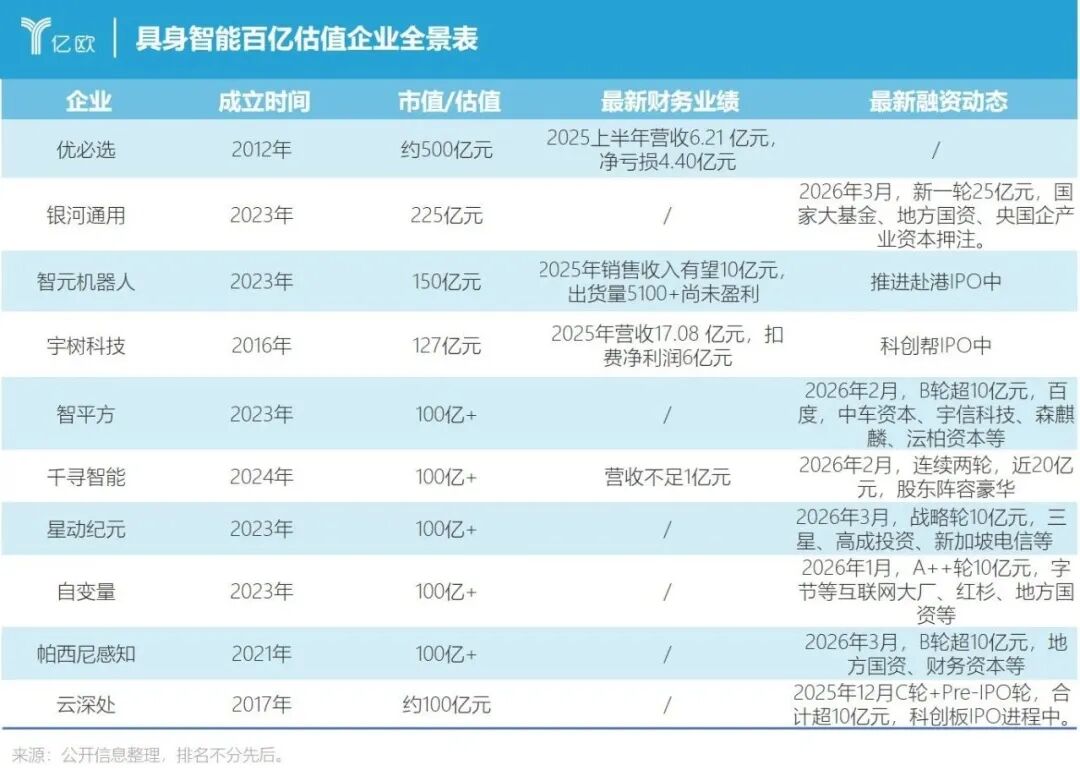
Amid the hustle and bustle, a core question emerges - What exactly does a billion - yuan valuation mean? Why do so many companies strive to cross this threshold?
The most fundamental value of a billion - yuan valuation is a financial safety cushion. Han Fengtao, the founder of Qianxun Intelligence, bluntly pointed out the cruelty of the competition in an exclusive interview: "The embodied intelligence in 2026 is very similar to the large - model track in 2023. If you can't get enough money, and your model performance can't enter the top echelon, you'll completely lose the chance to be at the table."
Among the three core criteria for top - tier companies he defined, "having enough money in the account" ranks first, combined with a solid foundation in hardcore AI technology, strong industrial investors, and the ability to commercialize, all three are indispensable.
According to industry investors' calculations, a billion - yuan valuation means that a company has at least 2 - 3 billion yuan in cash on its books. This is the core confidence to survive the industry's blank period and withstand competition, and also a guarantee to avoid being eliminated prematurely.
But money is just the entrance ticket. What really determines how far a company can go is resources. "Now everyone's valuations are rising rapidly. To become a giant, we need a trillion - yuan market value." "Financing is not just about raising money, but also about raising resources." Chen Jianyu, the founder of Xingdong Jiyuan, pointed out the resource logic behind the billion - yuan valuation. Only when reaching this level is a company eligible to be on the candidate list of top - tier strategic investors.
Taking Samsung, the lead investor, as an example, "They are also customers. They invested in one company each in China, the United States, and South Korea at that time to make a choice." Xingdong Jiyuan completed a 1 - billion - yuan financing in November 2025 and another 1 - billion - yuan strategic financing in March 2026. This in - depth binding brings not only funds but also orders, scenarios, and an ecological niche.
Meanwhile, a billion - yuan valuation is also the starting line for an IPO. 2026 is defined by the industry as a big year for humanoid robot IPOs, and more than 20 companies have clearly disclosed their listing plans. Shi Zhongxin of Qiancheng Capital pointed out that compared with hard - tech projects such as GPUs, the secondary - market imagination space for embodied intelligence is greater. "A billion - yuan valuation is the basic threshold for sprinting for an IPO. Without reaching this level, a company doesn't even have the qualification to enter the capital market."
In addition, a billion - yuan valuation is also a strategic position. The intensive entry of industrial capital and the "national team" is the most prominent feature of this wave of financing. Different from financial investment, the investment from industrial players such as CATL and SAIC is not just a simple capital injection, but strategic cooperation and ecological positioning. Relying on such cooperation, the scenario requirements of industrial players can be directly converted into effective orders, making the commercialization path of embodied intelligence companies change from "seeking scenarios" to "waiting for scenarios". Through equity binding, industrial players incorporate companies into their own supply - chain systems, and the two sides form a deep - seated binding in key links of the industrial chain.
The entry of the national team has elevated the billion - yuan valuation to a strategic threshold. The person in charge of Galaxy Universal pointed out that "the large - scale fund's investment is essentially a strategic definition of the industry at a certain stage"; an investor said bluntly: "If you're not favored by the national team, you don't even have the qualification to participate in standard setting." This means that a billion - yuan valuation is not only market recognition but also strategic access, determining whether a company can participate in defining industry rules.
From financial survival, resource breakthrough, to the IPO entrance ticket, and then to strategic positioning, the billion - yuan valuation is not just a capital - hyped halo, but a real survival bottom line and a competitive watershed in the embodied intelligence track. It determines who can stay at the table and is also a crucial battle to distinguish the future pattern of the track.
II. Heavy is the Head That Wears the Crown: The Costs and Hidden Dangers of a Billion - Yuan Valuation
Holding billions of cash flow, backed by top - tier capital, and wearing the halo of a billion - yuan valuation, these unicorns in the track seem to be at the top of the industry with a smooth path ahead.
However, beneath the prosperous appearance, the heavy pressure and hidden concerns brought by high valuations are also following closely.

Firstly, there is the cost of human resources. Under high - speed expansion, the turmoil of the core team is happening.
In February 2026, Xu Huazhe, the co - founder and former chief scientist of Xinghai Map, officially resigned and left to start a new business. According to the report of Science and Technology Innovation Board Daily, Xu Huazhe's new company will focus on the C - end application track of embodied intelligence and has already received a seed - round investment from Xinghai Map. The official defined this change as "caused by the difference between personal interest direction and the company's strategy" (Xu Huazhe focuses on the C - end, while Xinghai Map focuses on the B - end productivity scenario, which is an ecological layout, not a simple internal conflict). However, this change still reflects the subtle tension between strategic focus and talent retention for billion - yuan unicorns.
Similarly, Magic Atom also encountered the departure of its core founder on the eve of the IPO. Just when the company appeared on the 2026 Spring Festival Gala stage, completed a new round of 500 - million - yuan financing, and was preparing for the IPO, Wu Changzheng, the founder and former CEO, left to start a new business in late February. According to insiders, the reason was a difference in development concepts with the shareholders.
These two cases reveal a cruel reality: the higher the valuation, the heavier the expectations, and the differences between the team and capital, talent and strategy are likely to be magnified quickly under high pressure.
Secondly, there is the cost of money. Different sources of capital bring different costs.
Financial capital pursues financial returns and intervenes less, but its core demand is to "get in and out quickly". It requires companies to rapidly increase their valuations and go public quickly, leaving little time for technology polishing.
The entry of national funds means that a company has obtained the ticket to the "national team", but it also has to bear higher policy expectations and strategic missions - resonate with the national system in terms of technology routes and take more responsibilities in data security, standard compliance, and domestic substitution.
The investment from local state - owned assets often has the attribute of "investment promotion". It values industrial implementation (such as production capacity, tax revenue, and employment remaining in the local area) and usually comes with hard constraints such as gambling agreements, factory - building commitments, and tax contributions. A company not only has to make its technology work but also quickly build production lines in a specific area. A slight mistake may trigger the buy - back clause.
The money from industrial capital also comes with high risks. It comes with scenarios and orders and has much higher requirements for efficiency and input - output ratio than the capital market. According to industry investors' observations, at least two leading companies' humanoid robots were returned by factories due to sub - standard performance. Taking industrial money means accepting the test of real production lines. Once it fails, not only will the cooperation break down, but it will also send a fatal signal of "technologically unqualified" to the market.
Recently, the foreign humanoid robot company Cartwheel Robotics officially announced its closure due to exhausted financing and a broken capital chain. Founder Scott LaValley left a thought - provoking warning in his farewell letter: "No money is better than the wrong money". This sentence reveals the other side of capital - inflated development: not all money is good money.
A billion - yuan valuation is both an entrance ticket and a tight - binding spell. It allows a company to obtain the qualification for top - tier competition, with sufficient funds to invest in model training, recruit top - tier talents, and build a data closed - loop. But it also pushes the company onto a track where it can only accelerate and cannot stop. The patience for technology precipitation, the rhythm of commercialization, and the space for team stability are all constantly squeezed under the heavy pressure of high valuation.
III. Billion - Yuan Valuations but Hard to Find Profits: Chaos under the Bubble
Billion - yuan valuations are emerging in clusters, and financing news is flooding the screen, but only a few companies can produce profit statements.
Yushu Technology has a post - investment valuation of 12.7 billion yuan and is one of the few large - scale profitable examples in the industry at present. According to the prospectus, its revenue in 2023 was 159 million yuan, with a net loss of 11.1451 million yuan. It turned a profit in 2024, with revenue climbing to 392 million yuan and a net profit of 94.5018 million yuan. In 2025, it witnessed explosive growth, with annual revenue reaching 1.708 billion yuan and a net profit after deducting non - recurring items of 600 million yuan, a year - on - year increase of 674.29%.
UBTECH Robotics, the "first humanoid robot stock" in the Hong Kong stock market, still can't cross the threshold of profitability. As of March 21, 2026, its market value is 49.837 billion yuan. Financial data shows that its revenue in the first half of 2025 was 621 million yuan, with a net loss of 440 million yuan. Although the net loss rate narrowed to 28%, the cumulative loss from 2023 to the first half of 2025 is approaching 3 billion yuan.
Zhipu Robotics, another star in the track, has a valuation of 15 billion yuan. Its shipment volume exceeded 5,100 units in 2025, but it has not yet reached the profit - turning point. Deng Taihua, its chairman and CEO, revealed at the end of last year that the company's sales revenue in 2025 was expected to exceed 1 billion yuan. It's worth noting that Zhipu Robotics acquired a controlling stake in A - share listed company Shangwei New Materials through capital operation. The latter's market value once exceeded 60 billion yuan and reached 49.827 billion yuan as of March 2026.
Newly - emerged billion - yuan unicorns such as Qianxun Intelligence, Independent Variable, Xinghai Map, Zhipingfang, and Xingdong Jiyuan have not directly disclosed their revenue scales. However, according to Qianxun Intelligence's disclosure that its revenue target for 2026 is to reach the "hundred - million - yuan level", it can be predicted that the revenue scales of many companies are still in the tens of millions, which has a gap of dozens or even hundreds of times compared with their billion - yuan valuations.
It's worth noting that even for Yushu, the company with the most outstanding performance, it clearly mentioned in its prospectus that "affected by the company's robot products' performance at the Spring Festival Gala in early 2025, the company's brand awareness and attention across the country have continued to increase, and the demand for domestic orders has continued to grow". This means that Yushu's performance explosion in 2025 is contributed by both the improvement of product strength and the support of Spring Festival Gala traffic and the industry boom.
The mismatch between performance and valuation has attracted the attention and discussion of industry insiders. Liu Tianjie, the managing director of Huaying Capital, said bluntly in a public interview: "If you compare the first - level market attention, social attention, capital supply, and liquidity with its business results, shipment volume, and order volume, the humanoid robot industry is obviously in a bubble stage, and there's no need to avoid this fact."
Why does the bubble exist? Liu Tianjie analyzed that the market's expectation for the end - game is high enough. Humanoid robots are expected to enter massive scenarios such as industrial production, household services, and commercial receptions in the future, and the industrial scale will be no less than one trillion yuan. The popularity of the AI track and continuous technological iteration have made embodied intelligence regarded as a key carrier for the implementation of the AI industry. Tech giants are accelerating their investment, which stimulates the market to fall into a "fear of missing out" mood, only seeking to secure a position in advance, even if the profit is still a long way off.
The bubble not only inflates valuations but also brings a series of industry chaos. Han Fengtao, the founder of Qianxun Intelligence, recently pointed out that the industry competition is not "benign" in a public interview. He revealed that there are phenomena in the industry such as "cheating investors for financing, cheating for orders, or putting a shell on an open - source model to cheat", and he also implicitly mentioned being smeared by a peer through public relations during the financing process. Finally, he called on everyone not to attack each other so fiercely.
It's worth noting that the bubble itself is not terrible. It is an inevitable path for emerging tracks to accelerate iteration under capital drive. What's really dangerous is mistaking the bubble for a trump card and thinking that valuation equals a barrier and financing equals safety.
In the development of