Digging Deep into Unitree's Prospectus | The Journey and Ambitions of the "Cost Maniac"

Author: Lv Xinyi
Produced by: Embodied Learning Institute
As one of the most eye - catching and earliest enterprises in the embodied intelligence industry, the prospectus of Unitree Technology has gone beyond the scope of providing investment decision - making support through corporate information transparency. Its value lies in objectively reflecting the development context and core commercialization logic of China's embodied intelligence industry through a multi - dimensional presentation of Unitree's revenue structure, reasons for leadership, and future layout.
On March 20th, Unitree disclosed its prospectus and issued no less than 40.4464 million shares (accounting for no less than 10% of the total share capital after the issuance), with the total share capital after the issuance being no less than 404 million shares. The funds raised were approximately 4.202 billion yuan. According to the prospectus, the raised funds were mainly used for four projects: the intelligent robot model R & D project (investment of 2.022 billion yuan), robot body R & D (investment of 1.11 billion yuan), new product development (investment of 445 million yuan), and the construction of a manufacturing base (investment of 624 million yuan).
Looking through the prospectus and the two rounds of inquiry documents, overall, Unitree's success can still be attributed to the popularity from the Spring Festival Gala, which has been proven by the steep curve in the financial statements of the prospectus. However, popularity is just a bonus of luck. What really helped Unitree convert the popularity into beautiful financial statements is its mass - production capacity and the "production based on sales" model to relieve and control inventory pressure. This can be proven by both the fact that it has the highest sales volume of humanoid robots and the highest production - sales ratio of humanoid robots reaching 95.95% and that of quadruped robots reaching 98.56%. The "quadruped + humanoid" full - spectrum product matrix further broadens the demand coverage and avoids dependence on the growth of a single product.
Based on the localization advantages of the domestic hardware supply chain, Unitree's strategic core is to maximize this dividend. Through full - stack self - research of core components and in - depth integration of the domestic supply chain, it has not only established absolute control over the cost side but also ensured the stability of mass - production and delivery. This is also the key prerequisite for it to form a cost - performance advantage in the global market.
However, Unitree is not indulging in its current achievements. In both the prospectus and the inquiries, Unitree repeatedly mentions that there is great uncertainty in application scenarios. This uncertainty mainly comes from two aspects. Firstly, at the industrial level, there is no definite trend in terminal applications. As disclosed in the second - round inquiry, from January to September 2025, the proportion of industry application revenue was only 9%, and the scenarios were concentrated in shallow scenarios such as corporate tours. The depth of commercialization still needs to be explored. Secondly, in terms of competition, there are challenges in differentiation. Unitree clearly states that the company does not fully understand the specific usage scenarios of robots by industry customers. The current leading sales volume does not rely on the uniqueness of the application field but on the advantages of comprehensive cost - performance and iteration speed. This means that Unitree has not yet formed an irreplaceable real - scenario barrier (excluding scientific research).
This clear understanding of uncertainty precisely constitutes the underlying logic of Unitree's future strategic layout.
The core investment direction of the 4.2 billion yuan raised in the prospectus is to "strengthen weak links and build barriers". Among them, the research on technologies related to the robot's "brain" and "cerebellum" and the development and construction of data and training platforms are focused on. The planned investment amount accounts for 48.13% of the total amount of the fundraising projects, making it the fundraising project with the largest single investment scale.
Unitree's exploration is essentially a microcosm of China's embodied intelligence industry. Relying on the advantages of the local supply chain, it has achieved a "pioneering breakthrough" in hardware mass - production and cost control, but there is still a long way to go in in - depth scenario construction. What its prospectus presents is not only the growth path of an enterprise but also a real portrait of the industry's development. There are glorious moments of large - scale profitability, as well as the reality of unclear scenarios and challenges in conquering the "brain".
The Embodied Learning Institute believes that for the entire industry, Unitree's significance lies not only in becoming the "first stock" but also in the question of where the next step of embodied intelligence should go after building the hardware industrial chain thanks to macro - advantages.

Frankly speaking, Unitree's prospectus is a bit "counter - intuitive".
Generally speaking, cutting - edge technology industries often cannot escape the curse of "high R & D investment and long profit cycle". This is not a problem of a single enterprise but the inherent rhythm of the industry. In the prospectuses disclosed by pre - listed companies, it is almost always possible to see the financial pressure brought by continuous R & D. This is also the core logic for the Science and Technology Innovation Board to relax the profit requirements and support hard - technology enterprises.
As a member of the embodied intelligence industry, Unitree not only does not show excessive financial burden but also presents a beautiful report card. From 2022 to January - September 2025 (hereinafter referred to as the reporting period), it achieved operating revenues of 123 million yuan, 159 million yuan, 392 million yuan, and 1.167 billion yuan respectively. In the whole year of 2025 (reviewed), it soared to 1.708 billion yuan. The gross profit margins of the main business were 44.18%, 44.22%, 56.41%, and 59.45% respectively. Among them, the gross profit margins of humanoid robots from 2023 to January - September 2025 were 87.67%, 68.44%, and 62.91% respectively (the decline in gross profit margin was due to the low gross profit margin of product G1 and the price reduction of products)
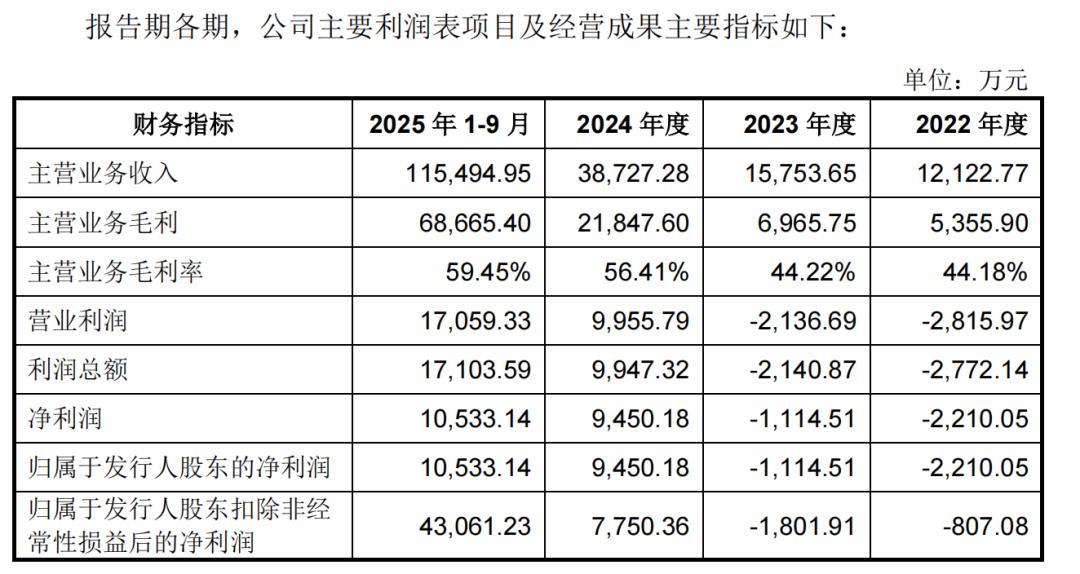
Behind this extremely high gross profit margin is Unitree's business model. If we want to find some other factors, it may also be related to Wang Xingxing's past experience.
On the one hand, when Unitree was founded, the relevant domestic industry had not taken shape yet. Unitree could not start in a mature environment, and Wang Xingxing has recalled his hand - made experience many times. Although this experience became an obstacle for Unitree at the beginning, it also created Unitree's current full - autonomous production ability in various components such as motors, reducers, joint modules, battery modules, circuit modules, structural components, and the whole - machine products.
The layout of components combined with the business logic of the body manufacturer gives Unitree a "manufacturing" curve. Large - scale mass production brings a significant cost - spreading effect. As the shipment volume surges, the fixed R & D and production costs per unit product continue to decline, and the profit margin continues to expand. The core components can be reused across product lines, and production personnel can be flexibly allocated among multiple production lines, further improving operational efficiency.
Of course, for process links with high technological maturity and sufficient market supply, such as SMT and injection molding, Unitree still adopts the strategy of outsourced processing to optimize resource allocation and improve cost - effectiveness. However, Unitree's large - scale mass production further strengthens its bargaining power with upstream suppliers, forming a continuous cost advantage.
During the reporting period, the procurement amounts of Unitree's outsourced production processing were 1.6623 million yuan, 2.3881 million yuan, 7.0118 million yuan, and 18.0338 million yuan respectively, accounting for 2.46%, 2.72%, 4.15%, and 3.84% of the operating cost respectively.
Unitree's "extreme cost control" is not limited to careful calculation at the production end. Even with the "huge traffic" such as exposure on the Spring Festival Gala, the company did not blindly expand production. Instead, it accurately matched supply and demand through the "production based on sales" model. A production - supply - sales meeting is held every month in combination with the sales plan and inventory dynamics, and the total production plan is broken down into specific tasks and distributed to each department. This not only avoids inventory backlog and capital occupation but also can quickly respond to market demand, realizing efficient linkage between production and sales.
It is worth mentioning that Unitree also chooses the most cost - effective solution for dexterous hands, which follows the logic of demand - driven R & D and R & D - and - demand - determined production.
Previously, the demand side did not have obvious requirements for "working", so Unitree's products were not equipped with dexterous hands. When some customers who purchased humanoid robots had the demand for five - finger dexterous hands, Unitree met the customers' needs by purchasing dexterous hands externally. After Unitree launched its self - developed three - finger and five - finger dexterous hands, it did not blindly make the self - developed products the "standard configuration" and start production. Instead, seeing that different customers have different configuration requirements for the size and parameters of dexterous hands, which are difficult to meet with a small number of self - developed dexterous hand models, Unitree then chose the externally purchased dexterous hand models that had been integrated and adapted as the optional configuration solutions for customers.

This combination of "self - control to build barriers + flexible strategies to control costs + precise production and sales to improve efficiency" enables Unitree to break out of the strange circle of "burning money for growth" in the cutting - edge technology track. The essence of its high gross profit is the concentrated realization of the triple advantages of technological autonomy, scale effect, and refined operation.

Whether in the prospectus or the two rounds of inquiry documents, it is not difficult to find that Unitree uses relatively cautious and frank language.
Regardless of the objective factors that require risks to be mentioned in the documents, Unitree's frankness seems to be a clear understanding of the essence of the industry. On the still - undefined track of embodied intelligence, even with the world's first sales volume and high gross profit, it still has to face the fog of "undetermined technological routes and unclear essential demand scenarios". This kind of confusion is not a shortcoming of the enterprise itself but an inevitable proposition in the early stage of the industry.
First, from the sales side, embodied intelligence is a typical demand - driven industry. The shift of Unitree's revenue focus is essentially the result of the combined effect of "short - term traffic dividends" and "supply gaps". As can be seen from Unitree's prospectus, from 2022 to 2024, the proportion of overseas revenue exceeded 55% for three consecutive years, that is, the proportion of domestic revenue was less than 45%. In 2025, the proportion of domestic revenue was 60.80% and that of overseas revenue was 39.20%.
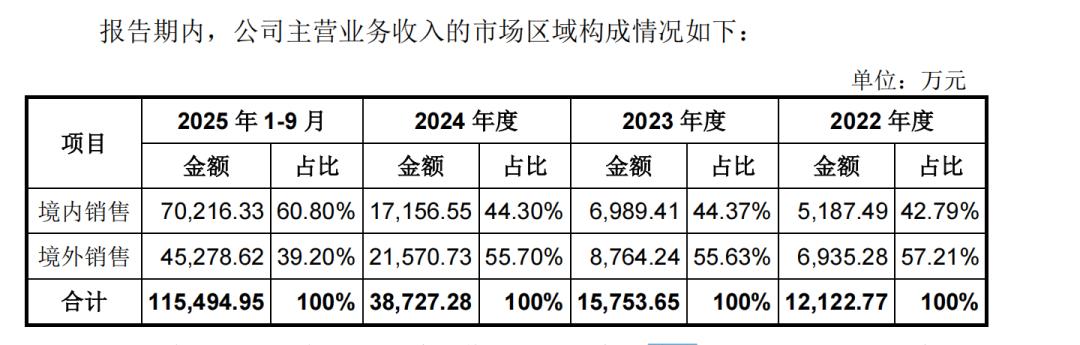
2025 was the first year when Unitree Technology's domestic revenue proportion exceeded that of overseas, but the absolute value of overseas revenue continued to grow.
Unitree attributes the change in the revenue structure to the promotion of the Spring Festival Gala. After all, before the 2025 Spring Festival Gala, embodied intelligence in China was still an "under - the - radar" project. The performance attribute had not been developed, and the attention economy had not taken shape. All demands had not yet germinated. Overseas research institutions and university laboratories had a greater demand for robot bodies than the domestic supply, which gave Unitree an opportunity. In 2025, overseas enterprises still lagged behind in mass production, which also explains why Unitree's overseas revenue proportion decreased but the revenue still increased.
However, there was also a small episode in Unitree's sales. In the third quarter of 2025, Unitree's revenue decreased by 26.01% quarter - on - quarter but maintained a relatively fast year - on - year growth. Among them, the revenue of quadruped robots decreased by 21.74%, and that of humanoid robots decreased by 32.22%. The main reason was that the Spring Festival Gala performance at the beginning of 2025 led to a significant increase in revenue in the second quarter, and the market popularity declined in the third quarter.
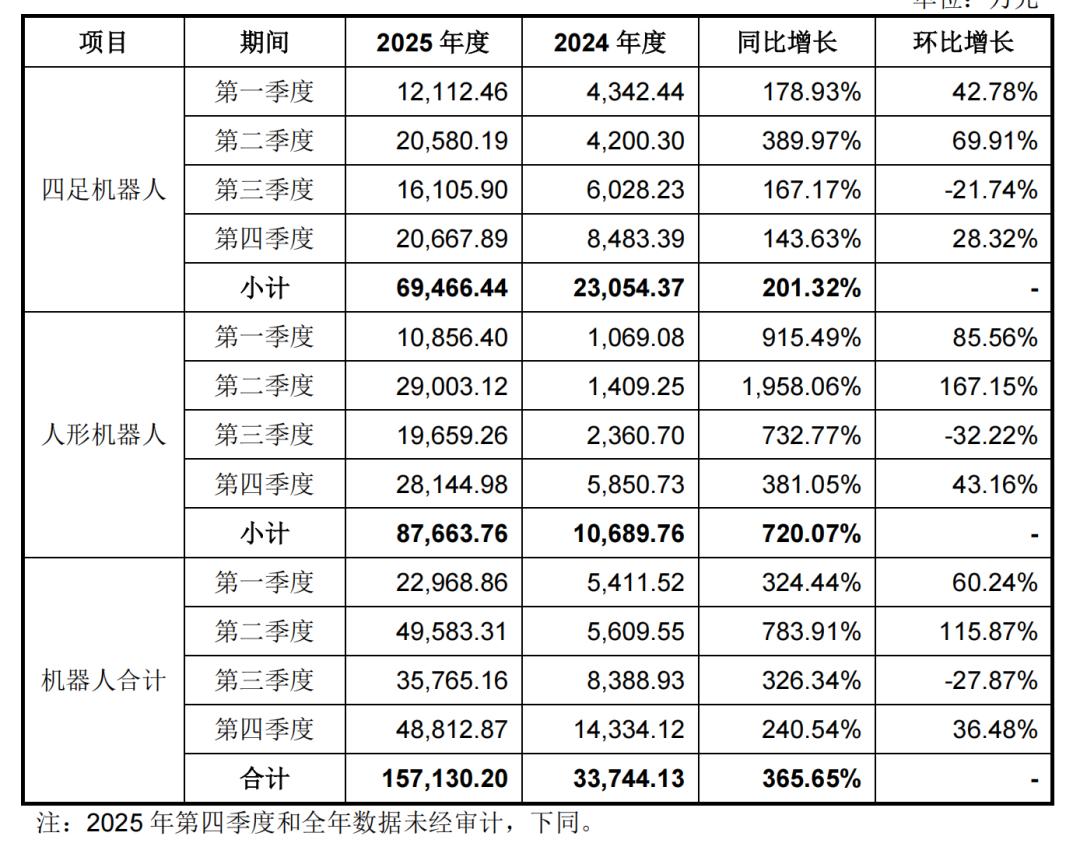
This small episode was quickly offset by the revenue recovery in the fourth quarter of 2025, but it also echoes Unitree's repeated mention of "uncertain demand" in the documents.
What is more worthy of concern on the sales side is where the robots are sold. This is also the industrial development that can be verified through Unitree's prospectus. Who are the essential demand scenarios?
This part needs to be analyzed separately for quadruped robots and humanoid robots. In 2025, the year - on - year revenue growth rates of quadruped robots were 258.81%, 493.68%, 236.02%, and 369.05% respectively. Among them, the year - on - year revenue growth rates of commercial consumption and industry applications in each quarter were significantly higher than those in the scientific research and education field. The growth in the commercial consumption field was due to factors such as the e - commerce warehousing model, which drove the rapid growth of online revenue of quadruped robots. In the industry application field, the reason for the quarterly revenue growth of quadruped robots was the continuous improvement of applications in scenarios such as intelligent inspection and fire emergency response, as well as the gradual expansion to scenarios such as exploration and detection and intelligent manufacturing. The proportion of revenue in the industry application field showed a rapid upward trend.
It can be seen that quadruped robots are gradually transforming from "teaching aids" to "consumer goods" and