Has the era of rising mobile phone prices arrived? Is halting the release of new models the optimal solution?
In 2026, the biggest "black swan" in the mobile phone industry was the soaring memory prices.
The "Memory Price Tracking Report" disclosed by Counterpoint shows that in Q1 2026, the price of DRAM increased by more than 50% quarter-on-quarter, and the price of NAND increased by more than 90% quarter-on-quarter. It is expected that in the second quarter, memory prices will continue to rise by about 20%.
Facing the pressure of rising memory prices, smartphone manufacturers such as OPPO, vivo, and Honor have raised the prices of their products, with price increases ranging from a few hundred to over a thousand yuan.
Shifting the cost pressure to the consumer market can relieve the operating pressure of mobile phone manufacturers in the short term, but it may also weaken consumers' willingness to buy mobile phones. Jeongku Choi, a senior analyst at Counterpoint, believes that "for terminal manufacturers, this is a double blow - the rising cost of components is compounded by the weakening purchasing power of consumers. As the quarter progresses, demand is likely to slow down."
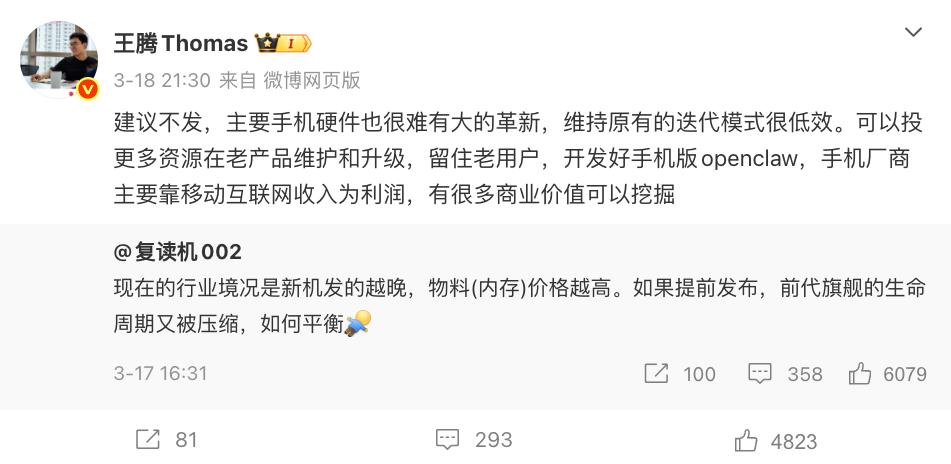
Image source: Wang Teng
As an "outsider", when talking about what choices mobile phone manufacturers should make against the backdrop of rising memory prices, Wang Teng, the former general manager of the marketing department of Xiaomi China and the general manager of the REDMI brand, said that he suggested that manufacturers not release new mobile phones because it is difficult to make major innovations in mobile phone hardware, and maintaining the original iteration model is very inefficient.
Wang Teng believes that mobile phone manufacturers can invest more resources in the maintenance and upgrading of old products to retain old users and develop the mobile version of OpenClaw (AI intelligent agent framework). "Mobile phone manufacturers mainly rely on mobile Internet revenue for profit, and there is a lot of commercial value to be explored."
So, the question is, is Wang Teng's suggestion reasonable? What growth points are worth exploring at the mobile phone system level? Since the input-output ratio of hardware investment is not ideal, why do smartphone manufacturers still launch new products in full swing?
Memory price increase: "Price increase and configuration reduction" becomes the norm for mobile phones
We all know that the current memory prices are rising rapidly, but how much does it actually affect the cost of a single mobile phone? At the MWC 2026 held in early March 2026, Lu Weibing, a partner, president, president of the mobile phone department, and general manager of the Xiaomi brand of Xiaomi Group, gave an intuitive quantitative explanation of the recent increase in memory prices.
Lu Weibing revealed that in Q1 2026, the quotation of memory was nearly four times that of the first quarter of last year. "A memory combination of 12GB + 256GB cost about $30 (about 207 yuan) at the price low point. Four times that means it has reached about $120 (about 826 yuan)."
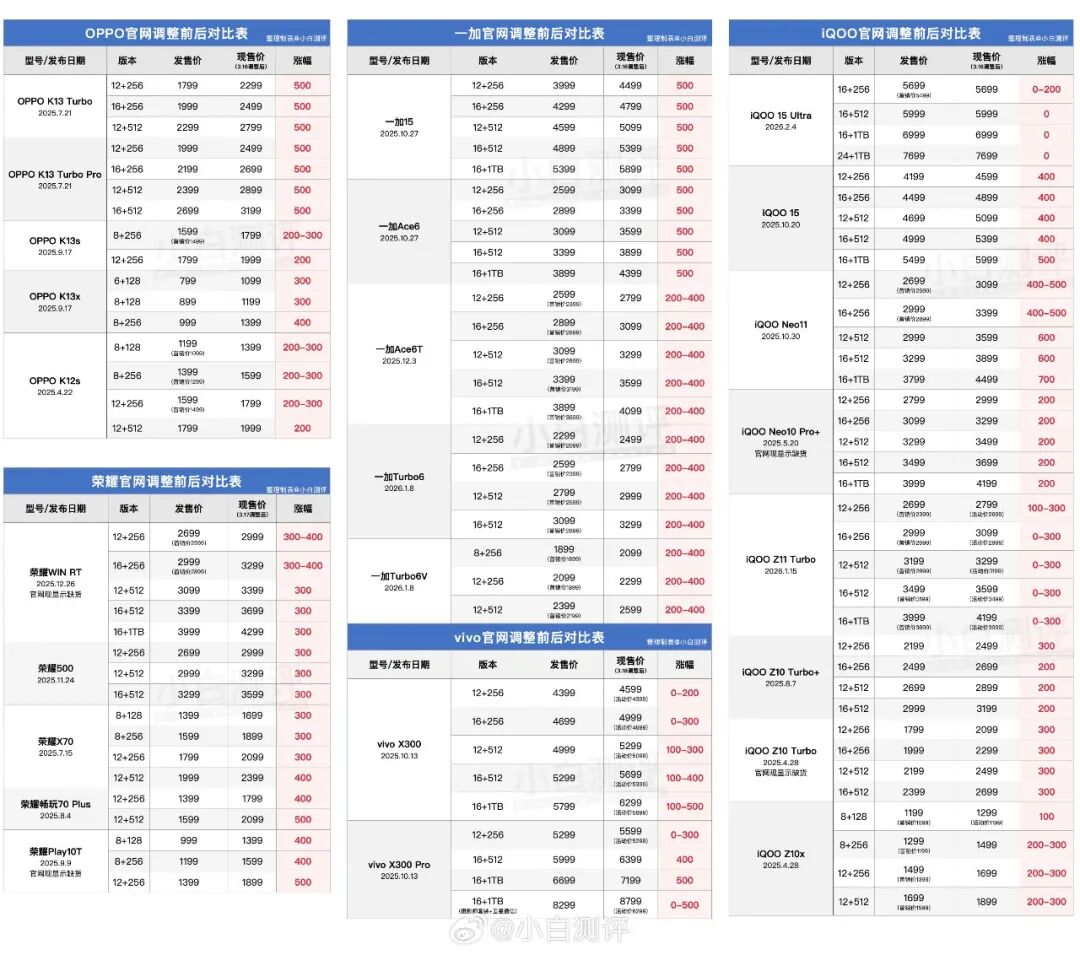
Image source: Xiaobai Evaluation
Based on the data provided by Lu Weibing, the memory price of a 12GB + 256GB mobile phone has increased by about 619 yuan. However, in comparison, smartphone manufacturers have not passed all the pressure of rising memory prices to the consumer market. The data statistics from Xiaobai Evaluation show that the price increases of many smartphone products recently range from 200 yuan to 500 yuan.
The reason is that smartphone manufacturers have realized that blind price increases may greatly suppress consumer demand. Therefore, mobile phone manufacturers also hope to relieve part of the cost pressure by themselves.
In early March 2026, when being interviewed, Lei Jun, the founder, chairman, and CEO of Xiaomi, said, "(The rising memory prices) have put great pressure on our mobile phone and related businesses. We may still try our best to digest these cost pressures through internal efficiency improvement. We will think of various ways to minimize the difficulty for consumers to accept."
However, it should be noted that due to the extremely fierce homogeneous competition in the smartphone industry, except for Apple, which can earn substantial profits through differentiation, the profits of many smartphone brands are very meager.
Taking Xiaomi as an example, in the first half of 2025, the gross profit margin of its smartphone business was 11.95%. During the same period, the average selling price of Xiaomi mobile phones was only 1,142.1 yuan, and the average gross profit per mobile phone was only 136.48 yuan. Due to the extremely limited buffer space for the overall profit of the mobile phone, smartphone manufacturers represented by Xiaomi have difficulty flexibly coping with the fierce cost impact.
In view of this, currently, in addition to raising prices, many smartphone manufacturers are also keen to make "subtractions" in terms of hardware configuration.
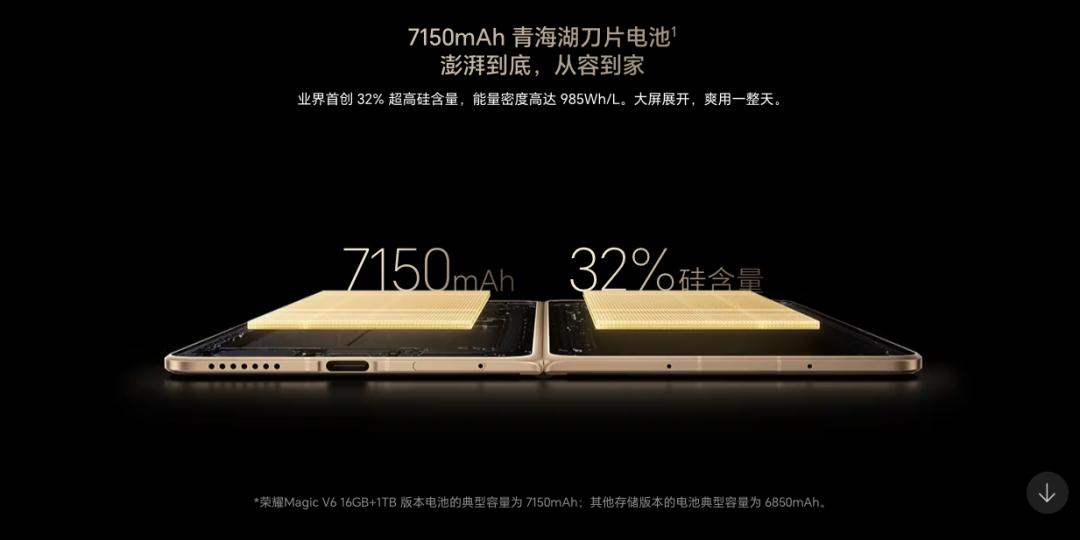
Image source: Honor
For example, the Honor Magic V6, released on March 10, is priced from 8,999 yuan to 11,999 yuan, and the price of the large-memory version has increased by 1,000 yuan. Although it is touted as a "grand slam folding screen", the imaging hardware configuration of the Honor Magic V6 has hardly been improved. Only the top - of - the - line 16GB + 1TB version is equipped with a 7150mAh battery and supports Beidou satellite messaging.
Even more, according to the well - known digital blogger "Digital Chat Station", currently, mid - and low - end new mobile phones are "going backwards", testing the mainstream screen configuration around 2019 - a 90Hz waterdrop screen.
In view of the high prices of new smartphone products and the limited upgrade range, consumers have started to hold back their money and vote with their feet. The data disclosed by "RD Observation" shows that in the first three days of the first - sale, the sales volume of the Honor Magic V6 was only 75% of that of the Honor Magic V5 during the same period.
From this point of view, recently, Wang Teng's suggestion of "not releasing new mobile phones" to smartphone manufacturers does have a certain degree of rationality.
Although smartphone manufacturers are adopting active strategies to cope with the pressure of rising memory prices, due to the excessive price increase, new mobile phones are inevitably subject to price increases and configuration reductions. This change not only makes consumers cautious about new smartphone products but also leads to a diminishing marginal return of the new - phone - driven sales model that smartphone manufacturers have always adopted.
Against the backdrop of an unsatisfactory input - output ratio for incremental users, smartphone manufacturers do need to turn their attention to existing users.
The era of AI is coming: manufacturers need to win the battle for the entry point
Different from traditional terminals, which have relatively limited connections with the platform after the transaction is completed, as a mass computing platform, after the transaction of a smartphone is completed, the manufacturer will still continuously provide services such as application distribution, finance, and games, maintain a long - term connection with users, and earn profits from this.
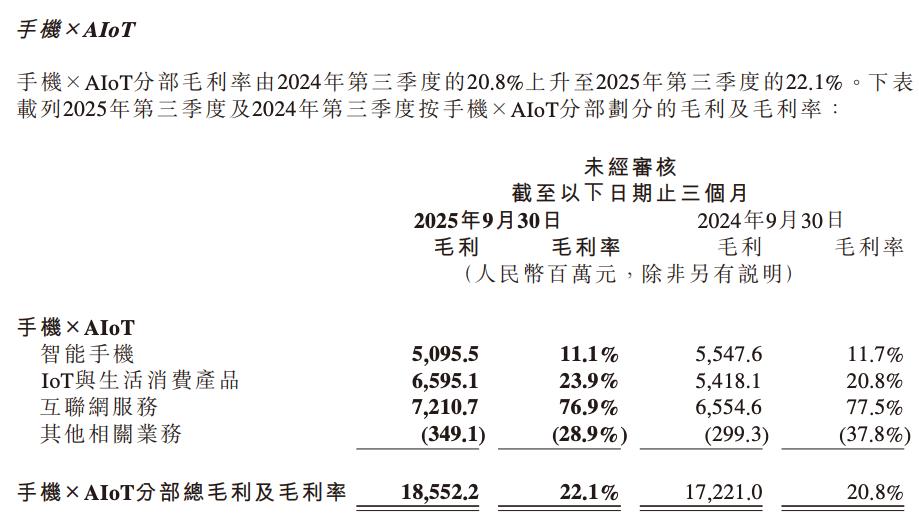
Image source: Xiaomi's Q3 2025 financial report
Taking Xiaomi as an example, although it is a smartphone manufacturer, it mainly makes money through Internet services. The financial report shows that in Q3 2025, the gross profit margin of Xiaomi's Internet services was as high as 76.9%, and the gross profit earned was 7.211 billion yuan, accounting for 38.87% of the total gross profit of the mobile phone × AIoT segment, far higher than that of the smartphone business.
Against the backdrop of the continuous increase in memory costs, if smartphone manufacturers allocate more limited resources to the operation of existing users, improve the smoothness of old models, expand the adaptation scope of new systems, strengthen software capabilities, increase user stickiness, and earn profits from this, it may be a safe way to get through the downward cycle.
More importantly, as technology matures, the smartphone industry is about to enter the AI era. The new market environment also puts forward new requirements for smartphone manufacturers.
Since 2026, driven by OpenClaw, the technology industry has witnessed a "shrimp - raising" craze. In the future, AI intelligent agent tools represented by OpenClaw may evolve into the core entry point for smartphones. In this trend, if they do not want to lose control of the primary entry point, mobile phone manufacturers must get involved themselves and build their own "lobster" system.
Image source: Xiaomi
Currently, many smartphone manufacturers are stepping up their efforts in OpenClaw - related businesses. For example, on March 6, Xiaomi released the mobile - end Agent product "Xiaomi miclaw" and has launched a closed - beta test. On March 10, Honor released the "Lobster Universe", and Honor mobile phone users can interact with the "lobster" through YOYO. On March 11, Huawei also launched the "Xiaoyi Claw" Beta version, which can handle tasks such as document editing, PPT writing, and email reply.
However, it should be noted that different from traditional software, which can spread the usage cost through economies of scale, OpenClaw consumes a large amount of Tokens when performing tasks, resulting in high costs. If smartphone manufacturers want to encourage users to develop the habit of using the "lobster", they need to invest huge subsidies in the early stage to educate the market.
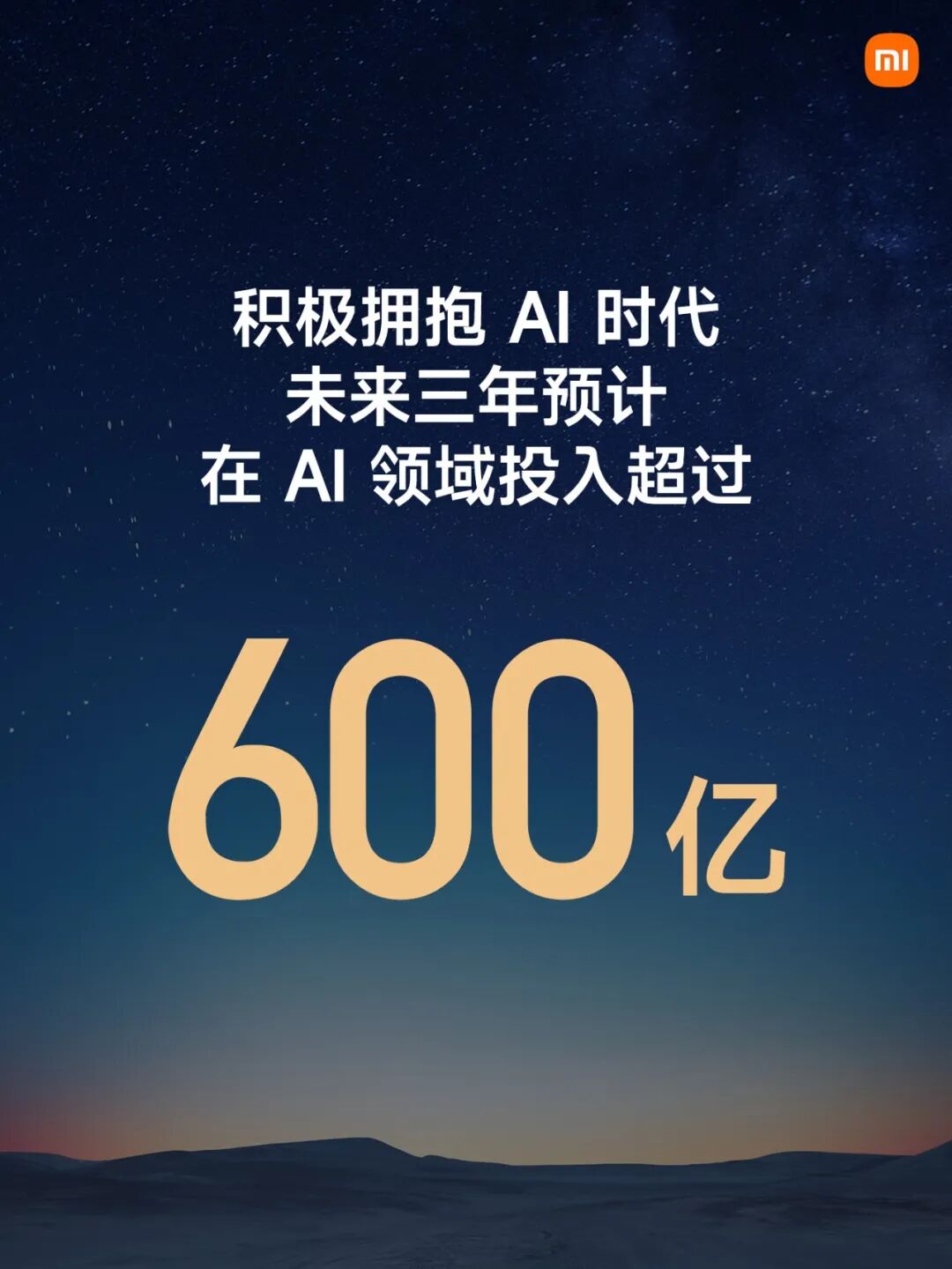
Image source: Xiaomi
For example, at the spring new product launch on March 19, 2026, Lei Jun said that Xiaomi is actively embracing the AI era and will invest more than 60 billion yuan in the AI field in the next three years. It should be noted that in 2024, Xiaomi's net profit was only 23.578 billion yuan. In the next few years, Xiaomi's huge investment in the AI field will put great pressure on the company's cash flow.
Obviously, for smartphone manufacturers, against the backdrop of the rapidly rising upstream memory costs, exploring the "surplus value" of existing users through software services is indeed a more rational choice. As AI technology matures, if smartphone manufacturers want to get the "ticket" to the AI era, they need to invest limited resources in software capability development and user subsidies.
Caught in the "Prisoner's Dilemma": new mobile phone launches cannot stop
Although Wang Teng's suggestion has a certain degree of rationality, smartphone manufacturers have not adopted a defensive stance but are launching new products in full swing.
Since 2026, smartphone manufacturers such as Samsung, Honor, and OPPO have successively released products such as the Galaxy S26, Magic V6, and Find N6. Next, brands such as vivo, OnePlus, and iQOO will also launch new products such as the X300 Ultra, OnePlus 15T, and iQOO Z11.
The reason why smartphone manufacturers do not stop launching new mobile phones according to the logic of "rational economy" is largely because they are caught in the "Prisoner's Dilemma".
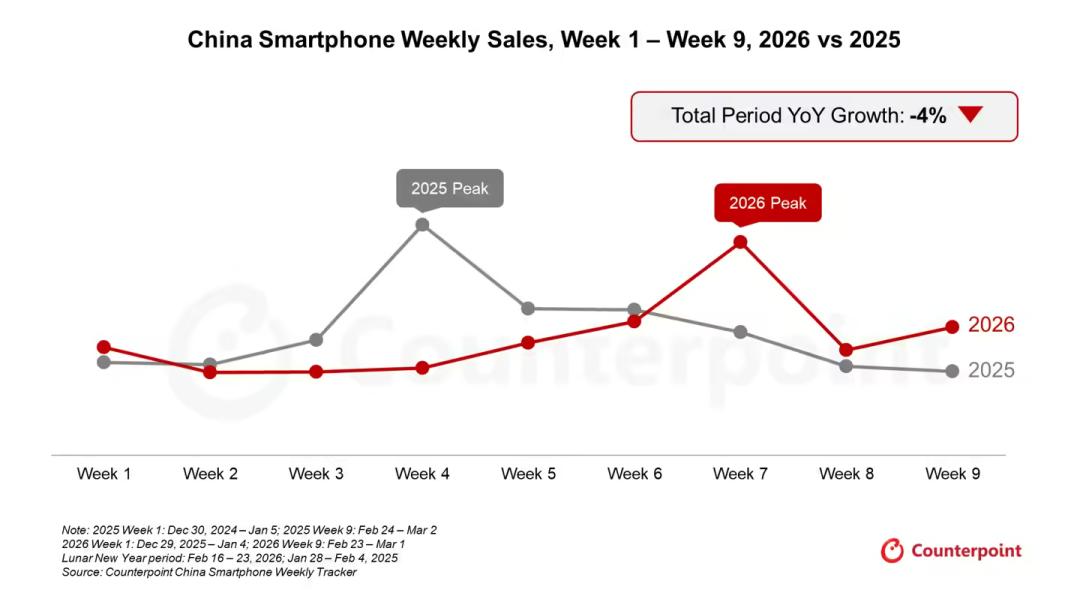
Image source: Counterpoint
Due to the rapid increase in memory prices, consumer demand has been greatly suppressed, and the mobile phone market size will shrink significantly. The data released by Counterpoint shows that in the first nine weeks of 2026, the sales volume of smartphones in China decreased by 4% year - on - year. IDC predicts that the global smartphone shipments will decline by 12.9% year - on - year in 2026.
In this context, although the input - output ratio of smartphone manufacturers is not ideal, the shrinking market size also means intensified involution competition. If a smartphone manufacturer stops launching new mobile phones, its market share will be eroded by competitors and may gradually fall into a "death spiral".
However, it should be noted that against the backdrop of rising memory prices, smartphone manufacturers have not implemented the "mass - phone strategy" as before but have taken advantage of the situation to target the high - end market. For example, the starting prices of the Honor Magic V6 and OPPO Find N6 are as high as 8,999 yuan and 9,999 yuan respectively, on par with the iPhone 17 Pro series.
The reason why smartphone manufacturers specifically focus on high - end flagships is that, on the one hand, flagship mobile phones are priced higher, providing sufficient buffer space for cost increases; on the other hand, they also hope to promote the implementation and application of AI technology through high - end models.
As mentioned above, driven by OpenClaw, smartphone manufacturers are actively "raising shrimps". However, due to the large amount of private information on mobile phones, after connecting to the "lobster", smartphone manufacturers also need to face the issue of privacy and security protection. In response, Lei Jun said, "What people are mainly worried about now is the process of uploading to the cloud, where many security factors are not in place. We strive to process highly private information locally."
Limited by the body space and heat dissipation conditions, there is an obvious upper limit to the performance release of smartphones. Currently, only flagship - level processors with higher energy efficiency ratios can provide relatively sufficient end - side AI processing capabilities.
