Adidas is not optimistic about itself in 2026.
Author | Xie Yunzi
Editor | Zhang Fan
Cover Source | Corporate official WeChat account
Adidas has almost delivered its best performance in recent years.
In the first full fiscal year after completely getting rid of "Yeezy", the old German sports goods group's global revenue in 2025 reached 24.8 billion euros (approximately 199.3 billion yuan), with a revenue growth rate of 13%, hitting a record high; the net profit attributable to shareholders was 1.34 billion euros, and the gross profit margin also reached a record high of 51.6%.
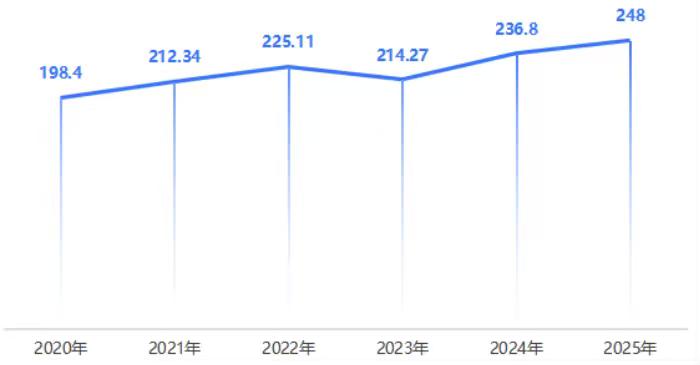
36Kr made the chart based on the financial report data, unit: billion euros
Specifically splitting by region, calculated on a currency-neutral basis, all major regional markets grew by more than 10% (excluding the impact of Yeezy). Among them, the North American market grew by 10%, the Greater China region grew by 13%, Latin America grew by 22%, and emerging markets grew by 17%.
The company said that this growth reflects improvements in both the wholesale channel and direct business. The 2025 financial report data also shows that the sales ratio of Adidas' DTC business to wholesale business has basically remained at 4:6.
Earlier this year, Adidas announced that it would launch a share repurchase program of up to 1 billion euros; after the official release of the annual financial report, the board of directors also extended Bjorn Gulden's term to December 31, 2030. These measures at least indicate that the management is satisfied with the current reform results of Adidas from the inside out and is optimistic about the brand's future revenue and growth rate.
However, the capital market still isn't buying it, and the reasons are mostly macro.
In recent years, the Trump administration has implemented tax - increase policies, especially targeting Southeast Asian manufacturing hubs and some European countries, which has directly pushed up the costs of European - headquartered companies. Calculated on a non - currency - neutral basis, without excluding the Yeezy brand, Adidas' sales in the North American market in 2025 declined by 1% year - on - year.
Adidas also admitted that exchange rate fluctuations and tariff policies are expected to have a negative impact of 400 million euros on 2026, and the annual revenue will achieve high - single - digit growth, with an operating profit of about 2.3 billion euros.
Analysts at RBC Capital Markets said that this profit outlook is 15% lower than the overall market expectation. They added: "Considering that Adidas tends to take a cautious approach at the beginning of the year, the key lies in how conservative this operating profit guidance is."
Therefore, on March 4 after the release of the financial report, Adidas' stock price once fell by more than 8%, and since the beginning of 2026, the company's stock price has cumulatively fallen by more than 21%.
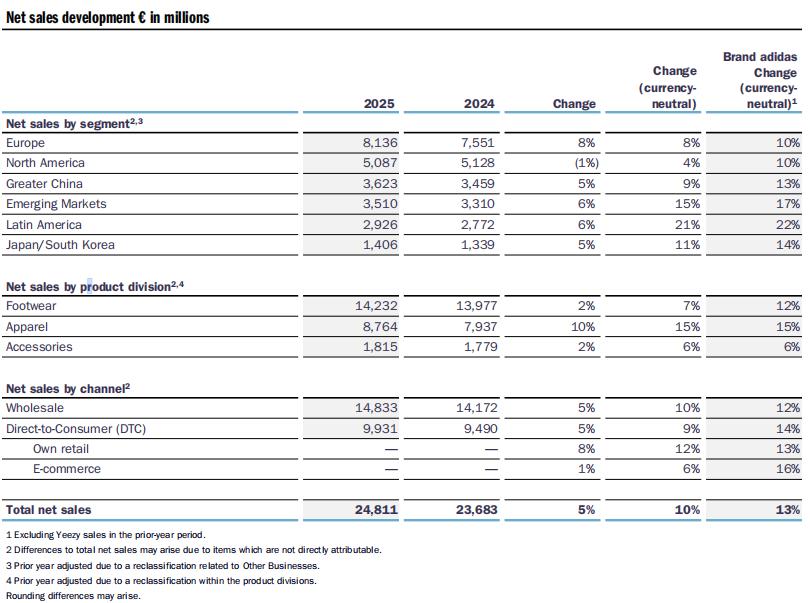
The picture is taken from Adidas' financial report
Samba Replaces Yeezy
Adidas was one of the early international brands to show an imbalance between fashion and sports professionalism.
In October 2022, due to the inappropriate remarks of American rapper Kanye West, Adidas terminated its cooperation with Yeezy, which caused the problem of the company "over - relying on trends and neglecting professional sports" to break out intensively. Coupled with the relatively aggressive DTC strategy during the pandemic, Adidas' performance once hit rock bottom.
It was also in this year that Adidas suffered its first annual net loss since 1992, with its market value shrinking by 50%, and the European, North American, and Greater China markets were all hit hard.
In January 2023, "Puma veteran" Gulden became Adidas' new CEO and promoted the company's comprehensive reform in four aspects: "clearing inventory", "repairing dealer relationships", "localization", and "returning to the origin of sports".
The product response lies in the strong revival of the classic German training shoe model Samba to weaken the impact of the Yeezy incident.
The history of the Samba sneakers can be traced back to the middle of the 20th century.
In 1954, the West German national team won the World Cup wearing Samba, elevating it from professional equipment to a totem of football culture. In the following decades, "football manufacturers were full of opportunities". Driven by European football fans, Samba once became a symbol of anti - mainstream and street fashion.
In 2001, Adidas Originals (the three - leaf clover), centered on retro style, became a sub - line of the brand, and the Samba series was included in it, and it became popular again more than twenty years later.
Public data shows that in 2024, the sales of Samba reached 1.5 billion euros, accounting for 7% of Adidas' total sales. It was also in the fourth quarter of that year that Yeezy completely cleared its inventory. At the financial report meeting of that year, the company's chief financial officer, Ham Almeyer, personally announced that "all Yeezys have been sold, and not a single pair is left."
More commendably, while sparing no effort to climb out of the "Yeezy pit", Adidas has also continuously laid out in "professional sports", which is mainly reflected in a series of ultra - light running shoes built around ADIZERO.
ADIZERO is the general term for Adidas' top - level racing product line. After Gulden clearly proposed to "return to the origin of sports", this series was taken as the flag of the brand's professional performance.
The 2025 financial report shows that the "ADIZERO 0 running shoe" series drove the company's overall running business to grow by more than 30%. As a category with a "low base" for Adidas, running achieved a year - on - year growth of 29% throughout the year. Based on the judgment of the long - term trend of running sports, Adidas expects the running category to achieve high - single - digit growth in 2026.
At the conference call after the release of the financial report, Gulden publicly admitted that Adidas' product portfolio is now healthier. "This feels much better than pinning my fate on one product line."
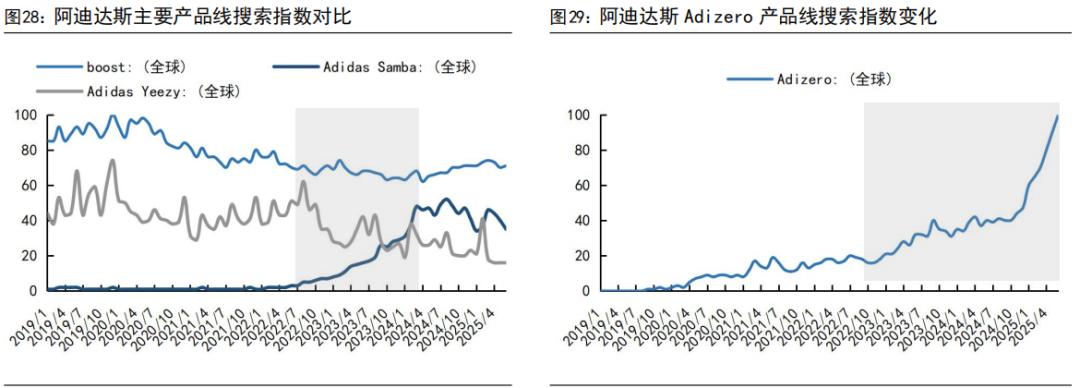
The picture is from the Economic Research Institute of Guosen Securities
Embracing Chinese Small Towns, but Held Back by Trump
It is a clear fact that after several years of adjustment, Adidas has shown a strong ability to correct mistakes, and the most representative case comes from the Chinese market.
In April 2022, Xiao Jiale, who had accumulated some local experience at Urban Revivo, "returned for a second term" and comprehensively led Adidas' market strategy of "in China, for China".
The following year, when Gulden took office, he further emphasized localization, especially focusing on China. His strategies mainly include "delegating power to the local team", "promoting the construction of a flexible supply chain based on sales - driven production", "using Shanghai as the global innovation's first - launch base", and "actively embracing China's sinking market".
In November 2025, Hailan Home, a well - known men's clothing brand in China, submitted a prospectus to the Hong Kong Stock Exchange, and its cooperation with Adidas was more publicly disclosed.
It is reported that the cooperation between the two parties started in 2022 and officially reached a strategic agreement the following year to open Adidas FCC (Future City Concept Store) stores in third - and fourth - tier cities, and even county - level cities in China. These stores mainly feature high - cost - performance (most product prices are below 1,000 yuan) sports and leisure products closer to people's daily lives.
According to 36Kr, Adidas FCC stores have a relatively high proportion of "exclusive models", and this type of products is selected or led in design by Hailan Home. This also means that the significance of China's low - tier cities to Adidas is not limited to clearing inventory. With the strong channels of Hailan Home, Adidas, which has always been unable to penetrate the low - tier market, can finally embrace Chinese "small - town youths" and gain new growth.
As of the first half of 2025, the number of Adidas FCC stores reached 529. At the same time, Adidas also opened more flagship stores in first - and second - tier cities in China; online, it also jointly launched new Chinese - style and three - leaf clover pet product series with Tmall, once triggering a "reverse purchasing agent" boom overseas.
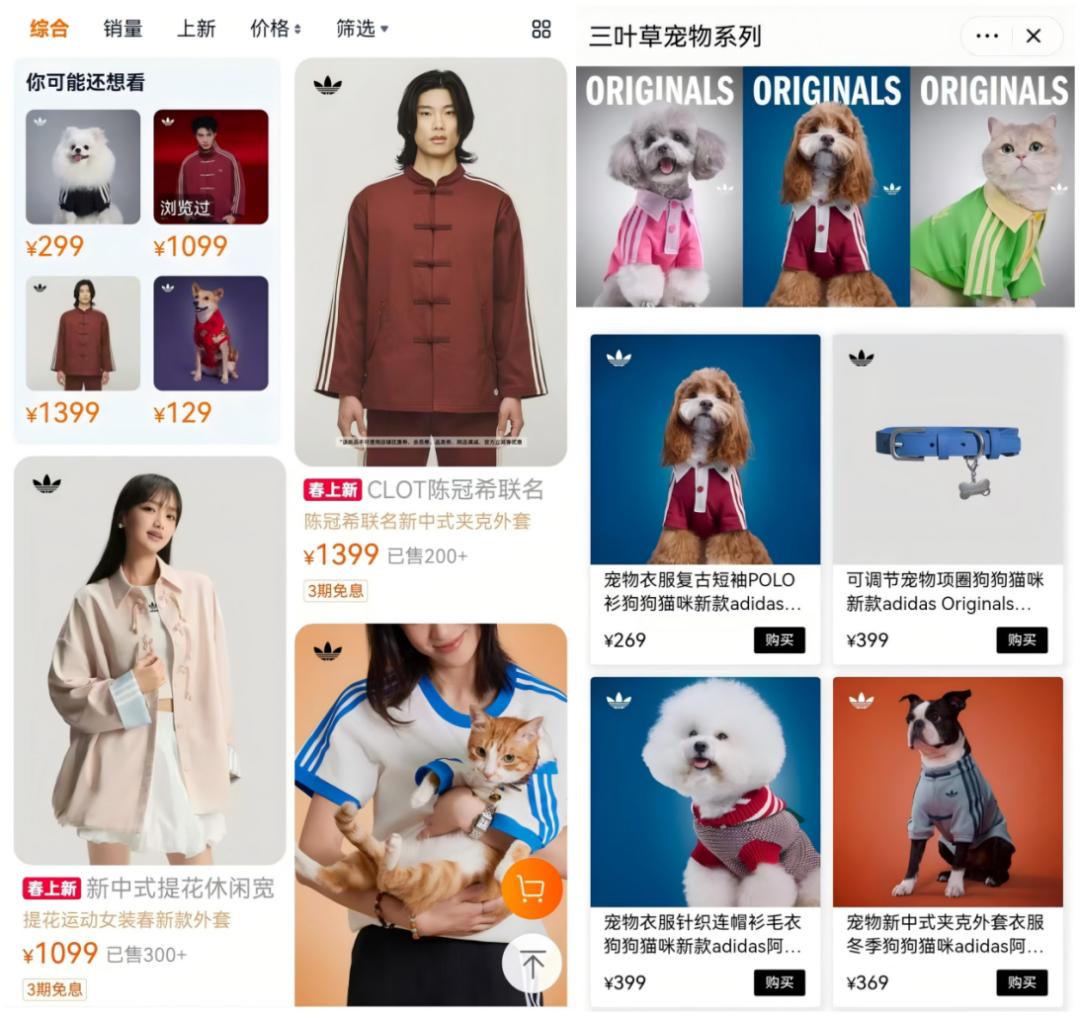
The picture is taken from the Tmall APP
However, while the Chinese market has achieved positive growth for eleven consecutive quarters, there has always been a view that "excessive penetration into the low - tier market" will have an impact on the brand's tone.
Under geopolitical conflicts, the European stock market, which was already in a correction, continued to decline. Regarding the upcoming 2026 "USA - Canada - Mexico" World Cup, the industry also has "mixed reviews". Although "there are opportunities everywhere on the football field", at least in the North American and Chinese markets, the impact of football events on the brand's performance is relatively limited.
The good news is that even in North America, Adidas' relationship with traditional retail partners is being repaired. As the second - largest market after Europe, the importance of the United States to Adidas is self - evident. In May last year, Adidas also opened "one of the world's largest - area stores" in Las Vegas.
In addition, regarding the performance in 2027 and 2028, Adidas expects its market share to increase, its sales to achieve high - single - digit growth, and its operating profit to increase by more than 10% in 2028. All these mean that the capital market needs more patience with Adidas.
Looking back at Adidas and the just - renewed Gulden, standing at the time node of 2026, to regain investors' confidence, they still need to more firmly deepen long - term value and constantly seek a balance between discounts and gross profit, market penetration into the low - tier market and brand tone, and fashion and sports professionalism. This is almost the key that all mature sports brands are constantly facing.
*Disclaimer:
The content of this article only represents the author's views.
The market is risky, and investment should be cautious. In any case, the information in this article or the opinions expressed do not constitute investment advice to anyone. Before making an investment decision, if necessary, investors must consult professionals and make careful decisions. We have no intention to provide underwriting services or any services that require specific qualifications or licenses for the trading parties.

Follow to get more information
This article is from the WeChat official account "36Kr Finance", author: Xie Yunzi Zhang Fan, published by 36Kr with authorization.