The new Xiaomi SU7. Lei Jun can't afford to lose.
Lei Jun has once again stepped into the spotlight.
At the launch event of the new - generation Xiaomi SU7 on the evening of March 19th, cheers and trending topics were all present. In the audience sat industry titans like Wang Chuanfu and He Xiaopeng, and the brand ambassadors invited to the stage even played on the homophone of "SU7" - actress Shu Qi and "Flying Man" Su Bingtian, both of whom generated a great deal of discussion for Xiaomi.
The standard version of the new - generation SU7 is priced at 219,900 yuan, the Pro version at 249,900 yuan, and the Max version at 303,900 yuan. The entire series has a price increase of 4,000 yuan compared to the previous generation. However, the entire series comes standard with an 800V high - voltage platform and a lidar, with a maximum of 69,000 yuan in benefits offered, and the fastest delivery within a week.
34 minutes after the end of the launch event, Xiaomi officially announced that the number of locked orders had exceeded 15,000.
Old car owners, seeing the new car with little change in appearance but a price increase, managed to save face and their wallets; new car owners, looking at the "more features without a price increase" configuration list, felt that it showed good sincerity.
However, compared with the first - generation SU7 (nearly 89,000 large - order bookings in 24 hours) and YU7 (over 200,000 large - order bookings within 3 minutes), which created a phenomenal level of popularity, the current market environment is extremely competitive, and the situation Xiaomi faces is much more complex.
Mid - last year was the most prosperous time for Xiaomi's automotive business. After the release of the YU7, market sentiment was quickly boosted. The automotive business not only seemed to drive growth but also had the potential to rewrite the company's valuation structure. Xiaomi Group's market value once reached a high of HK$1.59 trillion. At that time, the market still had a certain degree of tolerance and curiosity towards Xiaomi, a cross - industry player.
But soon, the situation changed. When it truly entered the center of the competition and faced off directly against industry giants like Huawei and Tesla, the capital market began to re - evaluate the cost pressure of the mobile phone business, the growth rate of IoT, and the sustainability of the automotive business's growth. By November, Xiaomi's market value fell below HK$1 trillion. As of now, Xiaomi's market value is HK$949.6 billion.
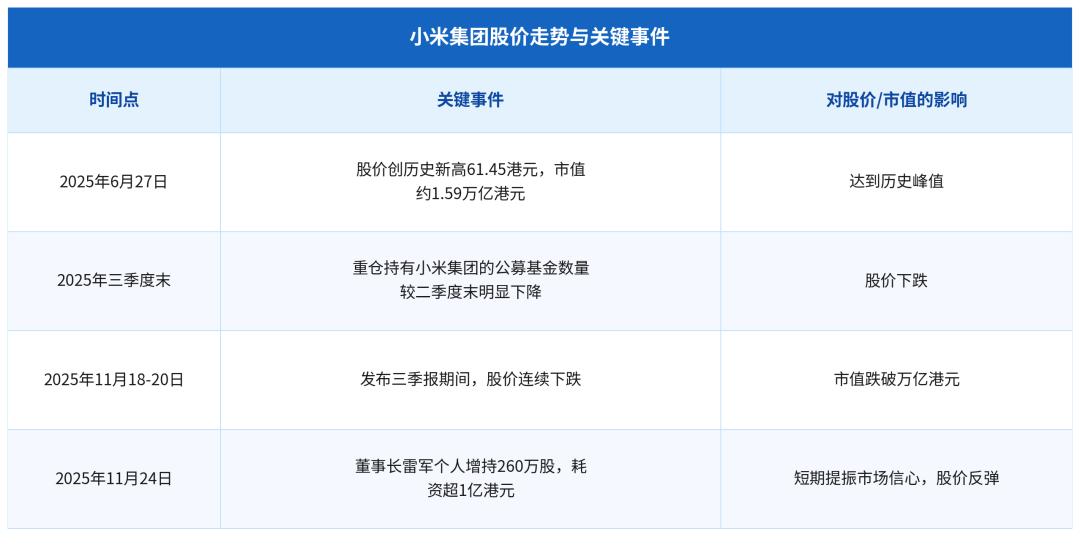
Chart by "AIX Finance"
The public opinion environment that Xiaomi faces has also changed. Issues such as promotion, after - sales service, accidents, and the safety of intelligent assisted driving have been taken out for repeated discussions. In this process, the side - effect of the brand being overly tied to Lei Jun's personal IP has become increasingly obvious.
The number of locked orders for the new SU7 only indicates that the car has had a good start; what really determines Xiaomi's future trend is whether the new SU7 can demonstrate real strength in terms of quality, safety, and intelligent driving. This is a battle that Xiaomi cannot afford to lose.
1
Is the new SU7 worth the 4,000 - yuan price increase?
In 2026, when the automotive industry is in a fierce competition, the price of the new SU7 has increased. The entire series has a price increase of 4,000 yuan: the standard version is 219,900 yuan, the Pro version is 249,900 yuan, and the Max version is 303,900 yuan. "The price of memory has skyrocketed, and with the increase in raw material prices, setting this price has been very challenging," Lei Jun said at the launch event.
An investor who follows Xiaomi told us that blindly reducing prices is not a good idea at present. Once the price is lowered, it will affect not only the profit but also the expectations of old car owners and the rhythm of subsequent product launches. Xiaomi must strive to find a balance between appeasing the emotions of old car owners and attracting new customers.
So, how to demonstrate cost - effectiveness? Xiaomi's approach is: slightly increase the price, but offset it with a significant upgrade in configuration and an extended interest - free period.
Compared with the previous generation, the biggest change in the new - generation SU7 is to "fill in the short - comings," and the upgrades are concentrated in areas that are more easily perceived by users and are most likely to be compared with competitors: charging efficiency, intelligent driving hardware, safety configuration, chassis performance, and cabin comfort.
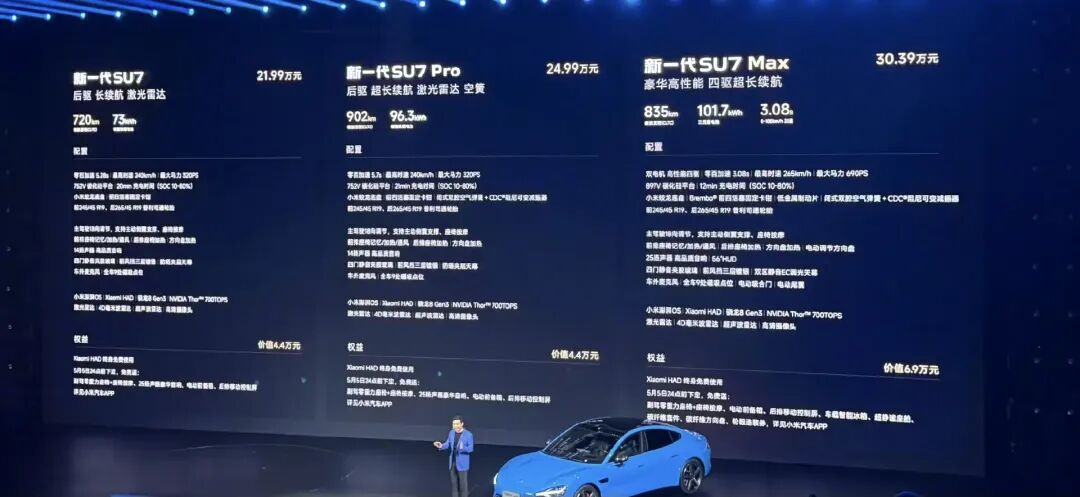
The most core upgrades are in intelligent driving and charging.
The entire series comes standard with a lidar, the high - voltage architecture has been upgraded from 400V to 800V, the computing power for assisted driving has been increased to 700 TOPS, a V6s Plus motor has been installed, the safety configuration has been upgraded from 7 airbags and 2000MPa steel to 9 airbags and 2200MPa ultra - strong steel, and a 1500MPa anti - scraping beam has been added to the bottom of the battery pack.
Even for the door handles, which were criticized by netizens, Xiaomi has come up with a solution: the entire series comes standard with triple - redundant door handles to ensure mechanical unlocking in extreme situations.
In terms of range, the CLTC ranges of the standard, Pro, and Max versions of the new - generation SU7 have been increased to 702 kilometers, 902 kilometers, and 835 kilometers respectively. The previous - generation SU7 had ranges of 700 kilometers, 830 kilometers, and 800 kilometers respectively.
The Pro version, the main sales model of this generation, best reflects Xiaomi's revision strategy. For users of pure - electric sedans priced around 200,000 yuan, what they are really sensitive to is not a few tenths of a second faster 0 - 100km/h acceleration, but fast charging and worry - free daily commuting and long - distance travel. Therefore, Xiaomi did not simply transfer the configuration of the old Max version down, but upgraded the parts that have the greatest impact on the user experience: increasing the CLTC range to over 900 kilometers, introducing dual - chamber air suspension and CDC, and keeping the price below 250,000 yuan.
The standard version, which was previously considered "lacking," has also added an 800V platform, a lidar, safety upgrades, and braking upgrades, and is expected to drive sales volume.
The top - of - the - line Max version focuses on luxury. The cabin has better quietness and comfort, and some luxury configurations have been upgraded to a higher level.
Even in some small details, Xiaomi tries to appeal to users with emotional value - for example, the NFC magnetic doll priced at 79 yuan at the launch event. It is not only a peripheral product for generating revenue but also an attempt to enhance the technological sense and youthfulness of the cabin.
So, is the 4,000 - yuan price increase really worth it?
This needs to be compared with competitors. At the launch event, Lei Jun compared the new SU7 with some competitors (Model 3 Performance, Zhijie S7 Max, and ZEEKR 001 High - end Version). Judging from the paper data, the range of the SU7 Pro version and the dual - chamber air suspension + CDC standard on the Pro/Max versions do give it an all - around advantage in the same price range. Especially when facing the pure - vision solution of the Model 3, the SU7 tries to compete with hardware stacking.
However, compared with the previous generation, the new - generation SU7 is facing opponents who have already refined the competition in terms of price, configuration, and intelligence. The Tesla Model 3 is still an unavoidable competitor in this price range, with its mature system, energy - consumption control, and brand recognition still having an edge; compared with Huawei - affiliated brands, Xiaomi's public perception of its assisted - driving capabilities still needs to be improved; models like the XPENG P7, ZEEKR 007, and ZEEKR 001 have long been in a fierce battle in the pure - electric sedan market and have a more in - depth understanding of high - voltage platforms, assisted driving, chassis, and performance.
Overall, this product upgrade is not perfunctory. It does not avoid the problems of the previous standard version, such as slow charging and weak intelligent - driving hardware, and the awkwardness between different versions. Instead, it puts the most noticeable upgrades on the table for users to clearly see the differences.
Of course, sincerity and competitiveness are not the same thing. The latter question still needs to be answered by the market.
2
The old orders are almost exhausted, and the new SU7 must step up
An important detail to note is that the rules for locking orders for the new SU7 have changed.
In the past, Xiaomi's production - scheduling logic was somewhat based on the idea of "the earlier you place an order, the more priority you get," creating a high - energy atmosphere during the initial launch. This time, the focus has shifted to "confirming the configuration and locking the order as soon as possible": orders can be refunded if not locked within 3 days, and if the configuration is changed within the specified time, the delivery cycle remains the same. The variable determining the production - scheduling order has changed from "the time of placing a small deposit" to "the time of locking the order."
This shows that after the previous long - delivery - cycle experience, Xiaomi now cares more about locking in orders and finalizing configurations to avoid being in a passive position in production scheduling and delivery.
To understand this change, we need to look at the roller - coaster ride Xiaomi has been through in the past year.
Ten months ago, the YU7 propelled Xiaomi to the peak. It once had nearly 400,000 orders (including the undelivered orders of the SU7 at that time). However, the delivery cycle often extended to six months or even ten months later, which exposed the shortcomings of Xiaomi's initial automotive manufacturing system.
As the production capacity of the second - phase factory increased, the monthly delivery volume began to accelerate from September, reaching 40,000 units and even exceeding 50,000 units. Among them, the YU7 contributed 70% of the delivery volume in October and November and became the absolute mainstay in December.
The total delivery volume in 2025 exceeded 410,000 units, nearly tripling compared to 136,000 units in 2024. On the surface, Xiaomi has survived the most difficult start - up period and entered the ranks of large - scale automakers.
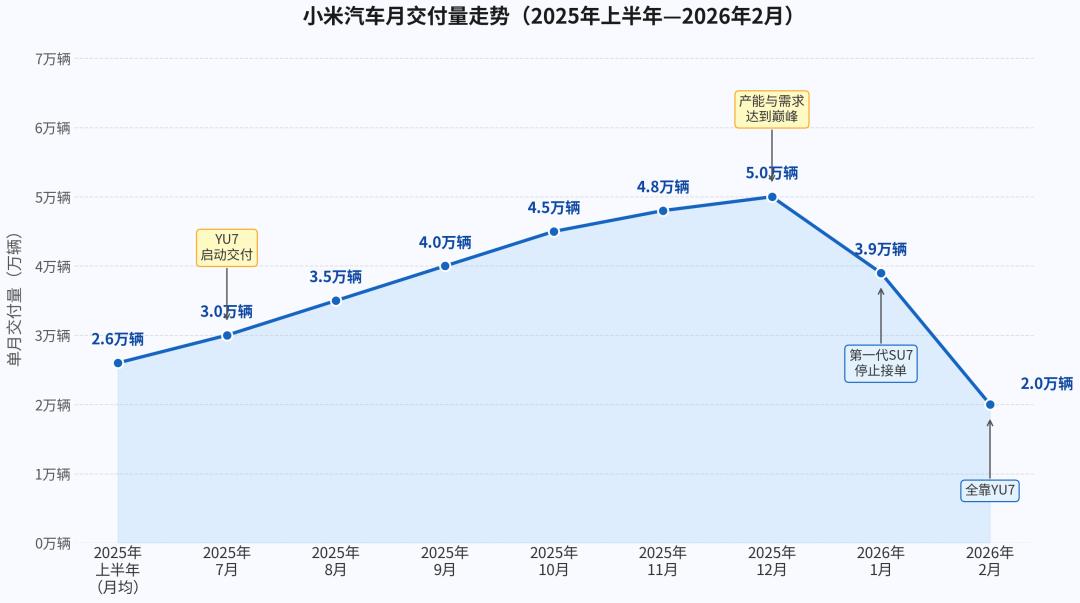
Chart by "AIX Finance"
However, in 2026, with the discontinuation of the old SU7 and the consumption of YU7 orders, the delivery volume began to decline. The delivery volume was over 39,000 units in January and over 20,000 units in February.
An automotive industry insider analyzed that Xiaomi's actual monthly production capacity reached 50,000 units by December last year. Even at a rate of consuming 30,000 orders per month, the orders accumulated in the second half of 2025 will be exhausted by mid - 2026. By then, the supply - demand relationship will change from "waiting in line for a car" to "cars waiting for customers."
This is why the new - generation SU7 must step up at this critical moment.
In 2026, Lei Jun set a goal of 550,000 units in annual delivery for Xiaomi's automotive business, which means an additional 34% increase on a already high base. The cumulative delivery volume from January to February this year was 59,000 units, and the remaining 491,000 units need to be completed in the remaining 10 months, with an average monthly delivery of 49,100 units. Compared with the average monthly delivery of about 34,200 units in 2025, the challenge is obvious.
Where will these additional over 100,000 units come from? The above - mentioned investor did some calculations for us.
The YU7 remains the foundation. It delivered 39,000 units and 38,000 units in December 2025 and January 2026 respectively. In the future, it also needs to maintain a monthly delivery rhythm of 30,000 - 35,000 units, accounting for the majority of the 360,000 - 420,000 unit sales volume. This means that it cannot have any major quality or public - opinion issues and cannot fall behind in the competition with rivals.
The new SU7 will be the main source of incremental sales. The cumulative delivery of the first - generation SU7 exceeding 381,000 units is already in the past. The new SU7 must stably deliver 15,000 - 20,000 units per month starting from the third quarter, contributing 100,000 - 150,000 units for the whole year.
Finally, there are some potential incremental sources. The new models planned for the second half of 2026 (SU7 Executive Version, YU7 GT, and Extended - Range SUV), if successfully launched as planned and making an impact in the segmented markets, could contribute an additional 30,000 - 50,000 units.
After doing these calculations, we can see that the market the new SU7 faces is no longer the "rookie village" that was full of curiosity about Xiaomi two years ago. Against the backdrop of the reduction of new - energy vehicle purchase - tax subsidies, in the most fiercely competitive market for pure - electric sedans priced between 200,000 and 300,000 yuan, it will be twice as difficult to refill Xiaomi's order pool.
3
Three challenges for Lei Jun and Xiaomi
Sales volume is only the obvious pressure. Beneath the surface, Xiaomi still faces several challenges.
From the launch of the first car in April 2024 to mid - 2025, with Lei Jun's top - level popularity and the narrative of the "full ecosystem of people, cars, and homes," Xiaomi's automotive business successfully disrupted the market and grabbed a large share of the cake.
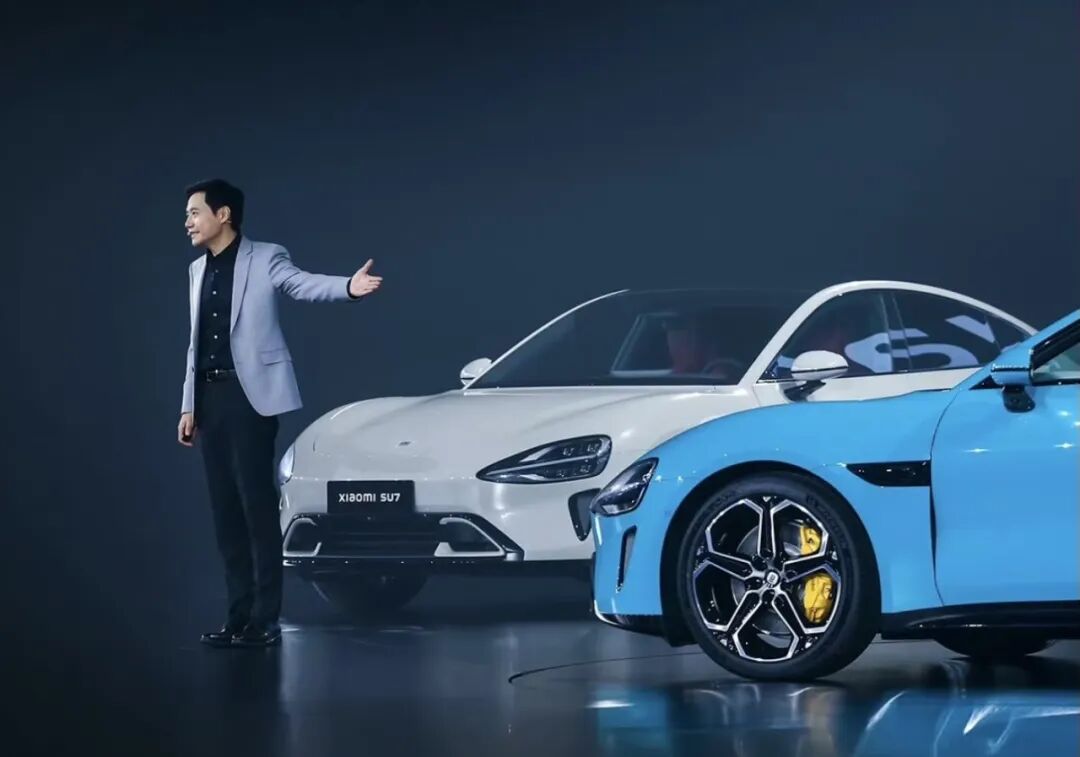
Lei Jun launches the first - generation SU7
However, when the growth is too rapid, many problems are easily overlooked. For example, due to adjustments in production - scheduling strategies, accident disputes, and public - opinion storms, Xiaomi lost some orders for the YU7. When the competition enters a stalemate and Xiaomi enters the product - switching period, some underlying problems