OPPO, can Dongge sell the products?
Following ZTE, Honor, and vivo, OPPO has joined JD.com's circle of partners.
According to the official WeChat account of JD.com's bulletin board, on March 17th, JD.com and OPPO signed a strategic cooperation agreement, setting a strategic goal for OPPO to achieve over 100 billion yuan in sales through JD.com's full - channel in the next three years.
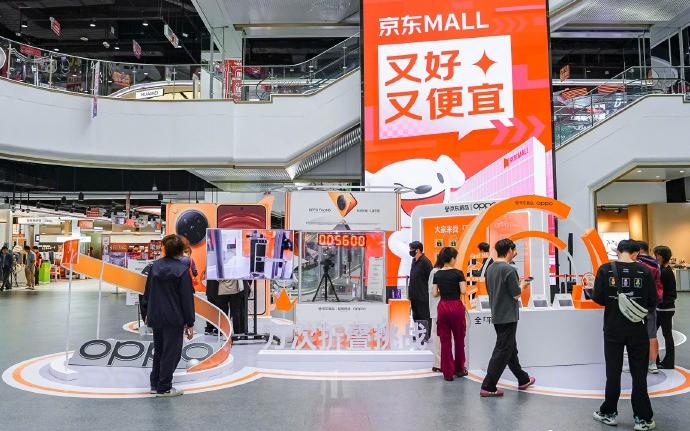
From the perspective of the goal setting, this is not only an upgrade of channel cooperation but also a deep - seated binding between the two sides in the fields of mobile phones and intelligent terminals. According to the agreement, the two sides will cooperate around five core dimensions: product, service, user, marketing, and channel, further strengthening the synergy between OPPO and JD.com. Meanwhile, the OnePlus brand will also be included in the overall strategic cooperation system.
The two sides stated that in the future, they will comprehensively promote the sales growth of all - category products such as mobile phones, tablets, and IoT through continuous product innovation and service upgrading, and expand the overall market scale.
At the product level, relying on its supply - chain capabilities and user data insights, JD.com will jointly promote the C2M (Customer - to - Manufacturer) reverse - customization model with OPPO, focusing on the new category of AI hardware. In the future, this cooperation model will be continuously deepened, covering the entire product life - cycle operation, including product selection, pricing, marketing, and user operation.
This is not just a simple "sales contract." It's more like a survival pact for the giants to support each other in the harsh business winter.
So, how much sales share has OPPO "given" to JD.com this time? What kind of play does OPPO want to stage on JD.com's platform? And in the current situation where various live - streaming rooms are frantically competing for the 3C market, what kind of defensive - counterattack strategy is JD.com hiding behind this 100 - billion - yuan order?
01
Is OPPO's 100 - billion - yuan bet worth it?
Betting its "fate" of 100 billion yuan in three years on a single channel is by no means an impulsive act of OPPO after having a bad drink.
Let's first do a basic calculation to see what the figure of "100 billion yuan in three years" really means to OPPO.
Many people have no concept of 100 billion yuan and think it's just a PR slogan casually mentioned when the two giants meet for a cup of tea. However, this is a strategic KPI clearly stated in black and white. On average, OPPO needs to sell over 33 billion yuan worth of products on JD.com's platform each year.
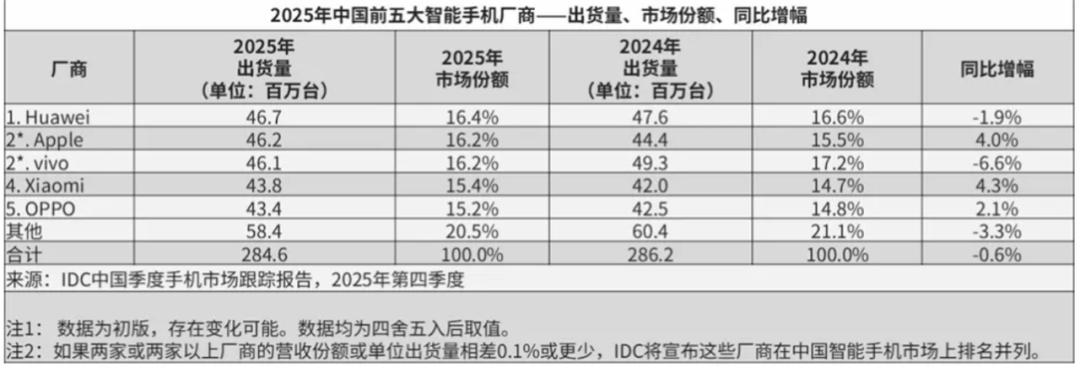
According to the "Global Quarterly Mobile Phone Tracking Report" released by IDC, OPPO's domestic shipments in 2025 were approximately between 40 million and 45 million units. This was already the result of OPPO's utmost efforts to maintain its market position.
Data from Counterpoint in 2025 shows that OPPO's average customer unit price was approximately $274, which is about 2,000 yuan. Even if the domestic average price is higher, a simple multiplication on a calculator can reveal that OPPO's current annual total revenue from mobile - phone hardware in China is only about 100 billion yuan.
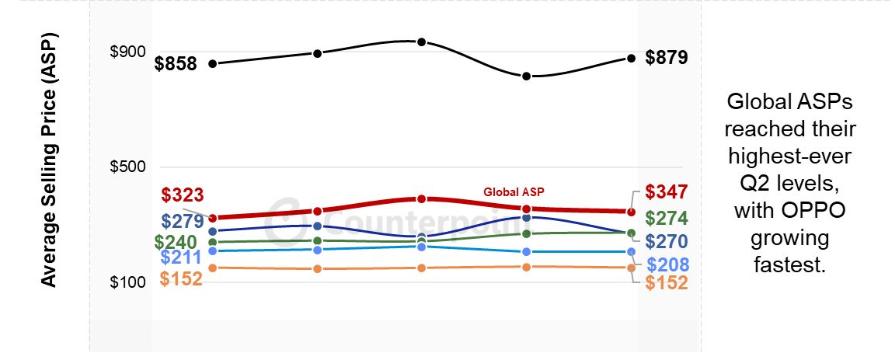
Note: The green line represents OPPO's ASP.
Combined with the three - year, 100 - billion - yuan cooperation, have you noticed the problem? JD.com's platform will account for nearly one - third of OPPO's domestic market share each year in the next three years.
In the physical retail industry, which highly values the principle of "not putting all eggs in one basket," this is an extremely crazy and dangerous move. Terminal manufacturers have always been most afraid of being controlled by powerful channels. Usually, they try their best to clearly divide the influence of agents, e - commerce platforms, and direct - sales stores to balance each other.
Now, OPPO has voluntarily offered itself and signed this extremely important agreement. The reason is simple. The current supply - chain environment no longer allows it to maintain the dignity of a large manufacturer and slowly balance its channels.
Since the fourth quarter of last year, the entire hardware industry has been severely affected by upstream semiconductor manufacturers. Especially the memory chips have witnessed an extremely fierce "super bull market."
Once the upstream oligarchs tacitly tighten production capacity, downstream mobile - phone manufacturers don't even have the right to negotiate. The memory procurement price in the first quarter directly jumped by 40% to 50%. Moreover, the prices of copper, silicon wafers, and even those insignificant small parts are queuing up to increase. The physical cost of a smartphone has been significantly raised.
Since March, mainstream manufacturers such as OPPO, vivo, Honor, Xiaomi, and iQOO have successively issued price - adjustment announcements. The prices of old models have generally increased by several hundred yuan, and the price increase of some new flagship models has exceeded 1,000 yuan. The overall market price is expected to increase by 15% to 25%.
However, how did domestic mobile - phone manufacturers seize market share in the past decade? It was by offering extremely high cost - performance. They squeezed their profit margins to the limit, used models priced at 1,000 to 2,000 yuan to boost sales volume, and outlasted their competitors.
But now, this strategy has completely failed. The price increase in the supply chain has directly broken through the cost bottom - line of mid - and low - end mobile phones. If you still dare to sell low - end phones at around 1,000 yuan without raising the price, you will lose money on each unit sold. It's like doing charity for upstream chip manufacturers.
Since doing business in the sinking market can only result in losses, OPPO is left with only one way out: to focus on the high - end market.
This is why OPPO's high - endization process has suddenly accelerated since last year. Only by relying on products with extremely high premiums can it dilute the extremely high component costs from upstream and maintain the profit margin in its financial statements.
But the most crucial problem lies right here. You've manufactured the devices and set the prices, but who will actually pay for them?
Looking back at JD.com at this point, you'll understand why OPPO is willing to make this one - third bet.
Among all retail channels, the traffic in JD.com's 3C digital section is like the most valuable and fattiest "pork belly." It gathers high - net - worth geeks in China who are most willing to spend money on electronic products, are extremely sensitive to new technologies, and are not overly concerned about prices.
Signing a cooperation agreement with JD.com is actually like spending a large sum of money to buy a VIP ticket to reach these high - quality buyers. OPPO desperately needs these people to click the payment button on their screens to clear out those high - profit AI mobile phones and performance flagships. These people are OPPO's life - savers in this hardware winter.
Besides finding the right people to sell products to, another thing that heavy - asset hardware manufacturers are most afraid of now is "inventory."
In the past, when manufacturing mobile phones, product managers would just come up with ideas based on the existing mature solutions in the supply chain, piece together a design, and then start production. But now, it won't work. Components are too expensive, and the margin of error has dropped to zero.
Once you misjudge consumers' preferences and the manufactured devices sit in the warehouse for months without being sold, the extremely high capital - occupation cost can quickly drain a company's cash flow.
Therefore, there is a seemingly unremarkable but extremely crucial clause in this agreement: to jointly promote C2M reverse - customization based on JD.com's user insights.
Translated, this means that OPPO no longer wants to blindly guess what consumers like. It directly asks JD.com to share its backend data to see what screen sizes people are searching for every day, which anti - human designs they are scolding in the comment section, and what configurations are most commonly found in the shopping carts.
Actually, the two sides have already tested this approach with real money. Last year's OPPO A6l was a very typical experimental product. JD.com analyzed the massive search data and found that there was a group of people who wanted large - screen phones with some AI functions and a specific price range.
After receiving this extremely precise "demand order," OPPO directly started the production line to meet the requirements. This approach is like finding buyers first and then purchasing components for production. These manufacturers are now very smart, reducing the trial - and - error cost to the minimum and not spending a single extra cent on manufacturing unwanted products.
Moreover, this strategy is not only well - calculated online but also very shrewd offline.
The agreement clearly states that OPPO's brand stores will be deeply integrated with JD MALL and JD Home. As mentioned before, OPPO's stores in the sinking market are unbeatable, but in the high - end business districts of first - and second - tier cities, its model seems a bit struggling.
High - end AI mobile phones, tablets, and even a full set of IoT smart home products require a strong sense of scenario to support their high prices. Consumers need to touch and experience them in a high - class, high - tech environment before they are willing to spend 10,000 yuan.
JD.com has invested a large amount of money in first - and second - tier cities in recent years and established many large - scale, cyber - punk - style JD MALLs. For OPPO, these are ready - made top - level display windows.
Putting its product portfolio into JD.com's large - scale stores not only instantly enhances the brand's image but also allows it to take advantage of JD.com's extremely mature warehousing, logistics, and after - sales network. It doesn't need to pay a single cent for the high rent in shopping malls and can avoid the cumbersome heavy - asset operation.
So, you see, there is no such thing as a groundless multi - billion - yuan alliance. In this bet, OPPO has ceded part of its channel control in exchange for high - end sales to resist supply - chain price increases, underlying data to avoid the inventory deadlock, and extremely scarce retail scenarios in first - and second - tier cities. OPPO knows exactly what it's doing.
02
JD.com's Defensive - Counterattack: Buying Out the Upstream When Someone Threatens Its Core Business
JD.com generally doesn't engage in PR stunts just to meet certain figures. Signing a three - year, 100 - billion - yuan super - order with OPPO is essentially JD.com's fight in a "3C core - business protection war" that it cannot afford to lose.
In recent years, both in the e - commerce and digital industries, people have a common feeling: selling mobile phones has become more and more like a close - combat fight in the mud.
Pinduoduo's 10 - billion - yuan subsidy is like a "meat grinder." No matter how high - end a model is, it simply slashes the price and crazily captures price - sensitive consumers in the sinking market. On the other hand, the super - anchors on Douyin and Kuaishou are relying on their highly appealing emotional value and dazzling live - streaming clips to snatch the wallets of young people in impulse - consumption scenarios.
For platforms that started with clothing and beauty products, losing a little market share in the 3C digital field may only be a bit painful. But for JD.com, 3C digital products are its absolute core business, the underlying foundation that supports its extremely large self - built logistics system and financial services. Anyone who tries to encroach on this territory is digging at JD.com's "core business."
Facing this besieged situation, JD.com has very cleverly chosen to launch a defensive - counterattack from the very source of the supply chain.
Imagine, if you are Pinduoduo or Douyin and want to offer low - price subsidies, what's the prerequisite? You need to have the goods first, and more importantly, the most in - demand and core products.
JD.com signs strategic agreements worth hundreds of billions of yuan with OPPO, vivo, and other major manufacturers. The core purpose is only one: to use the terrifyingly certain sales volume to obtain absolute priority in the upstream supply chain.
When OPPO is burdened with a sales KPI of 100 billion yuan in three years, who will get the priority for the first - release of this year's latest AI flagship phones? Which warehouse will the customized color schemes and popular memory combinations with extremely limited production capacity be stored in first? The answer is obvious. By deeply binding with these manufacturers, JD.com has virtually monopolized the best products. No matter how generous Pinduoduo's subsidies are, if it can't get those eye - catching high - end in - stock products, the show won't go on.
But this is only the first - level strategy. JD.com's ambition is no longer limited to being a simple "product transporter."
Looking closely at this cooperation agreement, it specifically emphasizes promoting the sales of "all - category products such as mobile phones, tablets, and IoT." In today's market where the overall mobile - phone market has reached its peak, the profit margin from simply selling a single mobile phone is extremely thin. What JD.com really has its eyes on is the full - scenario ecosystem behind OPPO.
JD.com's current ambition is to become the entry point for "AI - intelligent life" in Chinese families.
Whether you are a user of Huawei, Xiaomi, OPPO, or vivo, you can find the products you want in JD Mall. And at the moment you place an order, JD.com will naturally bundle and promote noise - canceling headphones, smart watches, and even the large - screen ecosystem in the living room along with the mobile phone. Turning a one - time deal into high - frequency associated consumption is the optimal solution to increase the customer unit price and the platform's profit margin.
When it comes to the profit calculation, JD.com has a deeper consideration - if selling hardware doesn't make money, then make a fortune by selling "services."
When we buy mobile phones on JD.com, we always see various additional options at the checkout: screen - break insurance, battery insurance, two - year extended warranty, and the very attractive JD Baitiao installment - payment service. These seemingly insignificant micro - services are actually the most profitable part of the entire 3C retail chain.
However, these high - profit services have a crucial prerequisite: they must be supported by an extremely large shipment base.
Just the 100 - billion - yuan order from OPPO means that tens of millions of devices will pass through JD.com's hands. How much profit can be made from the trade - in service? How much financial interest can be generated from the installment - payment service? How many copies of risk - free screen - break insurance can be sold? This "service ledger" hidden behind the hardware is where JD.com really makes a fortune quietly.
This also perfectly aligns with the positioning of JD MALL and JD Home. JD.com's offline stores have a strong after - sales and fulfillment ability. Mobile - phone manufacturers are responsible for setting up benchmarks in high - end business districts and arousing consumers' interest and desire. Meanwhile, JD.com's offline network is like a high - speed harvester, efficiently converting these desires into real orders and sales.
In this business alliance where both sides have their own agendas, JD.com not only firmly guards its 3C