The Disappeared "0-100km/h Acceleration", 100% Compliant New Door Handles: The New Generation SU7 Exits the Novice Zone
More than an hour after the press conference, Xiaomi officially released the first report card of the new-generation SU7:
In 34 minutes, the number of locked orders exceeded 15,000.
The locked order results were similar to my on - site feeling: the cheers this time were not as loud as the previous ones.
When Lei Jun announced the price of the new car, most of the "exclamations" around me came from bloggers who were recording their personal reactions with their mobile phones. And the others beside were significantly calmer than when Shu Qi and Su Bingtian appeared a few minutes ago.
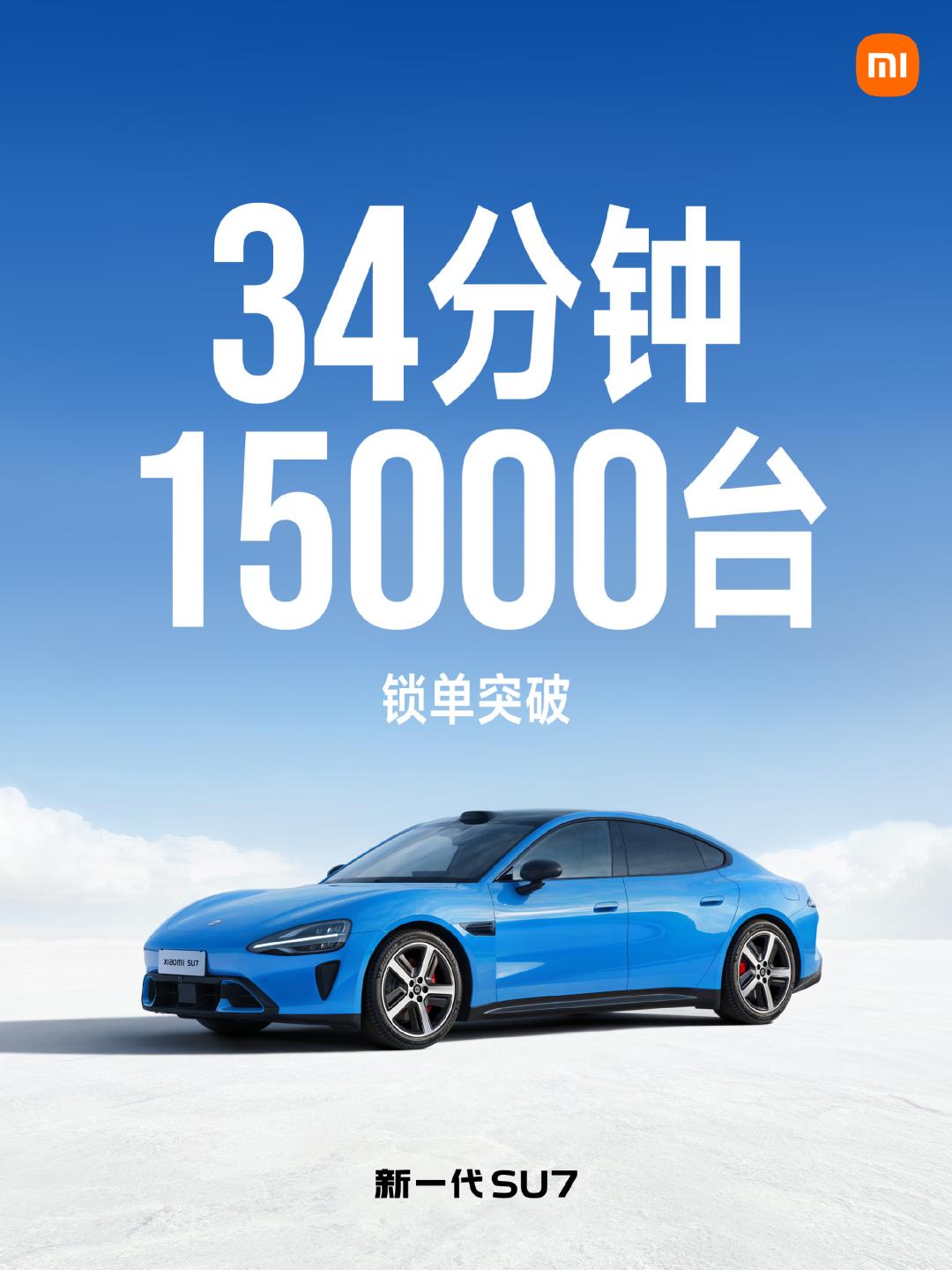
The first market report card of the new-generation SU7 | Image source: Xiaomi
As a facelifted model, such a "contrast" is not unexpected: after all, in terms of appearance, function, and price, the direct impact that the new-generation SU7 can bring to the outside world is difficult to reach the same level as that of a brand - new model launch. Moreover, the starting price of each configuration is 4,000 yuan more expensive than the previous generation (although the hardware configuration has been comprehensively improved).
Of course, I won't doubt that the new-generation SU7 has "fallen out of favor" because of this order. After all, in the past two years, Xiaomi has proven through three models that their hit - making strategy is effective.
In 2025, the first - generation SU7 delivered more than 246,000 units throughout the year. It was not only the sales champion among pure - electric sedans priced over 200,000 yuan but also comprehensively exceeded the "34C" models of BBA in the fuel - vehicle field. Xiaomi's automotive business also turned a profit in Q3 last year.
Starting from the new - generation SU7, Xiaomi needs to think about a brand - new question: in addition to product innovation of "show me your product", what other systematic capabilities outside the product need to be improved and told.
These capabilities are not only reflected in appearance, performance, and motor speed - in fact, if you pay close attention to the entire press conference, you will find that Lei Jun never mentioned the parameter of "0 - 100km/h acceleration" once - but also need to build a systematic capability covering the entire vehicle - using process.
Xiaomi's cars are moving towards their 2.0 era with the facelift of the SU7.
01
The same appearance, different inner qualities
Adhering to the principle of "don't mess with the appearance of successful models", the new - generation SU7 almost completely retains the sporty and low - slung exterior design language of the first - generation product. Except for minor adjustments to local parts such as door handles and front air grilles due to changes in sensor distribution, there is hardly any significant difference in the overall outline from the first - generation SU7.
The main changes are reflected in the color - matching aspect. The new - generation SU7 has launched a total of 9 color options, including 3 new color options, as well as popular color options like "Pearl White" and "Obsidian Black" on the Xiaomi YU7 and SU7 Ultra.
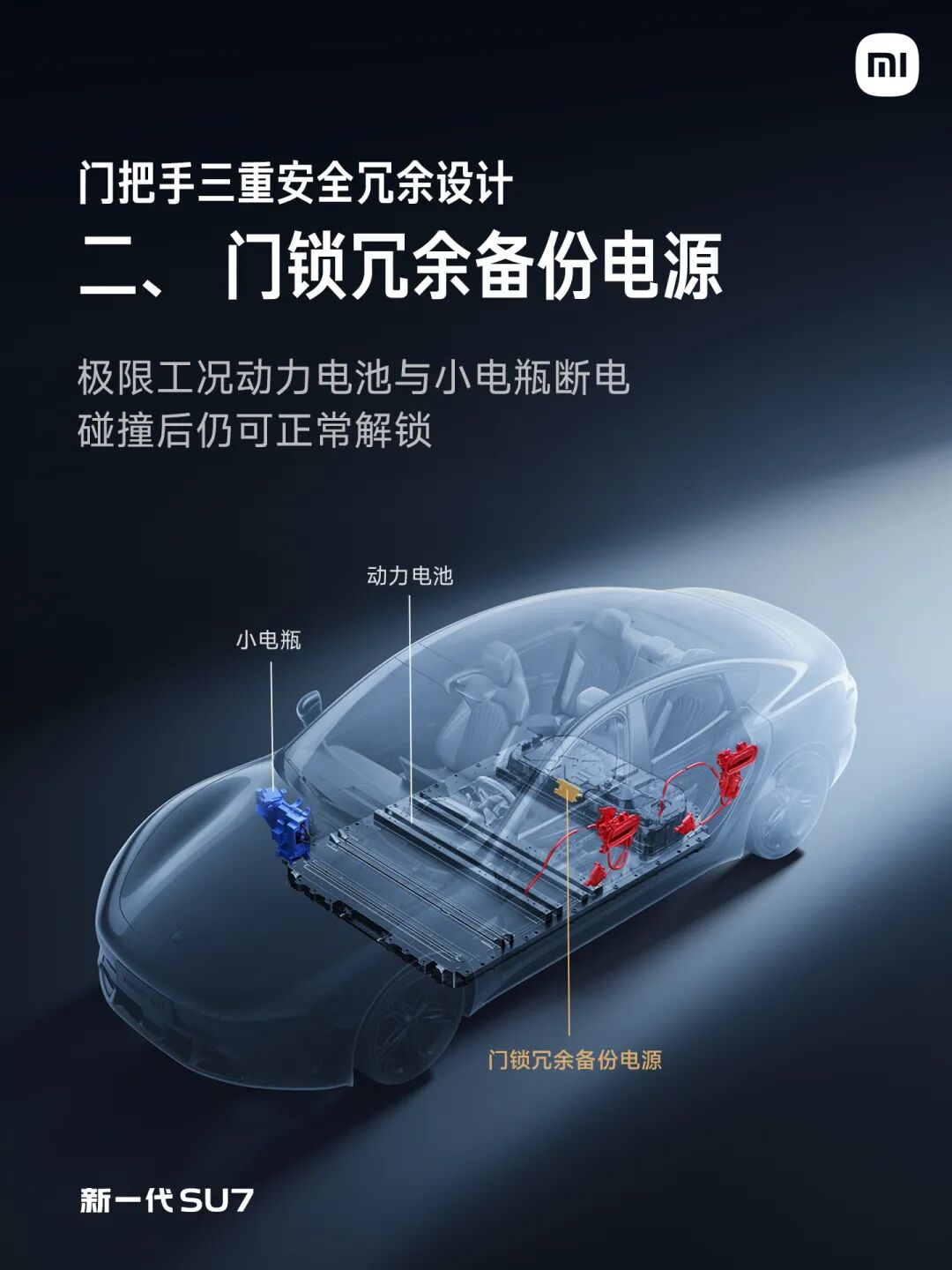
Lei Jun specifically emphasized the triple - redundant design of the "new door handle", including: an external mechanical handle, an internal emergency mechanical handle, and a separate "door - lock backup power supply" that can still supply power to the door lock when both the power battery and the battery (commonly known as the small battery) are powered off. The entire door handle "fully complies with the new - generation national standard".
In terms of the interior, the front console of the new - generation SU7 has been changed to a symmetrical design, and the steering wheel has been upgraded to a two - color splicing design.
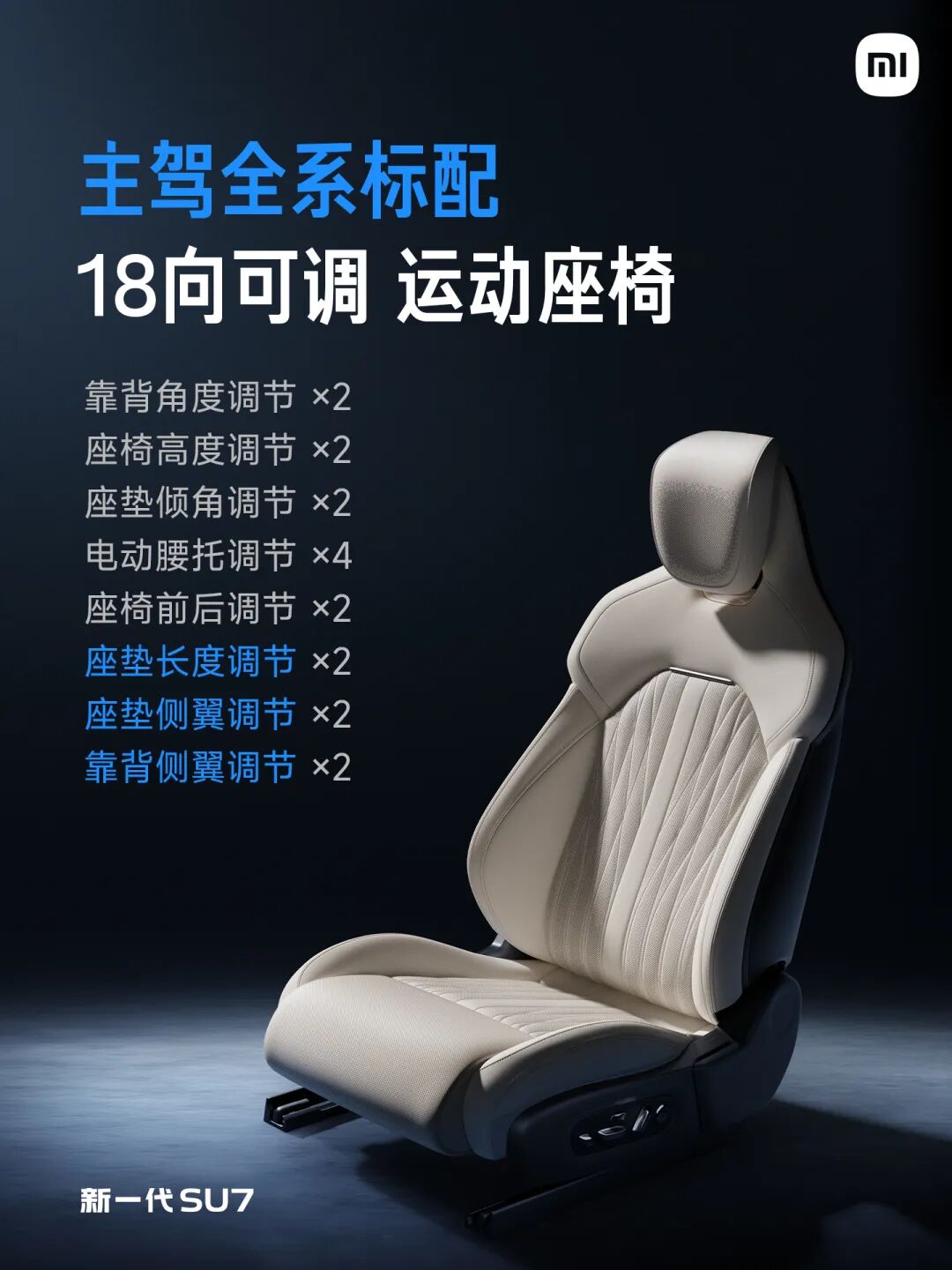
At the press conference, Lei Jun particularly emphasized the seat upgrade of the new - generation SU7 and invited users to "visit the store for a test - sit". The new seats can not only adjust the traditional backrest angle, front - to - back distance, and height but also adjust the seat cushion length, seat cushion side wings, and backrest side wings.
Just like the first - generation SU7, "sun protection" was also a key feature explained by Lei Jun this time. The new - generation SU7 has upgraded the "dual - zone intelligent dimming sunroof", which supports separate adjustment and control for the front and rear rows, meeting the different needs of front - and rear - row passengers.
In terms of electrification, the new - generation SU7 has optimized its range performance by improving the motor conversion efficiency. With the same battery pack capacity, the range of the standard version has been increased to 720 km, the Pro version to 902 km, and the Max dual - motor version to 835 km.
At the same time, the standard and Pro versions have been upgraded from the first - generation "400V architecture" to the "752V" high - voltage architecture, supporting a maximum charging rate of 3.5C. The official claims that it can charge from 10% to 80% in as fast as 20 minutes; the Max version has been upgraded to the "897V" architecture, supporting a maximum rate of 5.2C and can complete 10% - 80% energy replenishment in as fast as 12 minutes.
In terms of intelligence, the new - generation SU7 uses the same third - generation Snapdragon 8 cockpit chip as the Xiaomi YU7 and the NVIDIA Thor assisted - driving chip, and is also standard - equipped with a lidar across the entire series. The new version of Xiaomi's HAD assisted - driving software supports parking - space - level navigation in over 3,000 underground parking lots across the country.
02
The same "rival", different self
The new - generation Xiaomi SU7 is still divided into three SKUs: the standard version, the Pro version, and the Max version, with starting prices of 219,900 yuan, 249,900 yuan, and 303,900 yuan respectively. Lei Jun said at the press conference that due to the "nearly 20,000 - yuan increase" in material costs, the prices of the corresponding versions are 4,000 yuan higher than those of the first - generation SU7.
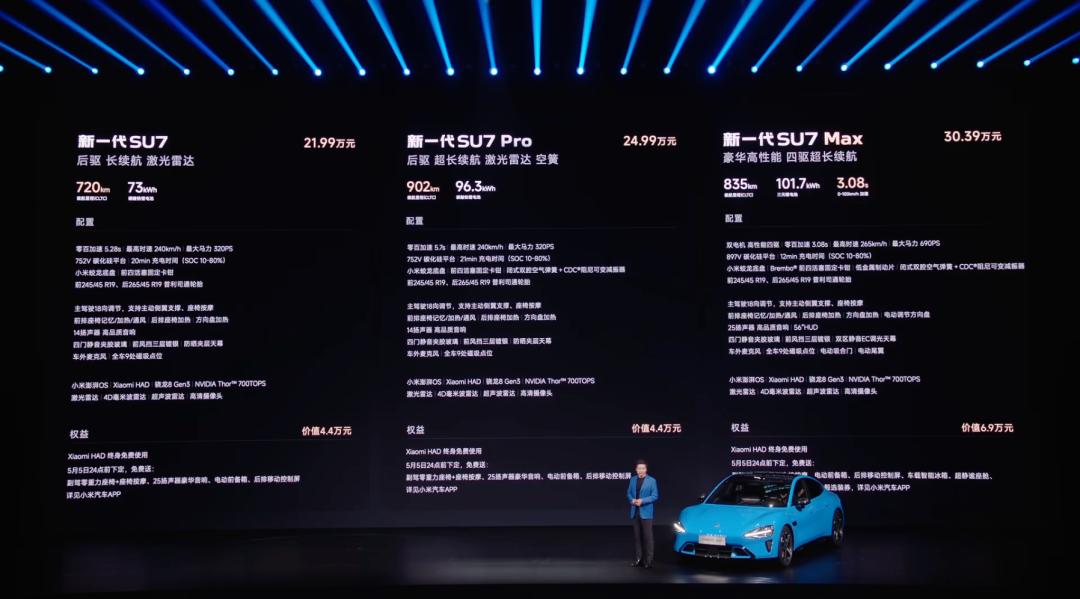
Lei Jun announced the price and benefits of the new - generation SU7 | Image source: Live - broadcast screenshot
Of course, during the price - announcement session, Tesla's name was mentioned again. At the press conferences of the first - generation SU7, Xiaomi YU7, and even the SU7 Ultra in the past, Tesla's Model 3, Model Y, and Model S Plaid have all appeared as important reference points. In the market of pure - electric sedans and pure - electric SUVs in the 200,000 - 300,000 - yuan range, Tesla is still Xiaomi's biggest rival in their eyes.
Different from when the first - generation SU7 was launched, two years later, the new - generation SU7 will inevitably face competition from more similar products. Just among the "Chinese - brand" models, two have been unveiled recently. Xiaomi opened up the previously unpromising pure - electric sedan market, and now it must face more intense competition.
In fact, in the past two years, as a newcomer, Xiaomi has proven that they can replicate their product capabilities from the mobile - phone field to the automotive field: the first - generation SU7 received nearly 90,000 orders in 24 hours; the Xiaomi YU7 exceeded 200,000 firm orders in 3 minutes... Apart from Tesla, Xiaomi is also one of the few automotive brands that adheres to the strategy of fewer SKUs and single - model blockbusters.
The Xiaomi SU7 Ultra, priced over 500,000 yuan, achieved its annual sales target in just one night, which also proves that the "Xiaomi" brand can move towards high - end.
However, a car is a consumer product with a long - term usage cycle, so the capabilities of an automobile enterprise are not only reflected in the product - definition stage.
For example, when everyone was questioning "high horsepower", Xiaomi once chose to limit the horsepower through software updates. It seems to be a safety - related issue, but behind it also involves communication and trust between the automobile enterprise and consumers.
Xiaomi may need to show connections with users at more levels.
During the entire press conference, I could feel some micro - level changes in Xiaomi: the parameter of "0 - 100km/h acceleration", which was once a standard parameter for each model launch, disappeared from Lei Jun's mouth. The high - frequency keywords that replaced "appearance" and "performance" became "safety". Lei Jun emphasized that Xiaomi has added a separate door - lock backup power supply to the new - generation SU7, which can still unlock the door in the extreme scenario where both the power battery and the small battery are powered off.
The new - generation SU7 is just Xiaomi's first card this year. To some extent, this is a "defensive move" and will face challenges from many latecomers. In the second half of the year, when Xiaomi's large SUV that has been polished for more than two years makes its debut, it will enter a brand - new family market, face a perhaps completely different user group, and will also be in full - scale direct competition with brands under Hongmeng Zhixing, Li Auto, NIO, etc. It is a market much larger in scale than the pure - electric sedan market and is also a highly competitive red - ocean market.
Xiaomi's cars need to adopt an image and strategy that is not just "product - first" to cope with it.
This article is from the WeChat official account "GeekPark" (ID: geekpark), author: Cao Siqi, editor: Jing Yu. Republished by 36Kr with permission.