Former Samsung technology experts start a business to create an edge-side "communication cerebellum" for robots and secure tens of millions in financing | Exclusive report from Yingke
Author | Qiao Yujie
Editor | Yuan Silai
Yingke learned that Beijing Qianjing Technology Co., Ltd. (hereinafter referred to as "Qianjing Technology") recently announced the completion of a Pre-A round of financing, with the financing amount reaching tens of millions of RMB. This round was exclusively invested by Qiying Tongchuang. The funds will be mainly used for the model iteration and toolchain productization delivery of the "Inference and Decision Middle Layer" (Connectivity Brain) for end-side connectivity intelligence.
As applications such as embodied intelligence and unmanned systems gradually enter real scenarios such as factories and industrial parks, the key issue faced by the industry is shifting from "action ability" to "connectivity ability". In complex physical environments, robots or unmanned devices often rely on wireless networks for data transmission and collaborative control. However, problems such as network latency, packet loss, and jitter can directly affect the system's stability.
Currently, some technology companies and communication manufacturers are trying to solve this problem at the network infrastructure level. Qianjing Technology, on the other hand, chooses to start from the end side. Through an AI model, it perceives and makes decisions about the communication environment at the device end, enabling robots to dynamically adjust communication strategies under complex network conditions.
Company CEO Hao Junru introduced to Yingke that Qianjing Technology's technical system mainly consists of two parts: wireless environment twin perception and end-side communication decision-making model.
In terms of wireless environment modeling, the company uses technologies such as ray tracing to simulate the propagation of electromagnetic signals in real space, thereby constructing a digital twin model of the wireless environment. Different from traditional network analysis methods based on statistical data, this method starts from the physical laws of radio wave propagation and conducts more detailed modeling and restoration of wireless signals in complex environments.
Currently, the company's relevant technology can achieve a data generation efficiency comparable to the operating speed of 5G/6G communication systems in the real world - the data generation cycle per frame is about 500 microseconds. At the same time, the company has also accumulated a relatively complete database of electromagnetic material parameters, providing basic data support for signal propagation modeling in different environments.
On this basis, the company has developed an AI model deployed at the device end, namely the "Connectivity Brain". This model can receive data from the robot's communication module, device sensors, and path planning system, and combine the information of the electromagnetic environment model to judge the current network status.
Hao Junru introduced that when a robot enters an area with a weak signal, this model can make dynamic decisions based on the network status, such as adjusting the device's path, switching communication links (e.g., switching between different communication methods), or compressing and degrading the data stream to ensure the stability of data transmission during the task operation.
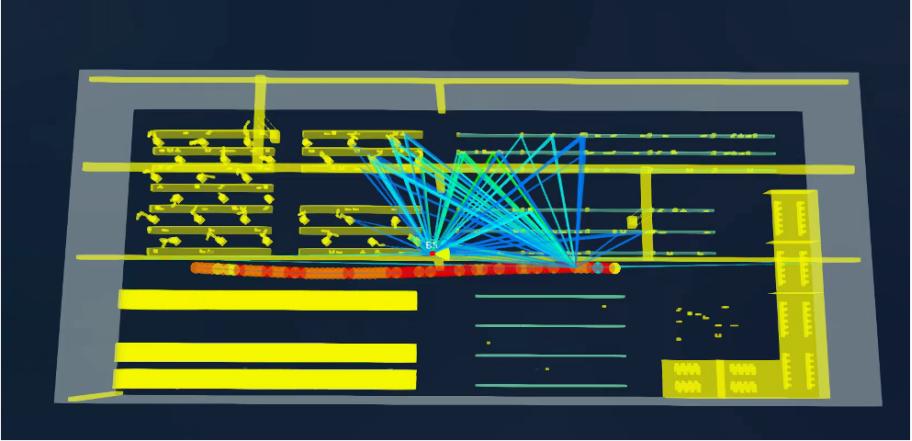
End-side dynamic network inference and behavior optimization of indoor mobile robots in complex scenarios (Source/Enterprise)
In terms of commercialization, before this round of financing, the company mainly carried out commercial exploration around its wireless environment twin capabilities. The relevant technologies have been applied in the communication test scenarios of mobile phone chip manufacturers and automobile enterprises. By constructing a wireless propagation model of the real environment, it provides a simulation environment for device communication performance testing.
The end-side Connectivity Brain is the product direction that the company has started to focus on this year. It is understood that this system will be launched in the form of an end-side hardware module in the future and delivered in the forms of "standardized hardware-software integrated modules" and "software licensing (License)". It can be integrated into robots or unmanned devices to improve the connectivity stability of devices in complex network environments.
After this round of financing, the company will focus on the iteration of the 1.0 version of the Connectivity Brain model and complete the engineering development of the end-side hardware module.
In terms of the team, Yu Junyi, the founder and CTO of Qianjing Technology, was formerly a senior product expert at Beijing Samsung Communication Technology Research Co., Ltd. He participated in and led multiple communication technology projects such as the 5G system-level simulation platform, spectrum sharing algorithm, and MAC layer optimization tool. CEO Hao Junru was formerly a member of the investment advisory committee of Burton Investment Family Office and has many years of experience in the digital industry and investment and financing. Currently, the company has about 15 full-time engineers, and the R & D team has more than 30 people, with systematic product R & D and engineering implementation capabilities.