The AI explosion intensifies the anxiety of ordinary people, and Kevin Kelly responds to the emotions of the era
Before the conversation started, the staff handed an AI headset to Kevin Kelly. He skillfully tested the microphone, saying, "testing one, two, three."
The other AI headset was passed to Qin Wen. He also followed suit and tested it, saying, "One, two, three." Facing an interview from a Chinese business blogger, Kevin Kelly casually responded in Chinese, "One, two, three, one, two, three, four, five."
Qin Wen burst into laughter.
A cross - language conversation began with this pair of AI headsets.
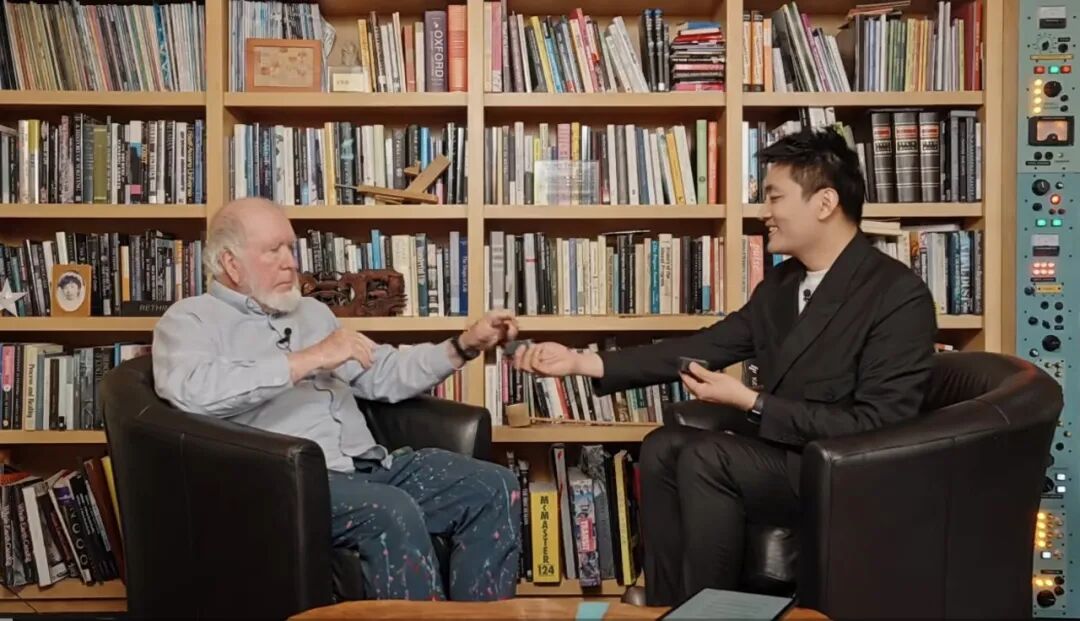
Before starting the conversation, Qin Wen handed the Timekettle AI headset to Kevin Kelly
On the evening of March 12th, the talk show "How Should Individuals Cope in the AI Era" co - hosted by Kevin Kelly and business blogger Qin Wen was launched on platforms such as Douyin, Video Accounts, and Xiaohongshu. Kevin Kelly is the founder of Wired magazine and the author of works such as Out of Control, The Inevitable, and 2049: Possibilities in the Next 10,000 Days. Qin Wen has long been concerned about business and era - related issues. In January this year, he specifically went to the United States to have a conversation with Kevin Kelly. After the show was launched, it quickly attracted a lot of attention.
The reason why this talk was quickly noticed is not complicated. There is too much information about AI today. Every day, people are talking about models, computing power, financing, and replacement. The excitement is always there, but the uneasiness in the hearts of ordinary people has not disappeared. Because, although AI sounds like a technical issue, in real life, it will ultimately become an issue of one's situation.
That's why what really touches people in this talk is not only that Kevin Kelly talked about AI, but also that it touches on the anxieties that many people can't avoid today.
For several hours, the two talked from AI anxiety to education, from work to the future, and also discussed how individuals can find their own positions in the new technological environment. At the end of the conversation, Kevin Kelly took off the AI headset, and so did Qin Wen. This cross - language communication was supported and completed by the headset from beginning to end. In a sense, what this interview discusses is how AI enters reality, and it itself has become an on - site answer to this question.
01
Anxiety Sets In
In the past two years, many people's feelings about AI have changed from amazement to nervousness.
At first, people were focused on the fact that the models were getting stronger. Writing, translation, summarization, and programming were advancing step by step, like a high - level technological competition. Now it's different. AI is starting to enter companies, processes, and positions, and it's also starting to enter the daily judgments of ordinary people. What really makes people anxious is never just "it's very powerful", but "it's starting to affect my life".
This anxiety is not false. A global survey by McKinsey in 2025 showed that 88% of respondents said that their organizations were already using AI in at least one business process; the proportion of regular use of generative AI also increased from 65% at the beginning of 2024 to 71%. The technology is spreading rapidly, and the problems have also changed. People are no longer asking "Is anyone using it?", but are more concerned about "How will it be really used?"
The uneasiness at work is particularly direct. In 2025, the Swedish fintech company Klarna continued to promote AI to the front - line of customer service and operations. The number of employees in the company decreased from 5,000 to 3,800. In February 2026, Block, a fintech company led by Jack Dorsey, also announced a large - scale layoff of more than 4,000 people, while accelerating the implementation of AI in internal operations. By March 2026, Atlassian announced a layoff of about 1,600 people, and the shift towards AI was also one of the backgrounds.
Looking at these companies together, the signal is clear. After AI enters reality, what it creates first is not abstract discussions, but a sense of tension among positions, processes, and people.
This sense of tension stems from the fact that the real world is much more complex than technical demonstrations. A model can write a decent plan and give a seemingly good answer. But once things really move forward, when it comes to making decisions, taking consequences, and dealing with gray areas, the coordinate system changes immediately. In the real world, the most difficult part is often not "answering the question", but "who is responsible".
Kevin Kelly believes that one of the most important differences between humans and AI lies here. People are hired not only to complete tasks, but also to be responsible for the results.
The real value of Kevin Kelly in this talk lies right here. He didn't exacerbate this uneasiness, but dissected it bit by bit. He repeatedly mentioned that what large - language models deal with today is mostly the language about the world. The more important next step for AI is to enter the real world, turn into specific actions, form specific processes, and enter specific relationships.
In other words, the reason why anxiety is increasing is not because the model has refreshed a record again, but because it is starting to take the place where humans used to bear the consequences.
The economic index released by Anthropic in January 2026 also provides a set of footnotes for this reality. By November 2025, "enhanced use" on Claude accounted for 52%, and "automated use" accounted for 45%. This shows that the more common form in reality is still "humans working with AI". It first enters the collaborative relationship and then gradually approaches full - fledged delegation. It is also in this process that people's uneasiness will be magnified. Because what people really worry about is not only whether the machine can do the work, but also whether they can still maintain their judgment, experience, and position in the process.
The reaction of organizations also shows this. A survey released by KPMG in January 2026 showed that 60% of the surveyed enterprises had taken measures to restrict AI agents from accessing sensitive data without human supervision, and 75% of the respondents listed security, compliance, and auditability as the most critical conditions when deploying agents. The more enterprises push AI to the executive level, the more they will first focus on boundaries, responsibilities, and consequences.
In China, this sentiment is also obvious. A survey of 11,814 employee questionnaires jointly conducted by Yicai and the research team of Cheung Kong Graduate School of Business showed that 85.53% of employees were worried that they would face the risk of unemployment due to AI replacement within the next three years, and 67.57% of people believed that they might be completely replaced by AI within five years. Another workplace survey also mentioned that in positions with higher - frequency AI use, such as administrative support and finance, the proportion of people anxious about "job replacement" exceeded 70%.
So, after AI is implemented, what it creates first is actually people's anxiety. Will work change? Will experience depreciate? Can trust be handed over? Who will be responsible for the deviations? These questions are more personal and more painful than model parameters.
That's why Kevin Kelly's words "Don't be the best, be the only one" are particularly important. AI is becoming more and more proficient in compressing average experience and delivering decent results that can be applied everywhere. The truly scarce part of humans is shifting to the other side. A sense of responsibility, judgment, experience, intuition, and the ability to push things forward in specific situations will become more valuable.
In Kevin Kelly's eyes, the more a person acts out of the ordinary and the more unique they are, the less likely they are to be replaced by AI.
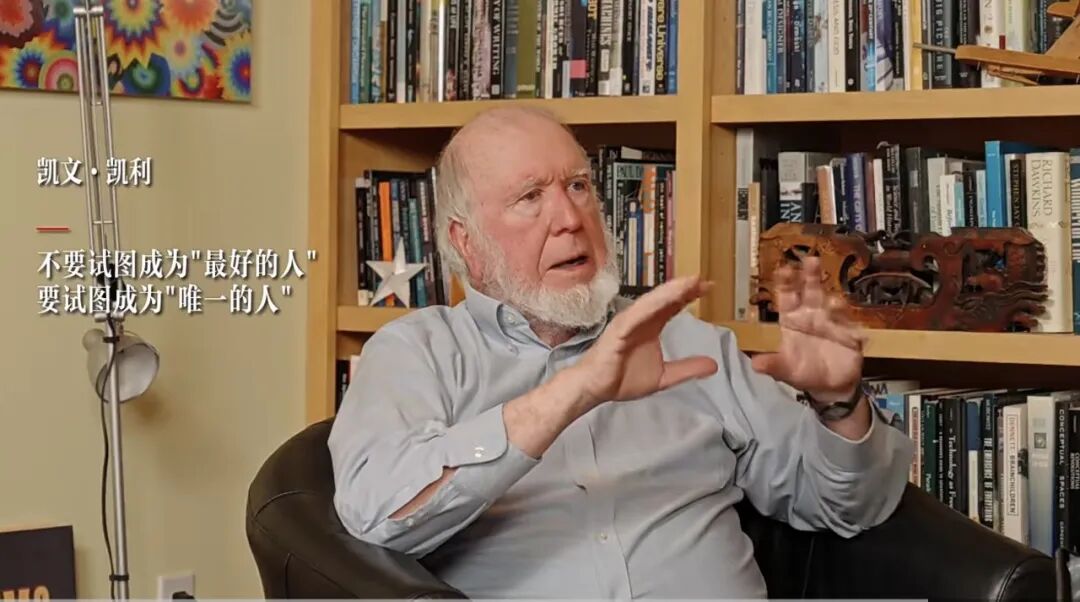
Kevin Kelly said in the program that don't try to be the "best person", try to be the "only person"
This meaning can be seen more specifically when it comes to Qin Wen.
The sliced video of this conversation released by Qin Wen alone was widely forwarded and commented on in a short period of time. Four days after the one - hour in - depth conversation between the two was released, it had exceeded 100,000 likes, 40,000 collections, and brought 20,000 new followers on a single platform. This result itself shows one thing. In today's era where AI - generated content is increasing in quantity, speed, and ease of mass production, what can really stay is still the content that carries personal judgment, problem - awareness, and interview skills.
To some extent, the reason why Qin Wen's in - depth interview was noticed is precisely because it made its own differentiation.
02
Communication Changes First
After AI enters real life, what it first encounters is often not grand scenarios, but the most ordinary moments. Asking for directions, having a meeting, conducting an interview, discussing cooperation, ordering a cup of coffee in a foreign country, or just trying to express a heartfelt thought to someone. Many things seem insignificant on a daily basis, but once the languages are different, the rhythm is disrupted, and the emotions are interrupted.
It is precisely here that many ordinary people's anxiety about AI becomes particularly direct. Language has always been regarded as a human ability. Expressing, understanding, asking questions, and confirming are the most natural actions between people. Once technology enters the fields of translation, transcription, and dialogue, people will naturally wonder whether their own expression still matters, and whether the subtle things between people will become more and more dependent on machines.
Relevant surveys show that 50% of respondents feel "more worried than excited" about AI entering daily life, and only 10% of people say they are "more excited than worried". Another survey also shows that nearly three - quarters of teenagers have used AI companion products, and one - third of them have preferred AI over humans in serious conversations. At this point, anxiety is no longer just a technological imagination; it has begun to affect changes in communication methods.
Therefore, the communication scenario is particularly important today. It seems simple, but it weighs heavily. Communication is not just about translating a Chinese sentence into an English one, nor is it just about sending information from one end to the other. In real communication, there are pauses, hesitations, confirmations, corrections of misunderstandings, and the subtle reactions on the other person's face after a sentence is spoken. It is closely related to people's emotions and the establishment of relationships.
This is also the reason why communication has become a threshold that AI must cross first. This scenario is frequent enough, in - demand enough, and honest enough. Whether a tool is valuable or not can be quickly determined in communication. If it goes smoothly, it goes smoothly; if it gets stuck, it gets stuck, and users hardly give much room for explanation.
This demand for a sense of certainty in communication is still increasing today. According to data from the National Bureau of Statistics, the number of inbound tourists to China reached 154.5 million person - times in 2025, a year - on - year increase of 17.1%; among them, the number of foreign tourists was 35.17 million person - times, and the total expenditure of inbound tourists was 131.1 billion US dollars, a year - on - year increase of 39.2%. After the flow of people becomes active again, cross - language, cross - cultural, and cross - regional contacts are also expanding. Communication is no longer just an issue of efficiency; it will directly affect whether a person can enter a new environment, complete a cooperation, and truly establish a relationship.
This change is often first perceived by commercial organizations closest to users. Many companies first focus on the communication scenario because it is closest to users, closest to business results, and easiest to verify value. If the experience is smooth, users can feel it immediately. If the experience gets stuck, users will leave immediately.
Putting this reality back into the conversation between Qin Wen and Kevin Kelly, many details become clearer. On the surface, they are talking about AI, but what they need to solve first is actually a more basic thing: how the two can really have a conversation. Only when the communication goes smoothly can the questions go deeper, and the views can enter more complex areas from the surface.
This is also why the communication scenario can relieve people's anxiety earlier than many grand narratives. When technology enters here, it doesn't necessarily mean that the relationship between people is taken away. In many cases, it just catches the interrupted communication and allows understanding to continue to develop.
Kevin Kelly mentioned in the talk that AI will increasingly enter different carriers such as headsets, cars, and robots in the future. Many capabilities will first enter daily life in a more personal way.
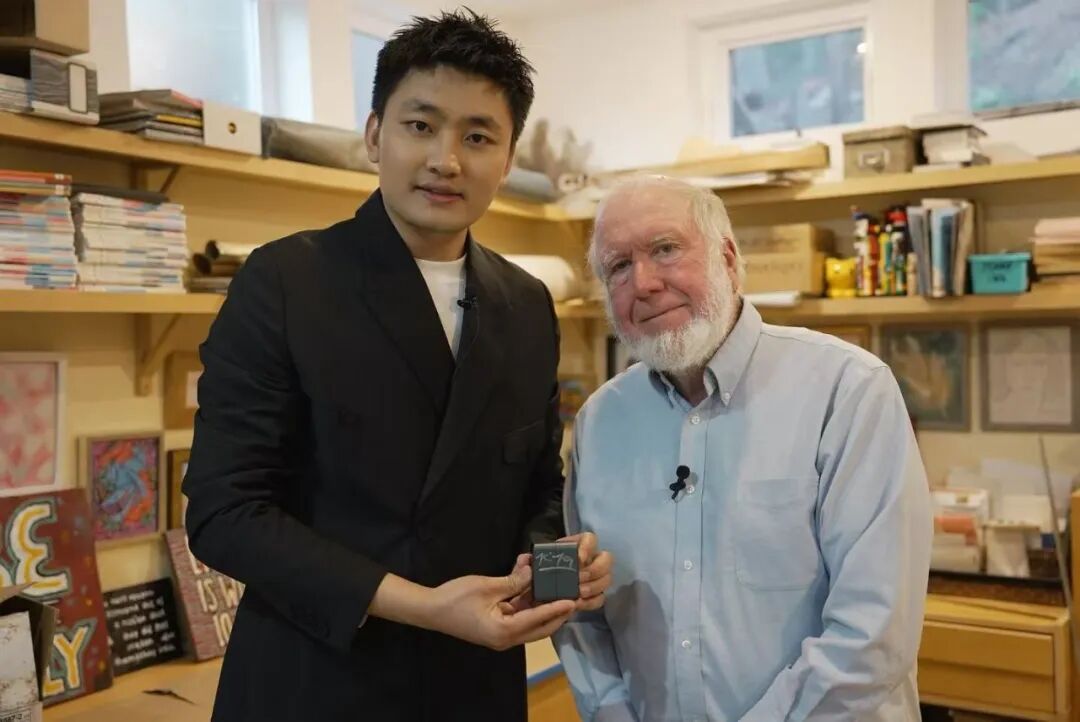
Qin Wen and Kevin Kelly took a group photo
Ordinary people's attitudes towards AI often change in such specific moments. It's not because they understand many model concepts, but because a sentence is finally connected, a conversation is finally continued, and a person separated by language can finally express their meaning more deeply.
What is more worth observing is actually products like AI translators. They target high - frequency, clear, and real - existing scenarios of cross - language communication. According to data from the United Nations World Tourism Organization, the number of international tourists globally reached 1.52 billion person - times in 2025, and the demand for cross - language communication is still increasing. At the same time, IDC disclosed that the global shipments of ear - worn devices reached 84.9 million units in the second quarter of 2025, accounting for more than 60% of the total shipments of wearable devices. As the scenarios are growing and the devices are mature enough, AI translators naturally become a direction worthy of attention in this round of implementation.
Many discussions about AI often end up in far - reaching places. But for most ordinary people, what really makes this matter concrete are often those small fragments.
03
Products Bring AI to People
AI has now become more like a relay race.
The first leg is in the laboratory, in model companies, and in the continuous advancement of computing power and algorithms. The second leg falls into the hands of commercial platforms, startups, and various specific products. For most ordinary users, the first time they really feel that AI is useful is often not because they understand a research paper or a model architecture, but because a product brings it to their eyes first.
This also means that ordinary people really feel AI, in many cases, not first in theory, but in products. The same is true for anxiety. People don't get nervous because of a model name first. More often, it's because a specific product or a specific ability has started to change their work and life. Once technology moves from concept to the palm of one's hand, abstract uneasiness quickly turns into a real - world problem.
When the technological wave in the laboratory hits the shore, the real splashes are rarely complex parameters, but more often the moments when ordinary people suddenly find it useful. This leap in perception marks that AI is moving from an "intellectual wonder" to a "production tool".
Some people first feel AI when they use summarization and rewriting functions in office software. Some people gradually get used to conversational interaction on customer service, search, education, and content platforms. Others first feel the implementation of AI in more specific hardware. Translation headsets, real - time transcription devices, meeting assistants, and AI agents integrated into workflows may seem scattered, but they are all doing the same thing: bringing the capabilities of high - level models into specific scenarios and turning them into real - world capabilities that ordinary people can directly use.
Whether technology can really enter society depends not only on its advancement but also on someone turning it into products, services, and a value that can be felt in a specific action. In many cases, ordinary people really come into contact with AI not at the place where the technology is born, but at the level of commercial implementation.
This process